A complete guide to building a winning content cluster strategy

Stevia Putri
Last edited February 1, 2026
Remember the old days of SEO? You'd just stuff a keyword into a blog post and cross your fingers. Well, those days are over. Since Google's Hummingbird update in 2013, search engines have become much smarter. They now focus on the context of a topic and what a user is actually trying to find, which means random, one-off blog posts don't cut it anymore.
For any business trying to stand out, proving you're an expert isn't just a nice bonus, it's essential. The tricky part is creating enough high-quality, connected content to build up your topical authority. This is where a content cluster strategy comes into play. It’s a smart way to organize your content that shows search engines you know your stuff and gives your visitors a much better experience.
Of course, to pull this off, you need a consistent flow of great content. Tools like the eesel AI blog writer are designed for this exact problem, helping teams turn a single keyword into a full, publish-ready article. This frees you up to focus on the bigger picture instead of just the writing.
What is a content cluster strategy?
So, what exactly is a content cluster strategy? Basically, it's an SEO method where you organize your content around a central "pillar" topic. Then, you create several related "cluster" articles that branch off from it. Picture a wheel: you have a main hub with several spokes connecting to it, as illustrated below. This structure tells search engines that you've covered a topic thoroughly.
Let's break down the three main parts:
- Pillar Page (The Hub): This is your big, comprehensive guide on a broad topic, like "Inbound Marketing." It's the core of your cluster and links out to all the supporting cluster pages. It typically targets a broad, high-competition keyword and provides a general overview of the subject.
- Cluster Content (The Spokes): These are more specific articles that dive deep into subtopics related to your pillar. For instance, if your pillar is "Inbound Marketing," a cluster post might be "How to Create a Buyer Persona." These articles target more specific, long-tail keywords and answer very particular questions your audience might have.
- Internal Linking (The Connections): This is what holds everything together. Every cluster page needs to link back to the main pillar page. The pillar page, in turn, links out to each cluster page. This linking structure helps users navigate your content easily and strategically distributes link equity across all the pages in your cluster, boosting their collective SEO power.
Why a content cluster strategy is crucial for modern SEO
As Google's algorithms (like RankBrain) have become more advanced, they've moved from simply matching keywords to understanding user intent and topical context. A content cluster strategy is perfectly suited for this new reality. It's more than just a neat way to organize things; it's a core method for improving your SEO performance. Here’s why it works so well.
Builds topical authority for E-E-A-T
A content cluster is one of the most effective ways to show you have deep expertise. When you cover a topic from every possible angle, you're signaling to Google that you're a real authority. This plays directly into E-E-A-T (Experience, Expertise, Authoritativeness, and Trustworthiness), which is a major factor in how Google ranks content. A well-constructed cluster proves you've done the work and aren't just scratching the surface.
Improves SEO performance
The internal linking structure is where the real benefits kick in. When one of your cluster pages starts ranking well and getting backlinks, it passes some of that authority back to the pillar page and other connected pages. This creates a ripple effect, lifting the rankings of the entire group of pages, including your most important pillar content.
Enhances user experience (UX)
Let's be real, no one likes hitting a dead end on a website. A content cluster provides a clear path for visitors to explore a topic in more detail. If they land on a cluster post about creating buyer personas, they can easily click back to the main "Inbound Marketing" pillar to see the bigger picture. This keeps them on your site longer, which sends positive signals to search engines.
Prevents keyword cannibalization
Have you ever had two of your own blog posts fighting for the same search term? That's known as keyword cannibalization, and it confuses search engines about which page is the most important. A cluster model fixes this by giving each piece of content a specific purpose and target keyword. The pillar targets the broad term, and each cluster post targets a unique long-tail variation, so they all support each other instead of competing.
| Feature | Scattered Content Approach | Content Cluster Strategy |
|---|---|---|
| Structure | Disorganized, individual posts | Organized hub-and-spoke model |
| SEO Impact | Risk of keyword cannibalization | Improved rankings for a group of keywords |
| Topical Authority | Appears shallow and disconnected | Demonstrates deep topical authority |
| User Journey | Dead ends, higher bounce rate | Clear path for deeper exploration |
Real-world examples of content clusters
It's one thing to talk about the theory, but seeing it in practice makes it click. Let's look at how some brands use this model to lead their industries.
HubSpot's "Instagram Marketing" cluster
HubSpot pretty much pioneered this model when they restructured their entire blog around topic clusters. A great example is their "Ultimate Guide to Instagram Marketing." This massive guide is the pillar page, covering everything you need to know at a high level. From there, it links out to dozens of specific cluster posts like "How to Write Good Instagram Captions" and "How to Use Instagram Stories." It's a textbook case of organization and authority building.
Zapier's "Remote Work" hub
Zapier’s "Ultimate guide to remote work" is another excellent example of a pillar page. As a company that lives and breathes remote work, they've created a central hub that links to articles on everything from productivity tips and team management to choosing the right software. It's an incredibly useful resource that establishes them as the go-to experts on the subject.
Alloy's "Digital Banking" guide
For a B2B example, take a look at Alloy's guide on digital banking strategy. The main page gives a strategic overview of the industry, which is perfect for their audience of financial decision-makers. It then links to supporting cluster articles that get into the details of topics like identity verification and fraud prevention, subtly positioning their platform as the solution.
How to build your content cluster strategy
Ready to create your own? The process is straightforward, as outlined in the steps below. It's all about moving from big-picture brainstorming to actually creating and scaling your content.
Step 1: Choose your core pillar topics
First, you need to decide what you want to be known for.
- Brainstorming: Start by listing the broad topics that are central to your business and solve your customers' main problems. These should be 2-4 word phrases that you can build a lot of content around.
- Keyword Research: Once you have your list, you need to validate it. Your pillar topic should be broad enough to generate at least 15-20 cluster topics, but not so broad that it's impossible to cover. The goal is to find a high-value topic that gets a decent amount of searches and directly relates to what you sell.
use communities like Reddit and Quora to see what questions people are asking and the level of engagement around those questions. Something with high engagement is likely a question worth answering in your blog content.

Step 2: Audit existing content
You're probably not starting from scratch. Many businesses already have a lot of content that just needs to be organized.
- Content Inventory: Go through your existing blog posts and group them under your new pillar topics. You'll likely find you already have a few potential cluster articles ready to use.
- Repurpose and Optimize: Now, it's time to give that old content a refresh. Update it with new information, optimize it for its specific long-tail keyword, and most importantly, add a link back to its pillar page. Sometimes, you might even merge a few weaker posts into one stronger article. After combining two competing articles, Backlinko saw a 466% increase in clicks to the new page.
Step 3: Scale your content creation with the eesel AI blog writer
This is where many strategies fall apart. The biggest challenge is creating high-quality content, in-depth cluster articles to build out your hubs. Doing this by hand is a slow and expensive process.
This is exactly why we created the eesel AI blog writer. It’s designed to help you get past the content creation bottleneck by generating a complete, SEO-optimized, and publish-ready blog post from a single long-tail keyword in just a few minutes.
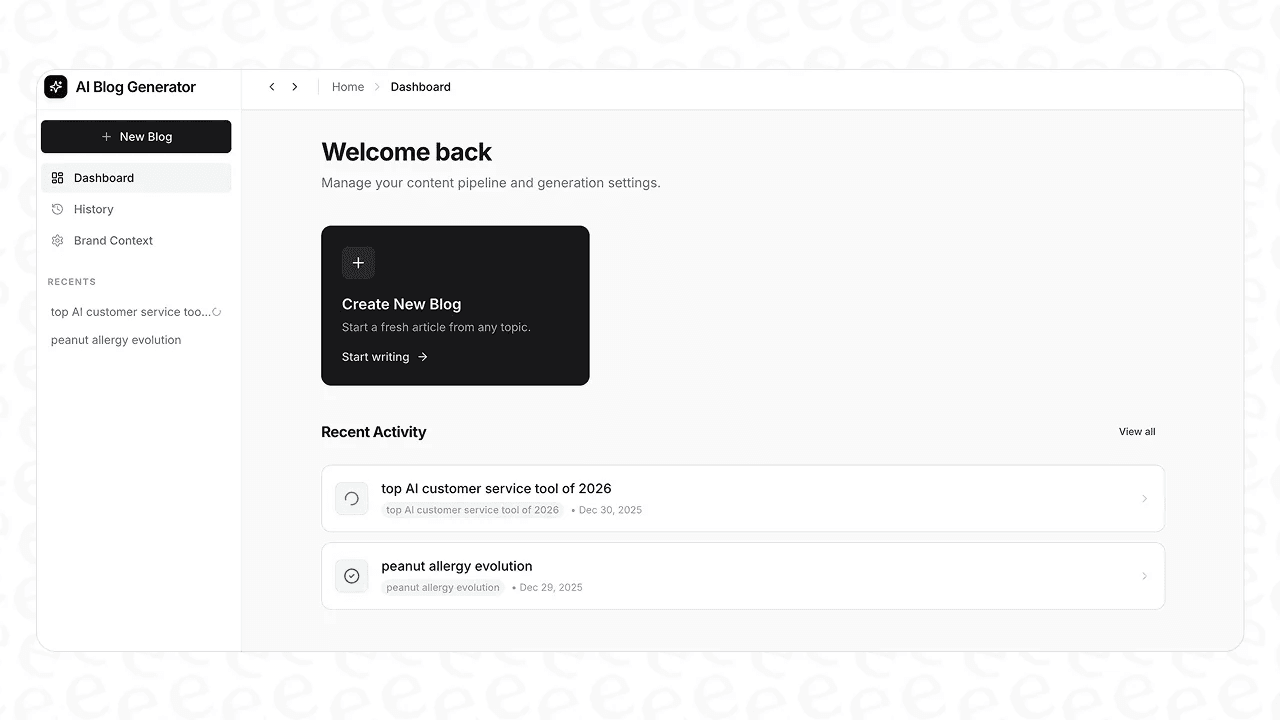
Here’s how it helps you build clusters at scale:
- Complete Post Generation: It doesn't just give you a rough draft. You get a full article with a proper introduction, headings, a conclusion, and even an FAQ section. This lets you create the "spokes" for your cluster in a fraction of the time.
- Automatic Assets & Media: Each article includes AI-generated images, tables, and relevant YouTube videos and Reddit quotes already embedded. This makes your cluster content more engaging and adds authenticity without any extra effort.
- Context-Aware and SEO-Optimized: Just add your website URL, and it learns your brand’s voice for natural product mentions. Plus, every article is optimized for both traditional SEO and AEO (Answer Engine Optimization) to help you rank in Google's AI Overviews.
- Proven Growth: We don't just sell it; we use it ourselves. We used this exact tool to grow our own blog from 700 to 750,000 impressions per day in just three months by publishing over 1,000 optimized posts.
While your competitors are hiring writers, training them on brand voice, waiting weeks for content, and paying monthly salaries, you're using Google NotebookLM to generate branded content in any language instantly.
For a deeper dive into how pillar pages and content clusters work together, check out this video for some practical tips.
Common mistakes to avoid
As you get started, try to avoid these common mistakes. They can easily undermine all your hard work.
- Creating "Thin" Cluster Content: Don't just write short, flimsy articles to check a box. Each cluster post should be a valuable, standalone piece that completely answers a specific user question.
- Forcing Irrelevant Topics: Trying to fit a subtopic into a cluster where it doesn’t naturally belong will only confuse your readers and weaken the authority of the cluster. If it feels like a stretch, it probably is.
- Weak or Missing Internal Links: The internal links are what make this a strategy and not just a pile of articles. Make sure every cluster links back to the pillar, and use descriptive anchor text (like "learn more about buyer personas") instead of generic phrases like "click here."
- Choosing a Pillar That's Too Broad or Narrow: A pillar like "Marketing" is too big to cover well, while a pillar that’s too niche won't have enough subtopics to build a strong cluster. Finding that sweet spot is crucial.
Building a smarter content strategy
At the end of the day, a content cluster strategy is the blueprint for success in modern SEO. It helps you move away from the old keyword-stuffing model and toward building real topical authority. It’s a framework that aligns your content with how both people and search engines discover information today.
But a great strategy is only as good as its execution. The biggest challenge is consistently creating enough high-quality content to build out each cluster and prove your expertise. That’s where you need a tool that helps you work smarter, not just harder.
Ready to build your content clusters without all the manual work? Try the eesel AI blog writer for free and generate your first publish-ready article in minutes.

Frequently Asked Questions
Share this article

Article by
Stevia Putri
Stevia Putri is a marketing generalist at eesel AI, where she helps turn powerful AI tools into stories that resonate. She’s driven by curiosity, clarity, and the human side of technology.