A practical guide to ChatGPT SEO writing

Stevia Putri
Last edited January 15, 2026
AI tools like ChatGPT have definitely shaken things up for anyone creating content or working in SEO. It seems like everyone’s using them to write faster, brainstorm ideas, and generally get more done. And honestly, it’s a seriously powerful assistant.
But using ChatGPT for SEO that actually works isn't as simple as typing "write me a blog post" and hitting publish. To create content that has a real shot at ranking, you need a solid process and a good grasp of its limitations. Even Google has chimed in, saying they care about high-quality, people-first content that demonstrates expertise, experience, authoritativeness, and trustworthiness (E-E-A-T). They don't mind if you use AI, as long as the final piece is genuinely helpful.
What is ChatGPT SEO writing?
So, what do people actually mean by "ChatGPT SEO writing"? It’s really just using OpenAI's ChatGPT to help with various tasks involved in creating SEO content. It’s not a one-click solution, but a collection of ways you can use it, such as:
- Coming up with blog topics and keywords.
- Creating outlines and structuring your content.
- Drafting copy for intros, body paragraphs, or conclusions.
- Writing meta titles and descriptions for your pages.
Yes, it is. We have this client with a 14,000-product eCommerce site that's rebuilding their website in React. The current version has the same title for all pages plus the product ID, and no meta description. We built a Python script that parses all the pages, sends them to the OpenAI API, and OpenAI generates proper titles and descriptions, which, of course, are vastly superior to the originals right from the start. We checked around 50 to 100 random products and they were perfect, so we didn’t bother reviewing all 14,000. TL;DR: Yes, it's very good and keeps getting better every day.

At its heart, ChatGPT is a Large Language Model (LLM). Put simply, it’s been trained on a gigantic amount of text from the internet, so it's excellent at guessing the next word in a sentence and writing text that sounds very human. That's why it can whip up an email or a paragraph so convincingly. But that’s also why it can sometimes lack real originality or factual accuracy unless an expert is guiding it with super-specific prompts and carefully checking its work.
The standard workflow for ChatGPT SEO writing
Step 1: Ideation and keyword research
You can kick things off by asking ChatGPT to brainstorm blog post ideas or keyword lists for a broad topic. For instance, you could prompt it, "Give me 10 blog post ideas for a company that sells project management software."
It will give you a creative list, but there's a big caveat: the suggestions are made in a bubble. ChatGPT can't access real-time SEO data. It has no idea about the search volume, keyword difficulty, or user intent for those ideas. This makes it a decent starting point for brainstorming, but it's not a substitute for a data-driven SEO tool that provides the numbers you need to make informed decisions.
Step 2: Crafting the perfect prompt
The quality of ChatGPT's output is a direct reflection of the quality of your input. This is where "prompt engineering" comes into play. A vague prompt will get you a vague, generic response. A strong, detailed prompt is your best bet for getting something useful.
Here’s a quick comparison:
- Weak Prompt: "Write a blog about SEO."
- Strong Prompt: "Write a 1500-word blog post about the basics of on-page SEO for small business owners. Use a friendly, conversational tone. The target audience is non-technical beginners. Please include sections on keyword research, title tags, meta descriptions, and header tags. Include the keyword 'on-page SEO for beginners' in the H1 and at least two H2s."
See the difference? The second prompt gives the AI clear instructions, boundaries, and context, which makes the output much better. Getting good at this takes practice and a fair amount of trial and error.
Step 3: Generating and refining the draft
Even with an amazing prompt, you’ll almost never get a perfect article on the first try. A better way to work is to generate the content piece by piece. You could ask it to write the introduction first, then tackle each H2 section one by one. This approach gives you more control and makes it easier to tweak the content as you go.
This is also where a human eye is absolutely essential. You have to fact-check every claim, statistic, and statement it produces. Then, you need to edit the text to sound like your brand and cut out all the classic AI-isms. You know the ones: "in today's digital landscape," "it's crucial to," "unlock the potential," and the ever-present "in conclusion."
here are my 2 cents as a SEO consultant with 15ys experience: - KW research: mostly manual, but chatgpt is good in identifying things you might have overlooked. when i make KW lists, i look for words that can be combined to relevant phrases by automatic tools. chatgpt helps me find expressions i might not have considered. - content writing: good for phrasing IF you provide the right structure/input/ideas. best not try to make it write an entire landing page, just single parts/slides/paragraph. also: Claude is better at this atm.
Step 4: On-page SEO and metadata
Once the main body of the article is done, you can circle back to ChatGPT and ask it to write the supporting SEO elements. You can prompt it to create a meta title and meta description based on the final text, or even ask for a list of alt text ideas for your images.
It can also generate basic structured data, like an FAQ schema, if you provide the questions and answers. While this is certainly helpful, the whole four-step process is manual, slow, and requires you to have a decent amount of SEO knowledge to guide it properly.
Key limitations of using ChatGPT for SEO writing
For teams trying to scale their content marketing and get consistent search rankings, relying on a general tool like ChatGPT can quickly turn into a bottleneck. Here are some of the major limitations that tend to get in the way.
The risk of generic content
Because ChatGPT is trained on a huge, generalized dataset of existing internet content, its output often feels like a summary of what’s already out there. It’s good at putting information together, but it can struggle to add new value, unique insights, or a fresh take. This can lead to repetitive content that doesn't really connect with readers or meet Google's E-E-A-T guidelines. Content that just rehashes the top 10 search results is exactly what Google's Helpful Content System is designed to push down in the rankings.
It's not bad, but the issue is that you, and 100 others, are writing the same descriptions with the same model with the same/similar prompts.
Lack of real-time research
ChatGPT isn't connected to the live internet. While its knowledge cutoff has been updated to August 2025, it can't browse the web for breaking news, the latest stats, or current discussions happening on forums. This means your content can become outdated pretty quickly. Additionally, it's known to "hallucinate," which is when the AI confidently states incorrect information as fact. Without careful fact-checking, you could end up publishing inaccurate content that hurts your credibility.
No built-in SEO framework
ChatGPT doesn't understand SEO on its own. It doesn't know your internal linking strategy, and it can't optimize for things like keyword density or semantic relevance without you giving it explicit, detailed instructions. More importantly, it isn't set up for Answer Engine Optimization (AEO). AEO is all about structuring content so it can be easily grabbed and featured by AI answer engines like Google's AI Overviews. This is a big deal, especially since Gartner predicts search engine volume will drop by 25% by 2026 as people get their answers directly from AI.
Why ChatGPT produces a wall of text
Maybe one of the biggest workflow considerations is that ChatGPT only gives you one thing: plain text. A great blog post is so much more than that. It needs images, infographics, charts, tables, and maybe even embedded videos to keep readers engaged and make the content easier to understand. With ChatGPT, you’re left to find or create all of those assets yourself, which adds a huge amount of manual work to your plate.
A streamlined approach to SEO writing: The eesel AI blog writer
From a single keyword to a publish-ready post
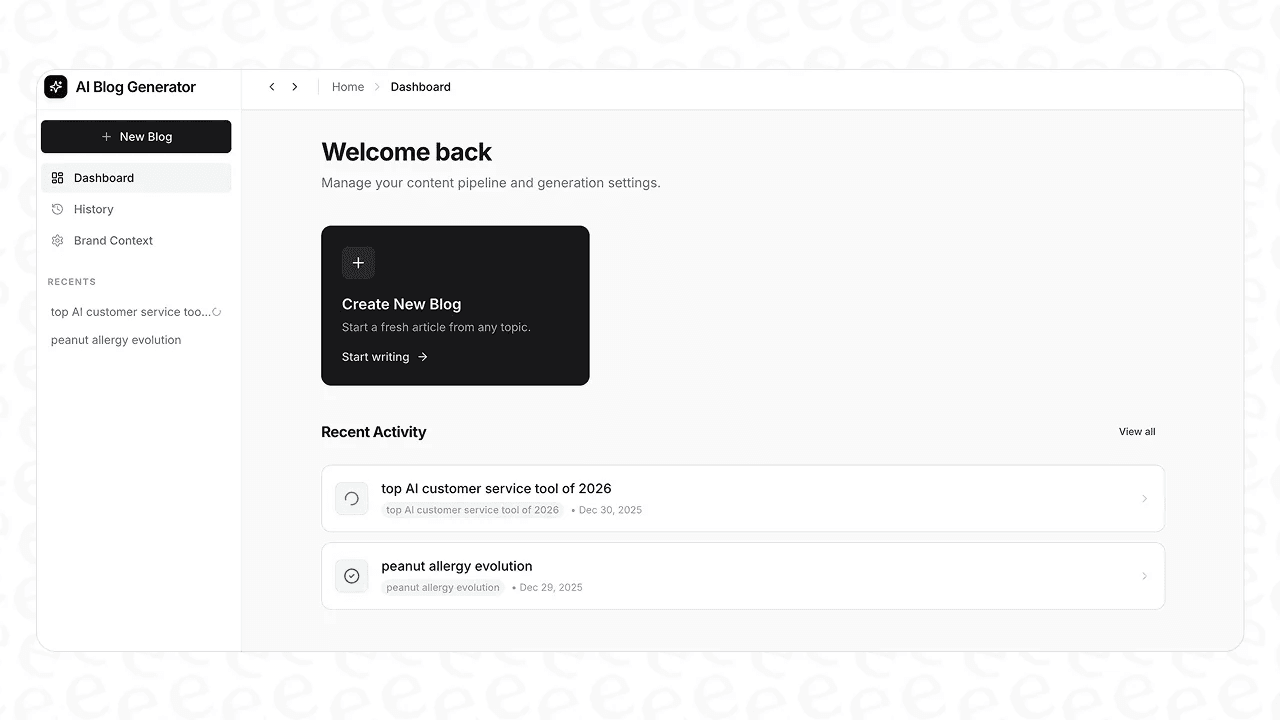
Instead of a multi-step prompting process, with the eesel AI blog writer, the workflow is simple: enter a topic or keyword, add your website URL for brand context, and get a complete article back in minutes. It takes care of the research, writing, structuring, and optimization for you. This streamlined approach is exactly what we used to grow our own blog from a modest 700 to 750,000 impressions in just three months.
Context-aware research and authentic social proof
One notable feature is context-aware research. The platform understands the type of blog post you're creating and automatically pulls in the right information. Writing a comparison post? It will find pricing data. A product review? It will find technical specs. This ensures the content is relevant and factually correct. To add a layer of authenticity that general tools can't, it can also embed relevant YouTube videos and pull real quotes and insights from Reddit threads, giving your content a genuinely human feel.
Automatic assets and media integration
The eesel AI blog writer addresses the "wall of text" issue. It doesn't just write; it builds a complete, media-rich article. The platform automatically generates and includes relevant AI images, tables, charts, and infographics right inside the post. This saves you hours of manual work and makes sure your content is visually appealing and engaging from the get-go.
Built-in SEO and AEO from the start
Finally, this platform is designed with SEO and AEO in mind. It automatically structures the content with proper H2 and H3 headings, works in your target keywords naturally, and builds in a smart internal and external linking strategy. Crucially, it's also designed for Answer Engine Optimization, formatting answers and key information in a way that makes it easy for Google's AI Overviews and other answer engines to feature your content.
ChatGPT vs. eesel AI: A feature comparison
To make it even clearer, here’s a quick side-by-side look at how a general AI assistant compares to a specialized AI content generation platform.
| Feature | ChatGPT (General AI Assistant) | eesel AI blog writer (Specialized Platform) |
|---|---|---|
| Workflow | Manual, multi-prompt, section-by-section | 1-click: from keyword to full article |
| Research | Limited to static training data (August 2026) | Context-aware, live data for specific post types |
| Content Output | Text only | Complete post with automatic AI images, tables, etc. |
| Media Integration | None | Embeds YouTube videos & real Reddit quotes |
| SEO/AEO | Requires manual optimization and expertise | Built-in optimization for Google & AI Answers |
| Best For | Brainstorming, quick drafts, simple tasks | Scaling high-quality, rank-ready blog content |
For a more visual breakdown of these workflows and to see how experts are using AI in their SEO strategies, the video below offers some great practical tips.
Moving from an AI assistant to an AI teammate
When it comes down to it, ChatGPT is a fantastic tool for assisting with individual writing tasks. It can get you past writer's block or draft a quick email. For teams looking to create high-performance SEO content consistently and at scale, a specialized, integrated solution can offer a more efficient workflow.
The future of efficient content creation isn't about spending hours trying to craft the perfect prompt for a general-purpose assistant. It's about giving high-level context and strategic direction to an AI teammate that understands your end goal and can handle the entire workflow for you. The aim is to produce amazing content that real people want to read and that search engines feel confident ranking at the top.
Ready to stop prompting and start publishing? Generate your first blog post for free with the eesel AI blog writer and see the difference for yourself.

Frequently Asked Questions
Share this article

Article by
Stevia Putri
Stevia Putri is a marketing generalist at eesel AI, where she helps turn powerful AI tools into stories that resonate. She’s driven by curiosity, clarity, and the human side of technology.