Chatbase Salesforce integration: A complete overview

Stevia Putri

Stanley Nicholas
Last edited January 26, 2026
Expert Verified
Salesforce has been a dominant force for a while, calling itself the #1 AI CRM. On the other hand, you have Chatbase, a super popular platform for building AI chatbots for support. So, it’s no surprise that teams are looking to bring these two together. The goal is pretty straightforward: connect them to automate customer support, answer questions, and generally make things run smoother.
This post provides a detailed look at the Chatbase Salesforce integration. We'll explore its capabilities, how it is structured, and how it compares to other options.
What is the Chatbase Salesforce integration?
At its heart, the integration lets a Chatbase AI agent connect to and perform tasks inside your Salesforce environment. It’s not a single, built-in tool, but an API-based connection that links two separate platforms.
It works in a couple of main ways:
- As an action hub: You can set up your Chatbase agent to perform specific actions in Salesforce. The most common use cases are creating a new support case when a customer issue needs a follow-up, or escalating a chat to a human agent.
- As a knowledge source: If you're on one of Chatbase’s pricier plans, you can link Salesforce as a data source. This allows your Chatbase agent to learn directly from all your past support tickets, soaking up the context from thousands of real customer conversations to provide better answers.
Think of it as giving your chatbot a direct line to your CRM. It can either pass information along or learn from the information that's already stored there.
Key features of the Chatbase Salesforce integration
The integration opens up several automation possibilities for support teams, letting the AI agent do more than just spit out answers. Let's break down the main features.
Automated case responses
This is the biggest draw. You can configure your Chatbase agent to not only reply to customers but also take action directly within Salesforce.
Inside the Chatbase dashboard, you can set up what they call "Salesforce Actions." The two primary ones are creating a support ticket for a human to handle later or initiating a handoff to a live agent. You can guide these actions with plain-English instructions. For instance, you could tell the bot, "If a customer brings up a 'billing error,' create a support ticket."
It's a handy feature, but it's worth noting that it's limited by your plan. The $32/month Hobby plan, for example, only gives you 5 of these AI Actions per agent.
Training your agent on Salesforce tickets
This is where things get really interesting. You can connect your Salesforce account as a data source, which lets your AI agent train on your entire history of support tickets.
Why does this matter so much? Because your agent learns from thousands of actual, historical conversations. It sees the common problems customers run into, picks up on your company's tone of voice, and understands what a good resolution looks like. This is miles ahead of just feeding it a static FAQ page.
However, this feature, using "Tickets as a source", is only available on the Chatbase Pro plan, which starts at $400/month. So, while it’s a huge boost for AI quality, it's definitely a premium feature.
Expanding workflows with third-party tools
Beyond the direct integration, you can use tools like Zapier to build more complex, multi-step workflows between Chatbase and Salesforce.
A common example is lead generation. You could set up a Zapier workflow (or "Zap") that automatically creates a new lead in Salesforce anytime a visitor shares their email address with your Chatbase bot on your website. This helps you connect your marketing and support efforts without needing a developer to write custom code.
Limitations and considerations
While the integration has its strengths, there are some important trade-offs and complexities to think about before you commit to this two-platform setup.
The complexity of the setup
Getting the basics connected is simple enough. But if you want to unlock the more advanced features, like a smooth, real-time handoff to a live agent inside Salesforce, you will have to do some configuration.
This usually involves a multi-step process within the Salesforce admin panel, such as adjusting Omni-Channel and Messaging Settings. This level of configuration might require developer assistance to implement correctly. For teams looking for a simple, plug-and-play solution, this can be a key consideration.
Managing two separate ecosystems
When you use Chatbase with Salesforce, you’re constantly juggling two different platforms. You build and manage your AI agent in Chatbase, checking its analytics and tweaking its behavior there. But all your customer data, agent workflows, and tickets live in Salesforce.
This separation means that managers may need to consult two different sources to get a complete picture of support performance. Agents might also switch between windows to see the full context of a conversation. This siloed approach is one factor to consider when evaluating support team efficiency.
An alternative approach: The AI teammate model
These considerations lead to different approaches for integrating AI. One alternative model is the AI teammate.

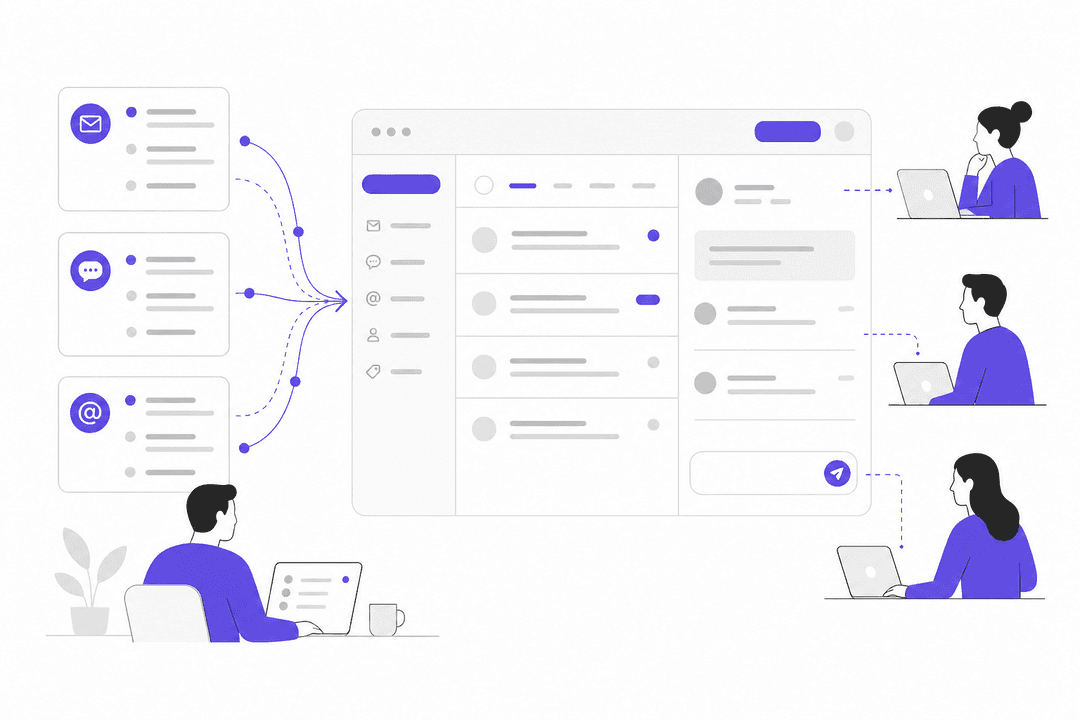
An example of this is eesel AI. Instead of being another platform to manage, eesel is an AI teammate that plugs directly into the help desk you already use. It connects and starts learning from your past tickets, help center, macros, and internal documents in sources like Confluence and Google Docs. This presents a more unified approach to bringing AI into a workflow.
Salesforce native AI vs. the Chatbase integration
Another option is to skip third-party tools entirely and use Salesforce's own AI solutions. It's worth comparing this native approach with an integration like Chatbase to see which makes more sense for your team.
What is Salesforce Agentforce?
Salesforce Agentforce is the company's native AI platform, designed to let organizations build and deploy their own autonomous AI agents. Think of it as a whole suite of AI tools, powered by Salesforce's proprietary Atlas Reasoning Engine. Because it’s built by Salesforce for Salesforce, it’s made for a deep, seamless integration with your CRM data and existing workflows.
A comparison of the two approaches
So, how do you choose? It really boils down to a trade-off between integration depth, cost, and complexity.
| Feature | Salesforce Agentforce (Native AI) | Chatbase + Salesforce Integration |
|---|---|---|
| Integration Depth | Deeply embedded in the CRM | API-based; connects two separate systems |
| Setup Complexity | Moderate to high; requires Salesforce expertise | Simple for basics, high for advanced features |
| Cost Model | Tied to expensive Service Cloud licenses (up to $550/user/mo) + consumption fees (e.g., $2/conversation) | Separate subscription (starts at $32/mo), but key features require the $400/mo Pro plan |
| Flexibility | Works best within the Salesforce ecosystem | Platform-agnostic; connects with other tools |
| AI Technology | Proprietary Atlas Reasoning Engine | Utilizes modern LLMs like GPT-4 |
Salesforce Agentforce offers an unmatched level of integration, but it comes at a premium price and requires specialized knowledge to make the most of it. The Chatbase integration offers more flexibility and a lower entry price, but it involves managing two separate systems and may require a more complex setup for advanced features.
Pricing breakdown: What does it really cost?
The true cost of each solution is a huge factor, and it's not always as simple as it looks.
For Chatbase, the pricing is usage-based. You can get started with the Hobby plan for $32/month (billed annually), but as we've covered, it’s pretty limited. To unlock the most important feature for a Salesforce integration, training the AI on your past tickets, you have to jump up to the Pro plan, which costs $400/month.
For Salesforce, the costs are layered. First, you need a Salesforce Service Cloud license for your team, which can run anywhere from $25 to $550 per user, per month. On top of that, Salesforce charges for AI usage with models like pay-per-conversation or by selling bundles of "Flex Credits." This tiered, multi-part cost structure is something for teams to consider when evaluating their budget.
Is the Chatbase Salesforce integration right for you?
So, what's the final call? The Chatbase Salesforce integration offers a flexible way to add AI capabilities to your support workflow. It can be a suitable choice for teams invested in the Chatbase platform who are prepared for the premium plan costs and technical setup for advanced features.
On the other hand, Salesforce's native AI offers deep integration but is designed to work within its own ecosystem and has a different pricing structure. Each approach has trade-offs to consider.
For those looking for a more hands-on guide, this video provides a walkthrough on how to connect a chatbot with Salesforce, which can help visualize the technical steps involved in such an integration.
This video provides a walkthrough on how to connect a chatbot with Salesforce, which can help visualize the technical steps involved in such an integration.
An alternative: The AI teammate model
Another alternative to consider is the AI teammate model, exemplified by eesel AI.
The eesel AI model is based on the concept of an AI teammate. It integrates into your existing systems to provide a single environment for AI and agent collaboration.
eesel also uses a progressive rollout model. You can start with our AI Copilot, which drafts replies for your human agents to review and send. This allows teams to verify performance in a controlled environment. Once confident, you can level it up to a fully autonomous AI Agent that resolves tickets on its own.

If you're interested in an AI solution that works like a member of your team, see eesel in action.
Frequently Asked Questions
Share this post

Article by
Stevia Putri
Stevia Putri is a marketing generalist at eesel AI, where she helps turn powerful AI tools into stories that resonate. She’s driven by curiosity, clarity, and the human side of technology.