
Let's face it, academic writing can be a grind. Between the research, drafting, citing, and formatting, it feels like there's never enough time, especially with deadlines looming. That's where AI paper writers come into the picture. They're not here to write your paper for you, your critical thinking is still the most important part. Think of them as assistants that help you organize your thoughts, track down sources, and get a solid first draft on the page.
In this post, I'll walk you through a hands-on comparison of the top AI writing tools for academics in 2026. We'll look at everything from specialized editors to powerful generators like the eesel AI blog writer, which is great for creating detailed first drafts with citations and media.
What is an AI paper writer?
An AI paper writer is a piece of software that uses AI to help with academic writing. This can mean anything from analyzing a prompt and gathering information to generating text, creating outlines, fixing grammar, and formatting citations. The key thing to remember is that these are assistant tools. They're meant for brainstorming, outlining, and drafting, not for writing a final paper without your input and oversight.
It's all about using them ethically. As Yomu AI's ethics statement points out, they're here to help, not to do the work for you. Before you start, it's always a good idea to check your school's policy on using AI writing assistants.
How I picked the best AI paper writer tools
To keep this comparison fair and practical, I tested each tool against the same set of criteria that matter most to students and researchers. Here’s what I looked for:
-
Content and Research Quality: The ability to generate accurate, coherent, and well-structured academic content with proper source integration.
-
Citation and Referencing: The presence of built-in features for finding credible sources and formatting citations in various academic styles (e.g., APA, MLA, Chicago).
-
Editing and Language Tools: Features for improving grammar, maintaining an academic tone, and enhancing the overall clarity of the writing.
-
Ease of Use: An intuitive user interface that does not require a steep learning curve to operate effectively.
-
Value and Pricing: The balance of features offered in free and paid plans, ensuring the cost is justified by the tool's capabilities.
Quick comparison of the best AI paper writer tools in 2026
Here is a high-level overview of the key features of the top-rated tools to help you see how they stack up at a glance.
| Tool | Best For | Citation Support | Plagiarism Detection | Free Plan | Starting Price (Billed Annually) |
|---|---|---|---|---|---|
| eesel AI blog writer | Generating media-rich first drafts | ✅ (External citations) | ❌ | Free to try | $99/mo for 50 posts |
| Paperguide | Full document generation from references | ✅ | ✅ | ✅ | $12/month |
| Jenni AI | AI-assisted collaborative writing | ✅ | ❌ | ✅ | $12/month |
| Yomu AI | All-in-one academic writing and editing | ✅ | ✅ | Free to use | $11/month |
| Paperpal | Language enhancement and submission readiness | ✅ | ✅ | ✅ | $11.5/month |
The 5 best AI paper writer tools for students and researchers in 2026
Now let's get into the details. Here's a full breakdown of each tool, covering what it does, its pros and cons, and how much it costs. The goal is to give you enough information to pick the right one for your specific needs.
1. eesel AI blog writer
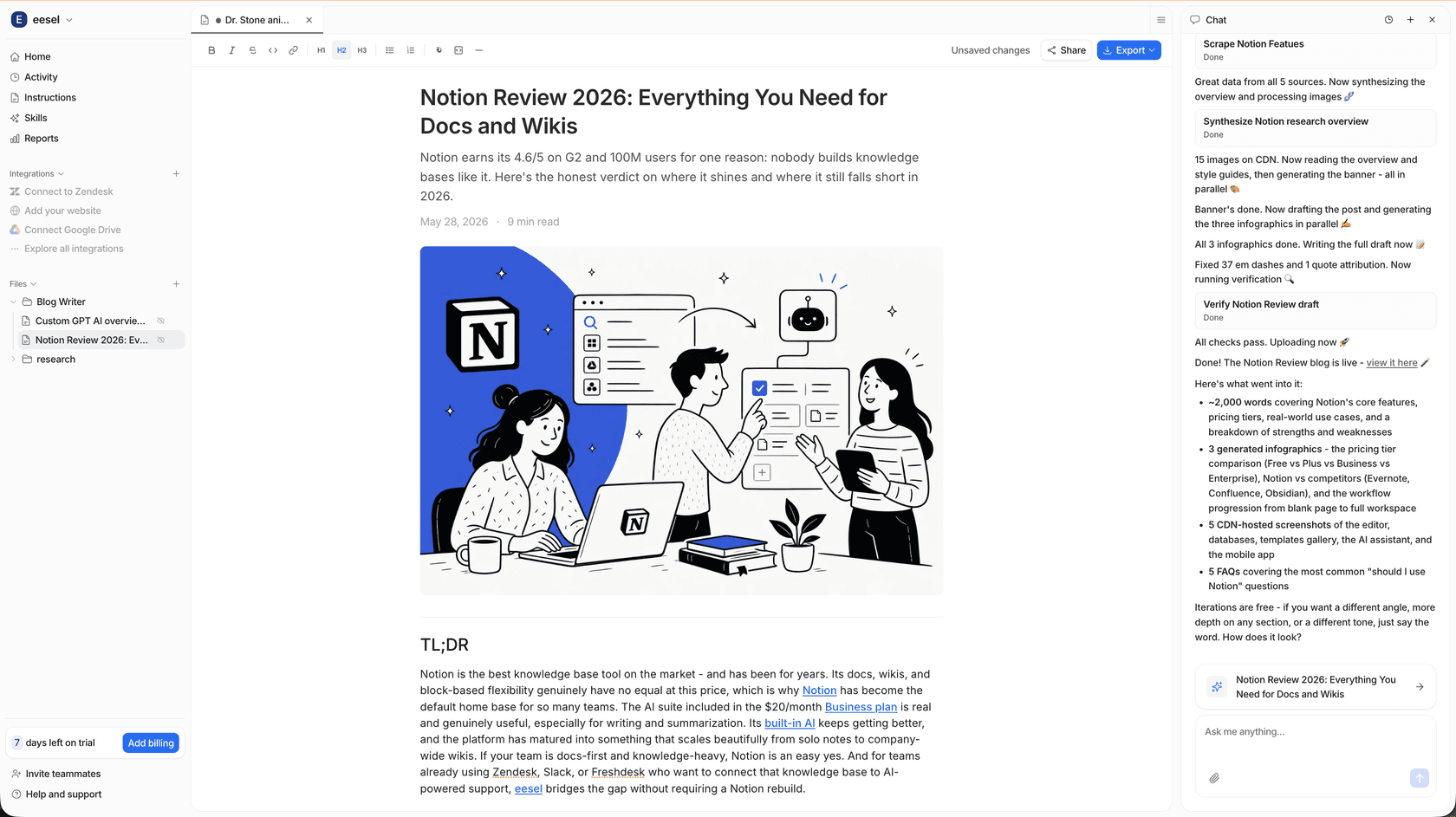
Although not designed strictly as an academic tool, the eesel AI blog writer is effective at creating detailed and well-organized first drafts. You can give it a single topic, and it will generate a deeply researched article with automatic assets like images, charts, and videos. One of its standout features is pulling in quotes from places like Reddit, which can add some real-world context to your research. The output is designed to have a natural, human-like tone.
-
Pros: Its main strength is its ability to generate a nearly complete piece of content with visuals, tables, and external citations. This saves a huge amount of time on initial research and structuring. It's perfect for getting a solid draft down quickly.
-
Cons: The biggest drawback is its focus on blog formats. You'll need to manually adapt the output to fit academic styles like APA or MLA. It also doesn't have a built-in plagiarism checker designed for academic work.
Pricing:
-
You can try it for free to generate your first article.
-
The Early Bird plan costs $99 per month for 50 blog generations.
2. Paperguide
Paperguide is an all-in-one AI research assistant built to create structured documents from sources you provide. Its "Full Document Generation" feature lets you produce research papers and essays with accurate citations already baked in. The platform can link with reference managers like Zotero or import sources directly, making sure the AI writes content based on your specific research materials.
-
Pros: Paperguide's ability to build a paper around references is its biggest advantage. It helps maintain academic integrity and keeps the content focused from the start. It also comes with useful tools for literature reviews and plagiarism detection.
-
Cons: The platform is very thorough, but if you prefer a more hands-on, sentence-by-sentence writing process, you might find its full-document approach a bit less interactive than you'd like.
Pricing:
-
A free plan is available with daily limits.
-
The Plus plan starts at $12 per month when billed annually.
3. Jenni AI
Jenni AI acts more like a writing partner. Its AI Autocomplete feature suggests text as you type, helping you push through writer's block by offering sentence-by-sentence completions based on your prompts and any research PDFs you upload. This gives you a more controlled, collaborative experience where you're guiding the AI instead of having it generate huge chunks of text. It also includes an AI chat assistant to help summarize and make sense of research papers.
-
Pros: The interactive writing style is a significant benefit, as it keeps you in the driver's seat while providing steady assistance. Its ability to generate text and citations from your own sources is also great for keeping your paper relevant.
-
Cons: According to its privacy policy, Jenni AI might use your data for model training. This could be a concern for users working with sensitive or unpublished research.
Pricing:
-
A free plan is available with daily word limits.
-
The Unlimited plan costs $12 per month when billed annually.
4. Yomu AI
Yomu AI is a comprehensive AI assistant designed specifically for the academic writing process. It brings together an intelligent document assistant, AI autocomplete, and useful editing commands like "paraphrase" and "summarize." It also has an AI-powered citation tool and an advanced plagiarism checker, making it a one-stop shop for students and researchers who want everything in one place.
try Yomu AI! it is pretty much complete academic writing tool that has so many features necessary for academic writing from autocompleting sentence, editing paragraphs, finding and formatting citations properly, checking for plagiarism, and downloading in DocX and LateX formats for submission. it even includes research library and chat assistant functionality which makes it a lot more flexible compared to many other tools which are mainly editors only.

-
Pros: Yomu's biggest strength is that it consolidates all the essential academic writing tools into a single, clean interface. You can go from drafting to citing and checking for originality without having to jump between different apps.
-
Cons: Some of its best AI models are only available on the pricier Ultra plan, which could be a downside for users on the basic paid tier.
Pricing:
-
A free version is available with limited features.
-
The Pro plan starts at $11 per month when billed annually.
5. Paperpal
Paperpal is an AI academic writing tool that focuses on language and grammar editing. Its AI has been trained on millions of published scholarly articles, so it can provide context-aware suggestions to improve your academic tone, word choice, and clarity. Beyond just correcting language, it offers a research tool to find and cite articles from a database of over 250 million sources, a plagiarism checker, and over 30 checks to make sure your manuscript is ready for journal submission.
Paperpal is best for manuscript edits and language and grammar checks. I don't think any other tool offers the same depth and coverage for academic & research writing. It's word trimming capabilities is also by far, the best of all I've seen till now.
-
Pros: Paperpal is especially helpful for non-native English speakers or anyone who needs to polish their writing to a high academic standard. Its commitment to security is also a significant benefit, as it guarantees that your data is never used to train its AI models.
-
Cons: Its main job is to edit and refine, not to generate full drafts from scratch. It's best used after you already have a draft ready to go.
Pricing:
-
A free plan is available with monthly usage limits.
-
The Prime plan starts at $11.50 per month when billed annually.
How to choose the best AI paper writer for your needs
The right tool for you really depends on your workflow and where you need the most help. To make it easier, here’s a quick guide to help you decide.
-
For generating a comprehensive first draft: If your main goal is to quickly produce a well-researched and structured draft with media, a tool like the eesel AI blog writer gives you a strong foundation to work from.
-
For a source-based, structured workflow: If you want an AI that builds a complete paper from your own list of references, Paperguide offers a focused and academically sound method.
-
For interactive co-writing: If you'd rather have an AI assistant that writes alongside you to help beat writer's block, Jenni AI provides a collaborative and controlled experience.
-
For an all-in-one academic toolkit: If you're looking for a single platform to handle drafting, editing, citations, and plagiarism checks, Yomu AI is a solid choice.
-
For polishing and language refinement: If you have a draft and just need to improve its language, grammar, and academic tone, Paperpal is the specialist tool for that job.
Pro tip
Make the most of the free plans or trials these tools offer. Spend some time with your top two or three choices to see which one fits your personal writing style before you decide to pay for a subscription.
The final verdict on finding the best AI paper writer
The "best" AI paper writer is really up to you and what you need, whether that's help with an initial draft or the final polish. These AI tools are powerful assistants, but they don't replace academic diligence. Their real value is in speeding up the research, drafting, and editing stages, giving you more time for critical analysis and strengthening your arguments.
You might consider a two-step process. For instance, a generator like the eesel AI blog writer can produce a comprehensive first draft. That last 10%, personalizing, fact-checking, and applying specific academic formatting, is where your effort makes all the difference.
By adding the right AI tool to your workflow, you can make academic writing a more manageable and efficient process. Using a draft generator and finishing with specialized editing tools can improve your productivity and the quality of your work.
Frequently asked questions
What is the best AI paper writer for students on a budget?
Many of the top tools, including Paperguide, Jenni AI, Yomu AI, and Paperpal, offer free plans with certain limitations, such as daily word counts. These are great for trying out the software before committing to a paid plan, which typically starts around $11-12 per month.
Can the best AI paper writer help with citations and formatting?
Yes, a key feature of the best AI paper writer tools is citation support. Most can format references in various academic styles like APA, MLA, and Chicago. Some, like Paperguide, can even build a paper around your existing list of sources.
Is it ethical to use the best AI paper writer for academic work?
Using an AI paper writer is ethical as long as it's treated as an assistant, not a replacement for your own work. These tools are meant to help with brainstorming, research, and drafting. Always check your institution's specific policies on AI usage to ensure you're following the rules.
What features should I look for in the best AI paper writer?
Look for high-quality content generation, built-in citation and referencing tools, grammar and language enhancement features, and a plagiarism checker. An intuitive user interface and fair pricing are also important factors to consider.
How does the best AI paper writer handle plagiarism?
Several of the best AI paper writer tools, such as Paperguide, Yomu AI, and Paperpal, include built-in plagiarism detectors. These features check the generated text against a vast database of sources to help ensure the originality of your work.
Can I use the best AI paper writer to generate a complete first draft?
Absolutely. Tools like the eesel AI blog writer and Paperguide are specifically designed to generate comprehensive first drafts. The eesel AI blog writer can turn a single topic into a researched article with assets, while Paperguide builds a document from your provided references.