A practical guide to building a B2B blogging strategy that actually drives revenue

Amogh Sarda
Last edited February 1, 2026
It’s a common sight: a B2B blog that feels more like a content graveyard than a lead-generation machine. Posts go live, a box gets checked, and then... nothing. No leads, no engagement, and certainly no impact on revenue. If this sounds a bit too familiar, the issue probably isn't your writing; it's the absence of a solid B2B blogging strategy.
A documented strategy is what separates blogs that attract random visitors from those that pull in qualified buyers. It’s the blueprint that turns your blog from a cost center into a revenue driver, ensuring every article has a purpose, a target audience, and a clear way to measure success.
This guide will give you a straightforward look at how to build a B2B blogging strategy that focuses on business results, not just vanity metrics. We'll cover the essential components, from defining your goals to proving your blog's impact on the bottom line.
To put that strategy into action at scale, AI-powered tools can be helpful. For example, an AI blog writer can help automate parts of the content creation process. We used our own tool, the eesel AI blog writer, to grow our blog from 700 to 750,000 daily impressions in just three months, and we'll show how such tools can fit into a modern B2B content plan.
What is a B2B blogging strategy?
So, what exactly is a B2B blogging strategy? Simply put, it's a documented plan that connects your content creation and distribution efforts to specific business goals. It's a roadmap for producing content that targets your ideal customer profiles (ICPs) at every stage of their buying journey.
It’s also important to know what it’s not.
- A B2B blogging strategy is: A framework for attracting qualified prospects, building trust in your niche, and supporting the sales team with tangible results. It’s all about creating content that answers your future customers' biggest questions.
- A B2B blogging strategy is not: Just a content calendar filled with keywords. It isn't a vague promise to "post twice a week" and hope something sticks. And it's definitely not about chasing high-volume keywords that have zero connection to what you actually sell.
A real strategy makes you prioritize buyer intent over raw search volume. It ensures the audience you attract can actually become your customers, turning every piece of content into a valuable asset.
Component 1: Defining your strategic foundation
Before you write a single word, you need to lay the groundwork. Skipping this step is like trying to build a house without a foundation; it’s just not going to hold up. Getting this part right ensures your content is focused and effective.
Set clear business objectives with the SMART framework
Every blog post needs a purpose. What are you trying to accomplish? The SMART (Specific, Measurable, Achievable, Relevant, Time-bound) goal framework is a simple way to bring clarity to your objectives.
Instead of a fuzzy goal like "get more traffic," a SMART goal looks more like this:
- Increase organic traffic for non-branded keywords by 25% in the next six months.
- Generate 50 new marketing-qualified leads (MQLs) directly from blog content each quarter.
- Establish thought leadership by ranking in the top three for the "customer service automation" topic cluster by the end of the year.
This approach pushes you beyond vanity metrics like page views and social shares. Those are nice to have, but they don't directly contribute to the business. The real aim is to track KPIs that matter, like assisted conversions, pipeline influence, and closed-won deals that involved your blog.
Develop buyer personas from customer insights
It’s easy to get lost in SEO tools and forget you’re writing for people, not just search engines. This is where buyer personas come in. A good persona helps you create content that resonates because it’s based on the real goals, challenges, and questions of your target audience.
Forget generic templates. The best way to build useful personas is to do a little research. Many experienced content marketers swear by this hands-on approach:
IMO opinion, AI is like most tools. Garbage in, garbage out. You can’t throw a Kw at it and expect a week written article. You still need to research proper KWs. You need to study the SERPs. You still need to perfect a great outline.

- Talk to your internal teams: Your sales, customer success, and solutions consultants are sitting on a goldmine of information. They talk to prospects and customers all day. Ask them: What are the most common questions they hear? What pain points lead people to look for a solution like yours? What are the "aha!" moments customers experience?
- Survey your actual customers: Use a simple survey tool to ask your best customers about their journey. What problems were they trying to solve? Where did they look for information? What kind of content do they find most helpful?
This process does more than just fill out a form. It helps you uncover the specific language your audience uses and the real problems they face, letting you create content that feels like you’re reading their minds.
Component 2: Planning and creating strategic content
Once your foundation is set, it's time to turn those insights into a plan for creating content that attracts and converts the right people. This is where you connect your business goals to the articles you publish.
Build topic clusters to establish authority
If you want to build serious SEO authority, the "topic cluster" (or "hub and spoke") model is the way to go. As explained by Ironpaper, the idea is to create a central, comprehensive "pillar page" on a broad topic (the hub) and support it with multiple, in-depth blog posts on specific subtopics (the spokes).
For example, your pillar page might be "The Ultimate Guide to AI in Customer Support." Your cluster posts could then be articles like "How to Choose an AI Chatbot," "Measuring the ROI of Support Automation," and "5 Ways to Reduce Ticket Volume with AI."
This structure signals to search engines like Google that you have deep expertise on a subject. By interlinking the pillar and cluster pages, you create a web of content that helps you rank for competitive, high-value terms over time. You can use keyword research to validate demand for your pillar topic and find all the long-tail keywords your customers are searching for to build out your spokes.
Map content to the buyer's journey
Here’s a quick breakdown of what that looks like:
- TOFU (Awareness): At this stage, people are just realizing they have a problem. Your content should be educational and helpful, not salesy. Think "What is..." articles, educational guides, and industry trend analyses.
- MOFU (Consideration): Now, they know they have a problem and are actively looking for solutions. This is where you can be more solution-oriented. Think in-depth comparison posts, detailed "how-to" guides that feature your product's approach, and case studies.
- BOFU (Decision): They're ready to buy and are just trying to decide which solution is the right fit. Your content here should build confidence and remove friction. Think implementation guides, articles that address common purchase objections, and ROI calculators.
Scale content creation with AI tools
Consistently creating high-quality, deeply researched, and SEO-optimized content across all funnel stages is a significant challenge in B2B blogging. It's often where strategies fall apart due to resource constraints.
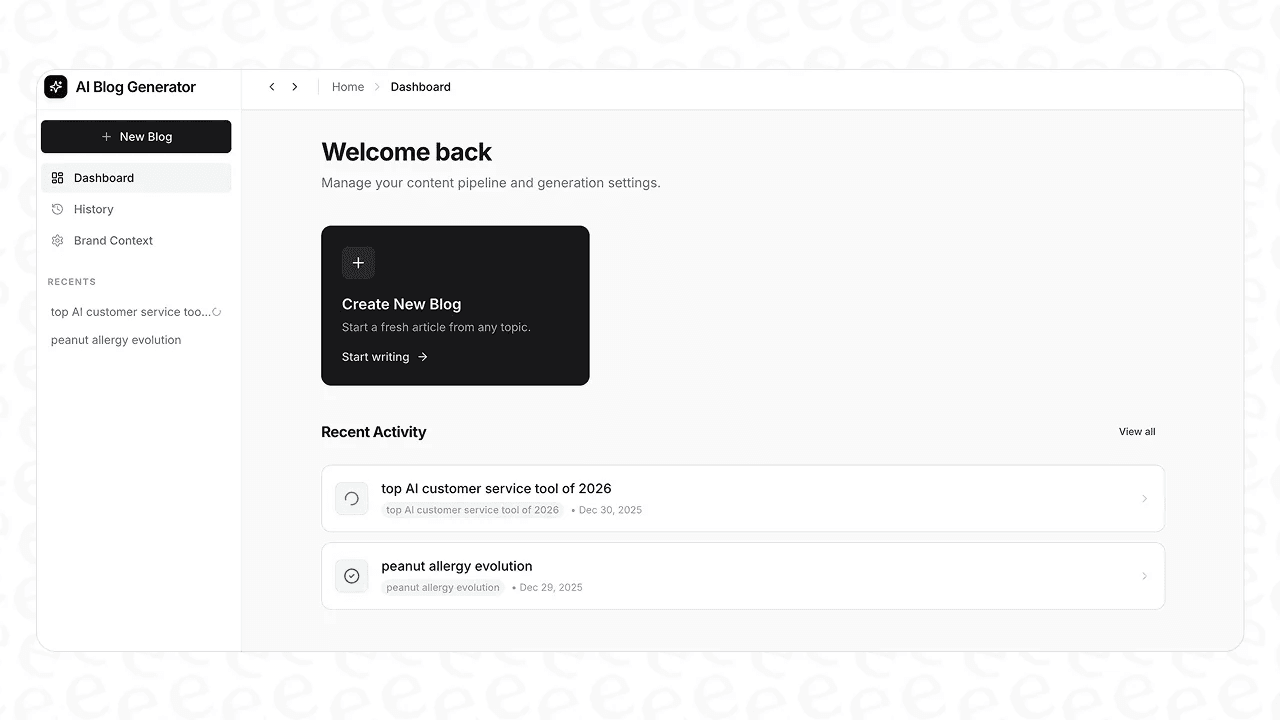
- From keyword to publish-ready post: You can take a long-tail keyword identified for a MOFU article, and the tool can handle the entire workflow. It generates a complete post with a proper structure, headings, an intro, a conclusion, and an FAQ section.
- Automatic assets and social proof: The eesel AI blog writer can generate relevant AI images and infographics. It can also embed relevant YouTube videos and pull in real Reddit quotes to add a human perspective.
- Context-aware research: The platform produces deeply researched content that matches search intent. For example, when writing a comparison post, it can pull in pricing data.
- SEO and AEO optimization: Every article is structured to rank on traditional search engines while also being optimized for AI Answer Engines, like Google's AI Overviews.
The tool is free to try, allowing users to test how it can turn a keyword into a blog post.
Component 3: Promoting and measuring performance
Creating amazing content is only half the battle. If no one sees it, it doesn't matter how great it is. An effective strategy includes a plan for getting your content in front of the right people and a system for proving its value back to the business.
Build an effective content distribution plan
Adopt the "create once, distribute everywhere" mindset. Your blog post isn't the final product; it's the source material for a whole range of other content assets.
Your distribution plan should include a mix of channels relevant to your B2B audience:
- LinkedIn: Share key insights, stats, or quotes from your article to start industry conversations and potential buyers.
- Targeted email newsletters: Send your best content directly to your subscribers, segmenting your list to ensure relevance.
- Partner co-marketing: Collaborate with complementary (not competing) companies to share each other's content with your respective audiences.
Don't forget the power of repurposing. That one in-depth guide you wrote can be turned into a dozen social media snippets, a short video script, a webinar topic, or even a section of a larger ebook. This maximizes the reach and ROI of every single piece you create.
Measure what matters: Connect your blog to revenue
This is the most important part. It’s easy to celebrate high traffic numbers while ignoring that none of that traffic is converting. True success lies in proving how your blog influences the sales pipeline and generates revenue.
Unfortunately, standard attribution in most CRMs is often too simple for the complex B2B buying journey. A prospect might read five of your blog posts, attend a webinar, and then finally request a demo. Single-touch attribution (like the "Primary Campaign Source" field in Salesforce) would only give credit to that last touchpoint, ignoring everything that came before it.
To get a more accurate picture, you need to look at multi-touch attribution models. These models (like First-Touch, Last-Touch, and Even-Distribution) help you see all the marketing touchpoints that contributed to a deal.
The key is to integrate your blog analytics with your CRM (like HubSpot or Salesforce). By tracking properties like "First touch converting campaign," you can see exactly which blog posts are originating new leads and influencing deals from the first read to the final signature.
Visualizing these concepts can help solidify your approach. For a deeper dive into creating a successful B2B blogging strategy, including tips on execution and measurement, the following video offers valuable insights from industry experts.
Putting your strategy into action
A successful B2B blog is more than a content checklist; it’s a strategic engine for growth, powered by a plan that connects audience needs with business goals.
We've covered the three essential pillars to get you there:
- A solid foundation: Built on clear business goals and deep, real-world buyer persona insights.
- Strategic content creation: Mapped to the entire buyer's journey and structured with topic clusters to build authority.
- Intelligent distribution and measurement: Focused on getting your content seen and proving its impact on revenue, not just traffic.
A great strategy requires effective execution. Tools like the eesel AI blog writer can help streamline the process of turning keywords into complete, SEO-optimized blog posts. If you are interested, you can try it for free.

Frequently Asked Questions
Share this article

Article by
Amogh Sarda
CEO of eesel AI. Amogh Sarda is obsessed with making the ultimate AI for customer service teams. He lives in Sydney, Australia and has previously worked at Atlassian and Intercom. Outside of work he’s usually surfing or on stage doing improv.