A practical guide to unique blog writing

Stevia Putri

Katelin Teen
Last edited January 20, 2026
It feels like the internet is overflowing with content, doesn't it? Millions of blog posts go live every day, and so many of them feel like they were written by the same bland robot, saying a lot without really saying anything. With AI content tools becoming standard, it’s tougher than ever to get your voice heard.
The good news is that both readers and search engines like Google are getting smarter about spotting low-effort, repetitive articles. They’re looking for content with personality, substance, and actual value. This is where unique blog writing becomes essential. It’s not just a nice-to-have anymore; it's how you grab attention, build a loyal audience, and establish yourself as an authority in 2026.
Thankfully, the tools we use are evolving too. They're moving beyond just spitting out text. For example, tools like the eesel AI blog writer are designed to help you produce genuinely unique, media-rich content at scale, letting you focus on the ideas instead of just rehashing what’s already out there.
What is unique blog writing?
When people talk about unique content, they don't just mean it passes a plagiarism check. That’s the bare minimum. Truly unique blog writing goes much deeper. It’s about adding something new to the conversation.
This means your content should have:
- A distinct angle: You aren’t just echoing the top 10 search results. You’ve found a specific viewpoint or a fresh take that makes people think.
- Original insights: You’re sharing knowledge from your own experience, not just summarizing what others have said.
- A clear voice: Your personality comes through. It doesn’t read like a corporate memo or generic AI filler.
- Real value: You're giving the reader something they can't find just anywhere, whether it’s a new piece of data, a detailed process you’ve perfected, or a solution to a problem they didn't know they had.
This approach aligns perfectly with Google's E-E-A-T framework (Experience, Expertise, Authoritativeness, and Trust). Google wants to rank content from people who have real-world experience. It rewards content that shows firsthand knowledge, which is precisely where a lot of generic AI text falls short. Google has been clear that it cares about the quality of the content, not how it was made. But to rank well, AI content must meet the same high standards as human-written content, and that includes demonstrating real experience.
The core pillars of unique blog writing
So, how do you actually create content that hits all those marks? It comes down to three core pillars that separate forgettable posts from fantastic ones.
Pillar 1: Deep research
Going beyond the first page of Google is a must. Unique content is built on fresh data, credible studies, and primary sources. It's about digging a little deeper to find the information that others have overlooked.
But it’s not just about stats. A great way to add authenticity is by tapping into real-world conversations. Looking through forums like Reddit for insightful quotes and discussions shows that you understand what people are actually thinking and feeling. It adds a layer of social proof and real-world context that readers (and search engines) appreciate. This kind of research adds credibility and strengthens the E-E-A-T signals that are so important for ranking.
Pillar 2: Finding a distinct angle
Anyone can write a post called "10 Marketing Tips." But what about an article titled "Why Most B2B Marketing Fails (And How to Fix It)"? The second one is much more compelling because it has a strong, specific angle. It promises an opinion and a solution, not just a generic list.
Your voice is just as important. Don't be afraid to let your personality show. Whether you're witty, analytical, or encouraging, your voice is what helps you connect with your audience. It's what makes them remember you. Think about who you're writing for; a clear persona helps you tailor your message and tone so it feels like a one-on-one conversation.
Pillar 3: Using rich media
Text is great, but a wall of it can be a bit much. Unique content often uses a mix of media to tell a more complete story. This isn't about just dropping in a random stock photo. It's about creating or finding media that adds genuine value.
Custom visuals like infographics, charts, and original screenshots make complex information easier to digest and much more shareable. Embedding a relevant YouTube video can provide more context, answer a question more effectively, and keep people on your page longer, which are all good signals for SEO. When you combine different media types, you turn a simple article into a comprehensive resource, telling both users and search algorithms that you’ve created something valuable.
Common hurdles in unique blog writing
If creating unique content were easy, everyone would be doing it. The truth is, there are some real challenges that can get in the way.
The time commitment of manual research
Building an authoritative blog post from scratch takes a lot of work. You can spend hours just trying to find the right statistics, hunting for credible sources, and digging through forums for relevant quotes. And that's all before you even start writing.
Then you have the visual side of things. Creating custom graphics, tables, or even just taking and annotating good screenshots takes time and often requires design skills. Finding the perfect YouTube video that actually adds to your point instead of distracting from it is another time-consuming task. All this manual effort can be a huge bottleneck, making it tough to scale your content strategy without burning out.
Limitations of generic AI tools
AI writing tools have improved a lot, but most still have some major limitations when it comes to creating truly unique content.
General-purpose chatbots like ChatGPT are effective for brainstorming and creating first drafts. Their output can sometimes be formulaic and may require fact-checking for accuracy, as they can occasionally produce incorrect information, or "hallucinations." To achieve a truly unique voice, the generated text often requires significant editing for creativity and originality.
Keep in mind those AI tools are just built on top of OpenAI, Anthropic etc, so you're getting the same results, just in a different interface for a marked up price.

More specialized assistants like Jasper are also useful for various types of marketing copy and include features like a "Canvas" editor for assembling articles. Typically, the workflow involves multiple steps, starting with a text document that users then manually format and enrich with social proof and visual assets. This process often requires detailed prompt engineering and editing to develop a final, unique piece of content.
How to scale unique blog writing with the eesel AI blog writer
This is where the right tool can make a huge difference. Instead of just giving you a block of text, the eesel AI blog writer is designed to handle the entire content creation cycle, automating the most time-consuming parts of producing unique content.
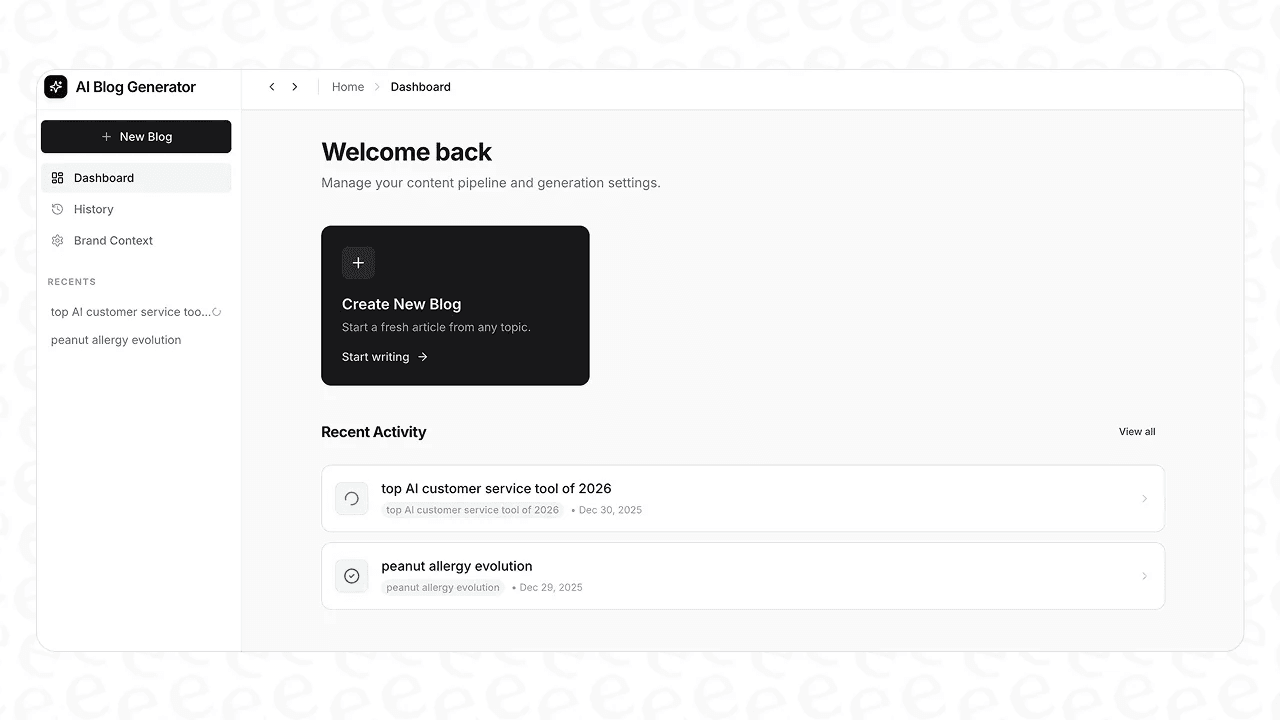
It’s built to generate a complete, media-rich, and SEO-optimized blog post from a single keyword, not just a rough draft. We used this exact tool to grow our own blog at eesel AI, going from 700 to over 750k impressions in just three months by publishing content that was high-quality and optimized to rank.
Here’s what makes it different and helps automate uniqueness:
- Context-Aware Research: It doesn't just scrape the web. It understands the search intent behind your keyword. If you're writing a comparison post, it will automatically pull in pricing data. For a product review, it finds the technical specs.
- Automatic Asset Generation: This is a massive time-saver. It creates and embeds relevant AI-generated images, data tables, and infographics directly into the post, solving the manual asset creation problem.
- Social & Media Integration: It automatically finds and embeds relevant YouTube videos and pulls real Reddit quotes to add that layer of authenticity and social proof that makes content feel real and trustworthy.
- AEO Optimization: Beyond standard SEO, it’s optimized for AI Answer Engines like Google’s AI Overviews and Perplexity. As search behavior shifts more toward conversational, AI-powered answers, this is a huge advantage for future-proofing your content.
Best of all, it’s completely free to try, so you can see the quality for yourself. The paid plan is straightforward too: you can get 50 complete blog generations for $99.
Seeing these principles in action can help solidify the workflow. The video below offers a practical guide on how to approach AI-assisted content creation, turning a simple topic into a well-structured and engaging article.
Your strategy for consistent unique blog writing
To consistently create content that cuts through the noise in 2026, you need a strategy rooted in the principles we've covered. Deep research, a strong angle, and value-added media are no longer optional—they're the price of entry for getting noticed.
The future of content creation isn't about replacing humans with AI; it's about forming a partnership. Your role shifts from being a manual writer to a content strategist. You're the one with the big ideas, the unique insights, and the final say on voice and tone. Smart automation handles the heavy lifting of research, drafting, and asset creation, freeing you up to focus on what humans do best: storytelling and connecting with your audience.
Final thoughts on unique blog writing
Creating unique blog posts is more important than ever, but it doesn't have to be an uphill battle. With the right strategy and the right tools, it's something you can do consistently and at scale. The modern content workflow empowers you to focus on high-impact strategic tasks instead of getting bogged down in the manual grind of production.
You can move faster, create better content, and finally build the audience you deserve.
Ready to stop writing generic content? Generate your first unique blog post for free with eesel AI and see the difference for yourself.

Frequently Asked Questions
Share this article

Article by
Stevia Putri
Stevia Putri is a marketing generalist at eesel AI, where she helps turn powerful AI tools into stories that resonate. She’s driven by curiosity, clarity, and the human side of technology.