

Going from a handful of posts a month to dozens a day sounds like a dream for any marketing team, right? But does that kind of speed mean you have to sacrifice quality?
For some teams, scaling content with automated blog writing has presented challenges. The focus can sometimes shift to quantity, resulting in generic articles that may not rank well or drive significant traffic. The key is to balance speed with quality.
The goal isn't just to automate things; it's to do it smart. This guide is all about how to create high-quality, SEO-optimized content that actually ranks, pulls in readers, and helps you hit your goals, all without the endless manual work.
It’s a problem we know a thing or two about. We built the eesel AI blog writer to solve this exact challenge. In fact, we used our own tool to grow our blog's impressions from a modest 700 a day to over 750,000 per day in just three months.
What is automated blog writing?
When we say "automated blog writing," we are referring to using software and AI to handle tasks across the entire content creation process. This includes everything from brainstorming and research to drafting the article, creating images, and even publishing it.
But it's not an all-or-nothing deal. Automation is more of a spectrum, with different levels of AI involvement:
- Basic Automation: This includes simple tools that help you schedule posts on a calendar or manage your content workflow. It’s helpful, but it’s not doing any writing for you.
- AI-Assisted Writing: This is where you use a general tool like ChatGPT or a more focused AI assistant to help with brainstorming, outlining, or drafting a few paragraphs. It can be a good starting point, but you’re still doing most of the heavy lifting: research, editing, formatting, and fact-checking.
- Full Content Automation: This involves systems that can take a single keyword or topic and generate a complete blog post from start to finish.
The key difference is the output. AI assistance provides a rough draft or a few ideas, while true automation can deliver a nearly-finished article that is ready for a final review before publishing. This visual guide breaks down the spectrum of automation.
The different approaches to automated blog writing
Jumping into automation is about choosing which parts of the content process you want to hand over to an AI. Each approach has its own workflow, pros, and cons.
Level 1: Manual writing with AI assistance
This is a common starting point. A writer uses a general AI tool like ChatGPT or a marketing-focused one like Jasper to help get things started. They might ask it to generate blog post ideas, create a basic outline, or write a rough first draft of a section.
The workflow here is still very human-led. The writer manages the entire article. They are responsible for the deep research, checking facts, structuring the post, finding visuals, optimizing for SEO, and ensuring it matches the brand's voice.
The main drawback is that while this can speed up initial drafting, it doesn't significantly change the total workload. You're just making one step in a long process a little bit faster.
Level 2: Semi-automated workflows
This approach is more technical. It involves connecting different specialized apps and APIs using a platform like Zapier. Some tools, like Jasper, offer an API that you can plug into these kinds of custom setups.
A typical workflow might look like this: You add a new blog topic to a Google Sheet. This tells Zapier to send that topic to the OpenAI API, which then writes a draft. Zapier then takes that text and creates a new draft post in your WordPress dashboard.
While this is technically "automated," the result is usually a large, unformatted block of generic text. It often lacks deep research, proper SEO structure, visuals, or your brand's voice. You have automated the drafting, but you have also created a full-time editing job to turn that raw text into something usable.
Level 3: Fully automated platforms
This is a highly efficient method. It involves using a specialized platform built to handle the entire blog creation process from a single input. You give it a keyword, and it returns a complete article.
The workflow is simple. The user enters a keyword or topic. From there, the platform takes over. It handles research, writing, SEO optimization, asset creation (like images and charts), and all formatting. The output is a complete, publish-ready post.
A look at the top automated blog writing tools
Now that we've covered the different ways to tackle automation, let's look at some of the automated blog writing tools that make it happen. We'll compare a few of the leading platforms, focusing on what they do best, where they differ, and who they're for.
eesel AI blog writer: For complete, traffic-driving content
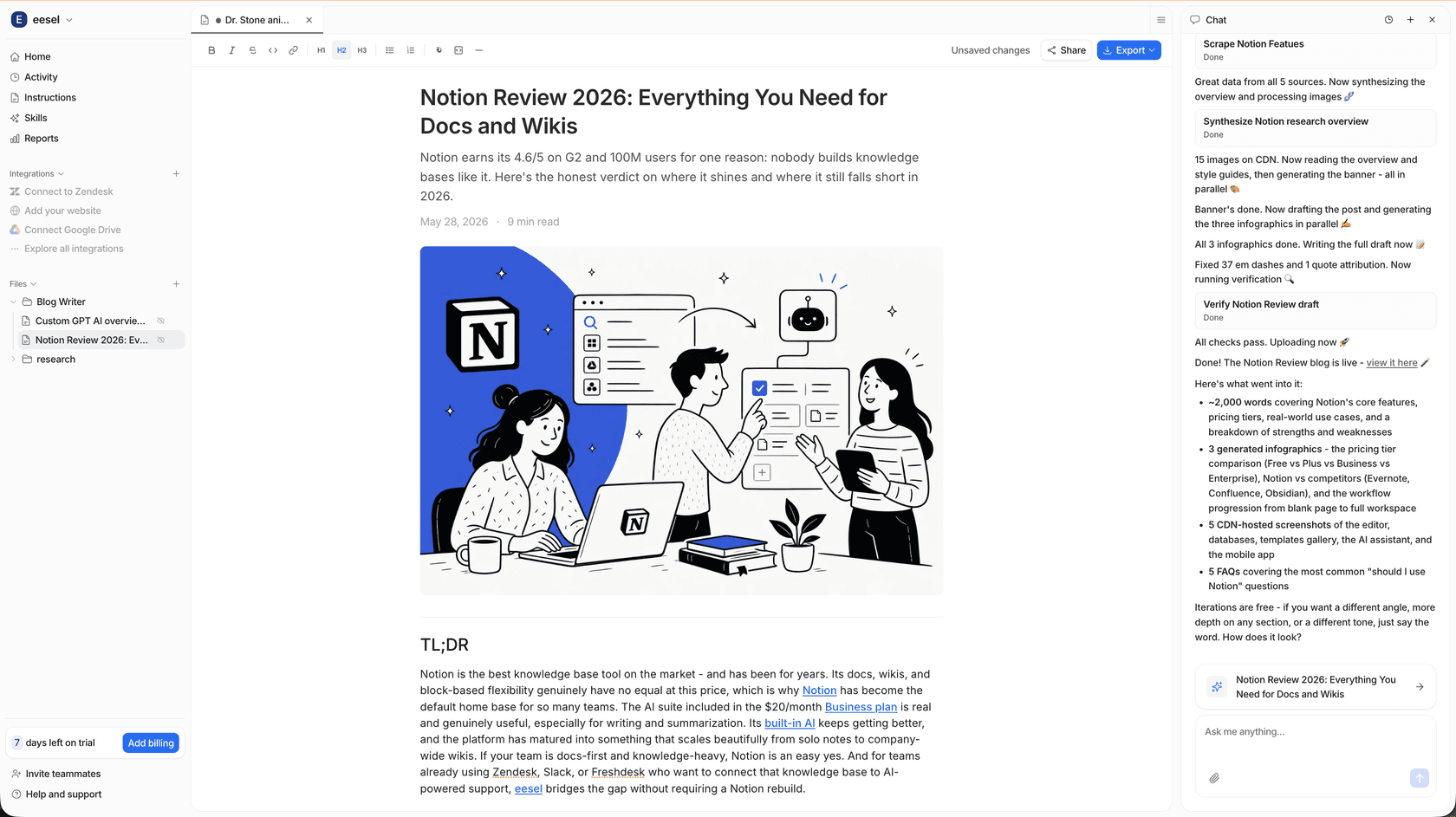
The eesel AI blog writer is an AI content platform designed to create complete, SEO-optimized, and media-rich blog posts from a single keyword. Its purpose is to generate a finished piece that is ready to publish and structured to rank in search engines.
Key Features:
- One-Click Complete Posts: You enter a keyword, and it generates a full article. That includes an intro, a well-structured body, a conclusion, and an FAQ section.
- Automatic Assets: It doesn't just write. It also includes relevant, AI-generated images, infographics, tables, and charts right in the article.
- Context-Aware Research: The AI can determine what an article needs. If you're writing a comparison post, it will automatically pull in pricing data. For a product review, it will find technical specs and add citations.
- Authentic Social Proof: To make content feel more human and trustworthy, it embeds relevant YouTube videos and finds insightful quotes from Reddit discussions on your topic.
- AEO Optimization: It's optimized not just for traditional SEO but also for AI Answer Engines like Google AI Overviews and Perplexity.
Limitations: It's a specialist tool built for creating long-form blog content. If your main goal is to generate short social media captions or ad copy, it might not be the right fit.
Pricing: The Early Bird plan is $99 per month for 50 blogs. You can generate your first blog post completely free to see the quality for yourself.
Jasper AI: A platform for marketing content
Jasper is a broad AI content platform built for marketing teams. Its focus is on automating the content lifecycle, not just blog posts. It uses features like "Content Pipelines" and customizable "Agents" to help teams build their own automated workflows for various marketing tasks.
Key Features:
- Brand Voice & Knowledge: Jasper IQ is a feature that helps maintain consistency. You can provide brand guidelines, tone, and messaging to keep all your content on-brand.
- Custom Workflows: Jasper Studio offers a no-code interface to build custom, agent-based workflows for different marketing needs, from email campaigns to social media.
- Collaboration Tools: The platform includes a document-style editor called Canvas, which is designed for teams to work together on creating and editing content.
Limitations: Jasper is a comprehensive platform, and creating a publish-ready blog post may involve setting up multiple steps or a custom workflow. This approach offers high customizability but might have a different learning curve compared to single-purpose tools.
Pricing: The Pro plan starts at $59 per month per seat when billed annually. They also offer custom Business plans for larger teams.
Koala AI: A specialist for SEO and affiliate content
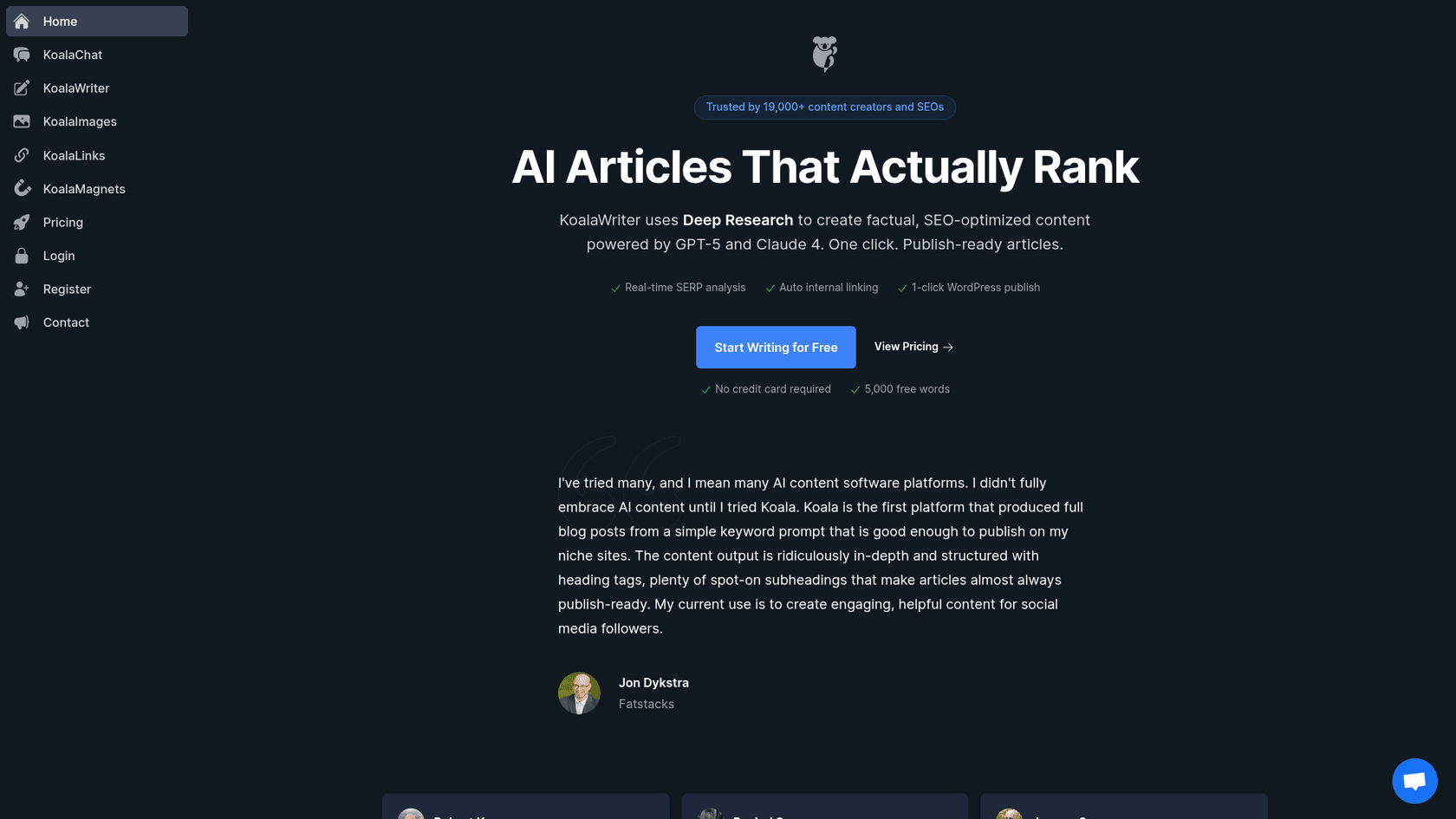
Koala AI is an AI writer focused on the needs of SEO professionals and affiliate marketers. It creates highly structured, factual content like listicles and product roundups, and it uses real-time data to ensure articles are optimized to rank.
Key Features:
- Real-Time SERP Analysis: Before writing, Koala analyzes top-ranking content for your keyword to identify topics and terms to include.
- Affiliate Content: It can generate product roundups and reviews using live data from Amazon, pulling in customer reviews, current pricing, and product specs.
- 1-Click Publishing: It has direct integrations with WordPress, Shopify, Webflow, and Ghost, making it easy to send finished articles to your site.
- AI Editing: It includes a "Polish" feature to improve the readability of the AI text and break up long paragraphs.
Limitations: It is effective for structured SEO content and includes a "Polish" feature to improve the readability of the generated text. Its focus on affiliate and SEO content makes it a specialized tool for those use cases.
Pricing: Plans start at $9 per month for 15,000 words. The price increases based on word count and feature needs. For example, their "Professional" plan is $49 per month for 100,000 words.
ContentBot: A generator for workflow and bulk content
ContentBot provides a set of AI tools focused on automating content creation at a large scale. Its main features are "AI Flows," which let you build custom workflows, and an "AI Importer" for generating content in bulk.
Key Features:
- AI Flows: This is a visual, drag-and-drop builder that lets you create your own automated content workflows by linking different triggers and actions together.
- Bulk Generation: The Importer feature is powerful for scale. You can upload a CSV file with topics or keywords and generate hundreds of product descriptions or blog post drafts at once.
- Humanizer Feature: ContentBot includes a tool designed to rewrite AI-generated text to help it pass AI detectors and sound more natural.
Limitations: Similar to Jasper, its workflow-based approach allows for custom setups. It also features a "Humanizer" tool designed to rewrite AI-generated text, which can be an additional step in the publishing process.
Pricing: Subscription plans start at $9 per month for 50,000 words. The Premium plan, which is needed for the AI Workflows, is $29 per month.
The risks and rewards of automated blog writing
Deciding to go all-in on AI for your content is a big move. It's important to be aware of both the potential upsides and the pitfalls.
The rewards of intelligent automation
When done right, the benefits are significant.
- You save a ton of time and money: You can shrink the time it takes to get from an idea to a published article. This frees up your team to spend more time on strategy, promotion, and analysis.
- You can publish consistently: Search engines often favor a consistent publishing schedule. Automation makes it easy to maintain a regular pace, which can be a strong ranking signal over time.
- You can target niche keywords: You can finally go after all those long-tail keywords you've been ignoring. Creating high-quality content for hundreds of niche topics becomes cheap and efficient, which is a great way to build organic traffic. Our own growth at eesel is an example of how well this strategy works.
The risks of low-quality automation
However, without the right tool or process, some challenges can arise.
- Generic, "thin" content: The biggest risk is producing a large volume of shallow, repetitive content that doesn't offer real value. This kind of content often fails to engage readers and does not rank well.
- Search engine penalties: As one Reddit user pointed out in a discussion about AI writers, it's possible that a future Google update could penalize low-quality, obviously AI-generated content. A future-proof strategy is to create content that is genuinely helpful, regardless of how it was written.
- Inaccuracy and brand damage: AI models can still generate incorrect information. These "hallucinations" can lead to publishing factual errors that can hurt your brand's credibility. A quality-focused tool and a human review process are important to mitigate this risk.
But I strongly suspect an algorithm update is coming that will destroy all of these sites.

For a deeper look at how these automated systems work behind the scenes, this video provides a great walkthrough of building a custom AI blog writing system. It shows how different AI agents can handle each part of the content creation process, from research to drafting.
Automate the process, not the quality
Automated blog writing is a powerful strategy, but only if you approach it the right way. It’s not about churning out as much text as you can.
The key consideration is the type of automation to adopt. One approach may result in significant editing work, while another, more integrated approach, can deliver results more efficiently.
The best approach is to use a platform that handles the repetitive, time-consuming tasks, like research, initial drafting, and asset creation, so you can focus your time on strategic review and adding that final human touch.
Getting started with automated blog writing
The eesel AI blog writer was built to address the quality challenge in content automation. We wanted a tool that didn't just write faster, but wrote better.
Don't just generate text; generate traffic. Try the eesel AI blog writer for free and see for yourself how quickly you can create a complete, publish-ready article from a single keyword.



