
Choosing the wrong project management tool costs teams more than just money. It costs momentum. Pick a tool that's too simple and you'll outgrow it in months. Pick one that's too complex and your team won't use it.
Linear and Asana represent two very different answers to the same problem. Linear is built for speed and focus, primarily serving software teams. Asana is built for flexibility, serving everyone from marketing to operations to product. Both are excellent at what they do, but they serve different needs.
While you're evaluating these tools, it's worth noting that teams focused on AI-powered customer service might need something entirely different. Traditional project management tools track work. AI teammates, like what we offer at eesel AI, actually do the work. We'll cover that later.
Let's break down what actually matters when choosing between Asana and Linear.
What is Linear?
Linear is an issue tracking and project management system built specifically for modern product teams. Founded in 2019 by former Uber engineers, it has grown to power over 25,000 product teams including OpenAI, Ramp, Vercel, and Opendoor.
Linear's core philosophy centers on three principles: purpose-built design shaped by world-class product teams, AI-powered workflows shared by humans and agents, and focus on speed to help teams ship faster.
The tool feels more like a native desktop application than a web app. Everything loads instantly. Keyboard shortcuts work for nearly every action. The interface is minimalist and dark-mode by default, clearly designed by developers for developers.
Linear takes an opinionated approach to workflow. Issues follow a predefined path: Backlog, Todo, In Progress, Done, Canceled. Priorities are standardized: Urgent, High, Medium, Low, No Priority. For teams comfortable with standard agile practices, this structure works well. For teams with unique processes, it can feel restrictive.

What is Asana?
Asana is a comprehensive work management platform designed for cross-functional collaboration. Founded in 2008 by Dustin Moskovitz (Facebook co-founder) and Justin Rosenstein, it now serves 85% of Fortune 100 companies and over 100,000 organizations globally.
Where Linear imposes structure, Asana provides building blocks. Lists, boards, timelines, calendars, portfolios, goals. You pick what works for your team. This flexibility has made Asana a favorite for organizations where different departments need to collaborate. Your engineering team can work in one style while marketing uses another, and everyone can see the big picture.
Asana's interface is immediately approachable. Most users can create their first project within minutes without reading documentation. The trade-off is that power users might find it slower than Linear's keyboard-driven flow.
The platform has evolved significantly with AI. Asana Intelligence now includes AI Studio for building no-code workflows, smart chat available in Slack and Microsoft Teams, AI-powered writing assistance, and autonomous AI Teammates that can handle routine tasks.

Asana vs Linear: Feature comparison
User interface and experience
Linear's interface prioritizes density and speed. Information is packed efficiently. Keyboard shortcuts are extensive. The learning curve is steeper for non-technical users, but those who master it move fast. Opening a new issue, assigning it, setting priority, and adding to a cycle can happen in seconds without touching the mouse.
Asana takes a more traditional approach with a cleaner, more spacious design. It's approachable from the first login. Most users can navigate intuitively. The trade-off is that common actions often need more clicking and menu navigation.
Task and project management
Linear organizes work around issues, teams, projects, and cycles. The workflow is opinionated: issues belong to teams, get prioritized, and get assigned to cycles (sprints). Sub-issues break down larger work. Labels provide categorization. This structure works beautifully for software teams following agile methodologies.
Asana offers far more flexibility. Tasks can live in multiple projects simultaneously. Custom sections can be created in any project. Custom fields track any data you need. Dependencies between tasks, milestones for key dates, and custom statuses via automation give teams the building blocks to model almost any workflow. This flexibility means you can configure Asana for nearly any process, but you also need to build and maintain that structure yourself.
Agile and sprint management
Linear was built for agile teams. Cycles provide built-in sprint management without complex setup. Velocity tracking happens automatically. The backlog is always visible. The triage inbox gives a structured process for handling incoming issues. For software teams, this works well. Everything you need for agile is there, ready to use.
Asana supports agile workflows but doesn't optimize for them. Kanban boards are available, but cycles and sprints require more configuration. Teams can make Asana work for agile, but it takes more effort to set up and maintain.
Integrations
Linear's integration strategy is focused and deep. The platform connects deeply with developer tools: GitHub and GitLab for automatic PR linking and status sync, Slack for notifications and issue creation, Figma for design collaboration, and Sentry for error tracking. The total count is roughly eleven core integrations, but each one is polished and powerful.
Asana integrates with nearly everything. The platform boasts over 300 integrations spanning Microsoft 365, Google Workspace, Salesforce, Tableau, Adobe Creative Cloud, Jira (with two-way sync), and countless others. For organizations using diverse tool stacks, this breadth is invaluable.
Reporting and analytics
Linear provides team-focused analytics that matter to engineering: cycle velocity, issue throughput over time, scope creep tracking, bug rate analytics, and team workload distribution. The reporting is clean and actionable, focused on metrics that help teams ship better software.
Asana offers more customizable reporting options. Unlimited custom dashboards, charts for any project or portfolio, goal progress tracking, workload heat maps, and universal reporting across all projects. For organizations needing executive visibility across many initiatives, Asana's reporting is more comprehensive.
Pricing comparison
Both tools offer free plans and per-user pricing that scales with your team. Here's how they compare:
| Plan | Linear | Asana |
|---|---|---|
| Free | Unlimited members, 2 teams, 250 issues | 2 users, unlimited tasks, 100+ integrations |
| Entry Paid | $10/user/month (Basic, annual) | $10.99/user/month (Starter, annual) |
| Mid Tier | $16/user/month (Business, annual) | $24.99/user/month (Advanced, annual) |
| Enterprise | Custom pricing | Custom pricing |
Linear's free plan is generous with unlimited members, making it attractive for small teams. The jump from free to paid is also less steep than Asana's. However, Asana's paid tiers include features like goals, portfolios, and advanced reporting that Linear reserves for higher tiers or doesn't offer at all.
Asana also offers several add-ons: AI Teammates for autonomous AI agents, Timesheets and Budgets for $5.99 per user monthly, and compliance management features for enterprise plans.
Source: Linear Pricing, Asana Pricing
Who should choose Linear?
Linear is a good fit when:
- Your team is primarily engineers, designers, and product managers
- You value speed and keyboard-driven workflows above all else
- You're comfortable with opinionated software that makes decisions for you
- Your workflow follows standard agile or scrum practices
- Deep GitHub or GitLab integration is critical to your process
- You're a startup or scale-up building software products
Teams at Vercel, Loom, Ramp, and OpenAI use Linear because it matches how they work. The speed difference is noticeable daily, and the tight integration with development tools reduces context switching.
Skip Linear if you need extensive customization, work with many non-technical stakeholders, or require broad integration with business tools outside the development ecosystem.
Who should choose Asana?
Asana is a better choice when:
- You need one tool for engineering, marketing, operations, and other teams
- Non-technical stakeholders need regular access to project visibility
- You have complex, custom workflows that don't fit standard templates
- Executive visibility across many projects is crucial
- You need goals and OKR tracking integrated with task management
- Your organization requires enterprise-grade security and compliance
Companies like Spotify, Amazon, and Google (for non-engineering work) use Asana because it adapts to how different teams work. The flexibility is invaluable when you need a single source of truth across departments.
Skip Asana if you're a pure software development team wanting minimal setup, or if speed and keyboard-driven efficiency are your top priorities.
eesel AI: When project management isn't enough
Here's something worth considering as you evaluate tools: Asana and Linear help you track and organize work. But what if you need something that actually performs the work?
At eesel AI, we take a different approach. Instead of managing tickets and tasks, our AI teammates handle customer interactions directly. We integrate with your existing help desk, whether that's Zendesk, Freshdesk, or Gorgias, and learn from your past tickets and help center to resolve customer issues autonomously.
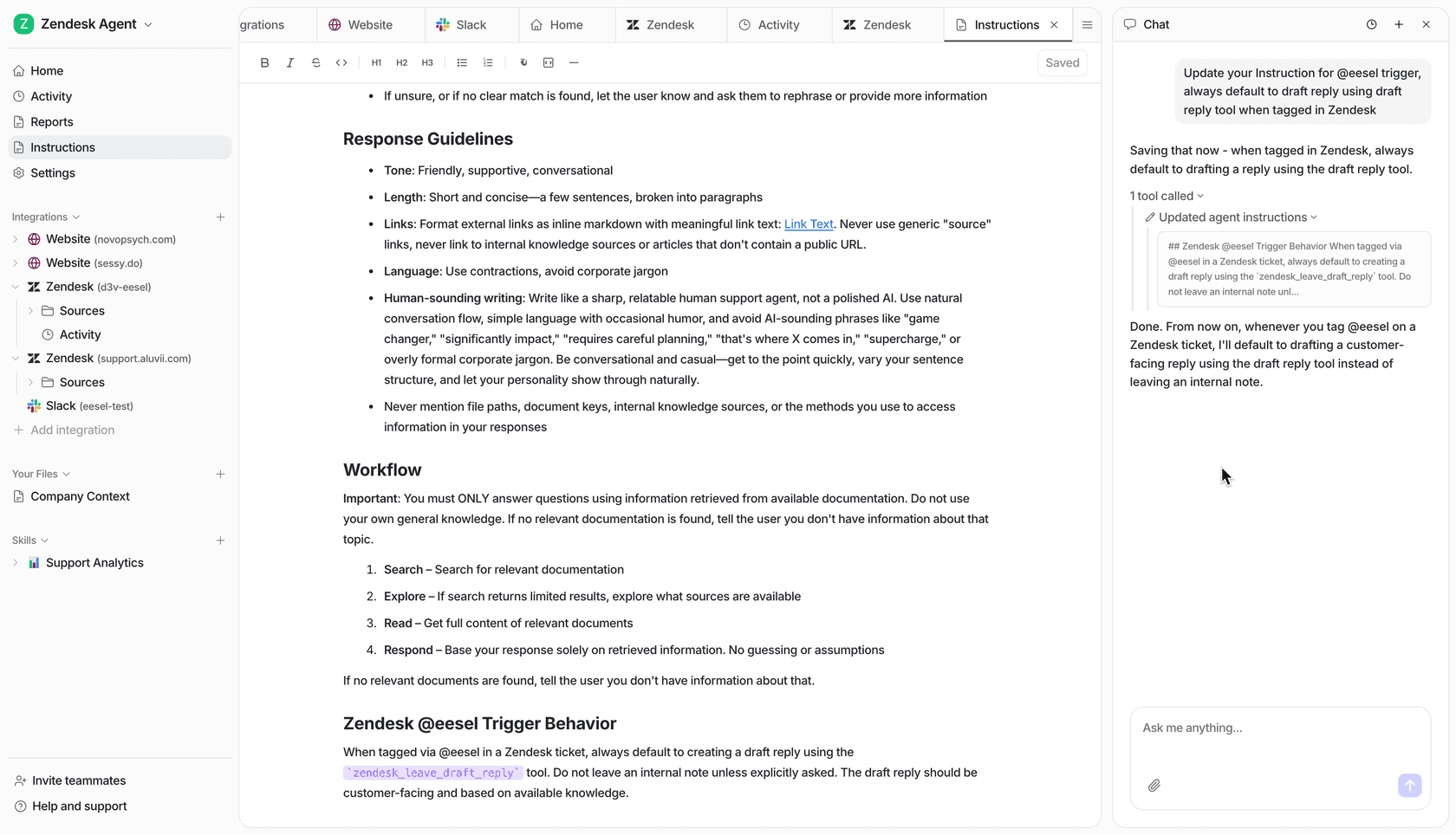
The difference is fundamental. Project management tools organize human work. Our AI Agent actually does the work, handling frontline support tickets end-to-end, escalating only what you define. Teams using eesel AI see up to 81% autonomous resolution rates.
If you're choosing between Asana and Linear primarily for customer service or support operations, you might be looking at the wrong category entirely. Check out our AI customer service solutions to see how an AI teammate compares to traditional project management. You can also explore our pricing to see how eesel AI compares to traditional project management tools.

Making your decision: Asana vs Linear
The choice between Asana and Linear comes down to specialization versus versatility.
Linear is the specialist. It does one thing, software project management, exceptionally well. If you're building software products with a technical team, Linear's speed, focus, and developer-centric design will make your team more productive. The performance difference is noticeable every day.
Asana is the generalist. It can handle almost any workflow for almost any team. If your organization needs a single project management tool across multiple departments, Asana's flexibility is invaluable. The cost of maintaining separate tools often isn't worth it.
For pure software development teams, we recommend Linear. For organizations where engineering is one of many departments, Asana makes more sense.
Both tools offer free plans, so the best way to decide is to try them. Set up a small project in each and see which one your team actually wants to use. The tool that gets adopted is always better than the tool that looks best on paper.


