

Creative writing is great, but we can all agree that staring at a blank page is just the worst. Thankfully, in the age of AI, you don't have to face it alone. Things like writer's block, annoying plot holes, and the time it takes to build a good story can derail even the most imaginative writers. This is where AI story writing tools can be a huge help. Think of them as a creative sidekick that doesn't need coffee breaks. They can help you brainstorm, flesh out characters, outline plots, and even draft entire scenes, which can really speed things up. This guide breaks down the 7 best ai story writer tools I found for 2026 after a lot of hands-on testing. And while many of these are for fiction, tools like the eesel AI blog writer are fantastic for creating brand stories and other narratives that need to get results.
I’ve been trying out AI tools for storytelling, and they’re super fun to use! So far, I’ve tried Jasper and MyEssayWriter.ai, and they’re great for coming up with creative ideas. But I know there are more tools out there that can help with writing stories, building worlds, or even creating characters.

What is an AI story writer?
An ai story writer is a tool that uses a large language model (LLM), the same kind of tech behind GPT-4o, to create stories based on your instructions. You give it a prompt, maybe a character description, a plot point, or just a basic idea, and the AI generates text for you. This could be a single sentence or a whole chapter. The goal is not to replace human creativity. They're more like assistants that help you bust through writer's block, play with new ideas, and get that first draft finished much faster. That leaves you more time to focus on your actual creative vision.
How we chose the best AI story writer tools
To build this list, I did more than just read reviews. I actually signed up and tested a dozen different platforms myself. I judged them all on the same things to make sure these recommendations are practical and genuinely useful.
Here’s what I focused on:
- Originality and creativity: How good is the AI at generating unique, engaging content that doesn't just rehash old clichés?
- Ease of use: Is the interface intuitive? Can a new writer jump in without wanting to throw their laptop out the window?
- Customization and control: How much control do you have over the story's genre, tone, characters, and plot?
- Genre flexibility: Does the tool shine with one specific genre, or can it handle a bunch of different styles?
- Pricing and value: Is the cost reasonable for the features you get and the quality of the content it produces?
Comparison of the top AI story writer tools at a glance
If you're short on time, here’s a quick side-by-side look at my top picks to help you see how they stack up.
| Tool | Best For | Key Feature | Pricing Model |
|---|---|---|---|
| eesel AI blog writer | SEO-driven brand stories & narratives | Complete, publish-ready posts with assets & AEO | Free to try, then $99/50 blogs |
| Sudowrite | Fiction and novel writers | Story Bible and chapter-by-chapter guidance | Subscription-based |
| NovelAI | Creative fiction & unfiltered content | Genre-specific AI models and high prose quality | Subscription-based |
| Jasper AI | Versatile content creation | Brand Voice and multiple content templates | Subscription-based |
| Squibler | Short stories and novel drafting | Expands short stories into full drafts | Subscription-based |
| Canva Magic Write | Integrated writing and design | Combining text generation with visuals | Freemium with limits |
| QuillBot | General writing assistance | Simple prompts and paraphrasing capabilities | Freemium with limits |
The 7 best AI story writer tools in 2026
Alright, let's dive deeper into each tool. Here’s the breakdown of their strengths, weaknesses, and who I think they’re perfect for.
1. eesel AI blog writer
While you probably wouldn't use this to write a sci-fi epic, the eesel AI blog writer is highly effective for creating engaging stories for a business. It takes a single keyword and turns it into a complete, story-driven blog post that’s genuinely ready to publish. It's the perfect fit for content marketing, brand storytelling, and case studies that need to connect with an audience and rank on search engines. We actually used it to grow our own daily impressions from 700 to 750,000 in just three months.
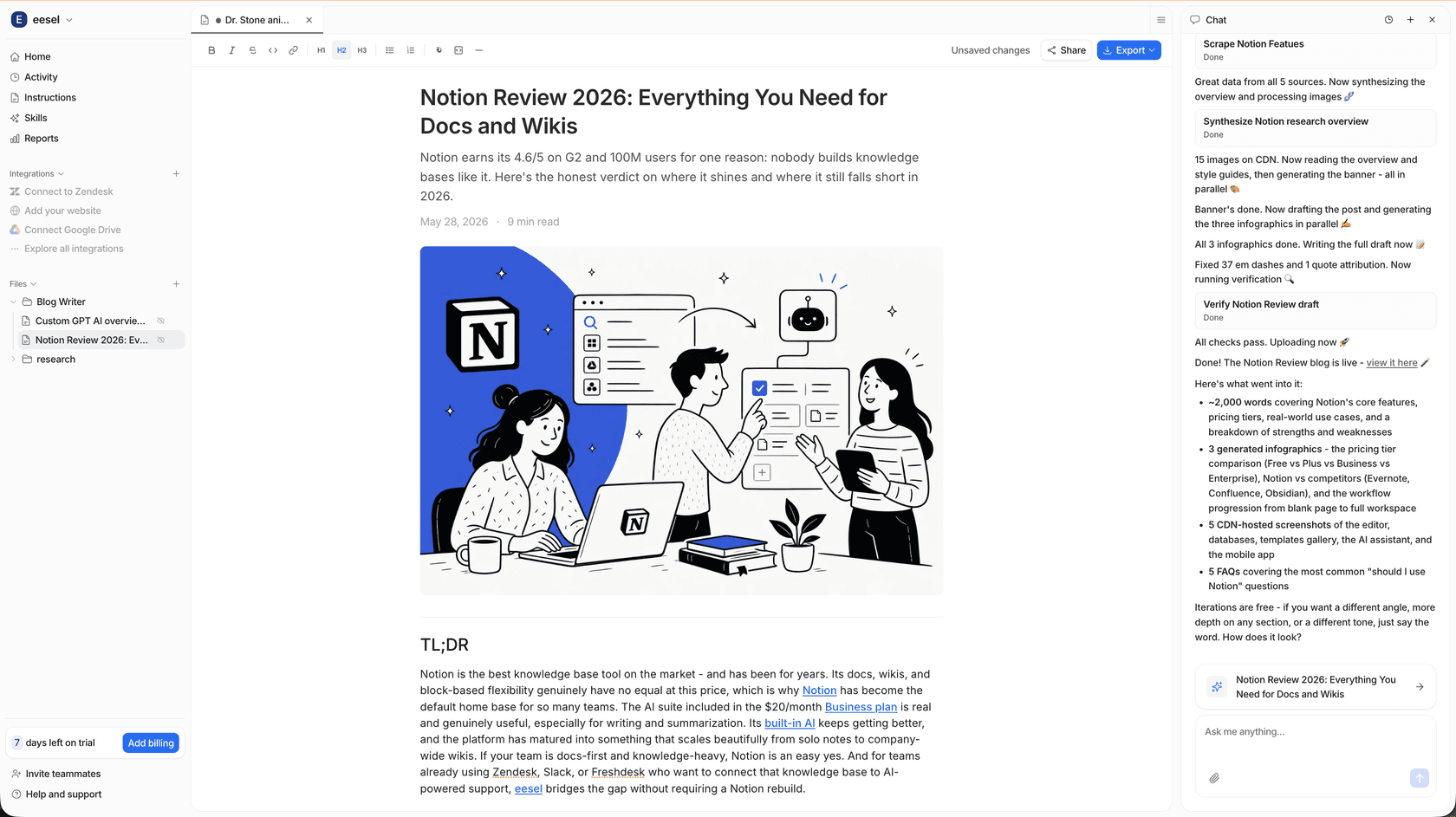
Its biggest advantage is that it creates complete posts, not just rough drafts that you have to spend hours editing.
Pros:
- Automatic assets: It generates and includes AI images, infographics, and tables right in the post, saving you a ton of time.
- Social proof: It pulls in real Reddit quotes and relevant YouTube videos to make your stories feel more authentic and trustworthy.
- Advanced optimization: The content isn't just optimized for traditional SEO. It's also optimized for AI answer engines (AEO), which basically future-proofs your content.
Cons:
- It’s a specialized tool. It's built from the ground up to create high-performing blog content and brand narratives. If your goal is to write a 300-page fantasy novel, this isn't the tool for that specific job.
Pricing:
- You can try it completely free. After that, paid plans start at a very reasonable $99 for 50 full blog posts.
2. Sudowrite
Sudowrite was made by fiction writers, and it shows. It's loaded with features built for novelists or anyone tackling a long-form story. Its "Write" feature is very effective, offering suggestions that match your unique voice, and the "Story Bible" is highly useful for keeping track of characters, plot points, and all those world-building details.
Pros:
- It has an incredibly deep feature set for fiction, including tools for brainstorming, visualizing characters, and rewriting sentences in different styles. You can tell it was designed by people who actually understand the creative writing process.
I’ve had a lot of success with Sudowrite, definitely recommend
Cons:
- All those features can be a bit overwhelming if you're just starting out. It’s also one of the more expensive options out there, which might be a barrier for hobbyist writers.
Pricing:
- It’s subscription-based, with different tiers depending on how many words you need to generate each month.
3. NovelAI
NovelAI has a big following, and for good reason. It’s known for its strong creative writing chops and a lack of content filtering, which appeals to writers who want to explore a wide range of themes without restrictions. It also uses specialized AI models that have been trained on specific literary genres, which helps it produce more authentic and nuanced writing.

Pros:
- The quality of the prose is often noted for feeling more literary and less generic. Its "memory" feature does a good job of maintaining context over longer stories, and you can even train the AI on your own writing to keep your voice consistent.
Novel AI is probably the best in terms of fooling around and having fun... However, 0 censorship, and some of the best prose in the industry.
Cons:
- The context window (how much of the story the AI "remembers") can feel a bit small on the cheaper plans. The AI can also wander off-topic if you aren't careful with your prompts. The interface is functional but may not be as modern as some alternatives.
Pricing:
- Subscription-based, with tiers that offer different memory sizes and features.
4. Jasper AI
Jasper AI is a versatile tool for AI writing. It can handle just about any task you throw at it, from writing ad copy and blog posts to creative stories. It has a huge library of templates, including some that are specifically designed for developing story plots and creating character descriptions.
Pros:
- Flexibility is its biggest strength. You can use it for pretty much anything. The "Brand Voice" feature is great for teaching it to adapt to your style, and it integrates with other marketing tools, making it a solid choice for professionals who need an all-in-one solution.
Cons:
- Jasper is a premium tool with a premium price tag. It might be overkill if all you need is an ai story writer. Its output can sometimes need a bit more editing to give it that human touch.
Pricing:
- Subscription-based, with plans based on features and your monthly word count.
5. Squibler
Squibler is a writing platform that includes a really solid AI short story generator. A key feature is its ability to take a simple prompt and quickly generate a structured story draft. You can then use that draft as the foundation for a longer piece or even a full novel.
Pros:
- The tool is super easy to use and is great at creating a solid narrative structure right off the bat. It gives you excellent control over story elements like tone and pacing, making it perfect for beginners or any writer who needs a little help with outlining.
Cons:
- It’s great for getting that first draft down, but the generated prose can sometimes lack the nuance and polish you'd get from a more advanced tool like Sudowrite. Think of it more as a starting point than a finishing tool.
Pricing:
- Subscription-based.
6. Canva Magic Write
You probably know Canva for design, but its Magic Write tool is a handy AI writing assistant built right into the platform. This makes it a good choice for creators who want to combine AI-generated text with visuals, like for an illustrated story, a social media narrative, or a presentation.
Pros:
- The seamless integration with Canva's massive library of design assets is the primary advantage. It’s incredibly easy to use and is a great option for short-form stories that are driven by visuals. The free tier is also pretty generous for casual use.
Cons:
- Magic Write isn't a specialized creative writing tool. It doesn't have advanced features for plot development, character management, or long-form writing. The output limit on the free plan can also be a bit tight.
Pricing:
- It's available for free with usage limits. A Canva Pro subscription unlocks more generations and features.
7. QuillBot
QuillBot is mostly known as a paraphrasing and grammar-checking tool, but it also has a simple AI story generator. It’s a great entry-level option for students, hobbyists, or anyone who just needs to generate some quick story ideas or a few paragraphs without a steep learning curve.
Pros:
- The main advantage of this tool is its simplicity. There are no complex settings to mess with. It’s a fast and easy way to get some ideas on the page when you’re stuck. The free version is surprisingly capable for basic tasks.
Cons:
- The tool is more basic compared to others on this list, lacking the depth for long-form writing. It offers limited customization, and its output generally requires significant editing to create a compelling narrative.
Pricing:
- Free to try. A Premium subscription unlocks longer inputs and more advanced features.
Tips for getting the most out of your AI story writer
No matter which tool you choose, a little strategy goes a long way. Here are a few tips to get better results.
Watching how other experienced writers approach AI can be a huge help. This video, for example, breaks down some of the common mistakes that make stories feel like they were written by AI, which is great for learning what to avoid.
- Get good at prompts: The quality of the AI's output is a direct result of your input. Be specific. Don't just ask for "a fantasy story." Instead, try something like, "Write a story about a reluctant elven archer who's afraid of heights and has to retrieve a stolen artifact from a dangerous mountain."
- Iterate and edit: Don't treat the AI's text as the final product. It's a first draft. Generate a few different versions of a scene or dialogue, then mix and match the best parts. Use the AI to build on your ideas, not just create them for you.
- It's a partner, not a replacement: Your voice is what makes a story unique. Use these tools to brainstorm and get past writer's block, but always add your own human touch during editing.
- Mix and match your tools: You don't have to be loyal to just one tool. You could use Squibler for outlining, Sudowrite for generating detailed prose, and something like the eesel AI blog writer to turn your story ideas into content for your website.
Choosing the right AI story writer
AI story writers are powerful tools, but the 'best' one really comes down to your specific goals. Whether you're working on your first novel, a few short stories, or a brand narrative for your business, there's a tool here that can help.
For serious novelists, Sudowrite's deep feature set is tough to top. If you need something that does a bit of everything, Jasper is a solid all-in-one choice. But for anyone creating story-driven content for a business that needs to rank, the eesel AI blog writer is the obvious pick.
If you want to create stories that connect with readers and show up in search results, give it a try. Generate your first blog for free with the eesel AI blog writer and see how quickly you can get a full, story-based article ready to go.