

The world of AI tools for writers has expanded rapidly. It can feel like every week there’s a new platform, and for an author, figuring out what’s useful and what’s just noise can be a challenge.
Being an author today means wearing a lot of hats. It’s not just about writing the next great novel. You also have to build an audience, figure out marketing, and convince people to actually read the work you’ve poured your heart into.
That’s why I put this list together. I’ve spent time testing the top AI tools that help with the entire author workflow, from coming up with that first idea to building an online presence that brings in loyal readers. This includes tools made specifically for drafting your manuscript and powerful content platforms like the eesel AI blog writer, which is a huge help for getting your work discovered in the first place.
What is AI novel writing software?
These tools can help in a bunch of different ways. Some are great at brainstorming plot points when you're stuck, others can flesh out character backstories, and some can even help structure entire scenes. They’re also becoming very useful for the business side of being an author, helping you create great content for your website or social media to build a following.
The point isn't to have an AI write your book for you. It's about giving your own creativity a boost, speeding up the more tedious parts of the process, and helping you push through the inevitable writer's block. You’re always the one in charge, making every final creative call.
How we chose the best AI novel writing software for authors
To make sure this list was actually helpful, I didn't just skim through feature lists. I got my hands dirty with each platform and judged them based on a few key things that matter to real authors.
- Fiction-Specific Features: How well does the tool handle storytelling? Can it keep track of characters, plot threads, and all the little world-building details?
- Quality of Output: Is the prose it generates creative and natural, or does it sound like a generic, robotic text generator?
- Ease of Use: Is the interface easy to figure out? You’re a writer, not a software engineer, so you shouldn't need a manual to get started.
- Author Platform Support: Does the tool help you with the important job of marketing your book and connecting with readers?
- Value for Money: Is the price fair for what you get? Does it actually help you in a way that justifies the cost?
Comparison of the top AI novel writing software in 2026
For a quick look at how these tools stack up, here’s a simple breakdown of the top contenders.
| Tool | Best For | Standout Feature | Pricing Model |
|---|---|---|---|
| eesel AI blog writer | Building an author platform and marketing | Automatically creates publish-ready, SEO-optimized blog posts | Starts at $99 for 50 blog posts |
| Sudowrite | Generating high-quality fiction prose | "Story Bible" for narrative consistency | Subscription (from $10/month) |
| Novelcrafter | Power users seeking ultimate control | "Codex" for world-building & BYOK flexibility | Subscription + pay-as-you-go AI fees |
| Squibler | Visual plotting and story organization | Digital corkboard for scene management | Freemium (Pro plan at $16/month) |
| NovelistAI | All-in-one content creation | Built-in cover design and audiobook generation | Credit-based (from $12/month) |
The 5 best AI novel writing software platforms (2026 update)
Before we get into the details, it's good to remember that these tools aren't one-size-fits-all. Each one is good at a different part of the author's journey. Some are built for drafting the manuscript itself, while others are designed to help you connect that finished story with the readers who will love it.
1. eesel AI blog writer
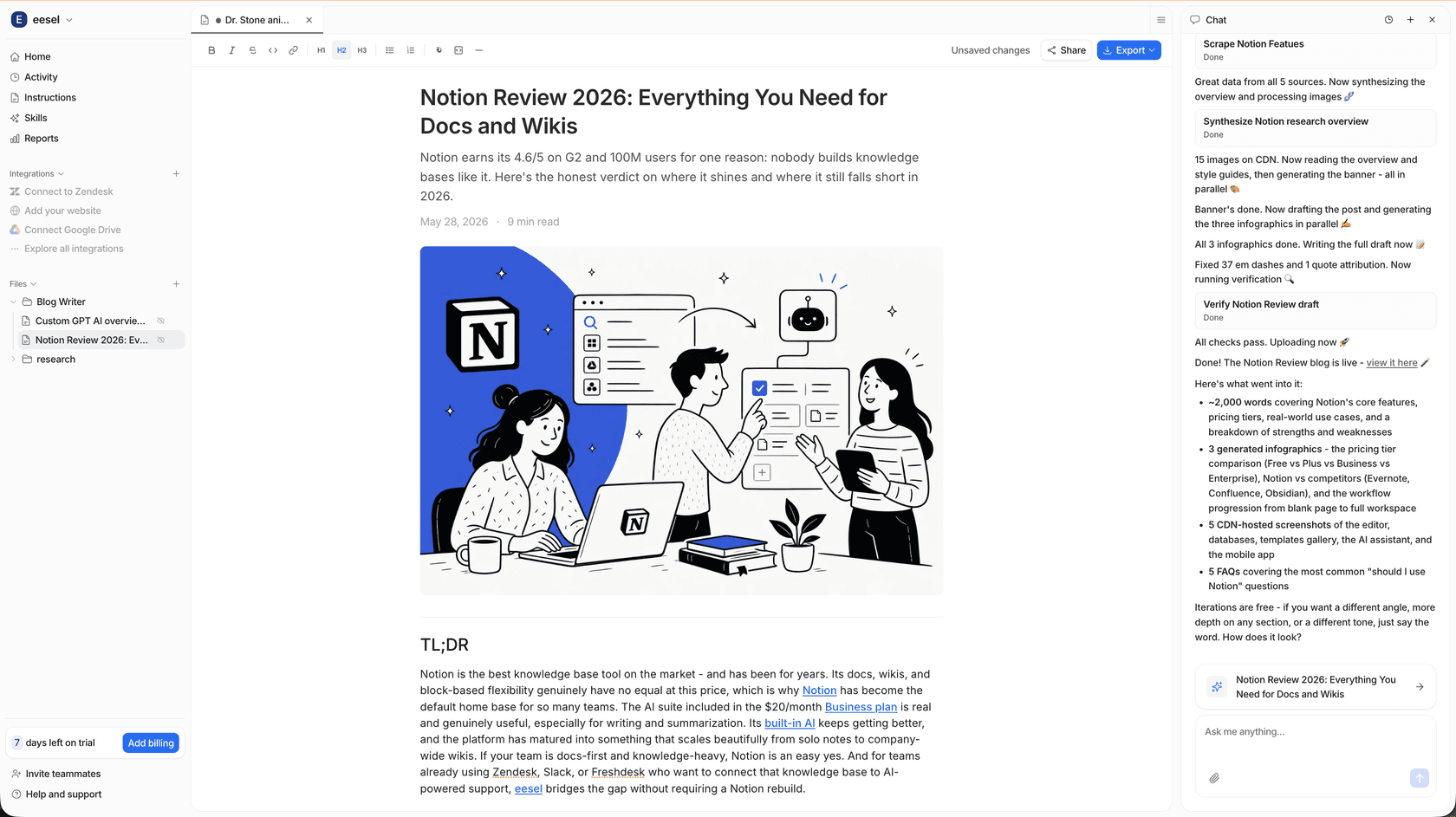
Our Experience: We used this exact tool to grow our own blog from 700 to 750,000 impressions in just three months. For an author, this can be very effective. You can write articles analyzing characters, exploring genre tropes, or sharing your writing process, all things that bring in traffic from Google. One of its features is automatically finding and embedding relevant Reddit quotes, which adds a layer of real-world conversation to your posts.
Pros:
- It creates content that's ready to publish, with headings, images, and tables included, not just a rough draft.
- The tone is genuinely human-like, so your blog will sound like you, not a machine.
- It automatically includes assets, so you can easily create tables to visualize character family trees or world-building timelines.
Cons:
- It's a specialized tool for blog content and marketing, not for generating long-form fiction. It's meant to be used alongside your novel drafter, not as a replacement.
Pricing:
- You can try it completely free to see the quality for yourself.
- The Early Bird plan is $99 for 50 blog posts per month.
2. Sudowrite
Our Experience: Sudowrite is effective for creative tasks. The "Describe" feature is perfect for adding rich, sensory details to a scene, and the "Story Bible" is very helpful for keeping your characters, locations, and plot points consistent throughout a long manuscript. A big plus for many authors is that it's uncensored, letting you explore mature themes without hitting a wall.
Pros:
- The quality of the prose is highly regarded for fiction.
- The Story Bible feature is fantastic for maintaining consistency in complex novels.
- Its brainstorming tools are perfect for breaking through writer's block.
Cons:
- It’s one of the more expensive options available.
- There's a bit of a learning curve to master all its features, and it can sometimes produce overly flowery language if you don't guide it carefully.
Story bible didn’t have enough room to put all the locations, characters, lore. But it also pulled too much from it, causing the prose to generate too far ahead of my beats. I got it to work by cutting and pasting information in and out for every scene change. That turned out to be too much of a hassle.
 Reddit
Pricing: Sudowrite uses a monthly credit system.
- Hobby & Student: $10/month for 225,000 credits.
- Professional: $22/month for 450,000 credits.
- Max: $44/month for 2,000,000 credits.
3. Novelcrafter
Our Experience: The standout feature is the Codex. It's basically an intelligent wiki for your story where you store everything about your characters, lore, and locations. The AI uses this Codex for context, which helps maintain consistency. Even better, its "bring your own key" (BYOK) model lets you connect to over 300+ different AI models via OpenRouter or even run models locally on your own computer.
Pros:
- Extremely flexible, giving you control over which AI models you use.
- The Codex is a very powerful tool for world-building and keeping your lore straight.
The Codex feature lets you set up your own world specific RAG network and enables near perfect detail consistency. If, and it's a big IF, you're willing to personally make codex entries for everything about your world...then yes, you will have characters consistent across however much length you desire and even across books. I've got two characters who have maintained narrative consistency across 190,000 words, death, and reincarnation into different bodies.
Reddit - It has collaboration features, which are great if you write with a partner or work closely with an editor.
Cons:
- All that flexibility brings some complexity, which might be overwhelming for beginners.
- The pricing can be unpredictable, as you pay a subscription fee plus the usage costs for any third-party AI models you use.
Pricing: Novelcrafter offers a 21-day free trial.
- Scribe: ~$5/month (AI features not included).
- Hobbyist: ~$10/month (enables BYOK AI integration).
- Artisan: ~$18/month (adds chat features).
- Note: AI usage costs from third-party providers are additional.
4. Squibler
Our Experience: The drag-and-drop corkboard is a standout. It lets you lay out all your scenes and chapters as virtual index cards, making it easy to see your story's structure and rearrange things whenever you want. It also comes with a bunch of handy templates for different genres and even screenplays, giving you a solid starting point.
Pros:
- The visual project management is excellent for plotting complex stories.
- The interface is clean, simple, and easy to get the hang of.
- It supports exporting your manuscript to all the important formats like PDF, Kindle, and Word.
Cons:
- The AI-assisted writing is good, but it’s not as specialized for creative prose as a tool like Sudowrite.
- Some users on its community feedback board have noted occasional bugs, which is a consideration for long-term projects.
Pricing: Squibler offers a free plan to get you started.
- Free Plan: Limited to 1 project and 6,000 AI words per month.
- Pro Plan: $16/month (billed annually) for unlimited projects and AI usage.
5. NovelistAI
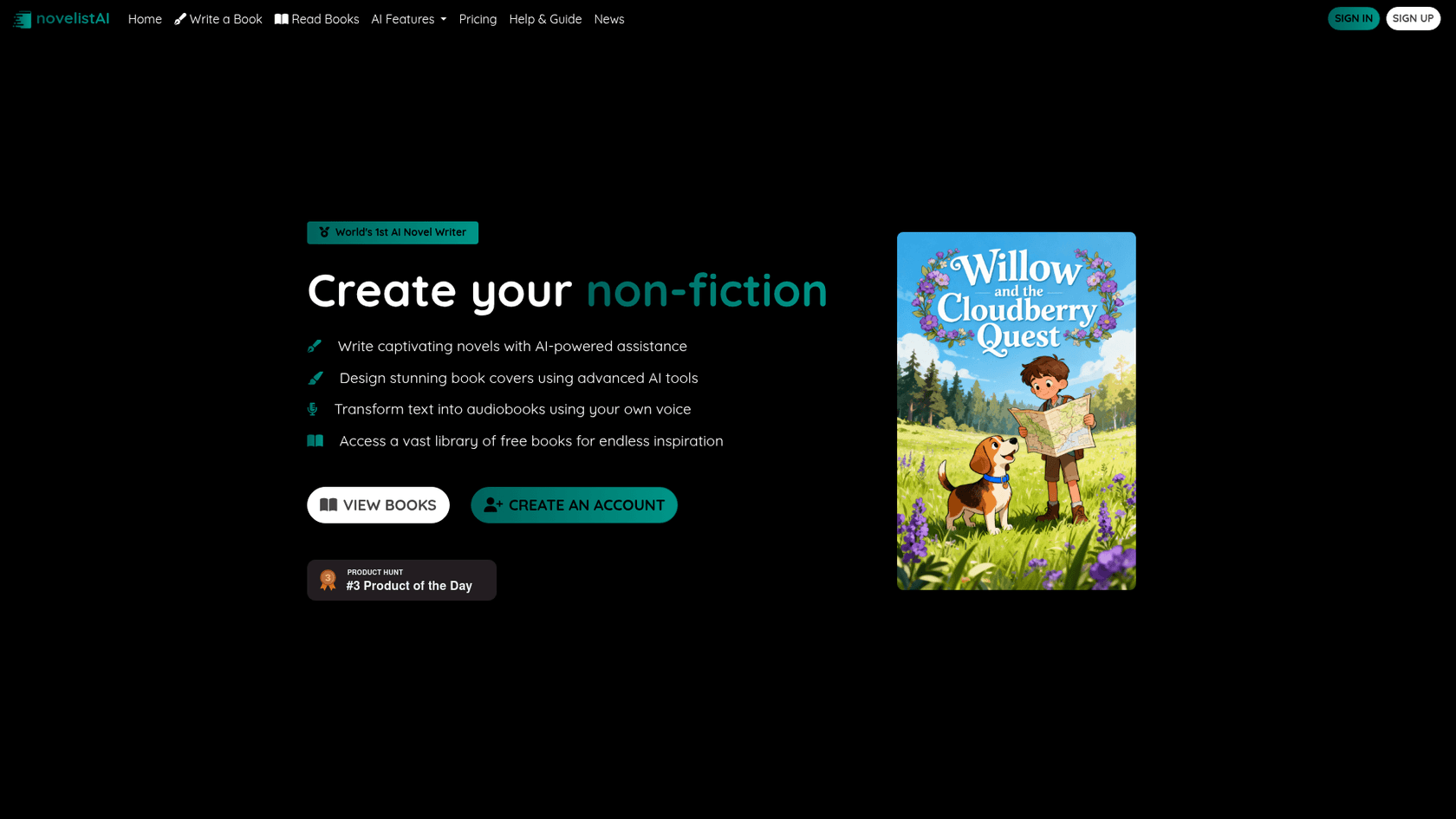
Our Experience: This platform is designed to handle multiple tasks. You can use it to write novels, scripts, poetry, and even interactive gamebooks. The built-in AI cover image generator is a useful feature for quickly mocking up cover concepts without needing a separate design app. Its text-to-audiobook generator is a unique feature that offers a lot of value for self-published authors on a budget.
Pros:
- It’s a multi-talented platform that handles writing, visuals, and audio in one place.
- It supports a huge variety of formats and over 88 languages.
- The free tier gives you a good way to test out its main features.
Cons:
- Because it does so many things, the depth of each individual feature might not match a more specialized tool.
- The credit-based pricing can be harder to track than a simple word-count limit. The free plan is very limited, with no ability to export or edit generated text.
Pricing: NovelistAI uses a credit-based system.
- Free Plan: 10 credits/month.
- Premium Plan: $12/month for 500 credits.
- Pro Plan: $48/month for 2,000 credits.
- On-demand credit packages are also available.
Key features to look for in AI novel writing software
- For World-Builders: If you're creating sprawling fantasy or sci-fi worlds, you need a tool that can keep it all straight. Look for features like Novelcrafter's Codex or Sudowrite's Story Bible. They act as your single source of truth for all your lore.
- For Plotters vs. Pantsers: If you love to outline every detail, a visual tool like Squibler's corkboard is a perfect fit. If you're a "pantser" who discovers the story as you go, the brainstorming and prose generation features in Sudowrite will be your best friend.
- For Marketers: An author's job isn’t finished when you type "The End." Marketing is key to helping a story find its audience, and that’s where a tool for this purpose becomes relevant. A tool like the eesel AI blog writer is designed for creating the website content that helps readers find your novel through Google searches.
Choosing the right AI novel writing software for your story
In the end, the "best" AI novel writing software is the one that fits your unique needs. There's no single platform that does everything perfectly for everyone.
To recap, Sudowrite is a go-to for top-tier prose quality, Novelcrafter offers unmatched control for power users, Squibler is fantastic for visual plotting, and NovelistAI is a great all-in-one suite.
For a more detailed look at the current landscape of AI writing tools, check out this video breakdown of the top options available for fiction authors.
While the tools above focus on drafting, building an author platform to connect with readers is also a key part of the process. This is where a tool like the eesel AI blog writer can be useful. It is designed to help create marketing content, such as blog posts, that can attract an audience to your work.
If you're looking to build an online presence for your novel, you can try the eesel AI blog writer for free to generate marketing content.