The conversation around AI in customer support can give you whiplash. One minute, you're hearing about instant resolutions and teams freed from repetitive tickets. The next, you're hearing horror stories about customers stuck in chatbot loops and managers defending pricey tools that no one actually likes.
This guide cuts through that noise. We're not talking about some far-off future. We're getting down to brass tacks on what modern AI first-line support looks like, why it so often misses the mark, and how you can deploy an AI teammate that actually helps your team instead of becoming another headache.
What is AI first-line support?
Put simply, AI first-line support uses artificial intelligence to field the first wave of customer or employee questions without a human having to jump in immediately.
This isn't about those clunky, old-school chatbots that only understood you if you typed the perfect keyword. Today's AI is powered by Natural Language Processing (NLP), which means it can grasp a user's intent, context, and even tone. It figures out what someone needs even if they have a typo or phrase their question in a unique way.
For this to work, a few key pieces need to be in place:
- Knowledge sources: This is the AI's brain. It learns from all the information you already have, like your help center, internal docs, and most importantly, your team's history of past support conversations.
- Automation engine: These are the hands. The AI can do more than just provide answers; it can perform actions like tagging tickets, routing issues to the right department, or closing a ticket once it's solved.
- Integration layer: This is the nervous system. A good AI should plug right into the tools your team already uses, like Zendesk, Freshdesk, or Slack, without forcing everyone to change how they work.
Here's the shift in thinking: you don't configure an AI first-line support system. You hire it like a new team member. Like any teammate, it learns your business, starts with guidance, and levels up to work autonomously. The difference is that what takes a human weeks to learn, a well-designed AI learns in minutes from your existing data.

Common use cases for AI first-line support
So what can a good AI teammate actually do for you? It's more than just a chatbot on your homepage. Here are the most practical applications.
Autonomous ticket resolution
This is what most people think of first: letting the AI handle high-volume, repetitive Tier 1 questions from start to finish. We're talking about things like "Where is my order?", "How do I reset my password?", or requests for software access.
For this to really work, the AI needs to do more than just quote from your help docs. It needs to connect to other systems to get live data. An AI that can perform custom actions, like looking up an order status from Shopify, is way more powerful than one that's just reading from a static page.
Our AI Agent is built for exactly this. It resolves tickets end-to-end, handling follow-ups and closing resolved conversations without human intervention.
Intelligent ticket triage
Even when a ticket needs a human, AI can speed things up. Instead of an agent manually reading and routing every single ticket, an AI can automatically tag, categorize, and assign it to the right team based on what the ticket says. This gets the issue to the right person much faster.
Our AI Triage product handles this automatically, keeping your queues clean without all the manual work. It tags tickets by topic, sentiment, urgency, and intent, not just keyword matching.
Agent assistance and copilot support
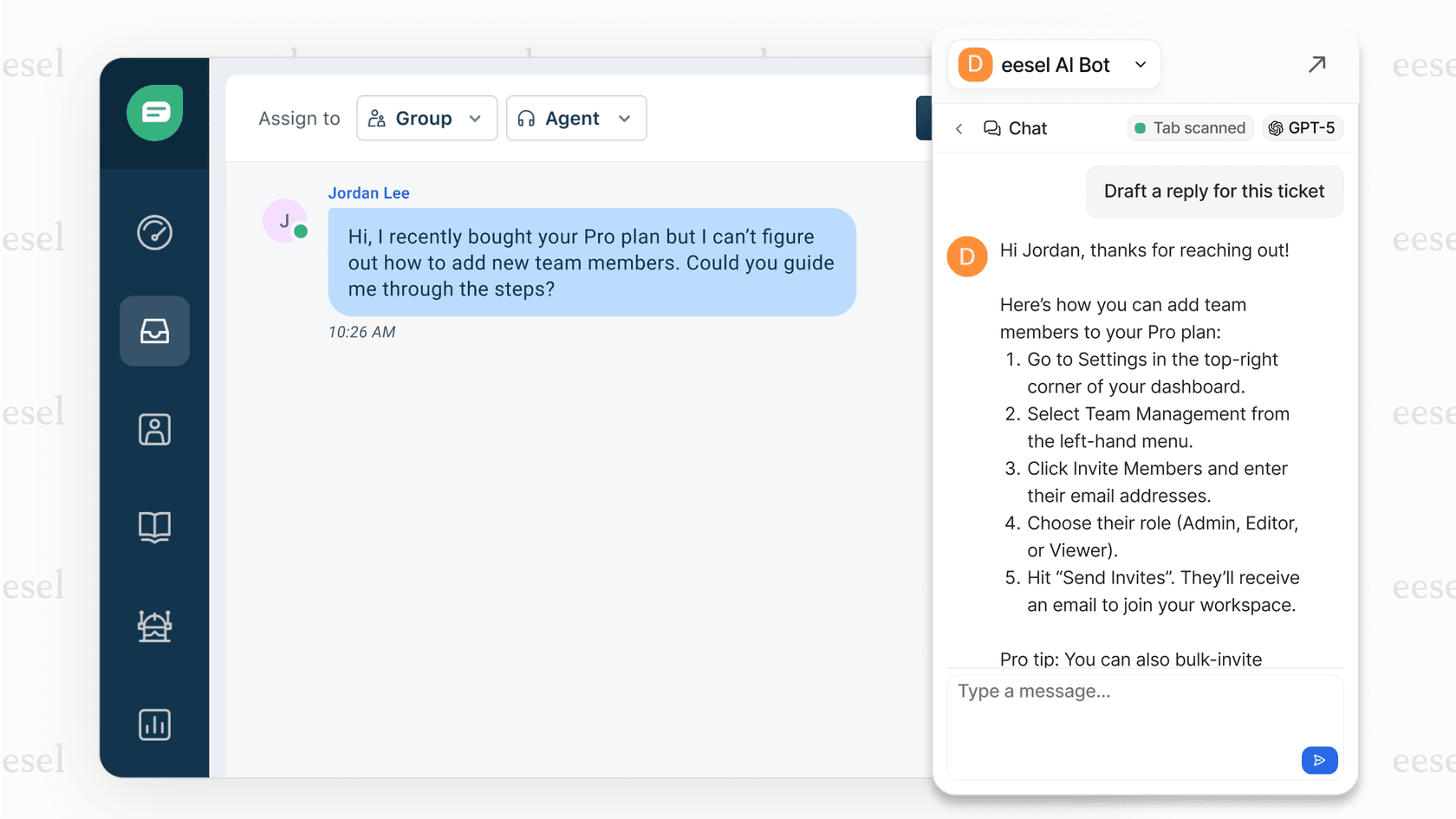
AI doesn't have to be a replacement; it can be a teammate. An AI copilot can work inside your helpdesk to draft replies for agents in your company's voice, suggest relevant help articles, and summarize long, complicated ticket histories. This helps new agents get up to speed quickly and takes some of the mental load off your whole team.
With our AI Copilot, agents open a ticket and see a ready-to-send draft. They approve, edit, or regenerate, then send. The drafts get better over time as the AI learns from agent edits.
Internal support and knowledge management
It's not just customers who need fast answers. Your own team does too. You can set up an AI assistant in Slack or Microsoft Teams that's trained on all your internal documentation. This gives your agents one place to find what they need to solve customer issues faster and more consistently.
Our AI Internal Chat answers employee questions from your company knowledge with citations to source documents. Update it by simply messaging: "We changed pricing to X" or "Here's the new policy."
Where most AI first-line support implementations go wrong
If AI first-line support is so great, why is there so much skepticism? Because a lot of people have been burned by AI tools that promised the world and delivered a headache. These are the most common ways it all falls apart.
Generic, out-of-context answers. You've seen this before. A customer has a specific, detailed issue, and the bot replies with a generic troubleshooting list it copied from a public FAQ. This is what happens when an AI doesn't have deep, company-specific knowledge. It's not just unhelpful; it's frustrating.
The rip-and-replace nightmare. Many AI vendors, especially the ones baked into big platforms, come with a huge string attached. To use their AI, you have to move your entire helpdesk over and upend the workflows your team has spent years getting right. It's a massive project that tanks productivity and morale.
The black box implementation. Some tools are just a switch you flip. One day it's off, the next it's on, and you have no real control over what it's doing. You can't test it safely, you can't choose which types of tickets it handles, and you can't roll it out gradually. The support manager is just left crossing their fingers, which is not a strategy.
Unpredictable, punishing costs. This is a big one. Many tools charge you for every resolution. It sounds fair at first, but it means your bill goes through the roof during your busiest seasons. You're basically getting penalized for successfully deflecting more tickets, making it impossible to budget.
How to choose the right AI first-line support platform
When you start looking at different vendors, it's easy to get lost in feature lists and marketing buzzwords. Here's a simple checklist of questions to ask to find a tool that will actually work for you.
Integration and setup
Ask this: Can I set this up myself in under an hour, or am I looking at a multi-month project that needs a developer?
Look for: One-click integrations with your existing helpdesk (Zendesk, Freshdesk, Intercom, etc.) and knowledge sources. A self-serve platform is usually a good sign that it's designed to be easy to use.
We designed eesel AI to integrate directly with your current helpdesk. No migration required. You can go live in minutes, fitting right into the workflows your team already has down pat.
Control and customization
Ask this: Can I control exactly which questions get automated? Can I define the AI's personality and the specific actions it can take?
Look for: The ability to define behavior in plain English without needing to write code or build rigid workflows. You should be able to start by automating just one simple topic and gradually expand as you get more comfortable.
With eesel AI, you define escalation rules in plain English: "If the refund request is over 30 days, politely decline and offer store credit." No code. No decision trees.
Knowledge and training
Ask this: How does the AI learn? Do I have to manually write out thousands of Q&A pairs, or can it learn from the data I already have?
Look for: The ability to automatically train on your historical tickets, help center articles, and internal wikis. This is the fastest way to get an AI that actually understands your business.
We learn from your past tickets, macros, help center, and connected docs from places like Confluence or Google Docs. No manual training. No documentation uploads. No configuration wizards.
Validation and reporting
Ask this: How can I be sure this will work before I turn it on for my customers?
Look for: A solid simulation mode. This is non-negotiable. A good platform will let you test the AI on your real historical data and give you clear reports on what its resolution rate would have been and where you might have knowledge gaps.
We let you run simulations on thousands of past tickets before going live. See exactly how the AI would respond. Measure resolution rates. Identify gaps. Tune prompts. Gain confidence before touching real customers.
Pricing model
Ask this: Is the pricing straightforward and predictable, or am I going to get a nasty surprise after a busy month?
Look for: Flat-fee, subscription-based pricing. Steer clear of per-resolution models that create unpredictable bills and penalize you for growth.
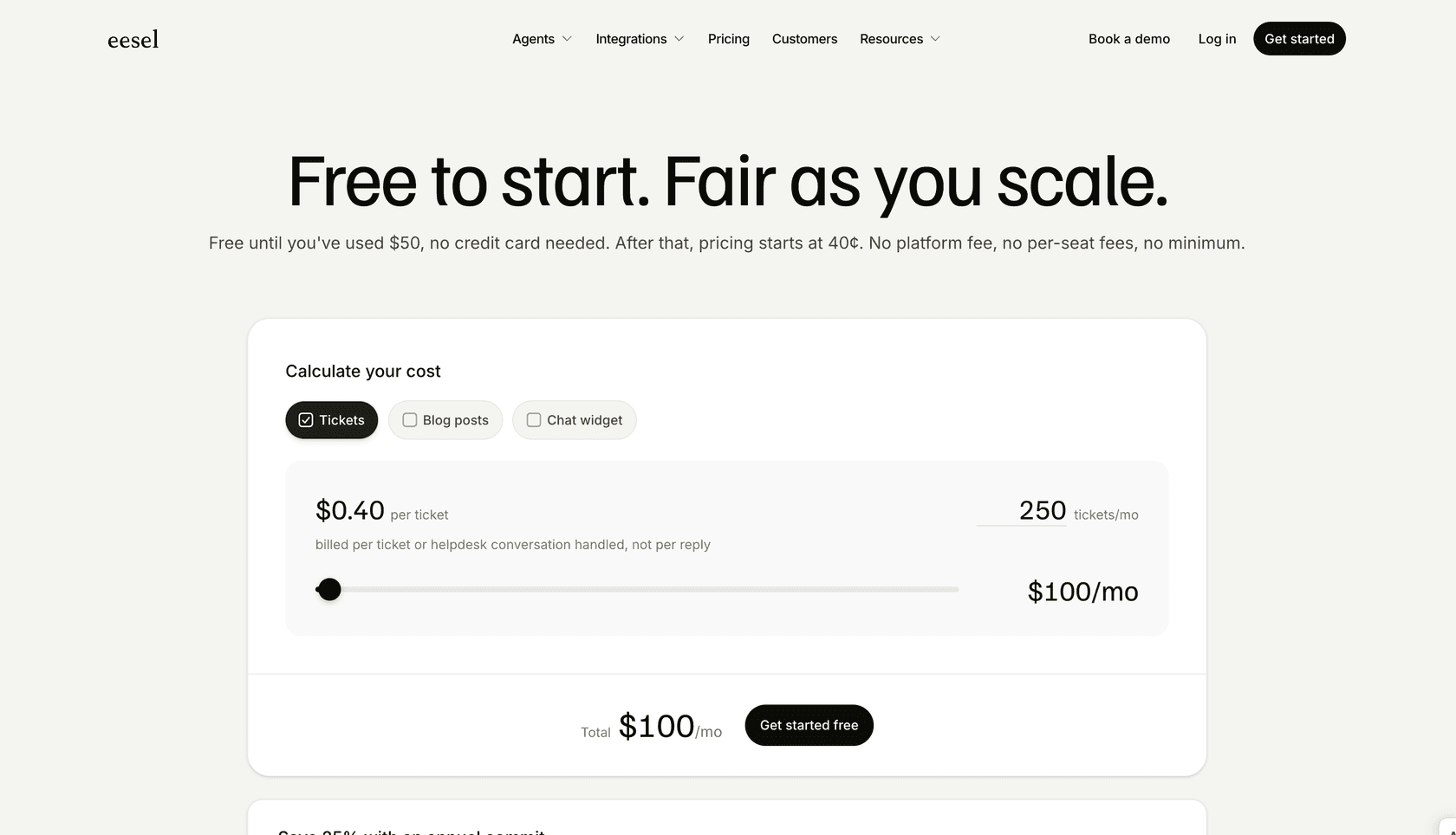
Our pricing is designed to be simple and predictable. The Team tier starts at $299 per month, and Business at $799 per month. You pay for interactions, not resolutions, so your costs stay the same no matter how many tickets you deflect.
| Plan | Monthly Price | Annual Price | Bots | Interactions/mo | Key Features |
|---|---|---|---|---|---|
| Team | $299 | $239/mo | Up to 3 | 1,000 | Train on website/docs, Copilot, Slack, reports |
| Business | $799 | $639/mo | Unlimited | 3,000 | + Past tickets, MS Teams, AI Actions, bulk simulation |
| Custom | Contact us | Custom | Unlimited | Unlimited | + Multi-agent orchestration, custom integrations |
Your 30-60-90 day implementation plan
A practical rollout plan starts with measurable outcomes, then expands autonomy as trust grows. Here's how to do it right.
Days 1–30: Onboard with guidance
Start by connecting your AI teammate to your help desk and knowledge sources. Run simulations on historical tickets to verify quality before going live. Begin with the AI drafting replies that agents review before sending. This lets you verify the AI understands your business before expanding its role.
Baseline your KPIs by intent: average handle time, first contact resolution, customer satisfaction, and reopen rates. This gives you a benchmark to measure improvement against.
Days 31–60: Expand to low-risk automation
Deploy AI triage for automatic categorization and routing with clear override rules. Launch customer self-service for FAQs and how-to flows with citation-backed answers. Instrument containment quality so you're measuring CSAT for contained conversations, not just deflection rates.
Days 61–90: Level up to autonomous resolution
Pick 2-3 high-volume intents with clear policies (refunds, password resets, subscription updates). Connect the systems required to complete the process. Define guardrails, approvals, and escalation rules in plain English. Measure resolution rate and exception reasons weekly.
Mature deployments with eesel AI achieve up to 81% autonomous resolution. The typical payback period is under 2 months.
Getting started with AI first-line support
Putting AI first-line support in place isn't some futuristic dream anymore, but it does require you to be smart about it. Success isn't about chasing the flashiest tech; it's about finding a practical, controllable tool that understands your business and works with your team, not against them.
By focusing on deep integration, risk-free testing, and clear pricing, you can skip the common headaches and build a support system that's both efficient and human-friendly.
Ready to hire your first AI teammate? See eesel AI in action and go from setup to your first autonomous resolution in minutes. You can also explore our AI Agent, AI Copilot, and AI Triage products to see which fits your needs.

Frequently Asked Questions
Share this article

Article by
Stevia Putri
Stevia Putri is a marketing generalist at eesel AI, where she helps turn powerful AI tools into stories that resonate. She’s driven by curiosity, clarity, and the human side of technology.