The practical guide to using an AI blog writer with SEO

Amogh Sarda
Last edited January 15, 2026
If you're a content marketer, you know the drill. The pressure to pump out high-quality, SEO-friendly content is relentless, and it's usually the biggest thing holding back growth. You’ve got the strategy, but actually researching, writing, and optimizing every single post takes forever.
The good news is that AI blog writers aren't the clunky text generators they used to be. Today, they're smart platforms that can create complete, publish-ready articles designed to rank. This isn't about firing your writers. It's about turning them into editors who can oversee a much bigger content machine.
This guide will break down what a modern AI blog writer with SEO can do, what features actually matter, and how it can help you grow organic traffic. We know this works because we did it ourselves at eesel AI. We used our own tool to scale our content, taking our site from 700 to over 750,000 daily impressions in just three months.
What is an AI blog writer with SEO?
An AI blog writer with SEO does more than just spit out words. It's a system built to understand a keyword, see what the competition is doing, and then generate a complete, structured article that's optimized to rank.
How an AI blog writer goes beyond a simple text generator
Using a general AI tool like ChatGPT for a blog post can be a starting point, but the output often requires significant work. The text can be generic, lack detail, and need substantial editing, research, structuring, and optimization before it's ready to publish. This comparison illustrates the difference in workflow and output.
A dedicated AI blog writer does all of that for you. It gets you from a blank page to a finished draft in minutes. Your job shifts from being a writer to being an editor. You get to spend your time adding your unique perspective instead of messing with the basics.
Right know 'AI' text ranks. It won't in the next year unless you do significant editing, and I mean nearly rewrite the entire thing. This is because MSFT and GOOG are going to topical authority sites with unique semantic linking profiles. If you drop 100 A.I articles on a site then chances are the site won't rank.

How an AI blog writer combines content creation and SEO
The main difference is that SEO is built-in, not an afterthought. These tools don't just write about a topic; they're built to create content that performs. This means the AI figures out what people actually want when they search for a keyword (search intent). Is it a guide, a comparison, a definition? It then looks at the top-ranking articles to see what headings and topics you need to cover. All the keywords and formatting are included from the start.
The point isn't just to get words on a page. It's to create a blog post that can actually rank and bring in traffic right away.
Key features of an AI blog writer for AEO success
When choosing an AI writer for content that performs, certain features are more impactful than others. While a user-friendly interface is important, the key is generating articles that are optimized to rank. Here are the features that make a real difference in getting your content seen by people and search engines.
Intelligent keyword optimization
A core job of an AI blog writer is to handle keywords smartly. The tool should automatically put your main keyword in the title, key headings, and throughout the article in a natural way. It should also find and include related secondary keywords. This helps build your authority on a topic and shows search engines that your content is a solid resource.
Automated structure and formatting
Readability is a big deal for ranking, but it's easy to forget. If someone clicks your article and sees a giant wall of text, they're gone. A good AI blog writer will create a logical structure with an intro, H2 and H3 subheadings, and a clear conclusion. It should also handle things like bullet points, lists, and bold text to break up the content and make it scannable.
Automatic asset generation
In 2026, text alone won't cut it. Visuals are key for explaining things and keeping readers hooked. The best tools get this and automatically create relevant assets like custom images, data tables, or simple infographics to go with the text. This saves you from having to find or make visuals yourself and makes the final article much stronger.
Authentic social proof integration
Modern SEO is all about E-E-A-T (Experience, Expertise, Authoritativeness, Trustworthiness). A good AI writer can help with this by pulling in outside proof. That could mean embedding a relevant YouTube video for another viewpoint or finding real quotes from Reddit. This adds a layer of authenticity that generic AI-generated text just can't replicate.
My two cents is yes. I use Active Inspiration (A.I.) software to 'break me out' of the blank page freeze. The issue is when the content is 70% AI or more. AI should really be used as an Assistive Interface for writing great content, not producing mechanical bastardized word slop by running and rerunning paragraphs through GPT-3.
AEO optimization
Search is changing. Answer Engine Optimization (AEO) is about structuring your content so AI search assistants like Google AI Overviews and Perplexity can easily use and cite it. Gartner predicts that search engine volume will drop 25% by 2026 because of this shift, so AEO is no longer a "nice-to-have." An AI blog writer built for today's SEO will use clear headings, give direct answers to common questions, and use structured data to make its content a top pick for AI-powered responses.
The eesel AI blog writer: A complete content generation platform
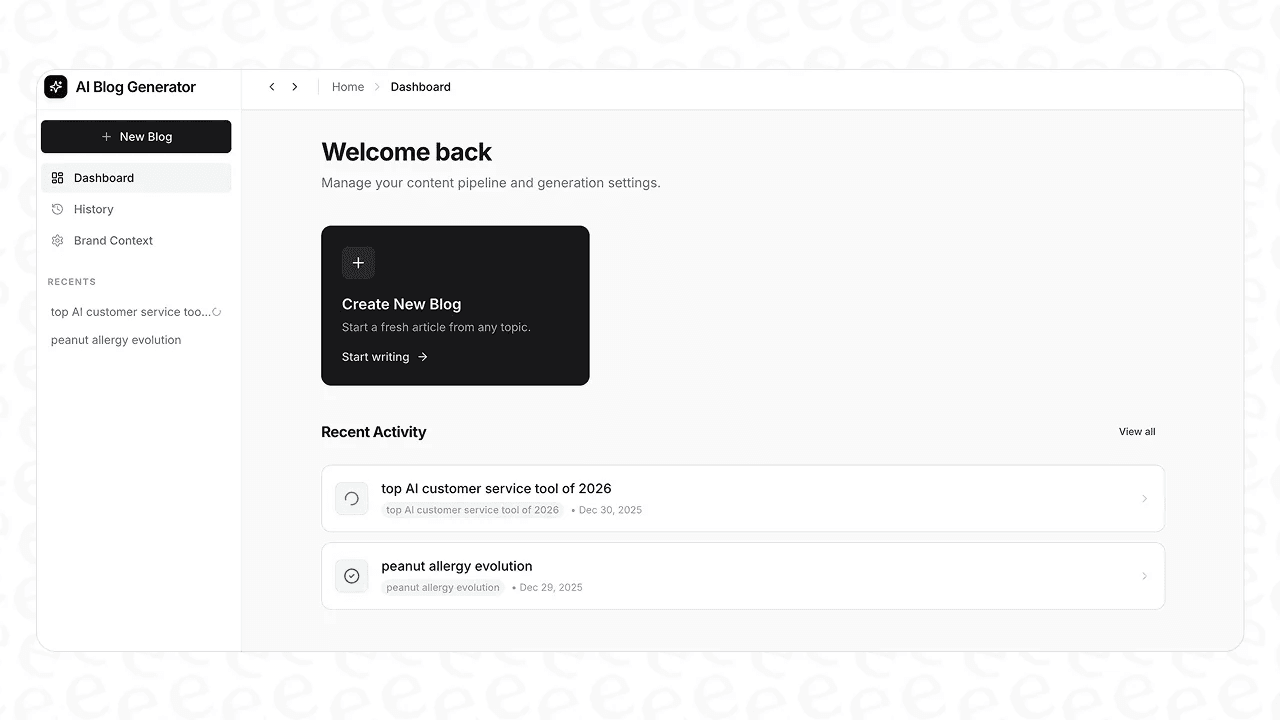
Now that we’ve covered what separates a simple text generator from a real SEO content platform, let’s look at a tool that does it all. The eesel AI blog writer is built to generate complete, traffic-driving blog posts from just a single keyword.
A streamlined workflow for better results
Instead of a complicated process that forces you to become a prompt engineer, we've made the whole thing simple. You can generate a publish-ready blog post in minutes with three easy steps:
- Enter your target keyword or topic. Tell the AI what you want to rank for.
- Add your website URL. This gives the AI context about your brand so it can add natural, subtle product mentions.
- Generate a complete blog post. In minutes, you get a fully researched, structured, and optimized article with all the assets included.
A complete content package
When you generate an article with the eesel AI blog writer, you’re not just getting a text file. You’re getting a full content package that’s ready to publish and built to perform.
| Element | Details |
|---|---|
| Structure | Complete blog with an introduction, headings, conclusion, and meta data. |
| Research | Deep, context-aware research that addresses search intent, not shallow AI filler. |
| SEO Optimization | Target keywords placed naturally in headings and body content. |
| AEO Optimization | Structured for AI answer engines like Google AI Overviews and Perplexity. |
| Assets | AI-generated images, infographics, charts, and tables included automatically. |
| Media Embeds | Relevant YouTube videos and real, insightful Reddit quotes integrated into the post. |
| Linking | Automatic internal links to your existing content and external citations to credible sources. |
| Brand Integration | Subtle, natural mentions of your product or service based on your website's context. |
Key differentiators of the eesel AI blog writer
The eesel AI blog writer is designed to address common challenges in the content creation workflow. Here are some of its key differentiators:
- Context-aware research: Unlike generic tools, our AI changes its research method based on the type of post you need. It knows to look for pricing and features for comparison posts, or tech specs and use cases for product reviews.
- Genuinely human tone: We've spent over a year tuning our models to create content that is engaging, clear, and readable. It avoids the robotic, repetitive phrasing that you see in so much AI content.
- Complete assets included: This is a big one. We provide a finished product with visuals, tables, and media embeds, which reduces the time needed for manual formatting and asset sourcing.
How an AI blog writer boosts organic traffic
Using the right tool isn't just about saving time. It's about building a scalable strategy to consistently grow your organic traffic. A platform like the eesel AI blog writer helps you do this by tackling the core drivers of SEO success.
Scale content production
The biggest lever you can pull for SEO growth is publishing high-quality content consistently. A specialized AI writer removes the main bottleneck, writing time, so you can go from a few articles a month to dozens. This lets you target more keywords, build authority faster, and get more traffic. It’s exactly how we were able to publish over 1,000 blogs and see our search impressions explode.
Match search intent
Ranking well comes down to giving searchers what they want. By analyzing top-ranking pages and understanding the intent behind a search, an AI blog writer creates content that directly answers the user's question. This leads to higher rankings, lower bounce rates, and a better user experience, all of which Google likes to see.
Increase reader engagement
Search engines reward content that keeps people on the page. Plain text articles are boring and lead to high bounce rates. By automatically including relevant images, helpful tables, YouTube videos, and real Reddit quotes, the content becomes far more interesting and authoritative. This increases the time people spend on your page, signaling to search engines that your content is a quality resource worth ranking.
Build topical authority
Publishing one great article is nice, but consistently publishing a cluster of articles on a specific topic is how you show Google you're an authority. An AI blog writer makes this possible to do at scale. Features like automatic internal linking help create a strong, interconnected web of content on your site, which helps both users and search engine crawlers understand your expertise.
For a deeper look at how different AI writers approach SEO, this video provides a helpful overview of the current landscape.
The conversation about AI in content is no longer just about "writing faster." It's about building a complete system for creating content that actually performs. A good AI blog writer with SEO isn't just a writing assistant; it's a growth engine that lets you scale a proven strategy for driving organic traffic.
The goal is to consistently create content that meets search intent, engages readers, and builds your brand's authority. The right tool makes that happen by delivering a complete, ready-to-publish asset, not just a text file that's the start of your work. It takes care of the tedious parts of content creation so you can focus on strategy.
Stop wrestling with drafts and start publishing content that ranks. Generate your first blog post for free with the eesel AI blog writer and see the difference for yourself.

Frequently Asked Questions
Share this article

Article by
Amogh Sarda
CEO of eesel AI. Amogh Sarda is obsessed with making the ultimate AI for customer service teams. He lives in Sydney, Australia and has previously worked at Atlassian and Intercom. Outside of work he’s usually surfing or on stage doing improv.