Salesforce Service Cloud vs Zendesk: Complete 2026 comparison

Stevia Putri
Last edited March 2, 2026
Choosing the right customer service platform can make or break your support operation. Two names come up again and again: Salesforce Service Cloud and Zendesk. Both are leaders in the space, but they approach customer service from very different angles.
Salesforce Service Cloud is the enterprise heavyweight, built for companies that need deep customization and already use Salesforce products. Zendesk is the nimble challenger, prioritizing ease of use and fast deployment for teams that want to get up and running quickly.
So which one fits your business? Let's break it down.
What is Salesforce Service Cloud?
Salesforce Service Cloud is the customer service arm of the Salesforce ecosystem. Founded in 1999, Salesforce has grown into a $30+ billion company serving over 150,000 customers worldwide, including Spotify, Toyota, and American Express.
Service Cloud positions itself as an enterprise-grade platform that goes beyond ticketing. It offers case management, omnichannel support, AI-powered routing, and a 360-degree customer view that pulls data from across the entire Salesforce ecosystem. The platform is designed for companies that need to connect customer service with sales, marketing, and commerce data in one unified system.
The core value proposition is integration. If you're already using Salesforce Sales Cloud or Marketing Cloud, Service Cloud plugs right in. Your agents see complete customer histories, purchase data, and previous interactions without switching between systems.
But that power comes with complexity. Service Cloud is built for organizations with dedicated IT resources, administrators, and developers who can configure the platform to match specific business processes.
What is Zendesk?
Zendesk takes a different approach. Founded in 2007 in Denmark, the company built its reputation on simplicity and fast time-to-value. With over 100,000 customers including Netflix, Dropbox, Uber, and Shopify, Zendesk has become the go-to choice for companies that want powerful customer service without the enterprise baggage.
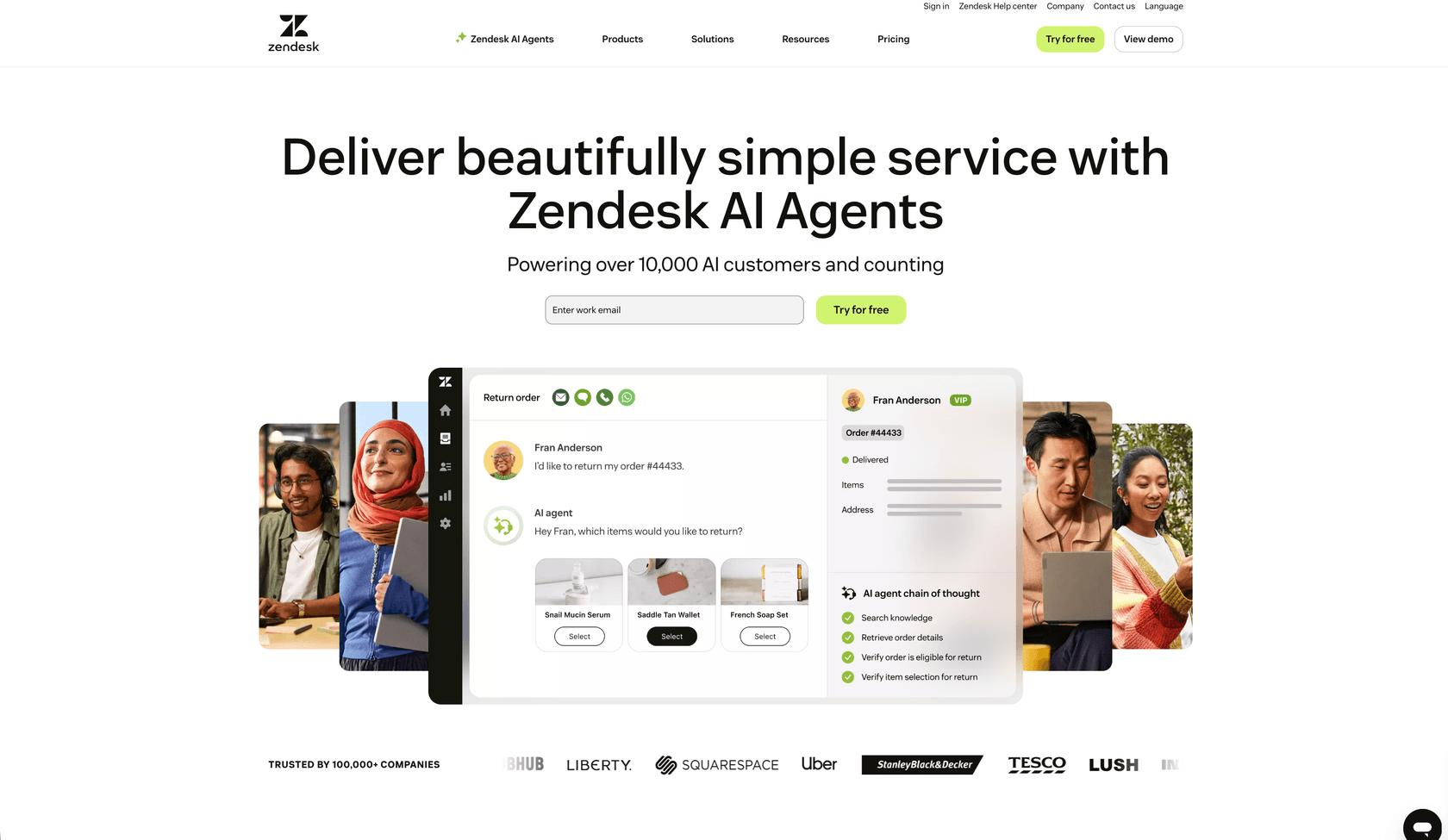
Zendesk is purpose-built for customer experience. While Salesforce spreads its focus across CRM, marketing, and commerce, Zendesk dedicates 100% of its R&D to service. The result is a platform that feels more intuitive out of the box, with features like AI agents, messaging, live chat, and knowledge management that work immediately without extensive configuration.
The platform targets SMBs to mid-market companies that need to deploy quickly and scale efficiently. Most teams can get Zendesk running in days, not months, with minimal IT involvement.
Feature comparison: Salesforce Service Cloud vs Zendesk
Ticketing and case management
Both platforms handle the basics well, but their philosophies differ.
Zendesk uses a ticket-based system that feels familiar to anyone who's used email. Tickets can be organized, tagged, and routed through intuitive workflow automation. The interface is clean, and agents can get productive with minimal training.
Salesforce uses a case-based system that's more robust but also more complex. Cases integrate deeply with CRM data, allowing for sophisticated routing based on customer value, product ownership, and interaction history. The trade-off is a steeper learning curve and more setup time.
AI and automation capabilities
This is where both platforms have invested heavily, but their approaches diverge.
Zendesk AI comes pre-trained on billions of service interactions. Features like AI agents, intelligent triage, and generative replies work out of the box with minimal configuration. The company claims its AI can resolve 80%+ of interactions autonomously. Zendesk's AI is purpose-built for customer service, which shows in how naturally it handles common support scenarios.
Salesforce Agentforce offers powerful AI capabilities through the Atlas Reasoning Engine, which can break down complex requests, plan actions, and execute tasks autonomously. The platform supports everything from service agents to sales development representatives. The catch? Getting the most out of Agentforce typically requires more setup and configuration than Zendesk's turnkey approach.
Omnichannel support
Both platforms offer email, chat, phone, and social media support, but with different defaults.
Zendesk includes native voice support at no extra cost on most plans. You get call routing, IVR, and voicemail without integrating third-party tools.
Salesforce typically requires a CTI (Computer Telephony Integration) partner like Amazon Connect or Genesys for voice functionality. While this offers more flexibility, it also adds complexity and cost.
Reporting and analytics
Salesforce wins on depth. The platform offers enterprise-grade business intelligence with customizable dashboards, predictive analytics, and deep integration with Salesforce's broader reporting ecosystem. If you need to correlate service metrics with sales pipeline or marketing campaigns, Salesforce is hard to beat.
Zendesk focuses on service-specific metrics. The dashboards are cleaner and more immediately useful for support teams, showing ticket volume, resolution times, CSAT scores, and agent performance without requiring a data analyst to interpret them.
Pricing comparison
Let's talk numbers. Both platforms use per-user pricing, but the totals can vary significantly.
| Plan | Zendesk (Annual) | Salesforce Service Cloud (Annual) |
|---|---|---|
| Entry | $19/agent/month | $25/user/month |
| Professional | $115/agent/month | $175/user/month |
| Enterprise | $169/agent/month | $350/user/month |
| Unlimited/Top Tier | Custom pricing | $550/user/month (Agentforce 1 Service) |
Sources: Zendesk Pricing, Salesforce Service Pricing
But sticker price only tells part of the story.
Zendesk claims a 42% lower total cost of ownership compared to Salesforce, with 71% lower admin costs and 53% cheaper implementations. These numbers come from their own comparison studies, but they align with what many users report: Salesforce often requires consultants, dedicated administrators, and ongoing professional services that add significantly to the bottom line.
Salesforce's pricing can also get complex with add-ons. Features like advanced AI, additional data storage, and API access may incur extra charges depending on your plan.
Ease of use and implementation
Here's where the difference becomes stark.
Zendesk typically deploys in days. The interface is intuitive enough that most agents need minimal training. You can start with email support and add channels like chat and voice as you grow. The platform is designed to be configurable by business users without coding.
Salesforce implementations typically take weeks to months. The platform is highly customizable, but that flexibility requires expertise. Most organizations need dedicated Salesforce administrators or hire implementation partners to get everything configured properly.
On G2, both platforms score well for usability, but Zendesk edges ahead in "ease of setup" and "ease of admin" categories. Salesforce scores higher for "meets requirements" and "enterprise scalability," which reflects its target market.
Sources: G2 Comparison
Integration ecosystem
Salesforce's AppExchange offers over 7,000 apps and integrations, the largest ecosystem in the CRM space. If you need to connect with enterprise tools, Salesforce likely has a pre-built integration. The native Slack integration is particularly strong since Salesforce acquired Slack in 2021.
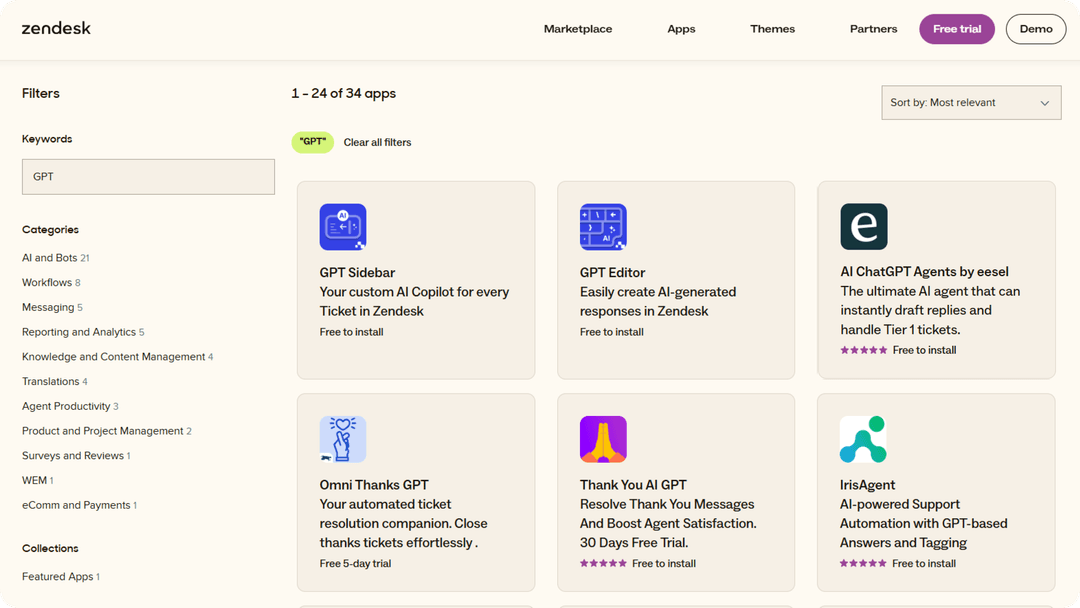
Zendesk's Marketplace offers 1,000+ apps. While smaller, it covers the essentials: CRM connectors for Salesforce and HubSpot, e-commerce integrations for Shopify and Magento, and communication tools like Slack and Zoom. For most SMB and mid-market use cases, the selection is more than adequate.
Both platforms offer robust APIs and connect with Zapier for custom workflows.
Who should choose which platform?
Choose Zendesk if:
- You need fast time-to-value with minimal IT resources
- Your priority is intuitive agent experience over deep customization
- You're a growing SMB or mid-market company
- You want purpose-built CX tools without enterprise complexity
- You need native voice support without third-party integrations
Choose Salesforce Service Cloud if:
- You're already invested in the Salesforce ecosystem (Sales Cloud, Marketing Cloud, etc.)
- You need deep customization for complex, unique workflows
- You require enterprise-grade scalability and security
- You have dedicated IT/admin resources to manage the platform
- You want to correlate service data with sales, marketing, and commerce metrics
A modern alternative: eesel AI
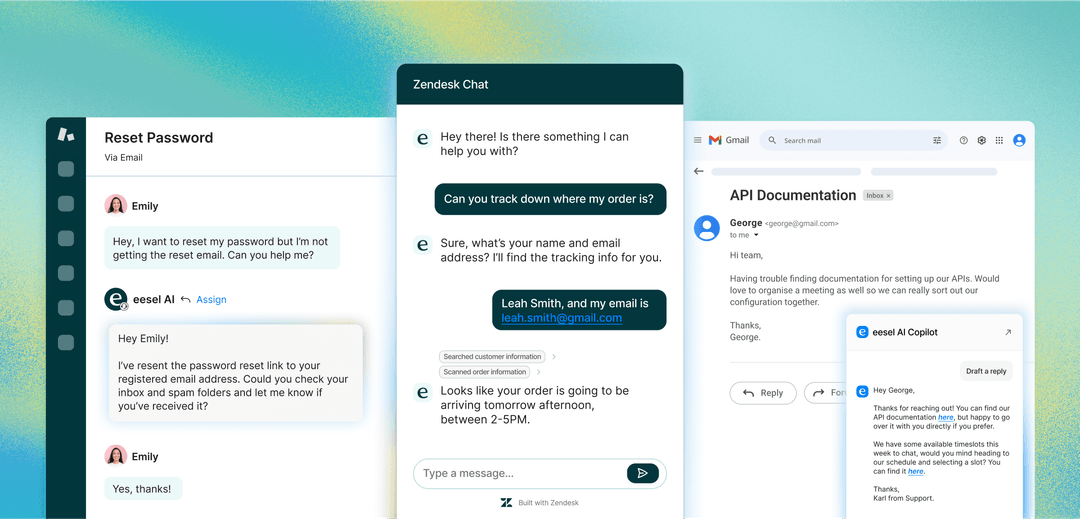
While Salesforce and Zendesk represent the established players, there's a third path worth considering. At eesel AI, we've built something that combines the best of both worlds: Zendesk-like ease of use with Salesforce-level AI capabilities.
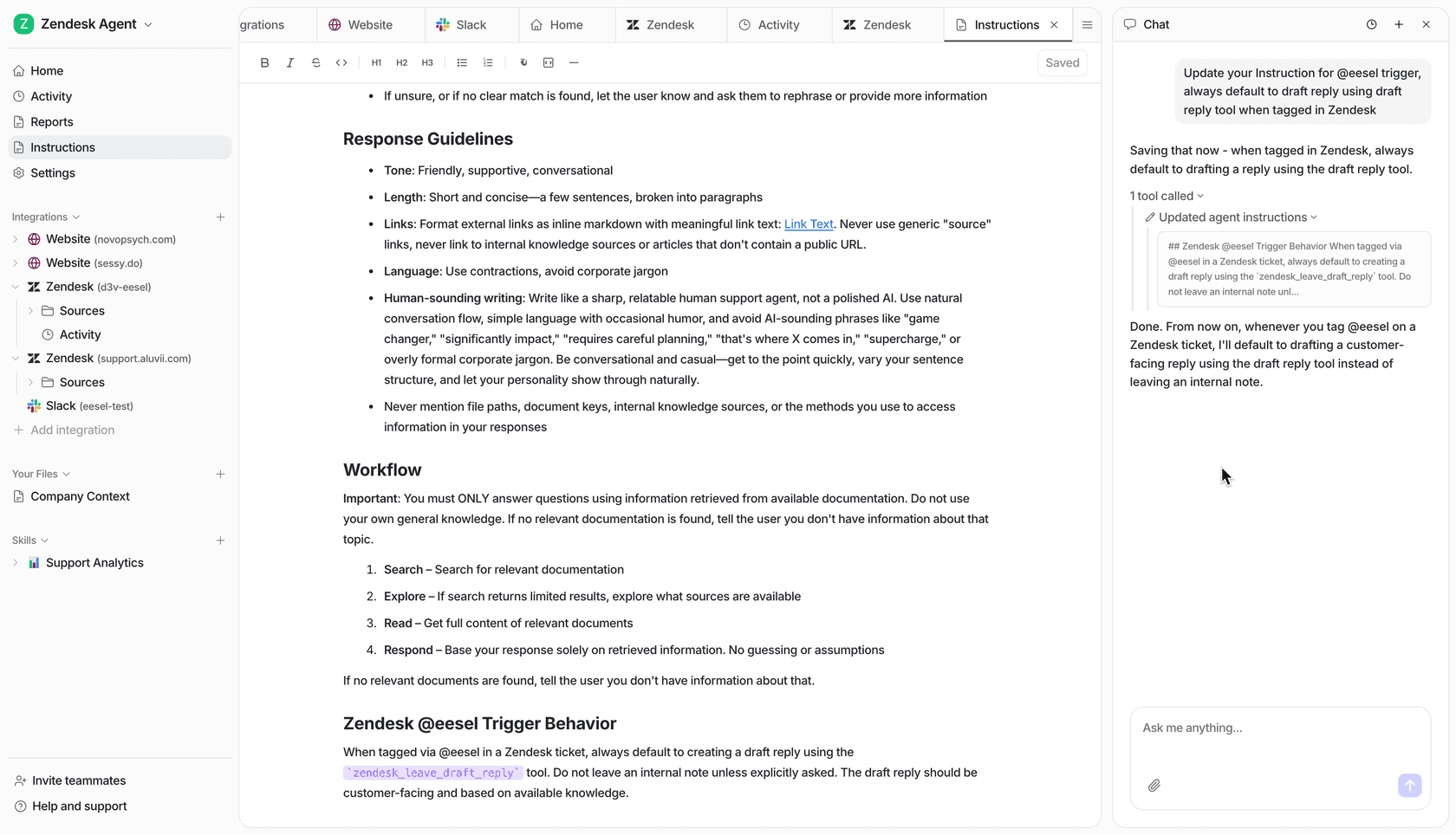
Here's what makes us different:
-
Minutes to deploy, not days or weeks. Connect to your help desk, and eesel learns from your existing tickets, macros, and help center articles immediately. No configuration wizards, no data uploads, no training required.
-
Truly autonomous resolution. Our AI agents don't just draft replies, they handle entire conversations end-to-end. They can look up orders, process refunds, and escalate only when necessary. Mature deployments achieve up to 81% autonomous resolution.
-
Plain-English control. Define escalation rules, policies, and workflows in natural language. No code, no complex decision trees. Just tell eesel what to do.
-
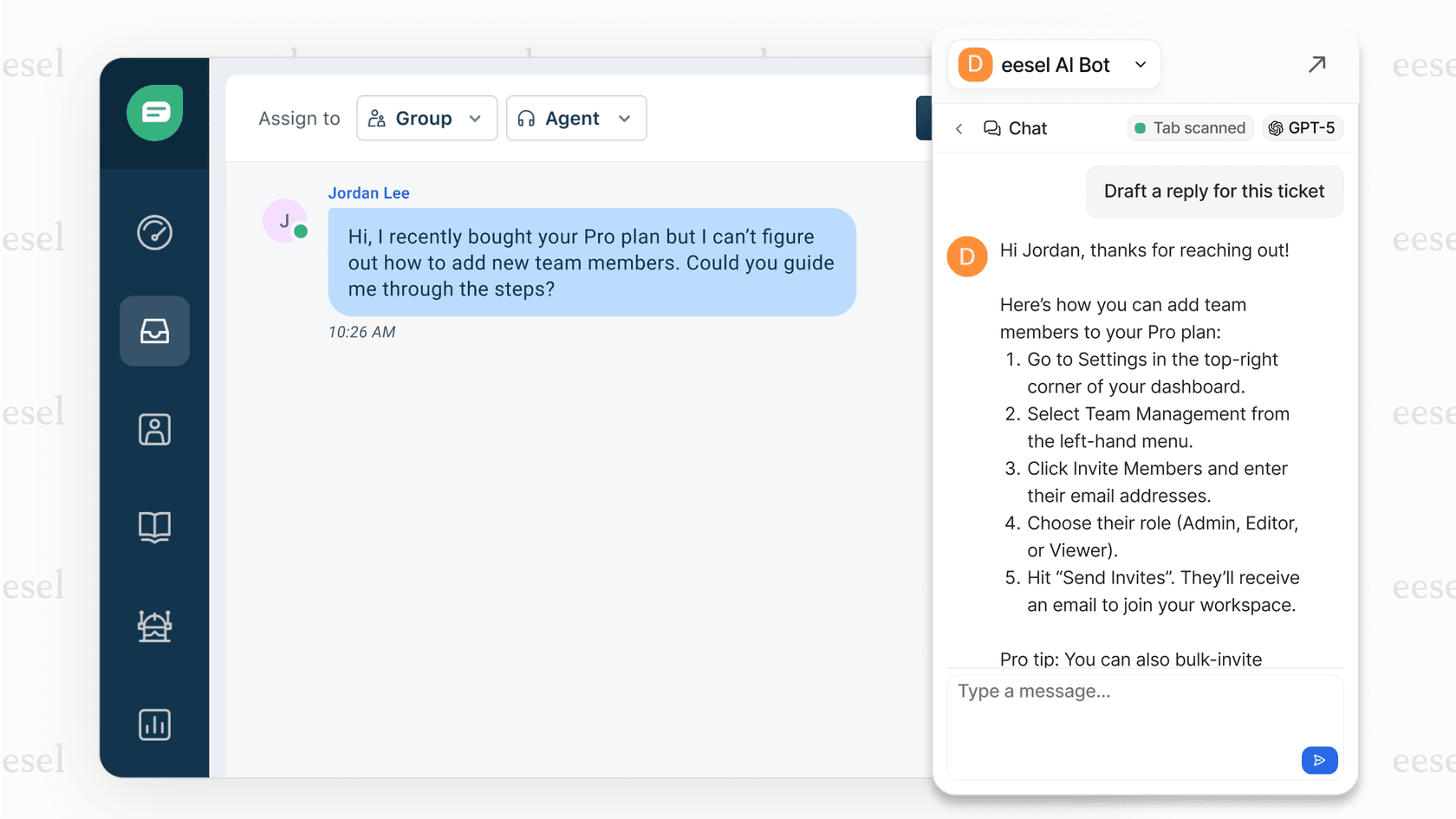
Progressive rollout. Start with eesel drafting replies for review. Once you're confident, let it send responses directly. You control the pace based on actual performance, not vendor promises.
The payback period? Typically under two months.
If you're evaluating Salesforce Service Cloud vs Zendesk, it might be worth asking whether you need a platform that requires months of implementation at all. Modern AI-native solutions can deliver comparable, or better, results in a fraction of the time.


Frequently Asked Questions
Share this article

Article by
Stevia Putri
Stevia Putri is a marketing generalist at eesel AI, where she helps turn powerful AI tools into stories that resonate. She’s driven by curiosity, clarity, and the human side of technology.