How to manage generated content at scale without sacrificing quality

Amogh Sarda
Last edited January 19, 2026
Generative AI has changed the game for content marketing. The old struggle of just creating enough content has vanished. But now we have a new, bigger problem: what do we do with all this stuff?
Marketing teams everywhere are drowning in drafts. The real work isn't hitting "generate" anymore. It's figuring out how to handle hundreds of articles while keeping quality, brand voice, and SEO in check. Anyone can produce a ton of content, but making sure it's all genuinely good is the hard part.
Understanding content at scale
"Content at scale" might sound like another marketing buzzword, but it's a simple concept. It's about having a system to create, manage, and share a lot of high-quality content that helps you reach your business goals.
So, scaling content isn't just about volume. It’s about methodically boosting your SEO, earning your audience's trust, and creating a reliable flow of organic traffic that builds up over time.
Core strategies for scaling content
To build a content engine that can scale without falling apart, you need a few key things in place. A good strategy comes down to three main areas: repeatable processes, the right technology, and smart optimization. If you nail these, you're on the right track.
Strategy 1: Establish repeatable workflows
Trying to scale content creation without a plan is a recipe for disaster. You'll end up with an inconsistent brand voice, missed deadlines, and a very tired team. A bit of structure can make all the difference.
Here’s how to build a system that actually works:
- Map everything out with a content calendar: This should be more than just a list of topics and due dates. Use a project management tool like Asana, Trello, or even a good old spreadsheet to track the entire journey of each content piece, from idea to promotion.
- Create standardized templates: Don't start from scratch every time. Develop clear templates for your usual content formats, like blog posts, case studies, or social media updates. This keeps everything looking consistent and really speeds up production.
- Develop a rock-solid brand style guide: This is your bible for consistency. A clear style guide should cover your brand’s voice, tone, formatting rules, and visual identity. It's essential for keeping content aligned, especially when working with different writers.
- Use a central place for your assets: Wasting 20 minutes looking for the right logo or an approved screenshot is a huge momentum killer. Keep all your approved images, brand docs, and other files in one easy-to-find spot, like Google Drive or a digital asset management (DAM) tool.
A workflow diagram showing four key steps for how to manage generated content at scale, including a content calendar and brand style guide.
Strategy 2: Use the right AI tools
Not all AI tools are the same, particularly when you're trying to scale quality content. Many are good at producing a first draft but leave you with the most time-consuming tasks like research, fact-checking, creating assets, and optimization.
Let's look at the main types of tools available.
Generic LLMs (e.g., ChatGPT)
- Best for: Brainstorming ideas, overcoming writer's block, or getting a quick summary of a long document. It’s a great creative sidekick.
- Limitations: As a general-purpose model, ChatGPT doesn't have inherent knowledge of your specific business, brand voice, or audience. The text it produces may feel generic and often requires significant editing to align with a particular brand. As OpenAI points out, its usefulness depends on how good your prompts are and how much time you're willing to spend fact-checking its output.
AI content platforms (e.g., Jasper AI)
- Best for: Marketing teams who need a flexible AI assistant. Jasper has useful features for maintaining a brand voice and running various marketing campaigns. It's a decent tool for generating copy that aligns with your brand.
- Limitations: Jasper's primary function is text generation. This means users often handle other aspects of content creation, such as manually finding and adding multimedia assets like images, charts, and videos. It provides a strong text draft that can be built upon.
A screenshot of the Jasper AI homepage, an AI platform that can help with how to manage generated content at scale. - Pricing: Jasper’s Pro plan starts at $59 per month for each user when billed annually.
Full-stack AI content generators (e.g., eesel AI blog writer)
- Best for: This type of tool is designed for teams looking for an end-to-end scaling solution. The eesel AI blog writer is built to handle the entire process, turning a single keyword into a complete, SEO-optimized, and media-rich blog post that’s ready to publish.
- Key features often include:
- Context-aware research: It goes beyond surface-level generation to find relevant data, stats, and details specific to your topic.
- Automatic asset generation: It creates custom images and infographics, builds data tables, and even finds and embeds relevant YouTube videos for you.
- Authentic social proof: To add a human touch and credibility, it finds and embeds real, relevant quotes from Reddit discussions, showing what actual people think about the topic.
- Optimized for everything: The content is structured for traditional search engines (SEO) and for AI Answer Engines like Google AI Overviews (AEO), so your content gets seen wherever people are looking.
- Pricing: The eesel AI blog writer has a simple credit-based system. You can get 50 blog posts for $99, and you can generate your first article for free to check out the quality.
Here’s a quick comparison:
| Feature | ChatGPT | Jasper AI | eesel AI blog writer |
|---|---|---|---|
| Best For | General-purpose tasks & brainstorming | On-brand marketing copy at scale | Generating complete, publish-ready blog posts |
| Automatic Asset Generation | No | AI images only | Yes (images, videos, quotes, tables) |
| Brand Context Awareness | Requires manual prompting | Yes (Brand Voice & IQ) | Yes (learns from your website) |
| AEO Optimization | No | No | Yes |
| Starting Price | Free plan available | $59/month per seat (annual) | $99 for 50 blogs |
Strategy 3: Repurpose and refresh content
Scaling isn't just about producing new articles. It's about getting the most value out of every piece of content you create.
Content repurposing
Don't let your content be a one-hit wonder. A single long-form blog post can be broken down into smaller content. Here are some ideas:
- Turn key points into a LinkedIn carousel.
- Pull out interesting stats for a series of tweets.
- Use the main ideas as a script for a short YouTube or TikTok video.
- Condense the data into a shareable infographic.
An infographic showing how to manage generated content at scale by repurposing a single blog post into multiple content formats like social media posts and videos.
AI tools can assist here by quickly summarizing points and adapting the tone for different social media platforms.
Content refreshing
This is one of the most effective and efficient SEO strategies available. Instead of always creating something new, go back and find your older, high-performing blog posts. Update them with new information, current stats, and fresh keywords to keep or even improve their search rankings. It’s a simple way to get a big impact and keep your content library relevant.
Overcoming challenges in content scaling
AI is a fantastic tool for scaling, but it's not perfect. It brings a few new risks you need to manage to protect your brand's reputation and content quality.
The risk of 'AI slop'
We've all seen it: generic, boring content that sounds like it was written by a robot. That's "AI slop." It has no unique perspective, offers no real value, and makes readers lose trust immediately.
The issue is that many AI models are trained on the same parts of the internet, so they tend to spit out similar phrases and sentence structures. This creates a lot of lookalike content, making it hard for quality work to stand out.
Keep in mind those AI tools are just built on top of OpenAI, Anthropic etc, so you're getting the same results, just in a different interface for a marked up price.

The fix involves two things. First, use an AI tool designed to sound human and do deep research, like the eesel AI blog writer. Second, always have a human review the final output. An expert can catch awkward phrasing, add a unique angle, and make sure the content truly resonates with your audience.
Ensuring factual accuracy
This is a major one. AI models can "hallucinate," which means they generate information that sounds correct but is completely made up. Even with good input data, large language models can still produce false information. This could be a slightly wrong statistic or a made-up quote from a real person.
Because of this, the bottleneck in content creation has shifted from writing time to fact-checking time.
This highlights why human oversight is so important. AI should be seen as a powerful assistant that helps human experts, not as a replacement for them. Your team's subject matter experts are more critical than ever. Using tools that cite sources can help, but a final human check is a must for any content representing your brand.
Hearing from experts who manage large-scale content operations can provide valuable insights. The video below discusses strategies for managing AI content effectively, touching on many of the challenges and solutions we've covered.
A practical workflow with the eesel AI blog writer
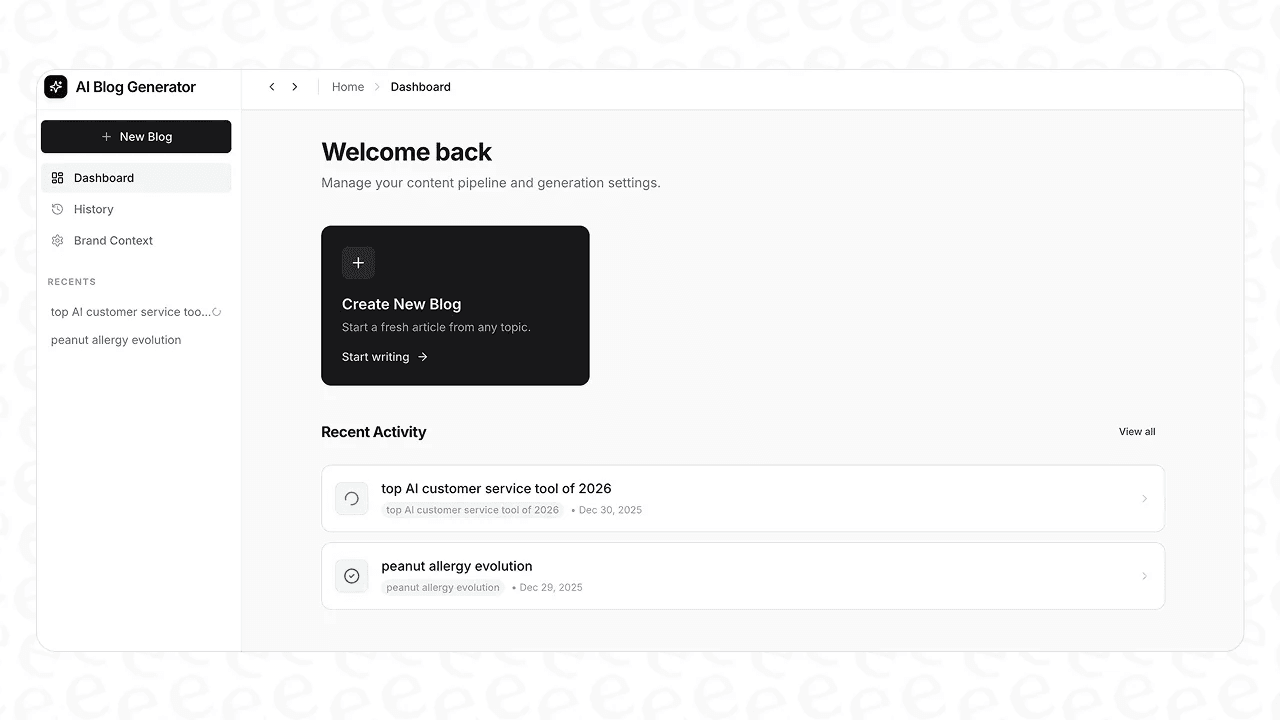
The eesel AI blog writer was developed to be a complete content scaling engine, managing the process from research to a ready-to-publish post.
The platform was used internally to grow organic traffic from 700 to 750,000 daily impressions in just 3 months by publishing over 1,000 optimized blogs.
It solves common scaling challenges by automating time-intensive tasks like research, writing, and asset creation, while allowing control over quality through deep brand context. A user provides a keyword, and the tool delivers a complete article that is ready to rank.
Successfully managing generated content isn't about who can publish the fastest. It's about creating an efficient, smart system that balances quantity with quality.
This involves setting up clear, repeatable workflows, using AI tools designed for the entire content lifecycle, and having a plan to get the most out of every asset you create.
With the right strategy and technology, scaling your content goes from being a management headache to a powerful engine for growing your brand.

Frequently Asked Questions
Share this article

Article by
Amogh Sarda
CEO of eesel AI. Amogh Sarda is obsessed with making the ultimate AI for customer service teams. He lives in Sydney, Australia and has previously worked at Atlassian and Intercom. Outside of work he’s usually surfing or on stage doing improv.