How to create original AI content that actually ranks

Stevia Putri

Katelin Teen
Last edited January 30, 2026
It feels like the internet is filled with generic, AI-generated content. You know the stuff. It can often sound robotic, bland, and impersonal. It lacks a convincing human touch.
This type of content can be ineffective for businesses. It fails to build any real connection or trust with your audience. Worse, it doesn't rank. Google has been pretty clear that content should be created for people, not just to game the system. If it's not helpful, it's unlikely to rank well on search engines.
What is original AI content?
When we talk about "original AI content," we're not just talking about passing a plagiarism check. That's the bare minimum. True originality is about blending the speed of AI with the irreplaceable value of human expertise, your company's unique data, and a distinct brand voice.
It’s the polar opposite of the generic AI output commonly found online. That content is usually just a rehash of the top 10 search results, spun into slightly different words without adding any new insights or perspectives. This is exactly what Google calls "unhelpful content," and it can negatively impact your SEO performance.
This distinction is crucial for ranking. Google’s algorithms are designed to reward content that demonstrates experience, expertise, authoritativeness, and trustworthiness (E-E-A-T). Generic AI can mimic expertise, but it completely fails on the "experience" front. It hasn't talked to your customers, it hasn't solved their problems, and it hasn't learned from your mistakes. That’s why human-led content performs better; it has a real perspective. Readers can often identify low-effort, impersonal content, and when they do, it can affect your brand's credibility.
The core components of original AI content
Start with your unique data
The saying "the quality of AI output depends on the quality of the input" is especially true for AI. AI models are trained on the public internet, which means they don't have your team's hard-won, real-world experience. The most valuable, original content you can create will always start with what you and your team already know.
Think about the valuable information you're sitting on: insights from customer support tickets, common questions from sales calls, and all the knowledge packed away in your internal docs like Google Docs, Confluence, or PDFs. This is your key asset. Your unique data and your team's perspective are your biggest competitive advantages. This is exactly why platforms like eesel AI are built to learn from these specific internal sources. Instead of just scraping the web, it trains on your company's brain, ensuring the content it helps you create is rooted in what you actually do and know.
Use AI for research
It's time to reframe how you see AI. Stop thinking of it as just a writer and start using it as a powerful research assistant.
Instead of asking it to "write a blog about X," ask it to analyze the top-ranking articles for your keyword. Have it pull out the main arguments, identify common themes, and pinpoint what everyone else is missing. You can even feed it transcripts from top YouTube videos or have it scour online forums to see what real people are saying. It can synthesize all of this information in seconds, giving you a clear picture of the conversation and where you can add a unique, valuable angle.
Using Fireflies.ai to transcribe sales calls → drop the summary into Claude → publish outline in Koala. Done.

Advanced tools like the eesel AI blog writer take this a step further by automating the process. It actively finds and embeds relevant YouTube videos and pulls real, insightful quotes from Reddit threads directly into your article. This adds layers of social proof and real-world context that generic content just can't match.
Develop a brand voice
If you want an AI to write like you, you have to teach it how. A generic prompt will give you a generic voice. To get something that sounds like your brand, you need to provide it with the right instructions.
A great way to do this is by feeding the AI samples of your best writing. Give it a few blog posts or marketing emails that you feel perfectly capture your tone, and explicitly tell it to adopt that style and vocabulary. Even better, create a simple brand voice guide that outlines your personality. Are you witty, formal, technical, or super casual?
This is another area where modern AI content platforms streamline the work. For example, with the eesel AI blog writer, you just provide your website URL. It automatically analyzes your existing content to understand and match your brand voice, ensuring every post it generates sounds consistent and authentic to you.
A practical workflow for creating original AI content
Step 1: Ideation and structured outlining
Don't just start with a single keyword. Use the AI as a brainstorming partner. Ask it for different angles on your topic, potential sub-topics, and common questions your audience might have.
Once you have a direction, get the AI to create a detailed outline for the post. A solid framework is your roadmap. It ensures the article flows logically, covers all the important points, and helps you organize your own thoughts before you dive into creating the actual content. This step alone can save you hours of work and prevent you from writing yourself into a corner.
Step 2: Create the draft from your own voice
This is a key step for creating truly original content. Instead of letting the AI guess what you want to say, tell it yourself.
Grab your phone, open a voice recorder, and just talk about the topic for 10-15 minutes. Imagine you're on a podcast or explaining it to a colleague. Don't worry about sounding perfect; just get your ideas out. Then, use an online tool to transcribe the audio.
This raw transcript, full of your natural language, unique phrasing, and genuine expertise, becomes the source material for the AI. You're not asking it to invent content from scratch; you're asking it to structure and refine your own original thoughts.
Why does this work? For a few reasons, mainly because you are using original content from your brain, and not asking the robots to do independent research which it will inevitably make mistakes with. Furthermore its basing the entire article off of your transcript so its less likely to make stuff up and fluff it up with unnecessary and inaccurate information.
Step 3: Generate a complete, media-rich post in minutes
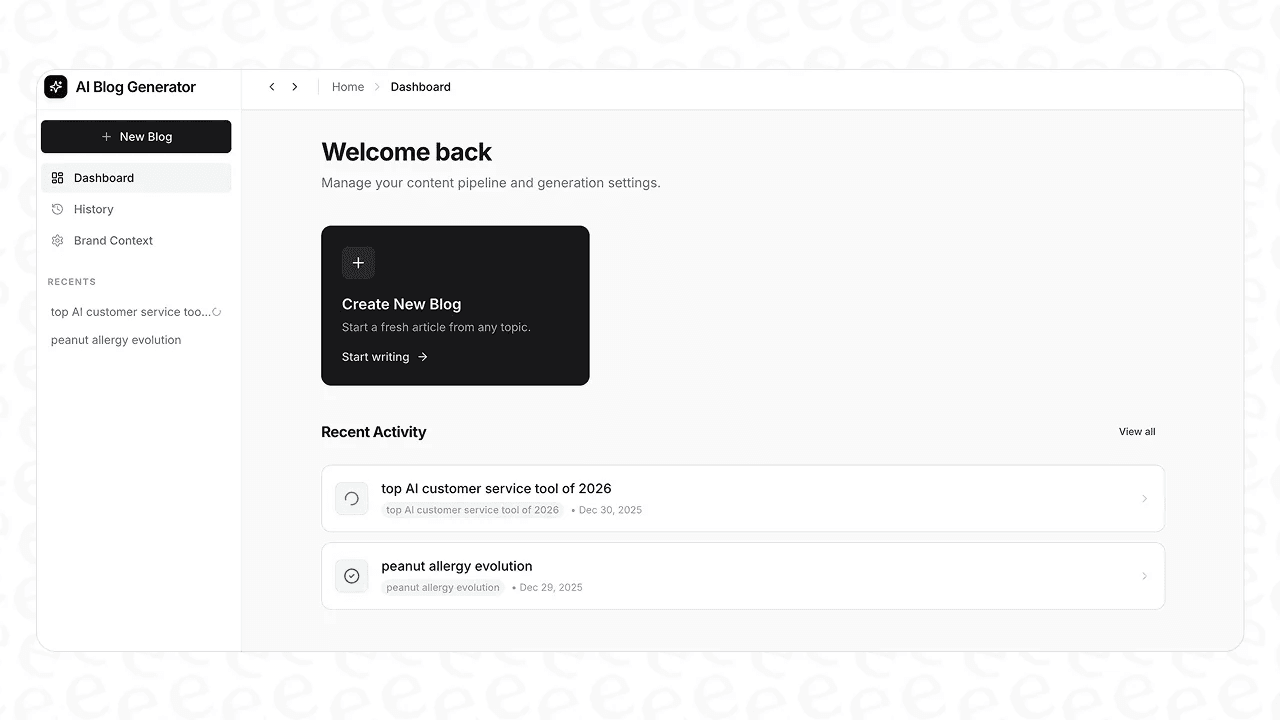
This is more than just pasting text into a generic chatbot. The eesel AI blog writer doesn't just write; it builds a complete, optimized article for you. Here’s what makes that different:
- Automatic Assets: It creates and inserts relevant images, infographics, and tables directly into the post. This breaks up the text and makes the content far more engaging and easier to digest.
- Social Proof Integration: It automatically finds and embeds real quotes from Reddit discussions related to your topic, adding authentic, real-world voices to your content.
- Media Embeds: It finds relevant YouTube videos and embeds them in the right places, which can seriously boost engagement and time on page.
- SEO & AEO Optimization: The content is automatically structured for both traditional search engines (SEO) and the new wave of AI answer engines (AEO) like Google's AI Overviews, Perplexity, and ChatGPT.
Step 4: The human-in-the-loop editing process
An AI-generated draft should not be considered final. The human touch is what elevates good content to great content. This final step is essential.
Read the entire article out loud. This is the fastest way to catch clunky phrasing or sentences that just don't sound natural. This is also your chance to inject more of your personality. Add personal anecdotes, specific examples from your own experience, and your unique sense of humor. This is the stuff that makes content relatable and memorable.
You can still use AI as an editing assistant here. Highlight a paragraph and ask it to be more concise or to vary the sentence structure. But you should always have the final say. This approach aligns perfectly with Google's guidelines, which emphasize the importance of clear authorship and having a human expert stand behind the content.
Common pitfalls in AI content creation
It's important to be aware of a few common traps when using AI for content, as they can affect your content's quality and credibility. Here’s what to look out for.
The generic "AI voice"
Low-effort AI content is often easy to spot. It's filled with cliché phrases like "in today's digital landscape," "unlock the power of," "in conclusion," and common phrases like "let's dive in." This can make your content sound generic.
How to avoid it: The voice-to-transcript method we covered earlier is your best defense. By grounding the AI in your own words, you force it to start from a place of authenticity. Using tools like eesel AI that are designed to learn from your existing site's tone also helps tremendously by ensuring the output naturally adopts a more human sound.
Factual inaccuracies and hallucinations
Large Language Models (LLMs) can sometimes "hallucinate," which is a way of saying they make things up and state them with complete confidence. Research from MIT explains that this happens because the models are designed to generate plausible-sounding text, not to verify truth. They're expert predictors, not fact-checkers.
For anyone reading: if you’re using AI for content, still double-check factuals. Some tools hallucinate dates/names hard.
How to avoid it: First, never trust an AI-generated fact, statistic, or quote without double-checking it yourself. But the best long-term solution is to use an AI that trains on your own verified knowledge. For example, eesel AI can be trained exclusively on your company's internal Confluence or Google Docs. This dramatically reduces the risk of hallucinations by limiting the AI's data pool to information you've already vetted and approved.
Content that lacks a real point of view
By design, most AI models are trained to be neutral and avoid taking a strong stance. This often results in content that lacks a strong perspective, presenting all sides of an issue without ever offering a clear recommendation or opinion. It might be informative, but it's also less memorable.
| Feature | Generic AI Content | Original AI Content |
|---|---|---|
| Tone | Robotic, full of clichés | Authentic, reflects brand voice |
| Accuracy | Prone to hallucinations | Grounded in verified data |
| Insight | Rehashes existing info | Offers a unique point of view |
| Engagement | Low, easily forgotten | High, includes media & social proof |
For a visual breakdown of how to put these principles into practice, the following video offers a step-by-step guide on making your AI-generated content truly original and effective.
From generic text to original content
Creating original AI content isn't about finding the perfect prompt or a push-button solution. It's a strategic process that uses AI to amplify your own expertise, not replace it.
The resulting workflow is both simple and powerful: you start with your own knowledge, use AI to do the heavy lifting of research and assembly, and always finish with a critical human edit. This is how you create content that not only ranks but also builds a real connection with your audience.
Ready to move beyond generic text and create high-impact content? Generate your first blog post for free and see the difference for yourself.

Frequently Asked Questions
Share this article

Article by
Stevia Putri
Stevia Putri is a marketing generalist at eesel AI, where she helps turn powerful AI tools into stories that resonate. She’s driven by curiosity, clarity, and the human side of technology.