

Disclosure: This article is published by eesel AI, a competitor of Ada. We encourage you to read Ada's own materials for their perspective.
Support teams at enterprise scale face a real problem: ticket volume grows faster than headcount, and customers expect faster answers than human agents alone can provide. Ada CX is one of the most established names in AI-driven customer service automation, with a track record across hundreds of global brands.
This review covers what Ada CX actually does, who it is built for, what its pricing model looks like, and where real users say it falls short. By the end, you will have a clear picture of whether it fits your situation or whether a different approach makes more sense.
What is Ada CX?
Ada is an enterprise AI customer experience platform founded in 2016 and headquartered in Toronto. The company says it serves 350+ global businesses, including Monday.com, IPSY, Pinterest, Square, and Cebu Pacific, and its February 2026 press release put total interactions since 2016 at more than 5.5 billion.
The platform centers on automating customer service conversations through AI agents that handle inquiries across web chat, email, voice, social channels, and in-app messaging. Ada uses industry-leading LLMs to understand customer intent, retrieve answers from a connected knowledge base, take action in integrated systems, or escalate to a human agent when needed.
Ada's own pricing page asks for your expected annual contact volume before booking a custom demo and says Ada is trusted by 350+ global enterprises, which puts it firmly in enterprise territory. Typical clients are large SaaS companies, fintech firms, and e-commerce retailers dealing with high volumes of repetitive inquiries.
Key features of Ada CX
Ada CX is a multi-component platform. Here is how its main capabilities are structured.
Unified Reasoning Engine
Ada's Reasoning Engine, launched in February 2026, is the patent-pending AI foundation that powers Ada's agents across all channels. Rather than using separate logic trees for voice, chat, and email, the engine provides one unified AI brain that applies consistent policies and knowledge everywhere.
The engine uses a dual-reasoning architecture: fast responses for simple inquiries handled in real time, and background processing for complex multi-step tasks (like invoice lookups or order edits) that run without interrupting the customer conversation. According to Ada's press release, changes configured once in the platform apply dynamically across all channels and supported languages.
Branch, a workforce payments platform, uses the Reasoning Engine to handle high-stakes voice conversations with the same AI logic powering their digital channels.
Playbooks
Playbooks are Ada's multi-step workflow system. They allow the AI to execute structured service operations using real-time data from connected systems, without requiring rigid scripted menus.
A Playbook for a shipping inquiry, for example, retrieves the customer's order ID, pulls live tracking data from multiple carriers, returns the status and expected delivery date, and offers escalation if the package is delayed. The same logic operates identically across chat, SMS, and voice. Ada has also introduced Ada Computer, which gives the AI agent API, code, and MCP tools to complete tasks in your business systems under your controls.
Loop Earplugs used its Ada AI agent to handle invoice retrieval and order edits, which helped them improve first response times by 194.52% (from five to six days down to a maximum of two hours) and achieve a 357% ROI.
Omnichannel Conversation Hub
Ada's Conversation Hub deploys agents across eight or more channels from a single platform: voice, email, web chat, Facebook Messenger, WhatsApp, SMS, Instagram DMs, in-app messaging, and custom channels via API. All channels share the same Unified Reasoning Engine, so conversation context carries over if a customer switches channels mid-interaction.
When escalation to a human agent is needed, Ada creates tickets in the connected helpdesk - Zendesk, Salesforce, ServiceNow, Freshdesk, Genesys, and others - and transfers the full conversation history so the agent picks up with complete context.
Cebu Pacific deployed Ada across voice, chat, and email channels, achieving a 50% CSAT increase and reduced wait times.
Coaching
Coaching is Ada's continuous improvement mechanism. After conversations, support managers review exchanges where the AI performed below expectations, provide feedback, and those refinements apply automatically to future interactions without requiring code changes or redeployment.
The feature is designed for non-technical users. One G2 reviewer noted that users "really like Ada's ability to train and improve, and to quickly see the results of updates." That said, coaching improves how the AI responds, not what it knows. If the underlying knowledge sources are incomplete, coaching alone cannot fill the gap.
Ada CX pricing
Ada's pricing is not publicly disclosed. To receive a quote, you contact Ada's sales team and share details about your business, including your expected annual contact volume. Ada's own pricing page lists no prices; it books a 30-minute expert call, then a custom demo and a business case built on your volume.
Because Ada's pricing is not publicly disclosed, your actual cost will depend on contract terms, conversation volume, and the specific features included in a custom agreement.
The table below compares what is known about Ada's model against eesel AI's publicly listed pricing:
| Aspect | Ada CX | eesel AI |
|---|---|---|
| Transparency | Not publicly disclosed | Publicly listed |
| Pricing model | Custom quote, contact sales | Fixed monthly credit plans; 1 ticket or chat = 1 credit (see eesel.ai/pricing) |
| Starting price | Not publicly disclosed | $299/month for 500 credits; free plan with 100 credits (eesel.ai/pricing) |
| Contract terms | Custom agreement via sales | Monthly; change plan size any time |
| Free trial | No self-serve trial; demo-based evaluation | Self-serve setup and free simulation |
Limitations and real-world reviews
Ada's case studies show strong results at enterprise scale. But user reviews point to patterns that are worth understanding before committing.
Setup complexity
Ada doesn't publish a standard deployment timeline. It says teams can go live in days, not weeks, and it holds a Fall 2026 G2 badge for fastest implementation in the enterprise segment. The route there is sales-led, though: an expert call, a custom demo, and a rollout plan built with Ada's team. For teams that want to start on their own, that process can be a meaningful constraint.
If your team needs faster time-to-value, eesel AI is built for self-serve setup. You can connect your helpdesk and knowledge base in a few clicks and have an AI agent running in under an hour, without waiting for an implementation specialist.
Performance and user feedback
G2, which primarily reflects the experience of support managers and platform builders, gives Ada 4.6 out of 5 across 173 reviews. Trustpilot, which reflects end-user experiences with Ada chatbots, gives it 1.7 out of 5 across 21 reviews. The gap is notable: the platform scores well among the teams building and managing it, but end users more often encounter conversations that stall without reaching resolution.
A recurring pattern in Trustpilot reviews is customers who are unable to reach a human agent when the AI cannot resolve their issue. This reflects how much Ada's performance depends on how thoroughly Playbooks have been built and tested. If a customer inquiry falls outside a configured flow, the fallback behavior matters.
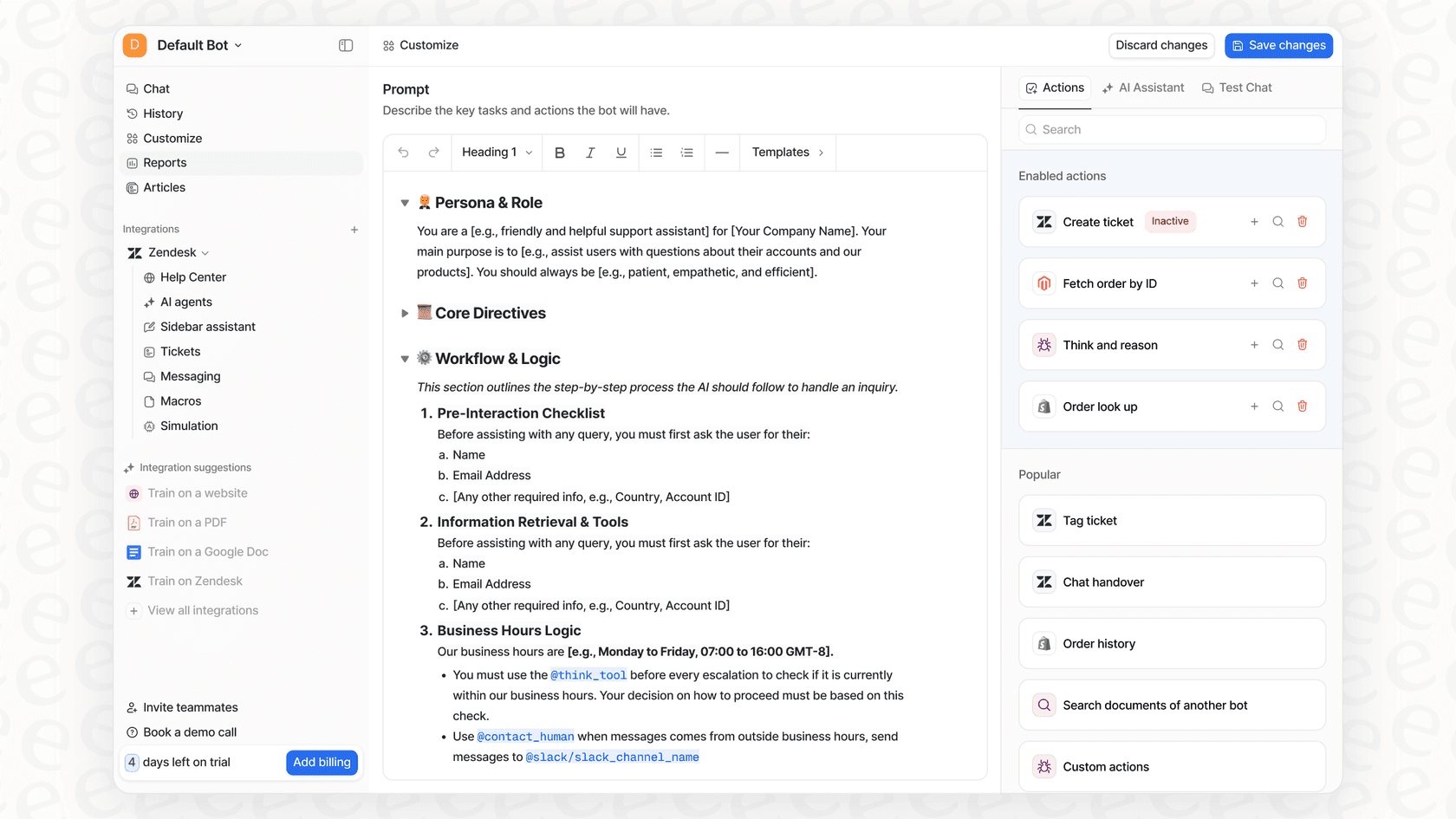
eesel AI lets you set automation and routing rules, with the ability to give the AI a defined persona and limit its scope to prevent off-topic responses.
Knowledge ingestion limits
Ada's AI answers from the knowledge sources you connect. Its knowledge docs list native connectors for knowledge bases such as Zendesk, Salesforce, and Contentful, alongside web import and articles written in Ada. Other authoring tools need a custom integration that Ada's team builds on its Knowledge API.
If your support knowledge is spread across multiple unstructured sources, that gap will affect resolution quality. Building out a structured internal knowledge base before deploying any AI platform is worth the investment regardless of which tool you choose.
No free trial
Ada does not offer a self-serve trial. Its old trial page now redirects to a demo-booking form, so evaluation starts with a sales consultation and a custom demo built on your use cases. This is a high bar for teams that want to prove ROI before signing a significant agreement.
A self-serve alternative: eesel AI
For teams that want AI automation without the enterprise procurement process, eesel AI is built to work on top of the tools you already have. It connects directly to help desks like Zendesk, Freshdesk, and Gorgias, and it is designed for self-serve setup without an implementation team.
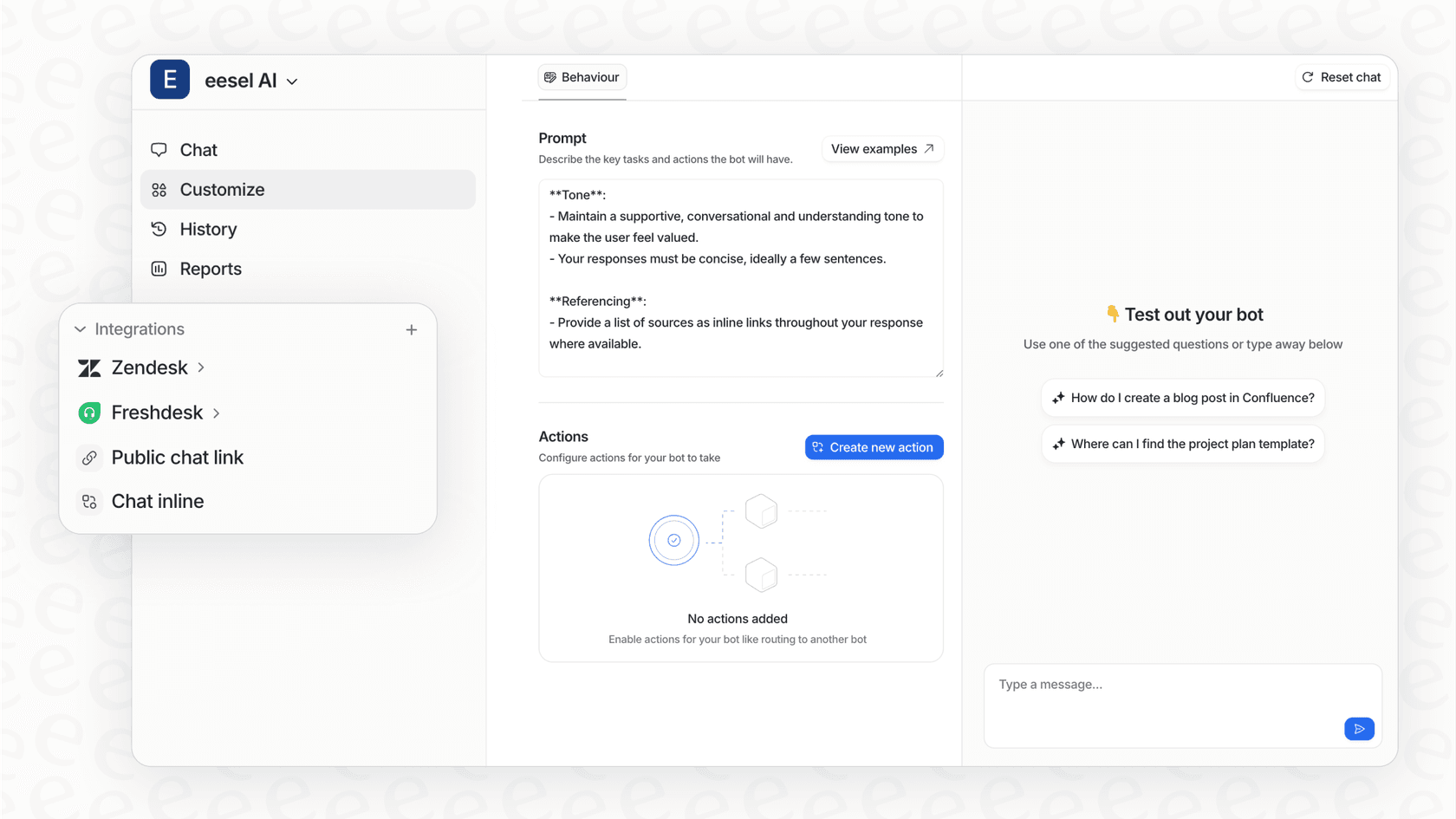
A few things that differentiate the approach:
- Self-serve setup: No implementation specialist required. You configure, test, and launch on your own schedule
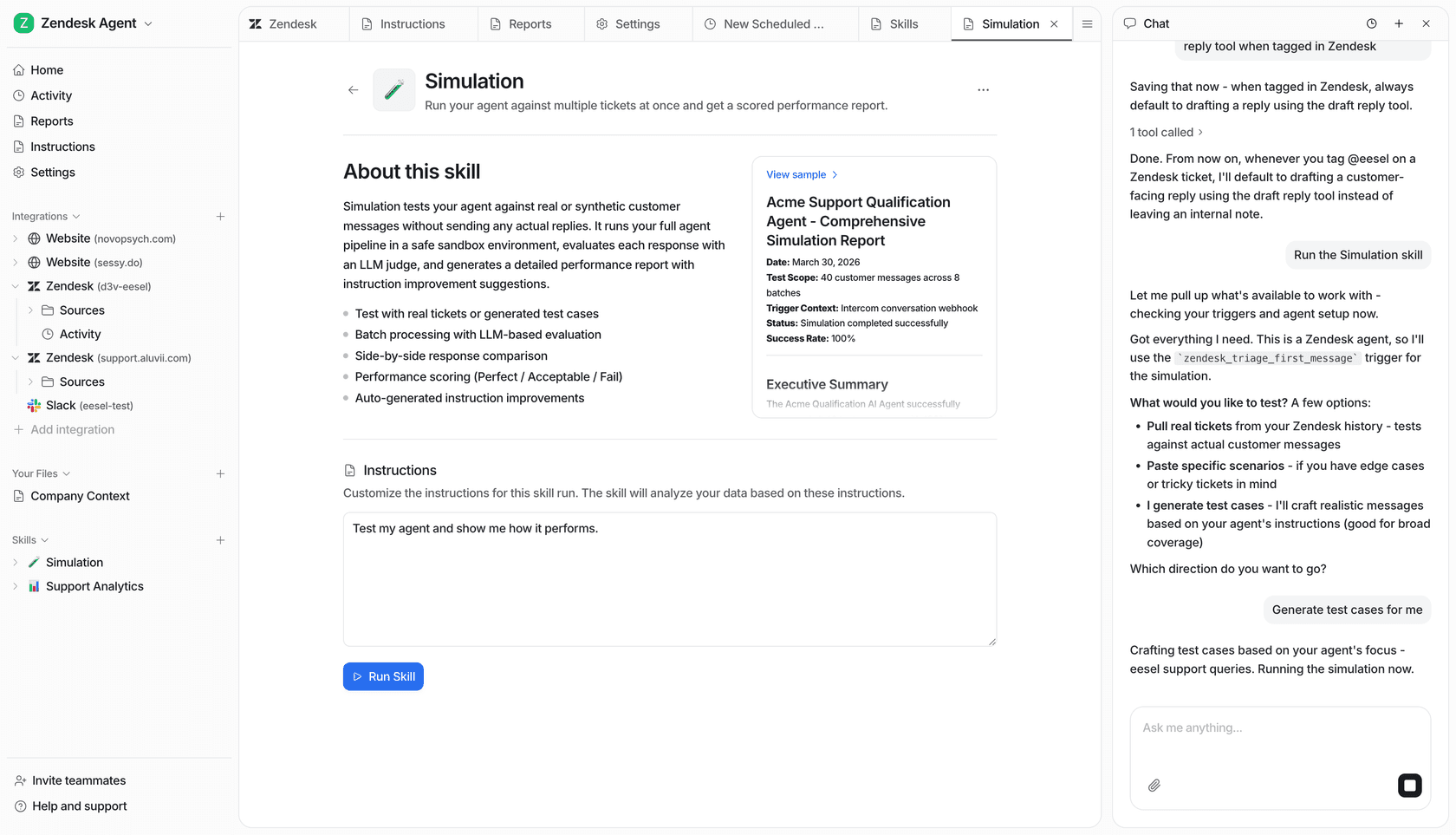
- Simulation mode: Test the AI against hundreds of your past tickets (or generated test cases) and get a scored report with suggested instruction fixes before going live
- Transparent pricing: All plans are listed on eesel.ai/pricing, with fixed monthly credit plans where one ticket or chat is one credit
- Works with your tools: Connects to your existing helpdesk and knowledge sources without requiring migration to a new platform
Is Ada CX right for you?
Ada CX is a capable AI automation platform built for enterprise scale. Its Unified Reasoning Engine, omnichannel consistency, and published case study results are genuine strengths. The tradeoffs are equally real: pricing is not publicly disclosed, the sales-led, demo-first buying process is built for large enterprises, and performance depends heavily on how thoroughly the platform has been configured.
If you run a large enterprise with the volume to qualify, a dedicated team to manage implementation, and a well-maintained help center as your knowledge source, Ada is worth a detailed evaluation. Reach out to Ada's sales team to discuss a custom quote for your situation.
For most teams looking for faster value, lower commitment, and transparent pricing, a demo-led evaluation and a sales-gated pricing model will be significant obstacles. If you want to see what AI can do for your support team without those constraints, a self-serve trial is the lower-risk starting point.
Simulate your AI agent's performance on your historical tickets with eesel AI today.
Frequently asked questions
What kind of businesses is Ada CX best suited for?
Ada CX is primarily designed for large, enterprise-level companies, particularly in sectors like SaaS, fintech, and e-commerce. According to Ada's pricing page, the platform is trusted by 350+ global enterprises, and pricing starts with a custom demo rather than a published price list.
How transparent is the pricing model for Ada CX?
Ada CX's pricing is not publicly disclosed. You must contact Ada's sales team directly to receive a custom quote. This makes it difficult to budget or compare options without investing significant time in the sales process.
What's the typical implementation timeline for Ada CX?
Ada doesn't publish a standard implementation timeline. It says teams can go live in days, and its sales process ends with an implementation plan built with Ada's experts. If your team needs to move faster, automating customer support with a self-serve tool can get you running in under an hour.
How effective is Ada CX at resolving complex customer issues without human intervention?
Ada's case studies report automated resolution rates from about 30% on day one (Deezer) to 77% (Dott), and its homepage cites an 84% automated resolution rate. However, end-user reviews on Trustpilot give the platform a 1.7 out of 5, with common complaints about conversations that loop without reaching resolution. Understanding your team's deflection rate targets before evaluating any AI platform helps set realistic expectations.
Does Ada CX offer a free trial or a low-risk way to test its capabilities?
Ada CX does not offer a self-serve free trial. Its old trial page now redirects to a demo-booking form, so evaluation starts with a sales consultation and a custom demo. If you want to test AI performance on your actual historical tickets before committing, eesel AI's simulation lets you do exactly that at no cost.


Article by
Kurnia Kharisma
Kurnia is a software engineer and writer at eesel AI with two years of SEO experience, writing about AI tools, helpdesk software, and customer support. He pairs a developer's understanding of how these products are built with search-driven research into what actually ranks and resonates with the people searching for them.