The 8 best Scalenut alternatives in 2026

Kurnia Kharisma

Katelin Teen
Last edited July 15, 2026

Why people leave Scalenut
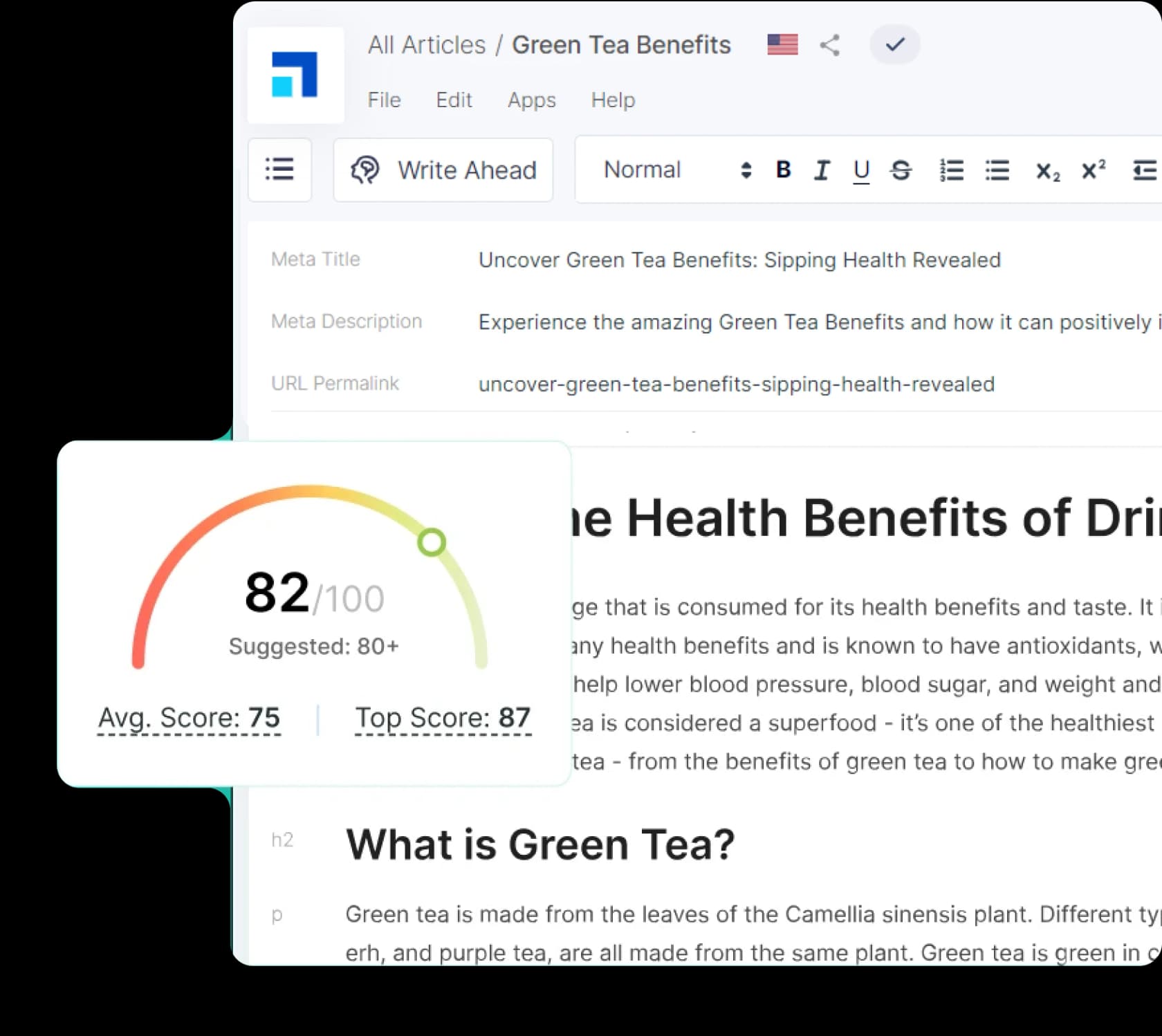
I run SEO content at eesel, so I've had most of these tools open at some point, Scalenut included. Credit where it's due first: Scalenut does the all-in-one thing well. You drop in a keyword, it pulls the SERP, gives you NLP terms to hit, and drafts a 1500+ word article in one flow. Reviewers consistently say it "replaces 2-3 tools," and its keyword planner and clustering get called out as standouts. That's real value.
So why switch? Two pains keep coming up.
The first is output quality. Scalenut's own G2 summary admits the AI content "can occasionally be repetitive, requiring additional editing," and it's the dominant complaint in reviews. One editor-in-chief who rated it 5/5 still noted the drafts "sound a bit repetitive or too generic, so I usually have to edit it." That's not unique to Scalenut, it's the whole category, but it means the "1500 words in 5 minutes" promise comes with an asterisk.
The second is pricing and billing. Scalenut's page shows list prices of $59 / $89 / $199 behind a near-permanent "60% off" promo, which is the kind of pricing that makes buyers nervous about what they'll actually pay at renewal. And there's a pointed 0/5 G2 review from a founder describing a refund and cancellation dispute, plus source data that came back geo-mismatched (Canadian sources for a US site) during the trial:
"Within 5 days the platform was not providing accurate sources for my articles (Canadian instead of US)... [support] refused the cancellation on 3 multiple attempts... [then said] there'd be a 10% deduction."

One bad review isn't a verdict. But combined with the "needs editing" theme, it's enough that shopping around makes sense.
The thing nobody tells you: the category split in 2026
Here's the reframe that matters before you pick anything. Through 2026, almost every "SEO content writer" repositioned itself as an AI-visibility / GEO platform (Generative Engine Optimization), tools that track whether your brand gets cited inside ChatGPT, Perplexity, and Google AI Overviews, not just where you rank on Google. Surfer rebranded to an "AI Search Operating System." Writesonic calls itself an "AI Search Growth Engine." Frase leads with GEO. Scalenut itself is now a "GEO platform."
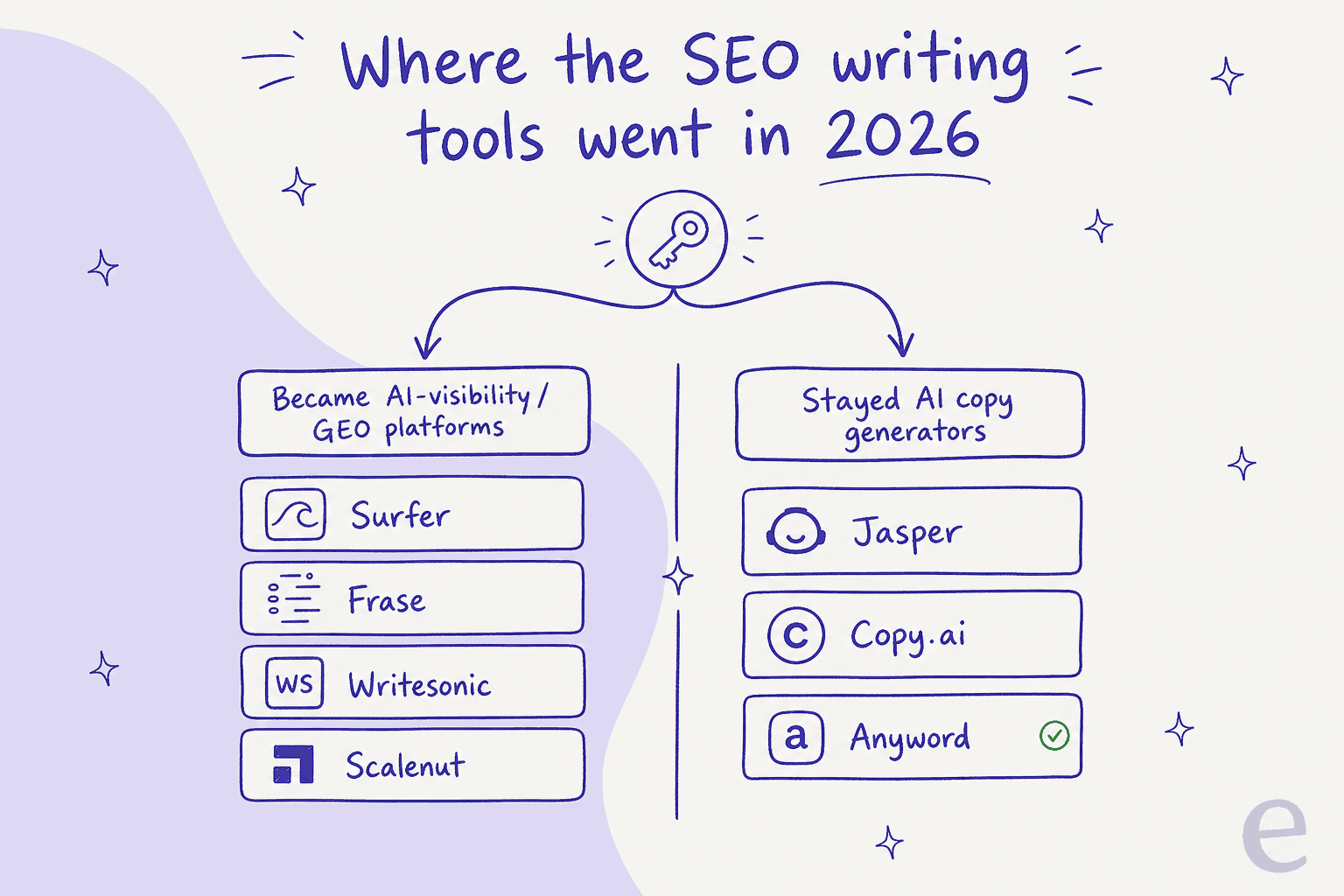
Why you should care: if you just want blog posts written, a GEO platform is now selling you a lot of tracking dashboard you may not use. If you want the tracking, great. But match the tool to the job, or you'll pay for half a product. The other camp, Jasper, Copy.ai, and Anyword, stayed closer to pure AI copy generation.
How I picked
I judged each tool on four things that actually decide the buy: real output quality (does the draft need a full rewrite?), the honest total price (not the promo sticker), what specific job it's best at, and whether it's a genuine Scalenut replacement or a different animal. Every price and limit below is pulled from the vendor's own live pricing page, and I've linked the source on first mention. For the deeper "how to judge these" logic, our guide to the best AI content generators goes further.
Here's the whole field at a glance before we get into each one.
Scalenut alternatives compared
| Tool | Best for | Entry price/mo | Free tier | Category | G2 rating | Standout |
|---|---|---|---|---|---|---|
| Surfer SEO | Optimization depth | $99 (billed yearly) | Trial only | GEO platform | 4.8 (543 reviews) | Content Score |
| Frase | Cheaper all-in-one | $49 | 7-day trial | GEO platform | 4.8 (301+ reviews) | SERP research briefs |
| Writesonic | AI search visibility | $79 (billed yearly) | 7-day trial | GEO platform | 4.7 (2,114 reviews) | Citation tracking |
| Semrush | Full SEO suites | ~$117 (billed yearly) | Limited free | SEO suite | 4.4 (3,955 reviews) | Data + ContentShake |
| Jasper | Enterprise marketing | $59/seat (yearly) | Trial only | AI copy | 4.7 (1,270 reviews) | Brand IQ governance |
| Copy.ai | GTM workflow automation | $29 | Trial only | AI copy | Mixed | Workflows at scale |
| Anyword | Conversion copy | $49 | 7-day trial | AI copy | 4.8 (1,226 reviews) | Predictive scoring |
| eesel AI Blog Writer | Just writing the blog | Free | Yes, free | AI writer | - | Zero-setup drafting |
Not sure which row is you? The picker below walks you to a shortlist in three clicks.
1. Surfer SEO, best for optimization depth
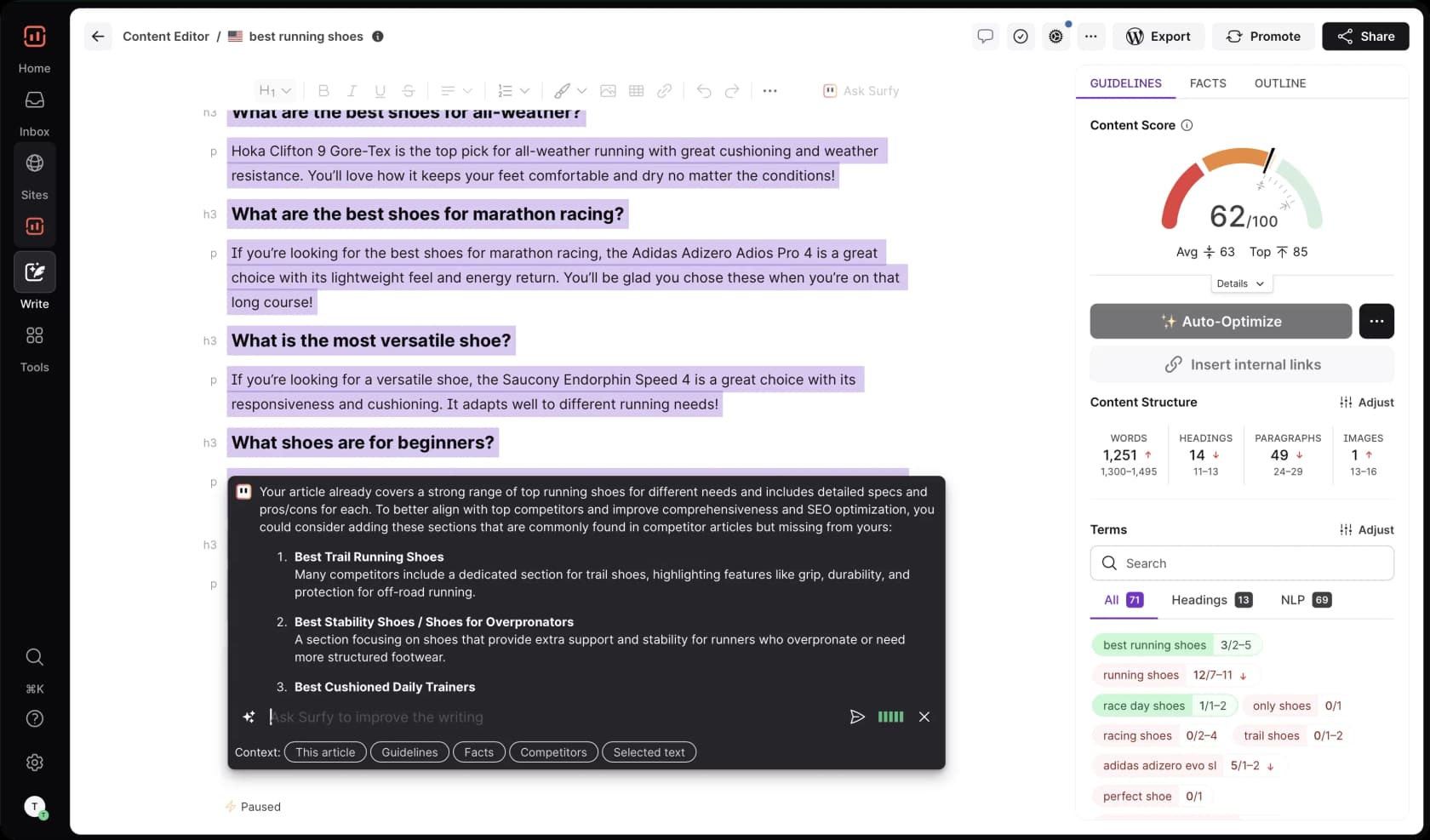
If Scalenut's SEO scoring is the feature you liked most, Surfer SEO is the tool that does it best. Its Content Score is the most widely-recognized metric in the category, a single 0-100 number reverse-engineered from the live SERP, and its editor tells you exactly which terms and how many H2s to hit. Surfer claims 150,000+ users and has 543 G2 reviews, which is real traction.
Like the rest of the field, Surfer rebranded to an AI-visibility platform in 2026 and now tracks AI citations alongside Google rankings. Its Surfer AI can spin a full draft in under 20 minutes across 11 languages.
Pros: the deepest optimization layer here, excellent SERP analysis, and an editor non-SEOs can actually use.
Cons: it's the priciest entry after Semrush, and the recurring Reddit critique is real, followed literally, Surfer pushes "SEO soup" (too many headings and too much word count). Its auto-writer is a good skeleton but weak for technical or how-to niches, so you're still editing.
Pricing: four plans billed yearly, per Surfer's pricing page: Discovery $49/mo (1 seat, no AI tracking), Standard $99/mo, Pro $182/mo, and Peace of Mind $299/mo. Enterprise is custom.
Our take: pick Surfer if optimization quality is the whole point and budget is secondary. It out-optimizes Scalenut, but it doesn't out-price it, and you'll want a separate data tool like Ahrefs or Semrush for the research layer.
2. Frase, best for the same workflow at a lower price
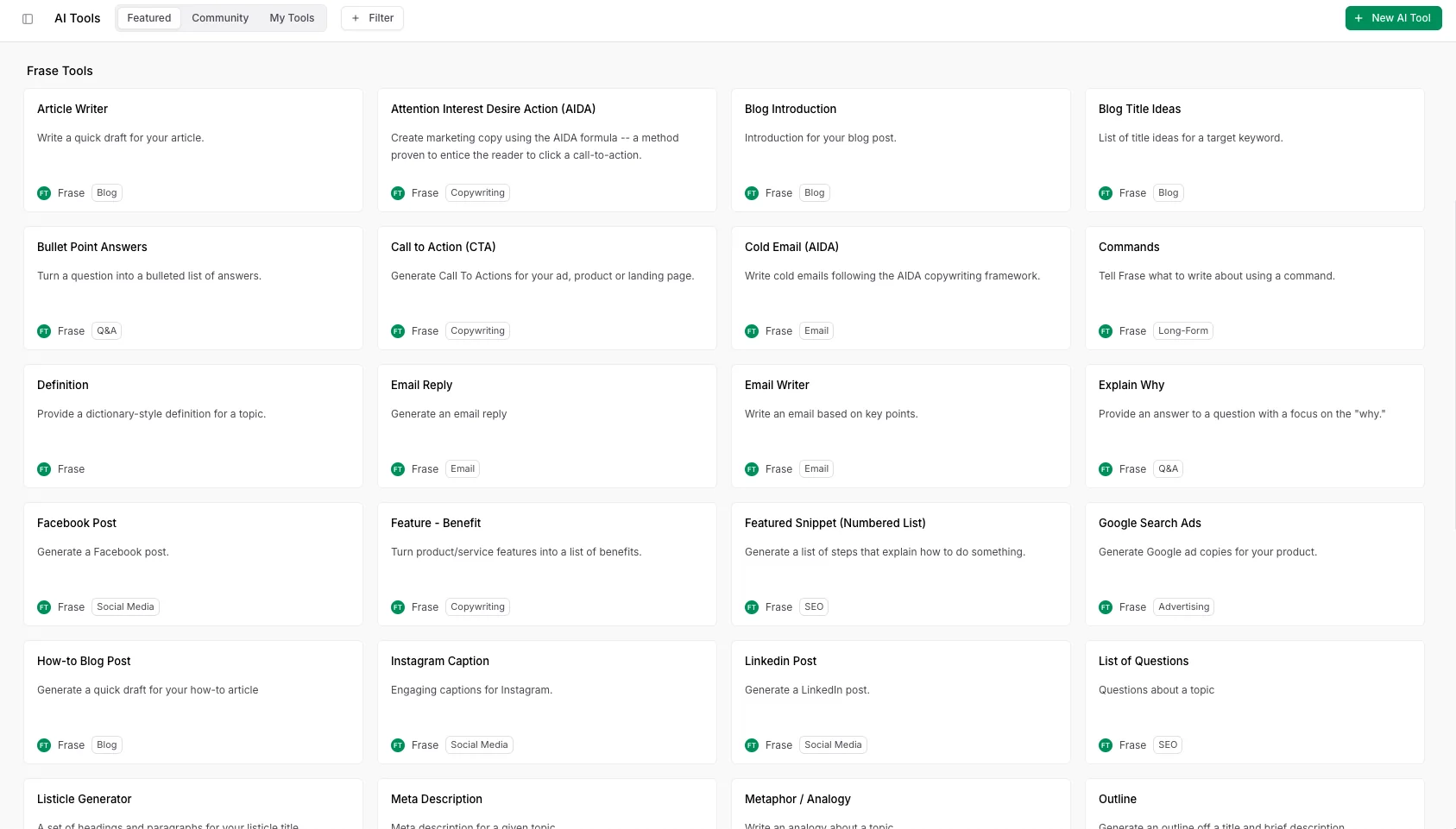
Frase is the closest thing to a like-for-like Scalenut swap, and it usually costs less. It does the same core loop, scrape the top SERP results in about 30 seconds, build an outline from the content gaps, then draft and optimize, and reviewers' most common description of it is simply "cheaper Surfer." It holds 4.8 across 301+ G2 reviews and a 98% would-recommend on its own site.
The nice thing about Frase's pricing is that every plan includes the full platform (AI Agent, SEO + GEO optimization, AI visibility, site audits, content briefs), plans differ in volume, not capabilities. That's the opposite of the tier-gating you hit elsewhere.
Pros: genuinely all-in-one, strong brief and outline generation, and the best price-to-capability ratio in this list. SOC 2 Type II available on Enterprise.
Cons: its optimization depth doesn't quite match Surfer's, and SERP-mirroring writers face an identity question in the LLM era (Frase's GEO pivot is its answer).
Pricing: per Frase's page, Starter $49/mo (1 seat, 10 articles), Professional $129/mo (3 seats, 40 articles), Scale $299/mo (5 seats, 100 articles), Enterprise custom. Extra seats are +$29 each.
Our take: if you liked Scalenut's all-in-one workflow but not the pricing anxiety, Frase is the obvious move. It's the safest default switch for a solo creator or small team.
3. Writesonic, best for AI search visibility
Writesonic is the clearest example of the category shift. The old template-heavy AI copywriter is mostly gone, the legacy product-descriptions template page now returns a 404, and the 2026 product is an "AI Search Growth Engine" focused on getting your brand cited across up to 10 AI platforms. It still has an AI article writer, but the center of gravity is visibility tracking and citation fixes, not bulk copy. It carries 4.7 from 2,114 G2 reviews.
Pros: one of the deepest AI-visibility toolsets here, with an Action Center that ranks citation fixes for you. SOC 2, GDPR, and HIPAA at the company level.
Cons: if you actually want to write blog posts and product copy, this is a weak fit now, its job changed. And the entry plan tracks ChatGPT only; you need $199/mo Basic just to add Gemini. A Reddit reviewer's blunt take: "I cancelled because the AI results were not as good as their competitors."
Pricing: billed annually per Writesonic, Starter $79/mo (15 articles, ChatGPT only), Basic $199/mo, Growth $399/mo, Enterprise custom for all 10 platforms.
Our take: choose Writesonic if your goal is "get found and cited by AI search," not "write my content." For the writing job, it's the wrong tool in 2026, which is a strange thing to say about a former AI writer.
4. Semrush, best if you want the whole SEO suite

If Scalenut felt too narrow and you want the full search-marketing stack, Semrush (now an Adobe company) is the heavyweight. Its content side, the Content toolkit plus ContentShake AI, drafts and optimizes, but that sits inside a platform with 28 billion keywords, rank tracking, backlinks, and AI-visibility monitoring. It rates 4.4 from 3,955 G2 reviews and serves everyone from solos to the Fortune 500.
Pros: the deepest data in the category by a mile, plus real automation (scheduled audits, white-label reporting). If you already live in Semrush, ContentShake is a natural add.
Cons: it's the most expensive option, the pricing is famously "nickel-and-dimey" with constant add-ons, and rank data is weekly (not real-time) on lower tiers. It's overkill if all you need is blog drafts. See our Semrush SEO pricing breakdown for the full picture.
Pricing: per Semrush, SEO $117.33/mo, Pro+ $248.17/mo, Advanced $455.67/mo (all billed yearly), Enterprise custom. Reporting add-ons run $10-$20/mo.
Our take: buy Semrush for the data and the suite, not for the writing. If content generation is your only need, you're massively overpaying, Frase or Surfer do the content job for a fraction of the cost.
5. Jasper, best for enterprise marketing teams
Jasper sits in the "stayed a writer" camp, but aimed squarely at marketing teams, not solo bloggers. Its pitch is Brand IQ, centralized brand voices, knowledge, and style guides so output stays on-brand across many assets, plus Jasper Grid for running content production at scale. It holds 4.7 from 1,270 G2 reviews.
Pros: the strongest brand-voice governance here, a mature Canvas workspace, and real enterprise controls (SSO, SCIM, SOC 2).
Cons: the same "generic output" complaint applies, one paying customer's blunt G2 verdict: "The output quality was very very bad... [ChatGPT] could follow our brand voice perfectly." And the good stuff is gated: Pro caps you at 2 brand voices, and Grid, unlimited voices, the style guide, and API access are all Business-tier (custom-priced) only.
Pricing: per Jasper, Pro is $59/mo per seat billed yearly ($69 monthly), single seat only; Business is custom. No free tier, 7-day trial.
Our take: Jasper makes sense for a funded marketing team that needs brand consistency across a big content operation and can afford the Business tier. For a solo blogger, the per-seat pricing and gated features make it a poor Scalenut swap.
6. Copy.ai, best for GTM workflow automation
Copy.ai has drifted furthest from its roots. It's now "the first AI-native GTM platform," built around Workflows, Tables, and Agents to automate sales-and-marketing processes at scale, and claims 17 million users. It can still write content at catalog scale (one case study cites 80% lower costs across 100,000+ product pages), but that lives behind the enterprise tiers.
Pros: genuinely powerful for bulk, workflow-driven generation and GTM automation, with strong brand-voice control and 2,000+ integrations.
Cons: the pricing cliff is brutal. The self-serve Chat plan is basically a prompt box; real Workflow credits (the actual meter) start at Growth for $1,000/mo. That $29 → $1,000 jump is the steepest in the lineup, and it's where buyers stall.
Pricing: per Copy.ai, Chat $29/mo (5 seats, chat only), Growth $1,000/mo (20K workflow credits), Expansion $2,000/mo, Scale $3,000/mo, Enterprise custom.
Our take: Copy.ai is a fine Scalenut alternative only if you're really buying a GTM automation platform. If you just want SEO blog posts, the Chat plan won't do it and the Growth plan is wild overkill.
7. Anyword, best for data-driven conversion copy
Anyword's differentiator is predictive performance scoring, a numeric prediction of how a piece of copy will perform before you publish it, trained on a real A/B-test dataset. It claims 82% prediction accuracy vs 52% for a generic model, and a ~30% average lift in conversion rates. It also ships a long-form Blog Wizard with SEO scoring. G2 rating is a strong 4.8 across 1,226+ reviews.
Pros: the scoring is a genuinely different angle, and it's the pick if your content is conversion-driven (product pages, ad copy, landing pages) rather than pure blog SEO.
Cons: the signature scoring is gated, real-time prediction starts on the $99/mo Data-Driven plan, and the performance data that makes it smart only scales on custom-priced Business. API and SSO are Enterprise-only.
Pricing: per Anyword, Starter $49/mo (or $39 yearly), Data-Driven $99/mo (or $79 yearly), Business and Enterprise custom. 7-day trial, no free tier.
Our take: Anyword is a better fit for a performance marketer than a blog-first SEO team. If your KPI is conversion rate rather than organic rankings, it's the most interesting tool here; if it's rankings, Frase or Surfer fit better.
8. eesel AI Blog Writer, best for just getting the blog written
Here's the honest framing. Every tool above is, at heart, a dashboard, keyword research, SERP scoring, visibility tracking, an editor you optimize inside. That's the right buy if you want to manage SEO. But a lot of people searching for Scalenut alternatives don't want another dashboard. They want the post written so they can move on.
That's the job eesel's AI Blog Writer is built for. You give it a topic, it does the research and writing, and produces a draft, with images and brand voice. The research and keyword side is covered by free tools too: the SEO Keyword Generator, long-tail keyword generator, and a SERP checker. All free to try.
Pros: genuinely zero setup, free to start, and it removes the "I still have to write this" step that every tool on this list leaves you with. Good for a founder or small team without a dedicated SEO seat.
Cons: it's honestly not a like-for-like Scalenut replacement. There's no live rank tracker or in-editor optimization score, if your workflow depends on obsessing over a Content Score, you'll want Surfer or Frase alongside it.
Pricing: the blog writer and free SEO tools cost nothing to try.
Our take: reach for eesel when the bottleneck is producing content, not analyzing it. Pair it with a data tool if you need the scoring; use it solo if you just need drafts shipping.
How these tools actually work (and where the editing comes in)
Most of the SEO writers in this list run the same pipeline under the hood. Understanding it explains why they all share the same weakness.
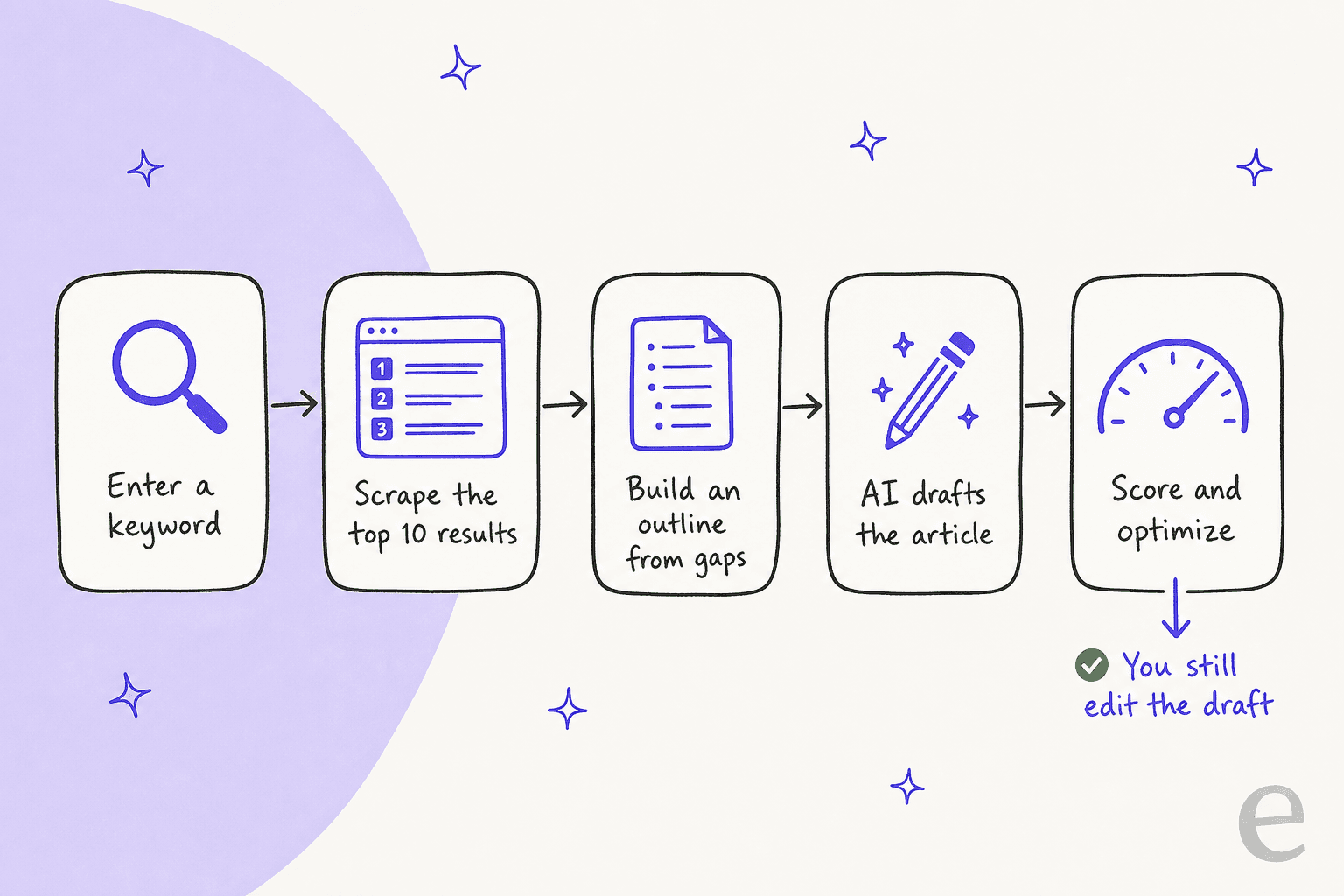
Because the draft is essentially a remix of what already ranks, the output trends toward the average of the SERP, which is exactly why "reads generic, needs editing" is the universal complaint. No tool escapes it; the differentiator is how good the starting draft is and how much you trust the optimization score. The takeaway: budget for a human editing pass no matter which one you pick. Our guide on writing semantic SEO content covers what that pass should actually do.
What you'll actually pay
Sticker prices lie a little here, because promos, per-seat pricing, and tier-gating change the real number. But the entry-price spread is worth seeing plainly.
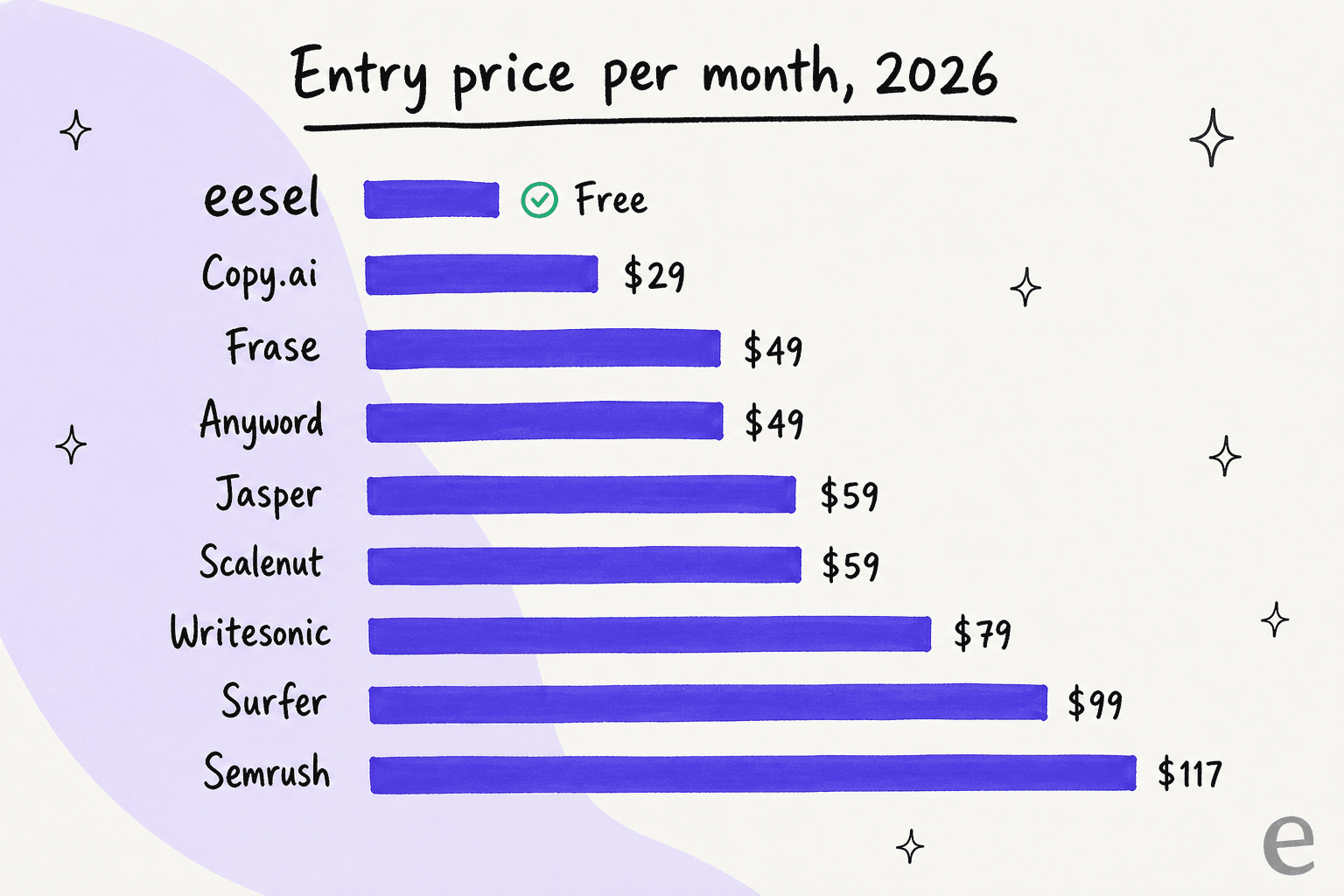
A worked example: say you're a solo blogger publishing ~8 posts a month and you want SEO optimization built in. Realistically that's Frase Starter at $49/mo (10 articles) or Surfer Standard at $99/mo, so call it $49-$99/month for the workflow, plus your own editing time. If you don't need the in-editor scoring and just want the drafts, eesel's blog writer covers the writing at no cost, and you spend the saved budget on a real editor or a data tool. The trap is buying Semrush ($117/mo) or Copy.ai Growth ($1,000/mo) when your actual job is "write 8 blog posts."
Try eesel
If you've read this far weighing SEO dashboards against each other, it's worth asking what you actually need. Every tool here leaves you with a draft to edit, that's the constant. eesel's AI Blog Writer is the option that just gets the draft written, with the research, keywords, and images handled, and it's free to try with no setup and no seat to buy. Pair it with the free SEO Keyword Generator and SERP checker and you've covered the writing and research side without a subscription. It won't replace a Content Score if that's your religion, but if the real bottleneck is producing content, it removes the step every other tool leaves on your plate.
Frequently Asked Questions
What is the best Scalenut alternative in 2026?
There's no single winner, it depends on the job. For deep SEO optimization, Surfer SEO is the strongest pick; for the same all-in-one workflow at a lower price, Frase is the closest direct Scalenut replacement. If your real bottleneck is just getting the blog written rather than running another SEO dashboard, eesel's free AI Blog Writer covers that side. See our full best AI blog writer roundup for more.
How much does Scalenut cost compared to the alternatives?
Scalenut lists at $59, $89, and $199/month (Starter, Plus, Professional), often shown behind a 60%-off promo. Among the alternatives, Copy.ai starts lowest at $29/month, Frase and Anyword at $49, and Semrush highest at about $117/month. eesel's SEO tools and blog writer are free to try, so they're the cheapest entry point.
Is there a free Scalenut alternative?
Most SEO content platforms only offer a 7-day trial, not a free tier. eesel's AI Blog Writer, SEO Keyword Generator, and SERP checker are free to use for the writing and research side. For paid tools, the cheapest way in is Copy.ai's $29/month Chat plan, though it's a prompt box, not a full SEO suite.
Why do people look for Scalenut alternatives?
The two recurring reasons in reviews are output that reads generic and needs heavy editing, and pricing friction, including a promo-heavy pricing page and a widely-cited refund dispute on G2. Teams also switch when they want either deeper optimization (Surfer) or a simpler, cheaper workflow (Frase). Our guide on semantic SEO content covers the quality gap in more detail.
Can AI SEO tools like Scalenut write content that ranks?
They can produce a solid first draft and score it against the top results, but every tool in this space, Scalenut included, shares the same limit: the raw output reads generic and needs a human editing pass before it ranks or gets cited. Pairing an AI content writer with real editing and keyword difficulty judgment beats trusting one-click output. See our take on the best AI content generators.