A practical guide to SaaS technical SEO

Stevia Putri
Last edited February 2, 2026
You've probably heard "Content is king" a million times. But what good is a king without a castle? For SaaS companies, technical SEO is that castle. It's the foundation that turns all your hard work on content into actual demos and sign-ups. If search engines can't find or understand your pages, your best blog post is basically invisible.
What is SaaS technical SEO (and why is it different)?
Let's keep it simple. Technical SEO is all the behind-the-scenes stuff you do to help search engines and the new AI answer engines find, crawl, understand, and index your website. It’s the plumbing and wiring of your site that lets all your other marketing efforts do their job.
Poor technical SEO foundations: Slow page speeds, mobile unfriendliness, and crawlability issues are silently killing organic traffic potential for numerous SaaS sites.

For SaaS companies, this often comes with its own unique set of headaches.
First, many modern SaaS websites are built on complex JavaScript frameworks like React or Vue. They create a slick user experience, but they can be a real pain for search crawlers. Some bots have trouble "seeing" content that's loaded by JavaScript. This isn't just a Google thing; other search engines like Bing really struggle with JS, and so do the AI crawlers from platforms like Perplexity that are becoming a bigger part of search.
Second, if you're all-in on product-led growth, you probably have dynamic URLs, filters, and tracking parameters that can create a mess of duplicate content without you even noticing.
The core components of a technical SEO foundation
Before you get into the weeds, you have to get the basics right. These are the non-negotiables for any SaaS website that wants to show up in search results.
Crawlability and indexability: Getting on Google’s map
If search engines can't find your pages, nothing else you do matters. Two little files are your best friends here.
First is your robots.txt file. Think of it as a bouncer for your website, telling search bots which areas they can enter and which are off-limits. You can check its status and make sure you aren't accidentally blocking important pages by looking at the robots.txt report in Google Search Console. A classic SaaS mistake is to accidentally block pricing pages or the entire /blog directory, so it's worth a double-check.
Next up is your XML sitemap. This is basically a map you hand directly to search engines, showing them a neat list of all your important pages. You can monitor how Google is using it with the Sitemaps report.
To see how you're doing overall, check the Page indexing report in Search Console. It shows you exactly which pages are indexed and flags any problems. If you see a lot of pages marked as "Crawled - currently not indexed," it's a hint that Google found the page but didn't think it was valuable enough to add to its index.
Site architecture: Building pathways to conversion
Your site's structure has a huge impact on both users and search engines. You want to make it as easy as possible for people (and bots) to find what they need.
yourdomain.com/blog) versus a subdomain (blog.yourdomain.com). While Google's John Mueller says both can work if they're linked well, the general consensus among SEOs is to stick with a subfolder. It helps keep all your content under one roof, which strengthens your domain's overall authority.
Your goal should be a logical, flat site structure. A user shouldn't have to click more than three or four times to get from your homepage to any important page, like pricing or a key feature.
This structure is also where internal linking becomes your secret weapon. You can use your high-traffic blog posts to pass authority and relevance to your high-intent product and feature pages with a simple link. For instance, a blog post about "the best project management techniques" should definitely link to your "project management feature" page.
Site speed and Core Web Vitals: Don't keep your visitors waiting
Nobody has time for a slow website. Site speed isn't just a nice-to-have; it's a major ranking factor because it's so tied to user experience. Google measures this with a set of metrics called Core Web Vitals.
Here’s what they mean in plain English:
- LCP (Largest Contentful Paint): How fast does the main content on the page load?
- INP (Interaction to Next Paint): When a user clicks something, how quickly does the page respond?
- CLS (Cumulative Layout Shift): Does the page layout jump around while it's loading?
An infographic explaining the three Core Web Vitals (LCP, INP, CLS) and their importance for SaaS technical SEO.
For SaaS sites, the usual culprits for slow speeds are huge, uncompressed images, bloated JavaScript files, and sluggish server response times. You can see your scores and find areas for improvement in the Core Web Vitals report in Google Search Console.
The biggest technical SEO challenges for modern companies
Once you've got the basics down, it's time to deal with the more advanced issues that can quietly hurt your organic traffic. These are especially common for SaaS businesses.
JavaScript SEO: A common hurdle
This is the big one. Google uses a two-phase indexing process. First, it does a quick crawl of your page's raw HTML. Then, sometime later, it comes back to "render" the page, which means it runs the JavaScript to see the final content. While the median time for this second step has dropped to around 5 seconds, that delay can still cause problems. In some cases, Google might just see a blank page on its first pass.
The best solution is Server-Side Rendering (SSR). With SSR, your server does the hard work and sends a fully-rendered HTML page to the bot right away. This means crawlers see everything immediately, which is a huge win for faster indexing and better crawlability.
Static Site Generation (SSG) is another great option, particularly for content that doesn't change much, like your blog or documentation. It pre-builds all the pages into lightweight HTML files for blazing-fast performance.
Duplicate content: A common problem
Duplicate content happens when the same or very similar content shows up on multiple URLs. For SaaS sites, this often happens by accident with things like tracking parameters (?utm_source=...) or by creating multiple landing pages for slightly different use cases that are 95% the same.
This confuses search engines and forces them to guess which version to show in search results. You end up splitting your authority and basically competing with yourself.
The fix is the canonical tag (rel="canonical"). It's a simple bit of code you add to a page to tell Google, "Hey, I know there are a few versions of this page, but this is the main one you should index and rank." If yourdomain.com/features/reporting and yourdomain.com/features/reporting?view=analytics show the same content, the second URL should have a canonical tag pointing back to the first.
Schema markup: Speaking the language of search engines
Schema markup (or structured data) is code you add to your site to explicitly tell search engines what your content is about. Instead of making them guess, you're giving them clear labels. Google recommends using JSON-LD because it's clean and relatively easy to implement.
For SaaS, a few schema types are especially useful:
SoftwareApplicationorWebApplication: Describes your product.FAQPage: Great for pricing and feature pages to answer common questions.Organization: Provides key details about your company, usually on your homepage.
The biggest perk? Schema markup can help you earn rich snippets in the search results. Those are the enhanced listings you see with star ratings, prices, or FAQ dropdowns. They make your listing pop and can seriously increase your click-through rate. You can check your work with Google's free Rich Results Test tool.
Future-proofing your technical SEO for AI search
Having a strong technical foundation is more important than ever in the age of AI-powered search like Google's AI Overviews.
Optimizing for AI Overviews and answer engines
Here’s the deal: many of the AI crawlers used by Google, ChatGPT, and Perplexity don't execute JavaScript well, if at all. They much prefer clean, simple HTML. This gives server-rendered sites a massive advantage for showing up in AI-generated answers.
These AI systems also rely heavily on structured data (schema) to pull factual information like pricing, features, and company details. It's not just about getting rich snippets anymore; it's about becoming a primary source for Answer Engine Optimization (AEO).
How a solid technical foundation unleashes your content strategy
Let's pull it all together. A technically sound website is the launchpad for your entire content strategy. Once it’s built, you can shift your focus from fixing technical problems to creating high-quality, optimized content at scale.
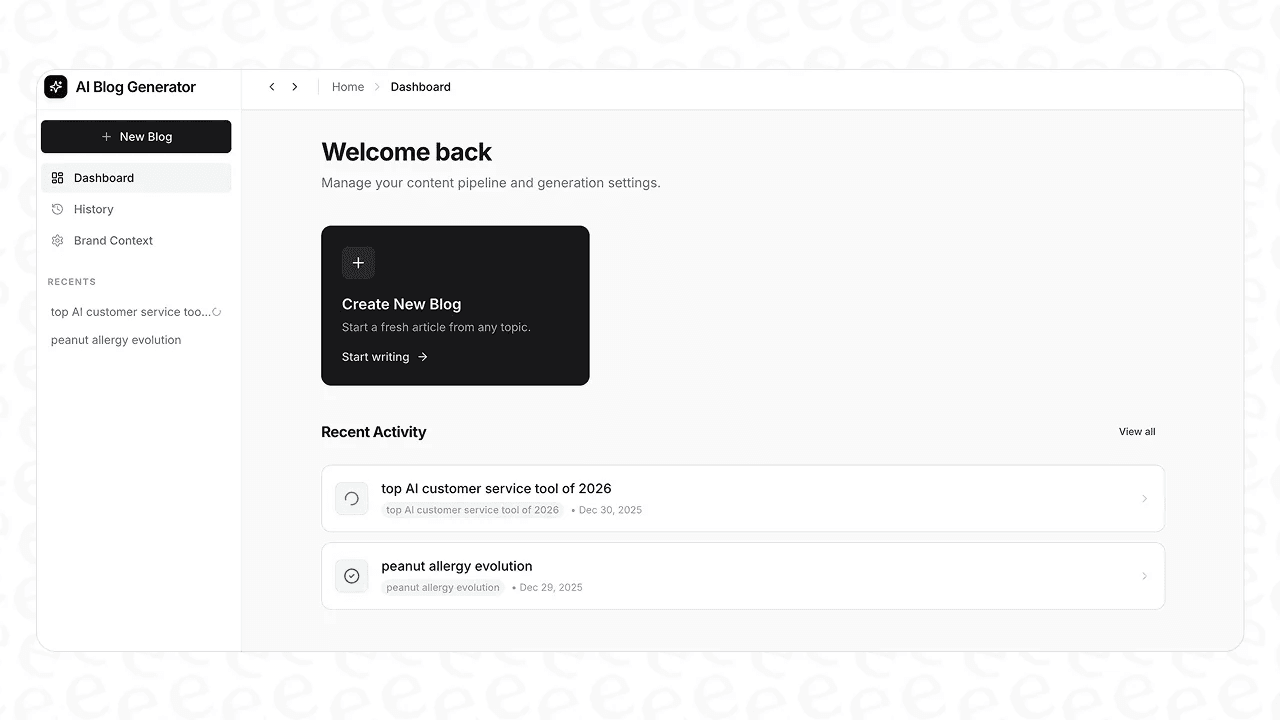
This is where a tool like the eesel AI blog writer can make a huge difference. It's designed to generate complete, publish-ready blog posts that are already structured for both SEO and AEO. It automatically handles things like proper headings, lists, and even finds assets, creating content that search engines can easily parse and understand.
Must-have tools for your technical SEO audit
You don't need a huge toolbox to get started. Here are a few essentials to help you find and fix technical issues.
- Google Search Console: This is non-negotiable. It's Google's free tool that gives you a direct look at how it sees your site. Use it to monitor indexing, Core Web Vitals, and overall site health.
- Screaming Frog: The industry-standard tool for doing a deep crawl of your website. Its JavaScript rendering mode is a must-have for finding issues on modern SaaS sites that would otherwise be invisible.
- Google PageSpeed Insights: The best free tool for checking your Core Web Vitals on a page-by-page basis and getting clear, actionable recommendations to improve performance.
- Ahrefs or Semrush: These are powerful all-in-one platforms for site audits, keyword tracking, and backlink analysis. The Site Audit tool in Semrush is also great for finding invalid or missing structured data.
For a deeper dive into the practical application of these concepts, the following video offers a complete guide to SaaS technical SEO, covering everything from crawlability to structured data.
Building your SaaS technical SEO roadmap
Technical SEO isn't a one-and-done task. It's an ongoing process that acts as the foundation for all your growth marketing. Getting it right makes sure that all the hard work you put into your product and content actually gets seen by potential customers.
It's opaque, hard to objectively measure, has a glacially slow feedback loop and is heavily dependent on external factors. Volume is low in new emerging markets, and competition brutal in established ones. The industry is also teaming with inexperienced, uninformed, or just plain bad faith practitioners.
Don't feel like you have to fix everything at once. Here are your first steps:
- Start simple: Run your homepage through Google PageSpeed Insights to see where you stand. If you haven't already, get Google Search Console set up. It’s free and only takes a few minutes.
- Check for red flags: Look at the "Pages" report in Search Console and tackle any critical errors, especially anything related to crawlability and indexing.
Once your technical house is in order, you're ready to fill it with amazing content that attracts and converts customers. If you want to see how quickly you can scale your efforts, try generating your first fully SEO-optimized article for free with the eesel AI blog writer.

Frequently Asked Questions
Share this article

Article by
Stevia Putri
Stevia Putri is a marketing generalist at eesel AI, where she helps turn powerful AI tools into stories that resonate. She’s driven by curiosity, clarity, and the human side of technology.
