A practical guide to product blog writing that drives sales

Stevia Putri

Katelin Teen
Last edited January 20, 2026
Expert Verified

You’ve got a fantastic product. You know it, your team knows it, and your first few customers are raving about it. But there’s a gap. You're finding it hard to connect with new customers online, build real trust, and show them why your product is the one they need. It's a common problem, and a frustrating one.
A product-focused blog is one of the most powerful tools in your arsenal, but it's often overlooked. It’s your space to teach your audience, position yourself as an expert, and gently guide visitors toward becoming loyal customers. This isn't about plastering "buy now!" everywhere; it's about earning their trust first.
This guide will walk you through the whole process, from mapping out a content strategy to creating posts that actually lead to sales. And since we’re in 2026, we’ll also look at how modern AI platforms are changing the game by automating research to writing a publish-ready draft in minutes.
What exactly is product blog writing?
Product blog writing is not about creating super long versions of your product pages. It's a content marketing strategy focused on giving real value to your audience. The content should be educational, entertaining, or insightful, and it always connects back to your product or the problems it solves.
Think about it like this: your product pages are for the final step of the customer journey, the purchase. They’re full of features, specs, and a clear call to action. They're for someone who is already thinking about buying.
Product blogs, however, are for building a long-term relationship. They catch people much earlier, when they're just trying to understand a problem or learn about a topic. The main goal is to make your brand a helpful, credible resource. When that person is finally ready to buy, your brand is the first one they think of because you’ve already helped them so much. It’s the difference between a sales pitch and a recommendation from a friend you trust.
| Feature | Product Page | Product Blog Post |
|---|---|---|
| Goal | Conversion | Education & Trust |
| Format | Bullet points & specs | Storytelling & tutorials |
| Tone | Persuasive & direct | Helpful & conversational |
| Audience Intent | "I'm ready to buy" | "I'm trying to learn or solve a problem" |
Developing a strategy for your product blog
Writing without a plan is a recipe for wasted effort. You might create some content, but it probably won’t get you where you want to go. Before you type a single word, a clear strategy makes sure your work is focused, efficient, and actually delivers results. Let’s break down the three pillars of a solid product blog strategy.
Identifying your audience
You can't help someone if you don't get what they're struggling with. That’s why the first step is always to get super clear on who you're talking to. Creating user personas is a decent start, but you need to go beyond simple demographics like age and location.
Dig deeper to understand their real motivations, their biggest headaches, and the exact questions they’re typing into search engines. What’s keeping them up at night? What are they really trying to accomplish?
For instance, a company selling smart home devices isn’t just targeting "homeowners." They're talking to tech-savvy people who care about home security or want to find smart ways to cut their energy bills. A skincare brand isn't just writing for "people with skin." They’re creating content for individuals dealing with acne or dryness, offering educational posts about ingredients and routines that can actually help. The more specific you get, the more your content will hit home.
Setting clear goals
Your blog shouldn't just be a side project. It needs to be connected to real business goals. Otherwise, you're just making noise. Ask yourself: what do we want our blog to actually do?
Here are a few common goals to consider:
- Increase organic traffic: This is all about getting new people to your site. You can target specific keywords that your audience is searching for when they first realize they have a problem.
- Build an email list: Your blog is the perfect spot to offer something valuable, like a detailed checklist, an e-book, or a free template, in exchange for an email address.
- Establish brand authority: The goal here is to become the go-to source in your niche. When people have questions, you want them to think of your blog first.
- Support the sales process: Good blog content can answer common questions that potential buyers have, making the sales team's job easier and smoothing out the path to purchase.
Brainstorming ideas that connect and convert
Once you know who you’re talking to and what you want to achieve, it's time for the fun part: coming up with ideas. Here are a few content formats that work really well for product-based businesses:
- In-depth how-to guides: Show, don’t just tell. Create a step-by-step guide that shows your product solving a real-world problem. For example: "How to Brew the Perfect Pour-Over Coffee With Our New Kettle."
- Customer success stories and case studies: Nothing beats social proof. Share the story of how a real customer used your product to get amazing results. It makes the benefits feel real and relatable.
- Behind-the-scenes content: People like to connect with the brands they support. Give them a peek at the craftsmanship, materials, or the awesome team behind your product to build a stronger personal connection.
- Gift guides and "best of" roundups: Position your product as a key part of a broader solution or lifestyle. For example: "The 10 Essentials for a Modern Home Office," where your ergonomic chair is one of the featured items.

The anatomy of a high-impact product blog post
A great strategy means nothing without solid execution. While topics will change, every successful blog post has a similar structure, one designed to be easy to read, engaging, and effective. Here’s a look at the essential parts of a post that works.
Crafting a title that grabs attention
Your headline is your first, and maybe only, chance to make an impression. It has to do two things at once: be interesting enough for a person to click, and be optimized with keywords so search engines understand what it’s about.
Here are a few headline formulas that work:
- The "How-To": How to [Achieve a Desired Outcome] With [Your Product]
- The "Listicle": 7 Creative Ways to Use [Your Product] You Haven't Thought Of
- The "Question": Are You Making This Common [Product Category] Mistake?
A good title promises value and sparks a little curiosity, making it hard for your target reader to ignore.
Structuring your post for readability
People don't typically read online, they scan. Your job is to make your content as easy to scan as possible. If a reader lands on a giant wall of text, they’re going to leave.
Break up your content with these practices:
- Keep paragraphs short, around 2-3 sentences.
- Use clear headings (H2s) and subheadings (H3s) to create a logical flow.
- Use bullet points and numbered lists to call out key information.
It is also smart to use the "inverted pyramid" writing style. Put the most important info right at the top of the article. Then, fill in the supporting details and context as you go. This respects the reader's time and makes sure they get the main point even if they only skim the beginning.
Integrating visuals and media
Text alone usually isn't enough to keep a reader engaged. Visuals break up the text, make complicated ideas easier to grasp, and make your content more memorable and shareable.
Feel free to mix it up with different visual elements:
- High-quality photos: Show your product being used in a real-life setting. Help people imagine themselves benefiting from it.
- Short videos or GIFs: These are great for showing off a key feature or a quick how-to.
- Screenshots: If you’re writing a tutorial for software or an app, screenshots are a must. They walk the user through each step.
- Infographics: Use them to simplify complex data or processes into something visually appealing and easy to understand.
Weaving your product in naturally
A common challenge is turning a helpful article into a sales pitch. The trick is to avoid the hard sell. Your product should feel like the natural, obvious solution to the problem you're discussing, not a jarring ad.
Focus on the benefits and outcomes the product provides. Instead of saying, "Our new kettle has a 1.2-liter capacity and a gooseneck spout," say, "The precision gooseneck spout gives you complete control over the pour, ensuring you saturate the coffee grounds evenly for a richer, more balanced flavor." See the difference? One is a feature; the other is a benefit.
When you do mention your product, link directly to the relevant shop page to create a smooth path for anyone who wants to learn more or make a purchase.
Scaling your content with AI
Consistently creating high-quality content is the biggest challenge in content marketing. It takes a huge amount of time and resources. This is where AI can help, but it's important to know that not all AI tools are the same. Using the right platform is the key to scaling up without letting quality slip.
Challenges with generic AI
The internet has seen a rise in content that can feel repetitive. Early AI writers, while capable of assembling sentences, sometimes struggle to capture a unique voice or brand context. This type of repetitive AI text may not build trust or rank well and can require significant editing, which may offset the initial time savings.
A modern approach to automating your workflow
The goal is not just to generate text faster, but to automate the entire content workflow. A context-aware platform can handle much of the heavy lifting. For example, the eesel AI blog writer is designed to turn a single keyword into a complete, SEO-optimized blog post that’s ready to publish. It’s what we use ourselves, and it has completely changed how we work.
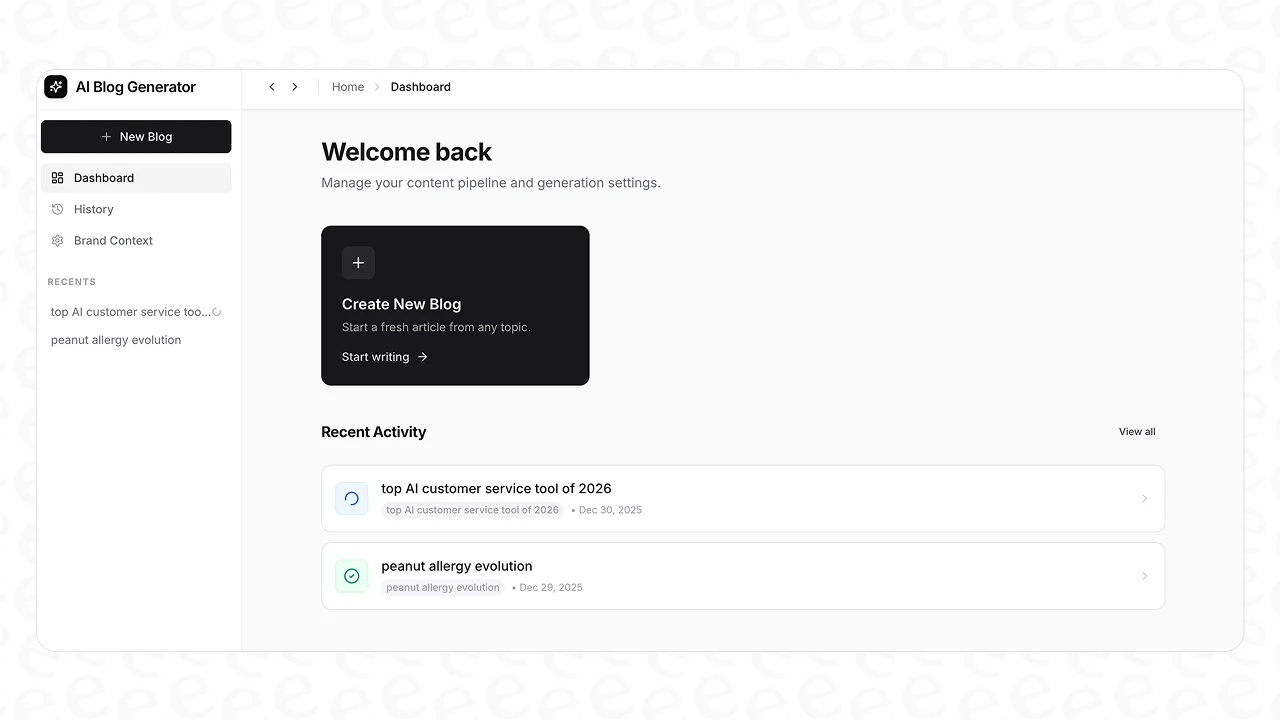
Here’s what makes this approach different:
- Context-aware research: The AI understands search intent. If you ask for a comparison post, it knows to find pricing data and feature lists. If you're writing a product review, it looks for technical specs. This ensures the content is deep and valuable, not just surface-level filler.
- Automatic asset and media generation: A great blog post is more than just words. Our platform automatically includes AI-generated images, custom infographics, and data tables. It even finds and embeds relevant YouTube videos and authentic Reddit quotes to add social proof and real-world context.
- Built-in SEO and Answer Engine Optimization (AEO): Every article is structured for traditional search engines, but it’s also optimized for the new wave of AI answer engines like Google's AI Overviews. This is a big deal, especially since Gartner predicts search volume will drop as these AI-driven features become more common.
We're not just guessing here. We used this exact tool to take our own blog from 700 to 750,000 daily impressions in just three months by publishing over 1,000 optimized articles. It works.
Watching experts break down their process can provide new insights. The following video offers a practical look at how to structure a blog post specifically to sell products, covering key tips that align with the strategies we've discussed.
This video provides a practical guide on creating blog posts that effectively sell products by converting them into landing pages and providing valuable content.
Turn your product blog into your best salesperson
A successful product blog doesn't happen by accident. It's built on a smart strategy, high-quality execution, and using the right tools to create great content at scale.
Your blog is a long-term asset. It works for you 24/7, building trust, educating customers, and answering their questions better than any traditional ad ever could. It guides potential buyers on their journey, so when they’re finally ready to make a decision, you’re the obvious choice.
The biggest hurdle has always been the sheer effort it takes to consistently publish great content. But with modern tools, that challenge is smaller than ever.
CTA: Ready to see what a complete, publish-ready article looks like? Generate your first blog post and get an SEO-optimized article in minutes.
Frequently Asked Questions

Share this post
Article by
Stevia Putri
Stevia Putri is a marketing generalist at eesel AI, where she helps turn powerful AI tools into stories that resonate. She’s driven by curiosity, clarity, and the human side of technology.