
Expanding your business is a huge win. You’re growing, opening new doors, and reaching more customers. But then the big question hits: how do you make sure people in each new city can actually find you? Getting your business to show up in local searches for one location is hard enough, but doing it for five, ten, or even fifty? That’s a whole different beast.
It’s a challenge worth tackling, though. A huge number of all Google searches are for local information, so if you’re invisible to nearby customers, you’re just leaving money on the table. Getting this right is absolutely essential for any multi-location businesses.
In this guide, we’ll walk through everything you need to build a solid strategy. We'll cover the website structure that keeps things organized, how to manage your online presence everywhere else (like your Google Business Profile), and a scalable way to create hyperlocal content. The biggest bottleneck is often creating unique, quality content for every single location page, which can feel impossible. The good news is, it's not, and modern AI tools can help you solve this problem without hiring an army of writers.
What is local SEO for multiple locations?
Local SEO for multiple locations is all about boosting search visibility for a business that operates out of more than one physical place. Think of a regional bank, a national retail chain, or a dental practice with offices in a few different towns.
It's a big step up from single-location SEO. With one shop, all your energy goes into ranking in that one geographic area. But with multiple locations, you have to play a dual role. You need to convince search engines that you're a single, authoritative brand while also proving that you're a real local player in a bunch of different communities at the same time.
The main goal is simple: when a customer in Chicago searches for your service, you want Google to show them your Chicago branch, not your headquarters in Miami or some random location in Denver. It’s all about connecting the right customer to their nearest storefront, without any friction.
On-site structure for local SEO
Before you can start ranking everywhere, you need to get your own house, your website, in order. A clean, logical structure is key for search engines to understand your business and for customers to find what they need without getting annoyed.
Use one domain to consolidate authority
It might seem tempting to create a separate mini-site for each new location, but this is one of the most common mistakes businesses make. Splitting your presence across multiple domains ("mybusiness-chicago.com", "mybusiness-miami.com") is a nightmare for SEO. It waters down your domain authority, so none of the sites ever gets strong enough to rank well. It also confuses customers and creates a ton of extra work.
Stick to a single domain (e.g., "mybusiness.com"). This acts as a central hub that collects all the SEO value you build over time. That authority then flows down to your individual location pages, making your entire brand stronger online.
1. One account per location 2. One landing page per location 3. Make sure the details in the landing page are consistent with their respective GBP. 4. Implement a proper local SEO campaign per location

Build unique location pages
This is probably the most important part of your on-site strategy. Every single one of your physical locations needs its own dedicated page on your website. As Google's community experts will tell you, each location is a unique entity, and your site needs to reflect that.
Each location page must include:
- Name, Address, Phone Number (NAP): This has to be 100% accurate and specific to that location. Seriously, use a local phone number for each branch, not a generic 1-800 number. It builds local trust and is a key signal for search engines.
- Business Hours: Don't just copy-paste. List the specific operating hours for that particular branch.
- Hyperlocal Content: This is your secret weapon against duplicate content issues. Write a unique description of the location. Mention nearby landmarks, talk about the neighborhoods you serve, and feature photos of the local team. Adding testimonials from customers in that specific city is a fantastic touch.
- Embedded Google Map: Make it easy for people to get directions by embedding an interactive map right on the page.
Create a clear URL structure
A logical URL structure helps both users and search engines get around your site. The simplest and most effective approach is to use subdirectories.
For example, your URLs could look like this:
- "mybusiness.com/locations/chicago"
- "mybusiness.com/locations/miami"
- "mybusiness.com/locations/denver"
This structure is clean, scalable, and easy to understand. While you're at it, optimize the title tag and meta description for each page. Include the city and your main service, like "Expert HVAC Repair in Chicago, IL | MyBusiness."
Implement local business schema
Schema markup is a bit of code you add to your website to help search engines understand your content on a deeper level. Think of it as a translator that speaks Google's language.
For each location page, you should use the "LocalBusiness" schema type. This lets you explicitly tell Google structured information like each branch's address, phone number, and hours. Getting this right can enhance your search listings, making your business stand out in the results.
If your business has distinct departments, like a pharmacy inside a grocery store, you can even get more granular with nested "department" schema to provide specific details for each one.
Managing your off-site presence
What happens away from your website is just as important for your local rankings. You need to manage how your brand appears across the web for every single one of your locations.
Optimize Google Business Profiles
This is completely non-negotiable. Every physical location you operate needs its own verified Google Business Profile (GBP). This is what allows you to show up in the local map pack, which is prime real estate in search results.
To keep things sane, you can use a "business group" in your GBP dashboard to manage all your listings from one place. This is a lifesaver for scaling.
For each listing, make sure you:
- Link it directly to the corresponding location page on your website (not the homepage!).
- Use the correct local phone number.
- Keep the business name consistent (e.g., "MyBusiness," not "MyBusiness - Chicago"). Using the location in the name can get you penalized.
- Upload high-quality, real photos of the storefront, your team, and your work in that area.
Build local citations
Citations are just mentions of your business's Name, Address, and Phone number (NAP) on other websites. Think of directories like Yelp, Bing Places, Apple Maps, and other industry-specific sites.
Consistency is everything here. According to local SEO experts, consistent NAP data is a foundational trust signal. It helps search engines confirm that your business is legitimate and that the information they have is correct.
Pro tip
Don't panic over tiny variations like 'St.' vs. 'Street.' Search engines are smart enough to figure those out. The key is to avoid major errors like a wrong phone number or an old address, which can create confusion and hurt your rankings.
Manage location-specific reviews
Online reviews are a massive ranking factor. Google wants to recommend businesses that are trusted by actual customers, and reviews are the most direct signal of that trust.
Here are a few simple ways to generate reviews for each branch:
- Train your staff at each location to ask happy customers for a review. A personal ask goes a long way.
- Include a direct link to the location’s GBP review page in your follow-up emails or texts.
- Respond to all reviews, both positive and negative. It shows you’re engaged and you care. Try to make your responses feel local. A reply to a review from Chicago can feel different than one from Miami if you mention something specific to their experience or area.
Scaling hyperlocal content
Content is the fuel that powers local SEO. But creating unique, relevant content for dozens of different locations is a huge operational headache. This can be a significant hurdle, but it’s also where you can get a serious competitive edge.
Why hyperlocal content is essential
Generic, corporate blog posts aren't going to help you rank in a specific neighborhood. You need content that speaks to the local community and answers their specific questions.
For example, a real estate agency could publish a blog post on "The Best Neighborhoods in Chicago for Young Families." A plumbing company could write about "A Homeowner's Guide to Winterizing Your Pipes in Boston." This type of content shows you have local expertise, builds trust, and helps you capture valuable long-tail keywords that your competitors are probably ignoring.
The challenge of creating localized content at scale
The problem is, doing this well is hard. Writing one great localized post is manageable. But writing ten, fifty, or a hundred? That's a massive project that requires deep local knowledge and a ton of time.
This can be a significant hurdle. The strategy is sound, but the execution can be too resource-intensive for many businesses. Most simply don't have the bandwidth to pull it off consistently.
How to automate hyperlocal content with the eesel AI blog writer
This is an area where AI-powered tools can be particularly helpful. The eesel AI blog writer is designed to address this problem.
Here’s how it works: you give it a local keyword (like "plumbing services brooklyn") and your website URL. The AI then does deep, context-aware research to generate a complete, SEO-optimized blog post that actually sounds human. It's not just a rough draft; it's publish-ready content.
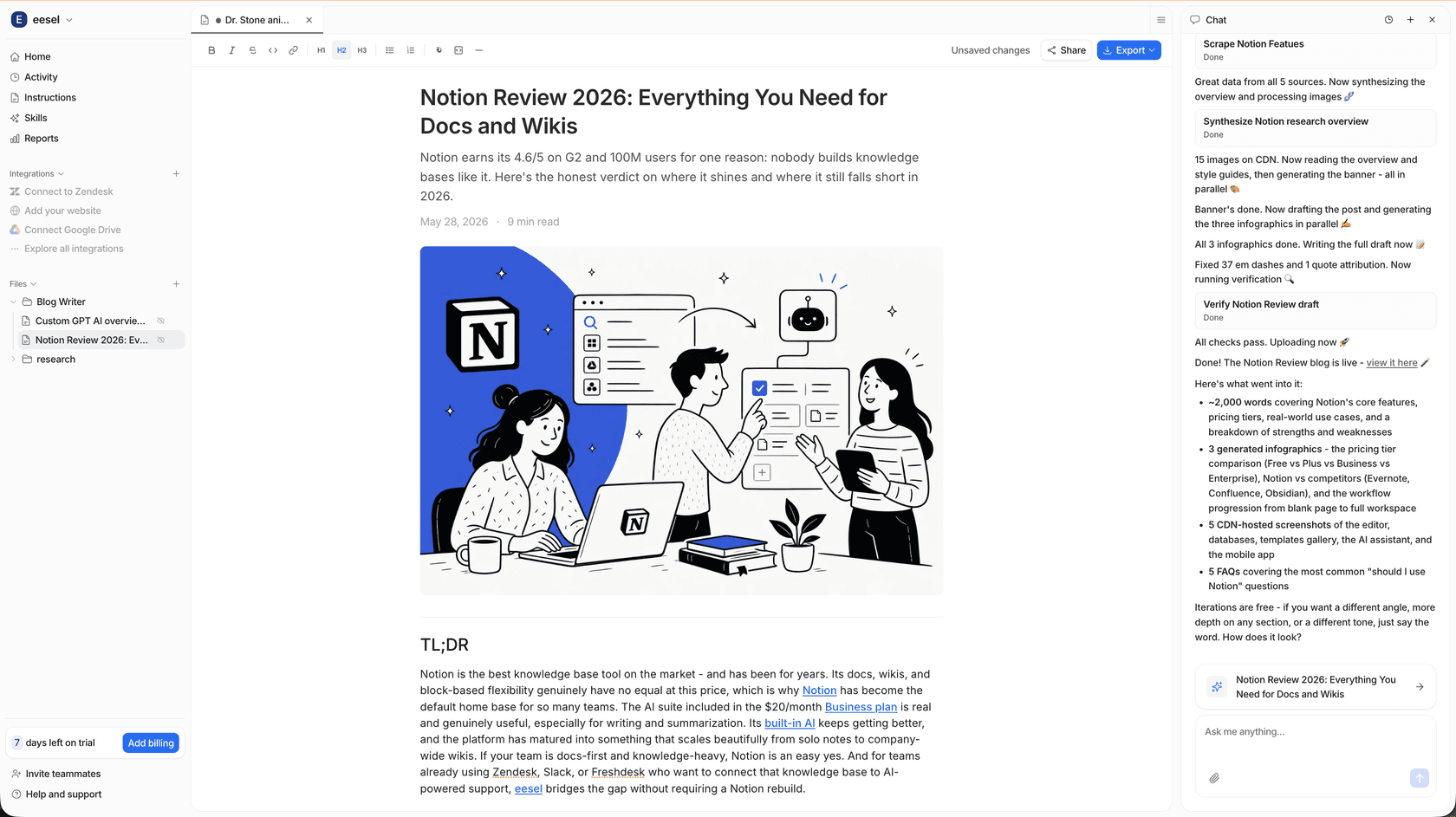
It has several features that make it perfect for creating hyperlocal content at scale:
- Authentic Social Proof: It automatically pulls in real quotes from Reddit and other forums, adding a layer of genuine local perspective that’s impossible to fake.
- Automatic Assets: The tool generates and includes relevant images, charts, and tables to make the content more engaging and useful for readers.
- Smart Linking: It intelligently adds internal links to your other relevant pages and external citations to authoritative sources, which is great for SEO.
We used this exact tool ourselves at eesel to go from 700 to over 750,000 daily impressions in just three months by scaling up our content production. It turns a process that used to take days into a matter of minutes.
Build local backlinks
Finally, don't forget about backlinks. Getting links from other local websites, like a local news blog, a charity you sponsored, or a partner business, is a powerful signal to Google that you're a legitimate part of the community.
Sponsor or collaborate with local events, charities, or blogs in each city. These backlinks can perform better than generic ones.
You don't need a complex strategy here. Simple things work best: sponsor a local youth sports team, partner with a nearby, non-competing business for a joint promotion, or join the local Chamber of Commerce. These activities not only build goodwill but also generate valuable local links.
For a more visual walkthrough of these concepts, the following video breaks down how to effectively target multiple cities or neighborhoods to expand your reach and improve your local SEO.
A unified strategy for multi-location SEO
Winning at local SEO for multiple locations comes down to three core pillars: a solid on-site structure with unique pages for every location, a consistent off-site presence anchored by Google Business Profile, and a scalable hyperlocal content strategy.
The key is to think of your business as one strong brand with many individual, local personalities. Each location needs its own digital identity that speaks to its community, all while contributing to the overall strength of your company. It's a lot to manage, but with the right foundation and the right tools, you can dominate local search in every market you serve.
To streamline this process, generate your first hyperlocal blog post for free with the eesel AI blog writer and see how it works.
Frequently Asked Questions
What is the most important first step in setting up local SEO for multiple locations?
How does Google Business Profile work with local SEO for multiple locations?
Should I use the same content for all my location pages?
How can I manage online reviews when doing local SEO for multiple locations?
What's the biggest challenge with content in local SEO for multiple locations?


Article by
Riellvriany Indriawan
Riell is a designer and writer at eesel AI with about two years of experience researching CX platforms, AI chatbots, and helpdesk software. She combines her design background with a sharp eye for how these tools actually look and feel in practice — making her comparisons unusually visual and user-focused.