If you run a local business, you’re playing a totally different game than the big online-only brands. Your customers aren't scattered across the globe; they're right around the corner. And when they need something, their first stop is almost always Google.
The stats are pretty eye-opening. A huge 46% of Google searches are for local information, and an incredible 80% of those searches result in a sale. People are constantly looking for "pizza near me," "best plumber in Brooklyn," or "bookstore open now," and the businesses that pop up first are the ones that get the business.
An infographic showing how to create local SEO content by highlighting that 46% of Google searches are local and 80% of those convert.
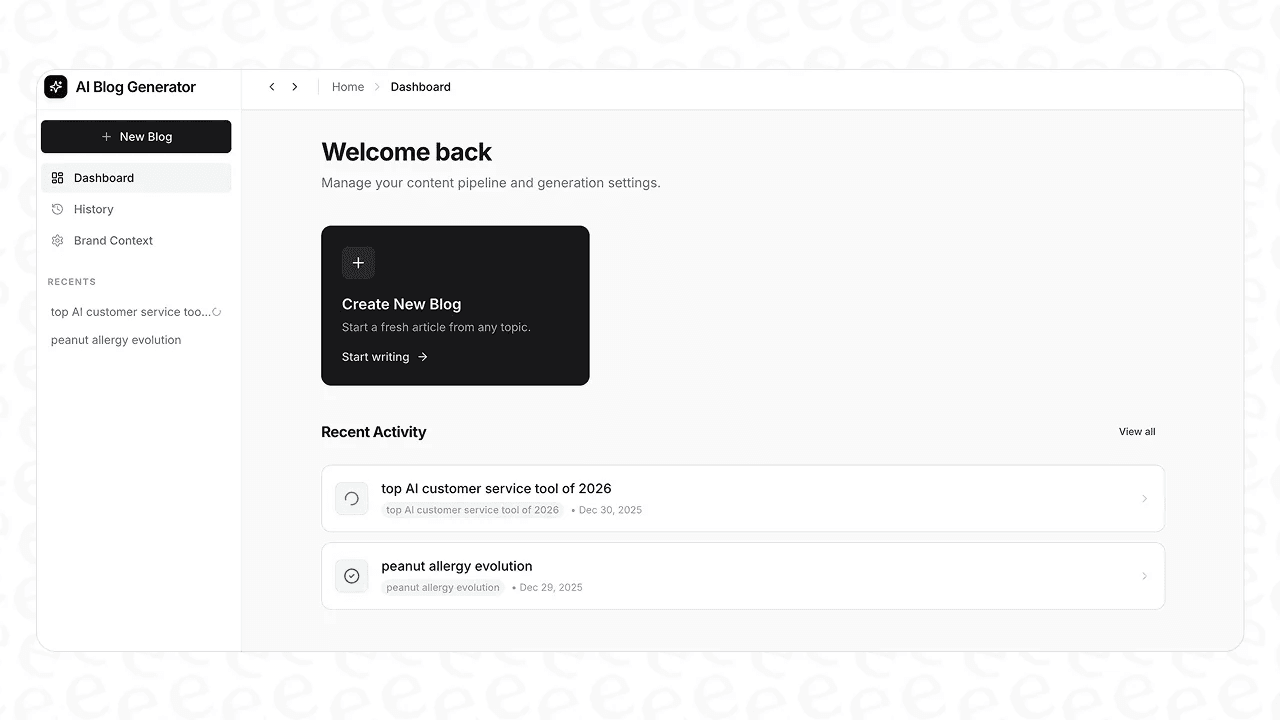
This guide will walk you through what you need to know to create local SEO content that puts your business right in front of those searchers. The biggest challenge, as you’ll soon see, is that creating genuinely good, locally-focused content takes a lot of time and research. It's hard to do at scale. That's where specialized AI tools can help. For instance, the eesel AI blog writer can take a simple local keyword and generate a full, ready-to-publish article with images and social proof, helping you do in minutes what used to take hours or even days.
A view of the eesel AI blog writer, a tool that shows how to create local SEO content automatically.
What is local SEO content?
Local SEO content is anything you create specifically to make your business more visible in local search results. You know that "local pack" that appears with a map and three businesses when you search for something nearby? That’s the digital real estate you're aiming for.
The main difference from regular SEO is the intense focus on a specific geographic area. You're not trying to rank for "best coffee" in the world; you're trying to rank for "best coffee in downtown Austin."
According to Google's own guidelines, your content needs to deliver on three key things to rank well in local searches:
Relevance: How well does your online presence match what someone is looking for? If they search for a "vegan bakery," your content needs to make it obvious that you sell vegan treats.
Distance: This one is simple. How close is your business to the person searching? You can't move your shop, but you can create content that reinforces your service area.
Prominence: How well-known is your business? Google figures this out by looking at online reviews, articles about you, and links from other local websites. The more positive buzz, the better.
An infographic explaining the three pillars for how to create local SEO content: relevance, distance, and prominence.
Basically, all your local content should be working to convince Google that you’re the best, most relevant, and most trusted answer for people searching in your area.
Foundational pillars of local SEO
Before you start writing a single blog post, you need to get your foundation sorted. These are the absolute must-haves for any local business. Think of it as building the house before you start picking out furniture.
Optimize your Google Business Profile
Your Google Business Profile (GBP) is your digital storefront. For many local customers, it's their first impression of your brand. A neglected profile is like having a permanent "closed" sign on your door.
Nail your NAP: Your Name, Address, and Phone number (NAP) must be 100% accurate and identical everywhere it appears online. No shortcuts or variations.
Pick the right categories: Be specific. Instead of just "Restaurant," choose "Italian Restaurant" or "Pizzeria." You can add secondary categories, too.
Upload high-quality photos: Show off your space, your products, and your team. Geo-tagging your photos (adding location data to the image file) is a great little bonus.
Get and respond to reviews: Reviews are a huge deal. Google has even said that high-quality, positive reviews can improve your business's visibility. Make it easy for happy customers to leave feedback, and always reply, even to the negative comments.
Pro tip
It can be tempting to stuff keywords into your business name, like 'Joe's Plumbing - Best Pipes in Phoenix.' Don't do it. This is against Google's rules and can get your profile suspended. Just keep it clean and accurate.
Build a network of high-quality local citations
A NAP citation is just a mention of your business's Name, Address, and Phone number on another website. This includes directories like Yelp, Apple Maps, Bing Places, or industry-specific sites like TripAdvisor for restaurants or Avvo for lawyers.
When search engines see your exact NAP info listed consistently across dozens of reputable sites, it builds a massive amount of trust. It confirms that you are who you say you are and where you say you are. While some SEOs debate their importance, Ahrefs points out that citations are still a foundational part of confirming your business details with search engines. Consistency is everything.
Create dedicated location and service pages
If your business has multiple locations or serves several different areas, you need a unique page on your website for each one. A common mistake is creating one service page and just changing the city name. That's a fast track to duplicate content issues, which Google is not a fan of.
Each location page should be unique. Here’s what to include for the best local impact:
A unique description of the services at that location, mentioning nearby neighborhoods or local landmarks.
The specific address, phone number, and store hours for that location, with an embedded Google Map.
Testimonials from customers in that specific area.
Photos of your team or projects from that location.
Master on-page SEO for local search
On-page SEO is all about optimizing the actual content on your web pages. The same core ideas apply to local SEO, just with a geographic spin.
Focus on these elements:
Title Tags: This is the headline that shows up in Google search results. It should clearly state the service and the location.
Meta Descriptions: This is the short description under the title tag. It doesn't directly affect your ranking, but a good one makes people want to click. Include your location and a call to action.
Schema Markup: This is a bit more technical, but it's code you add to your site to give search engines structured information about your business. Using LocalBusinessschema helps Google instantly understand your NAP, hours, and service areas.
Here’s what that looks like in the real world:
Element
Poor Optimization
Good Local Optimization
Title Tag
`Plumber
Smith's Plumbing`
Meta Description
We offer plumbing services.
Fast, reliable plumbing in San Diego for leaky faucets, burst pipes, and more. Get a free quote today!
Finding the right topics for your local content
Okay, your foundation is solid. Now it's time to figure out what to actually write about. This all starts with understanding what your local audience is searching for. You can't just guess; you need to look at the data.
Identify your core local keywords
Local keywords are usually pretty straightforward. They combine a service or product with a location. Your job is to brainstorm all the different ways a potential customer might search for what you do.
Try these common formulas:
[service] in [city/state]: "personal injury lawyer in austin"
[service] near [neighborhood/zip code]: "coffee shop near 90210"
best [service] in [city]: "best tacos in san diego"
You can use free tools like Google Keyword Planner to see how many people are searching for these terms. For deeper insights, tools like Ahrefs can help you find a wider range of topic ideas and see what's popular nationally, which you can then adapt for your local area.
Develop locally relevant content ideas that build authority
The best local content goes beyond basic service keywords to build trust and position your business as a community authority. This is how you become the go-to resource, not just another name in a list.
Here are a few ideas to get you going:
Hyper-local Guides: Instead of a generic post about furnaces, an HVAC company in Chicago could write "A Complete Guide to Winterizing Your Home for a Brutal Chicago Winter." A pet groomer in Austin could create "Our 5 Favorite Dog-Friendly Patios in East Austin."
Local Event Recaps: Did your business sponsor or show up at a local farmers' market, street fair, or charity event? Write a blog post about it! Include pictures and mention other local businesses that were there.
Community Spotlights: Interview the owner of a nearby, non-competing business. This is a great way to build relationships, create interesting local content, and earn some valuable local backlinks when they share the article.
Local Case Studies: Show off a project you completed for a well-known local client or at a recognizable landmark. This provides powerful social proof and local relevance.
Scaling local SEO content creation
Here’s the reality check. Everything we’ve discussed so far works. But it’s also a lot of work. Manually researching local topics, writing good content, finding images, and optimizing it all for SEO is incredibly time-consuming. Trying to scale this process, especially if you have more than one location, can feel downright impossible.
The challenges of manual and generic AI content creation
Doing it all by hand is slow and can get expensive. So, what about AI? Generic tools like ChatGPT can help you write text, but they have certain limitations for local SEO. They only give you text, meaning you still have to find your own images and visuals. They don't have deep local context unless you feed them tons of specific prompts, and even then, the information may lack specific local nuance or require updating. And they definitely can't find real-time social proof or build a fully formatted, publish-ready post for you.
ChatGPT for content creation, but don't publish content as generated by ChatGPT without edits. Google has revealed that content generated by AI without proofreading or editing will be marked as pages with low-trust and this in turn affect's rankings
This is the exact problem that specialized tools like the eesel AI blog writer were built to solve. It’s a platform designed to help local businesses get over the scaling hurdle.
The process is simple. You give it a local keyword or topic, like "best brunch spots in Denver," and it generates a complete, SEO-optimized blog post that’s ready to go live. It's not just a rough draft; it's the final product.
A five-step workflow explaining how to create local SEO content using the eesel AI blog writer, from keyword input to a publish-ready post.
Here are the features that make it so useful for local content:
Deep Research with Citations: The platform doesn't just make things up. It does deep research on your topic, pulling in relevant data and automatically adding links to authoritative sources and your own website.
Automatic Asset Generation: This is a big one. It creates relevant images, infographics, and data tables and embeds them right into the article. No more searching for stock photos.
Authentic Social Proof: To add a real community voice, it can pull in actual quotes and discussions from Reddit forums related to your topic. This makes your content feel much more authentic and trustworthy.
AEO Optimization: The content is structured not just for traditional SEO but also for Answer Engine Optimization (AEO). This helps you appear in new formats like Google's AI Overviews, which are becoming more common.
Comparing specialized vs. generic AI for local content
The difference between a specialized tool and a generic one is night and day for creating effective local content.
Often requires specific prompting and manual fact-checking.
Automatically researches local landmarks, neighborhoods, and events.
Asset Generation
Generates text; visuals require separate tools and processes.
Generates a complete post with images, infographics, and tables.
Social Proof
Does not integrate real-time community feedback from social platforms.
Integrates real Reddit quotes for authentic local perspectives.
SEO & AEO
Basic structure, needs manual SEO work.
Creates fully optimized content for both search and answer engines.
Final Output
Produces a text draft requiring further editing and asset creation.
A publish-ready blog post designed to rank and engage.
To see these strategies in action, watching a video walkthrough can be incredibly helpful. The following guide provides a practical overview of creating content specifically for local SEO, breaking down the steps in a clear, visual format.
This guide offers a practical, visual overview of creating content designed to rank well in local search results. ## Your next steps in local SEO
Winning in local search isn't about finding a single magic trick. It's about building a strong, consistent strategy. It starts with a solid foundation: a perfectly optimized Google Business Profile, a clean network of citations, and dedicated pages for your locations and services. From there, it's about doing smart keyword research and consistently creating valuable, locally-focused content that answers your customers' questions and builds your authority.
For most businesses, the biggest obstacle is finding the time and resources to create that content consistently without letting quality slip. That’s where you have to work smarter, not just harder.
Don't let content creation be your bottleneck. Try the eesel AI blog writer for free and see for yourself how easy it can be to generate your first piece of high-ranking local SEO content in just a few minutes.
Start with your Google Business Profile. It's your digital storefront and the most critical piece of your local presence. Make sure your business name, address, and phone number (NAP) are 100% accurate and fill out every section completely.
Think about your customers' common questions. Combine your services with your location (e.g., "emergency plumbing in Brooklyn"). You can also create content around local events, community spotlights, or guides to your neighborhood that subtly feature your business.
While not strictly necessary, a blog is one of the most powerful tools. It allows you to target a wide range of local keywords, answer customer questions in detail, and establish your business as a local authority. Location and service pages are essential, but a blog takes your strategy to the next level.
A common mistake is inconsistency with your Name, Address, and Phone number (NAP) across different websites. Another is creating generic, non-local content. Your articles should feel like they were written specifically for your community, mentioning local landmarks, events, or neighborhoods.
Absolutely. While generic AI can be a bit hit-or-miss, specialized tools like the eesel AI blog writer are designed for this. They can research local topics, find relevant images, and even pull in social proof to create a publish-ready post in minutes, which helps you scale your efforts significantly.
Share this article
Article by
Stevia Putri
Stevia Putri is a marketing generalist at eesel AI, where she helps turn powerful AI tools into stories that resonate. She’s driven by curiosity, clarity, and the human side of technology.