Kustomer self-service: A complete guide for 2026

Stevia Putri
Last edited March 9, 2026
Customer self-service has become the frontline of modern support. Research from Harvard Business Review shows that 81% of customers try to resolve issues on their own before contacting support. For teams evaluating self-service platforms, Kustomer has emerged as a significant player, particularly after their 2023 independence from Meta. This guide covers everything you need to know about Kustomer's self-service capabilities, pricing, and how it compares to alternatives like eesel AI.
What is Kustomer self-service?
Kustomer self-service is a suite of AI-powered tools designed to help customers resolve issues without human intervention. It's part of Kustomer's broader CRM platform, which takes a "customer-centric" approach rather than the traditional ticket-based model used by many help desks.
The core philosophy is simple: give customers the tools to help themselves while preserving context when they do need to speak with an agent. This includes AI chatbots that can handle conversations across multiple channels, a customizable knowledge base, and automated workflows that trigger based on customer behavior.
Kustomer's approach requires adopting their full CRM platform. This means migrating from your existing help desk, configuring workflows, and training teams on a new system. For organizations already considering a CRM switch, this can make sense. For teams that want to add AI self-service to their existing setup without disruption, alternatives like eesel AI offer a different approach working alongside your current help desk rather than replacing it.
Key features of Kustomer's self-service platform
Customer Assist (AI chatbot)
Customer Assist is Kustomer's conversational AI that handles customer inquiries across chat, SMS, WhatsApp, and voice. Unlike simple keyword-based bots, it uses intent detection to understand what customers actually need, even when they phrase requests differently.
The chatbot integrates with backend systems like Shopify to perform actions not just provide information. It can look up orders, process refunds, and handle exchanges. When issues exceed its capabilities, it hands off to human agents with full conversation context, so customers don't repeat themselves.
According to Kustomer's case studies, HexClad saw Customer Assist handle 10% of chat conversations on day one, with that number increasing steadily over time. Everlane reported a 4x increase in deflections after implementing the AI features.
Knowledge base
Kustomer's knowledge base includes an SEO-optimized help center that customers can access 24/7. The visual theme builder allows customization to match brand identity, and search functionality goes beyond keywords to understand intent.
The knowledge base connects to the AI chatbot, so when customers ask questions, the AI pulls from help center content to generate responses. This means maintaining accurate, comprehensive documentation directly impacts self-service effectiveness.
AI-powered automations
Beyond customer-facing AI, Kustomer includes KIQ Assist for agents suggesting responses and surfacing relevant knowledge during conversations. The workflow builder enables multi-step automations triggered by customer actions or system events.
Proactive messaging is another key feature. Instead of waiting for customers to report problems, the system can detect issues (like shipping delays) and send notifications before customers need to ask.
Unified customer timeline
Kustomer's CRM-first approach means all customer interactions appear in a single timeline view. Agents see purchase history, past conversations, and current issues in one place. This context preservation across channels is designed to eliminate the frustration of repeating information.
For teams comparing AI helpdesk tools, this unified view is a genuine differentiator though it requires full adoption of Kustomer's platform to achieve.
How Kustomer self-service works in practice
Consider a typical e-commerce scenario: a customer wants to check their order status and potentially request a refund.
With Kustomer self-service, the workflow might look like this:
- Customer searches the knowledge base for "where is my order"
- The AI chatbot engages, recognizes the intent, and asks for an order number
- Integration with Shopify pulls real-time order information
- The bot presents options: track shipment, modify order, or request refund
- If a refund is requested, the bot checks policy rules and either processes it or escalates to an agent
This entire flow can happen without human involvement for straightforward cases. Makesy, an online DIY marketplace, reported 48 tickets resolved autonomously in week one, increasing to 71 by month three as the AI learned.
The key to success is integration depth. Without connections to order management systems, payment processors, and inventory databases, the AI can only answer questions it can't take actions. Teams should audit their integration requirements before committing to any platform.
Understanding deflection rates and how to measure them helps teams evaluate whether their self-service implementation is actually reducing ticket volume or just adding another channel.
Kustomer pricing breakdown
Kustomer's pricing follows a seat-based model with AI add-ons:
| Plan | Price | Key Features |
|---|---|---|
| Enterprise | $89/user/month (annual) | Core CRM, self-service, workflows, knowledge base |
| Ultimate | $139/user/month (annual) | Advanced AI, multi-brand support, custom permissions |
| AI for Customers | $0.60/engaged conversation | AI agent resolutions beyond base plan limits |
| AI for Reps | $40/seat/month | Agent assist features (KIQ Assist) |
Important: Both core plans require a minimum of 8 seats and annual billing (monthly billing costs more). This means the actual minimum monthly cost is $712 for Enterprise or $1,112 for Ultimate.
Total cost considerations
For a team of 10 agents handling 3,000 AI conversations monthly:
- Base cost (Ultimate): $1,390/month
- AI for Customers: $1,800/month
- AI for Reps (optional): $400/month
- Total: $3,190-$3,590/month
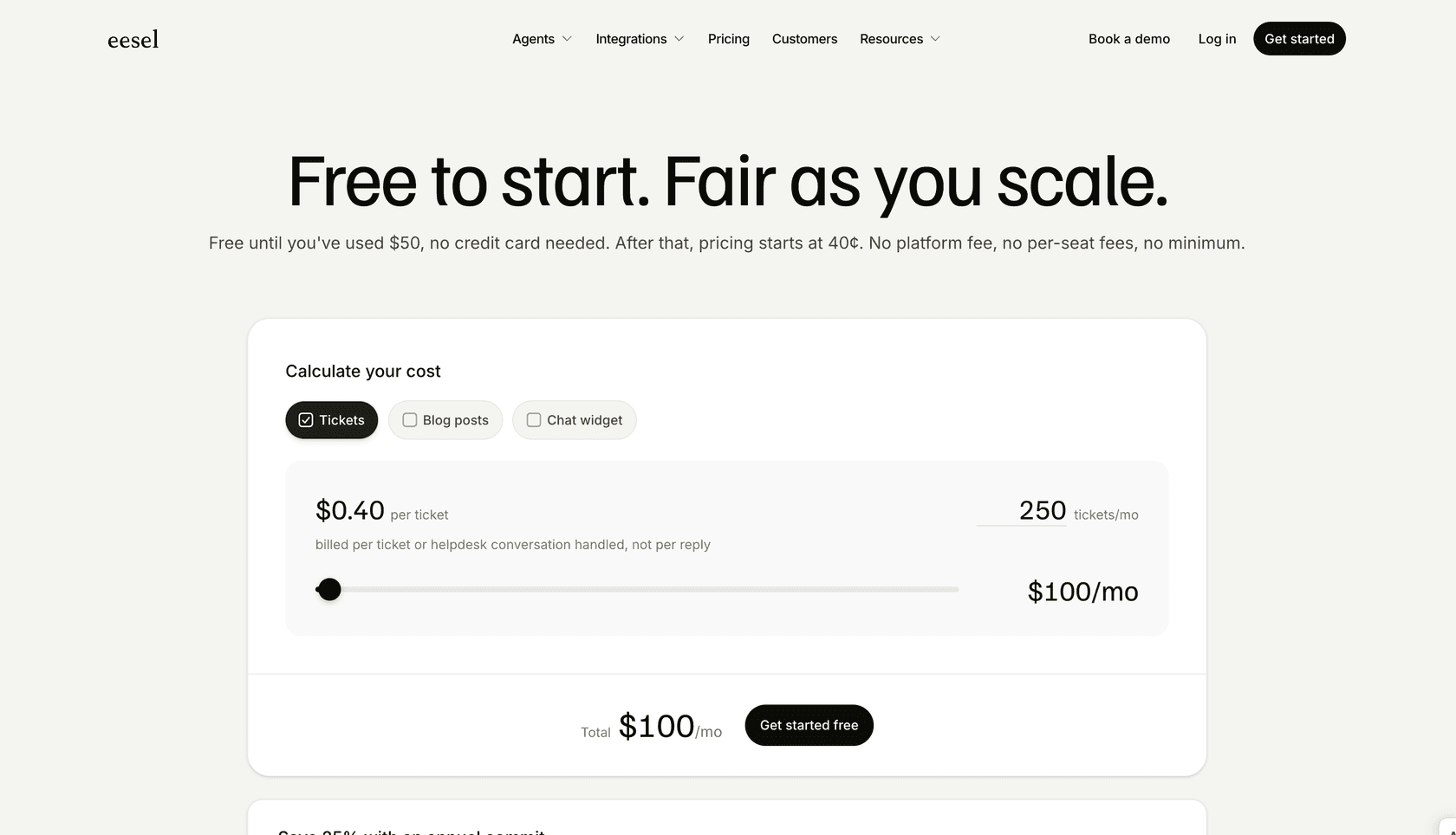
This doesn't include implementation costs, training time, or potential integration development. For comparison, eesel AI's pricing starts at $239/month (annual) for up to 3 bots and 1,000 interactions, with no per-seat fees. A similar 10-agent team with 3,000 interactions would pay approximately $639/month on the Business plan.
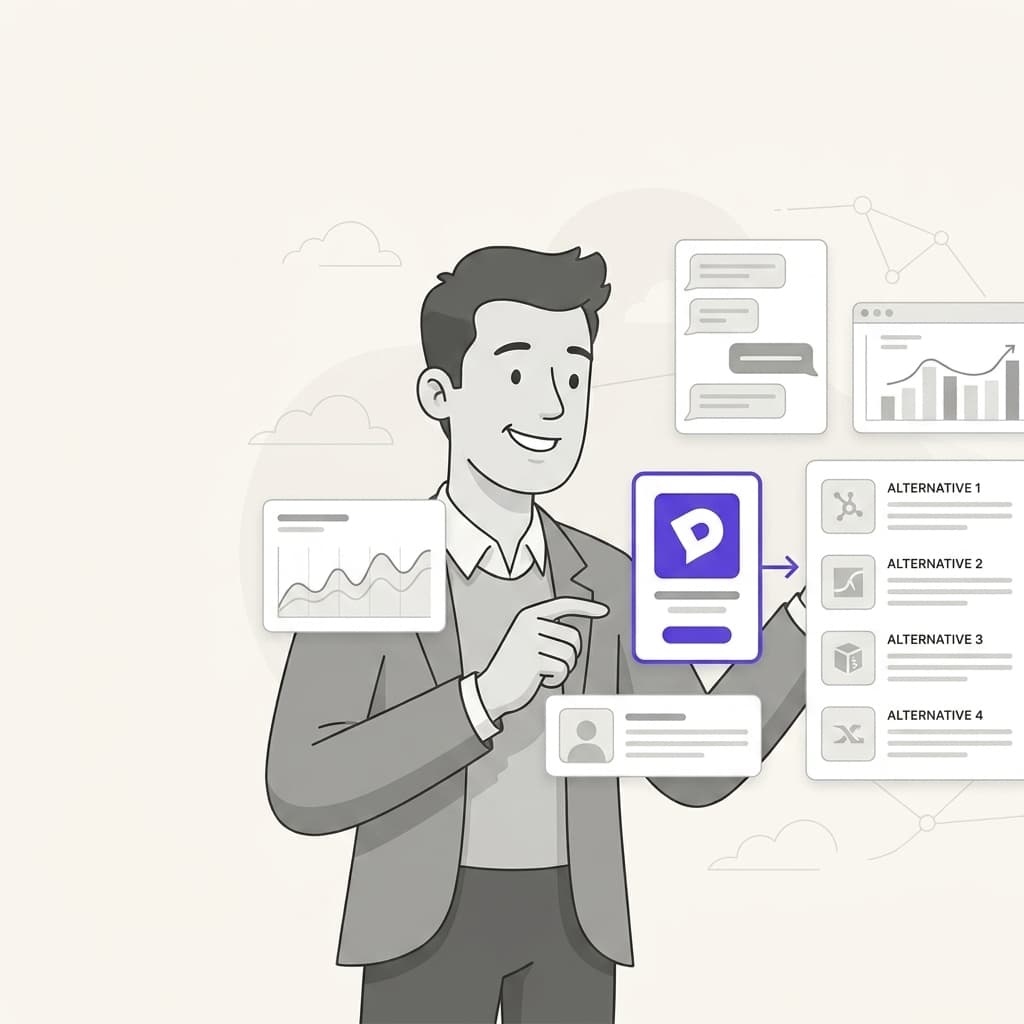
Kustomer vs alternatives: Choosing the right approach
Comparison with other platforms
Zendesk remains the market leader with extensive integrations and flexibility. Kustomer positions itself as a more modern, CRM-first alternative to Zendesk's ticket-based model. For teams considering this transition, our Zendesk AI analysis covers the key differences.
Freshdesk offers a more affordable entry point with solid AI features through Freddy AI. The Freshdesk vs Zendesk comparison helps teams understand where each platform excels.
Gorgias competes closely with Kustomer on AI capabilities for e-commerce, with pricing that can become expensive at scale.
Platform vs teammate approach
The fundamental difference is between Kustomer's platform approach and eesel AI's teammate model:
Kustomer (Platform approach):
- Requires migrating to their CRM
- Extensive configuration and workflow building
- Seat-based pricing scales with team size
- Best for: Large teams with dedicated ops resources, complex multi-brand needs, organizations ready to consolidate on a single platform
eesel AI (Teammate approach):
- Works with existing help desk (Zendesk, Freshdesk, Gorgias, etc.)
- Learns from existing data in minutes, not weeks
- Usage-based pricing, no per-seat fees
- Best for: Teams wanting immediate value without platform migration, organizations with limited technical resources, companies wanting to test AI before full commitment
Progressive rollout
One advantage of the teammate approach is progressive deployment. With eesel AI, teams can start with the AI drafting replies for agent review, then expand to autonomous handling as confidence grows. This "start with guidance, level up to autonomous" model reduces risk compared to all-or-nothing platform switches.
Implementation considerations
Rolling out Kustomer self-service involves several phases:
Timeline expectations: Full deployment typically takes weeks to months, depending on integration complexity. Data migration, workflow configuration, and team training all require dedicated time.
Integration requirements: Kustomer offers 100+ pre-built integrations, but custom integrations may require development resources. E-commerce teams should verify Shopify (or other platform) connection capabilities upfront.
Change management: Support teams need training on the new CRM interface, AI handoff procedures, and updated workflows. The shift from ticket-based to customer-centric thinking requires mindset changes, not just tool training.
Knowledge base quality: AI effectiveness depends on help center content. Teams should audit existing documentation and plan updates before launch. Gaps in knowledge base coverage become gaps in AI capabilities.
For a practical framework on implementation, see our guide to mastering AI and automation in customer support.
Getting started with AI-powered self-service
Choosing the right self-service approach depends on your team's specific situation:
-
Consider Kustomer if: You're already planning a CRM migration, have dedicated technical resources for implementation, need complex multi-brand support, and have budget for seat-based pricing at scale.
-
Consider alternatives like eesel AI if: You want to enhance your existing help desk without migration, need faster time-to-value, prefer usage-based pricing, or want to start with guidance before full automation.
The most important factor is matching the solution to your team's readiness. Self-service succeeds when it genuinely helps customers and reduces agent workload not when it creates new friction points.
For teams wanting to explore AI self-service without platform commitment, eesel AI's chatbot offers simulation capabilities to test performance on historical tickets before going live. This "test before you deploy" approach can build confidence and identify gaps before customers experience them.
Whatever platform you choose, start with clear metrics for success. Whether it's deflection rate, response time, or customer satisfaction, having baseline measurements lets you demonstrate ROI and iterate toward better outcomes.

Share this article

Article by
Stevia Putri
Stevia Putri is a marketing generalist at eesel AI, where she helps turn powerful AI tools into stories that resonate. She’s driven by curiosity, clarity, and the human side of technology.