Hypotenuse AI vs Writesonic: An in-depth comparison for 2026

Amogh Sarda
Last edited January 26, 2026
Trying to choose the right AI writer these days feels a bit like navigating a packed food court. Do you go for the specialized pizza place or the all-you-can-eat buffet? Every tool promises to make your life easier, but they’re all getting incredibly specialized. Two of the big names you'll run into are Hypotenuse AI and Writesonic. Both are powerful, but they’re built to solve very different problems.
Most of them are technically speaking GPT3 wrappers. Meaning they call the API in the background. They normally don‘t have their own models and most of them suck if they have. The user interface might be nice but honestly just use GPT3 or GPT4 in ChatGPT or get a developer account o pay in tokens for ChatGPT3.

The game is changing, too. It's not just about ranking on Google anymore. With the rise of AI-powered search, where tools like ChatGPT and Perplexity answer questions directly, AI is changing search and making it harder to get your brand seen.
This article will help you cut through the noise. We will do a deep dive into Hypotenuse AI vs Writesonic, breaking down their features, pricing, and who each tool is for. For those whose main goal is scaling organic traffic with blog content, we’ll also discuss the eesel AI blog writer, which offers a focused, publish-ready workflow.
What is Hypotenuse AI?

Hypotenuse AI is a specialized AI platform for e-commerce. It's not trying to be a jack-of-all-trades. Instead, it’s laser-focused on helping e-commerce brands and large teams manage and scale the massive task of creating content for product catalogs.
If you’ve ever had to write descriptions for hundreds (or thousands) of products, you know how soul-crushing it can be. Hypotenuse AI is built to take that pain away.
Here’s what it does best:
- Product content generation: Its biggest strength is the ability to generate thousands of product descriptions and titles in one go. You feed it your product data, and it spits out copy that matches your brand’s voice.
- Data & image enhancement: It goes beyond text. The platform can use AI to automatically fill in missing product details and even has an AI batch editor to clean up your catalog images and make them look studio-quality.
- Factual article writing: For blog content, it has a neat feature called Content Detective. It actively researches a topic in real-time to extract facts from the web. This is great for creating credible, well-sourced articles without having to do all the manual research yourself.
What is Writesonic?
Writesonic takes a completely different approach. It bills itself as the only platform that helps you track and boost your brand’s visibility across both traditional search (Google) and AI search (like ChatGPT, Gemini, and Perplexity). This is a pretty big deal.
Its core idea is something called Generative Engine Optimization (GEO). In simple terms, GEO is the practice of making sure your brand gets mentioned and cited when AI models answer questions related to your industry. If someone asks an AI chatbot "what's the best tool for X?" you want your name to pop up.
Here are its main features:
- AI visibility analytics: This is the heart of GEO. Writesonic can monitor your brand mentions, sentiment, and share of voice across more than 10 different AI platforms, so you know where you stand.
- Action center: It doesn't just give you data; it tells you what to do with it. The Action Center points out "citation gaps," where competitors are mentioned but you aren't, and even generates outreach email templates to help you get included.
- SEO and content suite: Alongside the GEO tools, it has a full suite for traditional SEO. This includes an AI Article Writer, SEO site audits, and content strategy tools that pull in live data from Google.
Feature comparison
Target audience
- Hypotenuse AI: This platform is built for e-commerce teams, agencies, and digital merchandisers. The entire workflow is designed around managing huge product catalogs. If your world revolves around SKUs, product data, and getting product detail pages live, Hypotenuse is speaking your language.
- Writesonic: This tool is designed for marketing directors, SEO managers, and content teams. Its focus is squarely on winning visibility wherever people are searching. It combines the old-school discipline of SEO with the new frontier of Generative Engine Optimization (GEO).
Unique features
Sometimes a simple table makes it easiest to see the differences. Here’s a breakdown of what makes each platform unique.
| Feature | Hypotenuse AI | Writesonic |
|---|---|---|
| Core Focus | E-commerce Product Content & Data | SEO & Generative Engine Optimization (GEO) |
| Standout Feature | Bulk Content & Data Workflows: Enrich product data, generate thousands of descriptions, and edit images in batches. | AI Visibility Tracking (GEO): Monitors brand mentions and citations across ChatGPT, Gemini, Perplexity, and more. |
| Integrations | Deep e-commerce integrations, including a direct connection to Shopify. | Integrates with Google Search Console, Google Analytics, and offers a Zapier connection. |
| Content Research | Content Detective: Researches live web content to find facts and sources for creating credible, cited articles. | Real-Time Data: Uses live Google data for keyword research and SERP analysis to inform content creation. |
| Actionability | Streamlines the path from raw product data to a live, optimized product detail page. | Action Center: Identifies specific visibility gaps and provides workflows (e.g., outreach) to close them. |
Content quality
- Hypotenuse AI: The emphasis here is on factual accuracy and brand consistency. Its Content Detective is all about pulling in real sources, making it great for articles that need to be trustworthy. For e-commerce, its ability to learn your brand voice ensures all that bulk-generated copy actually sounds like you.
- Writesonic: The focus is on creating content that is built to rank and get cited by other AI engines. Its AI Article Writer 6.0 is designed to produce source-backed articles with fact-checking and even adds internal links automatically. It’s all about optimizing for both Google and the new wave of AI answer engines.
Pricing breakdown
Hypotenuse AI pricing
Hypotenuse AI splits its pricing based on whether you're focused on marketing content or e-commerce workflows.
- Marketing & SEO Plans:
- Entry Plan: Starts at $29/month for 50,000 words. If you pay for the year upfront, it's $19/month.
- Essential Plan: Jumps to $87/month for 250,000 words, or $56/month if billed annually.
- E-commerce Plans: For the heavy-duty e-commerce features like bulk generation and data enrichment, you'll need to talk to them for custom pricing.
They also offer a 7-day free trial so you can poke around and see if it works for you.
Writesonic pricing
Writesonic's pricing is a bit more straightforward, but it’s important to pay attention to which features are included in each plan.
- Free Trial: They offer a free plan to let you get a feel for the basic tools.
- Paid Plans:
- Lite Plan: This plan starts at $49/month and gives you access to the SEO and content tools, but it does not include the GEO features.
- Professional Plan: This is the first plan that includes their core differentiator, the AI Search Tracking (GEO). It starts at $249/month, or $199/month if you pay annually.
- Enterprise Plan: This is custom pricing for teams that need unlimited usage, full access to the Action Center, and a dedicated GEO strategist to help guide them.
The key takeaway here is that if you're interested in Writesonic for its unique GEO capabilities, you need to be looking at the Professional plan or higher.
An alternative for publish-ready SEO blogs: eesel AI
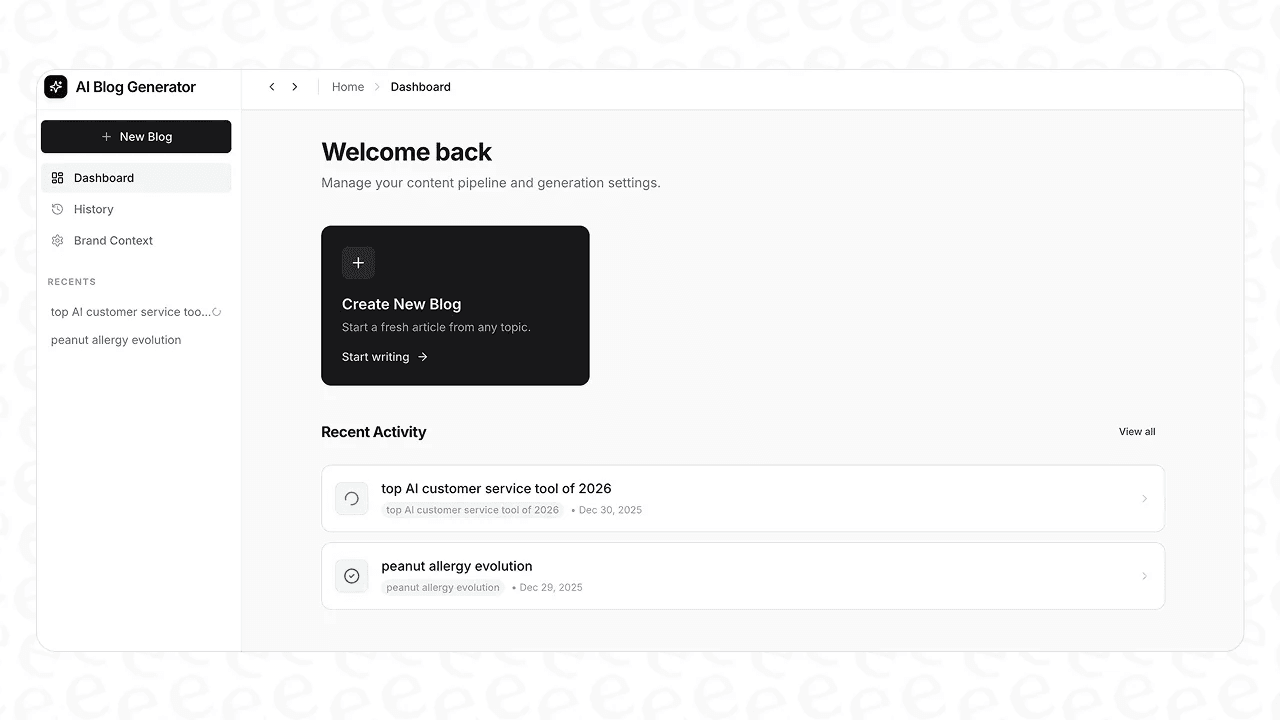
This tool was used to grow the eesel AI blog's traffic from 700 to 750,000 daily impressions in three months. It is designed as a specialized writer for driving traffic.
Here’s what makes it different and addresses common challenges in blogging:
- One-click from keyword to complete post: From a keyword, it generates a fully structured article, including an introduction, headings, a conclusion, and an FAQ section. The output is a complete draft rather than a rough outline.
- Automatic assets included: The eesel AI blog writer automatically generates and embeds relevant assets like images, charts, and tables into the post, which can save time on sourcing visuals.
- Authentic social proof: The tool finds and embeds relevant quotes from Reddit and clips from YouTube to add social proof and authenticity.
- Context-aware research: It performs context-aware research. For example, it pulls pricing data for comparison posts or technical specifications for product reviews to ensure the content is detailed.
It is free to try, allowing you to generate a full blog post to evaluate the quality.
When to choose Hypotenuse AI vs. Writesonic
So, after all that, which one should you choose? It really comes down to your primary goal.
- Choose Hypotenuse AI if: you run an e-commerce business or agency. If your main job is creating and managing product descriptions, enriching product data, and enhancing catalog images at scale, this tool is custom-built for your workflow.
- Choose Writesonic if: you are a marketing or SEO professional looking for an all-in-one platform. If you need a toolkit for creating content, running SEO analysis, and, most importantly, tracking and improving your brand's visibility in AI search engines (GEO), then Writesonic is the way to go.
For teams whose primary mission is to consistently publish SEO-optimized blogs with minimal pre-publication work, a specialized tool like the eesel AI blog writer can be an effective option.
For a visual breakdown and to see these platforms in action, the video below provides a direct comparison of Writesonic and Hypotenuse AI, helping you understand their features and interfaces.
Final thoughts
At the end of the day, the choice between Hypotenuse AI and Writesonic is a choice between two different strategies. Hypotenuse AI is the specialist for e-commerce content operations, designed to master the world of product data. Writesonic is the comprehensive suite for modern marketers who need to win on both traditional search and the new frontier of AI-driven answers.
The best tool is always the one that fits your team's workflow and helps you hit your main business goals.
If that main goal is to drive organic traffic with blog content, you can generate your first blog for free with the eesel AI blog writer and see the difference firsthand.

Frequently Asked Questions
Share this article

Article by
Amogh Sarda
CEO of eesel AI. Amogh Sarda is obsessed with making the ultimate AI for customer service teams. He lives in Sydney, Australia and has previously worked at Atlassian and Intercom. Outside of work he’s usually surfing or on stage doing improv.