How to increase organic traffic: A comprehensive guide

Stevia Putri
Last edited January 15, 2026
Trying to get more people to visit your website can feel like shouting into the void. You create good content, hit publish, and... crickets. What’s the deal? Often, the missing piece is organic traffic. These are the people who find you through a search engine simply because you have the answer to their question. This kind of traffic is great because it’s targeted, doesn't cost you per click, and tends to grow over time.
But getting that traffic is tough. It demands patience, consistency, and a clear plan. It really comes down to three main things: making sure your website is technically sound, consistently publishing helpful content that people actually want to read, and building a trustworthy reputation online.
What exactly is organic traffic?
Before we get into the tactics, let's quickly define what we're talking about. Organic traffic is just people who find your website through unpaid search results. They type something into Google, see your page, click the link, and land on your site. That's it.
- Paid Traffic: Comes from ads you pay for, like on Google.
- Direct Traffic: When someone types your URL straight into their browser.
- Referral Traffic: Visitors who follow a link from another website to yours.
Most people agree organic traffic is the best kind because it's sustainable. If you rank for a keyword, you can get clicks for months or years without paying for them. It also helps build your brand's credibility.
Build a solid foundation for organic traffic
You wouldn't build a house on a shaky foundation, and the same goes for your website. Before you can succeed with content, your site needs to be technically sound, fast, and easy for people to use. These core elements make sure search engines can find, understand, and rank your pages.
Master keyword research and search intent
Everything starts with knowing what your audience is actually searching for. As Google suggests, you should think about the words a user might type to find your content.
But it's not just about the words themselves, it's about the reason they're searching. This is called search intent. Are they looking for information, a specific website, product comparisons, or are they ready to buy? Figuring this out helps you create content that gives them what they need.
Pro tip
Don't just chase the huge, competitive keywords. Look for long-tail keywords, which are longer, more specific phrases like 'how to increase organic traffic for a new blog.' They usually have less competition, and the people searching for them are often more serious about taking action.
Prioritize user experience and site performance
Have you ever clicked a search result only to leave immediately because the page took ages to load? We all have, and Google doesn't like it. Google is focused on a great page experience, and its Core Web Vitals are important for ranking. A slow or clunky website is a fast track to the second page of search results.
A mobile-friendly site is also a must. Google uses mobile-first indexing, meaning it primarily evaluates the mobile version of your site for ranking. If your website is a disaster on a phone, your rankings will take a hit.
Finally, make your site easy to navigate for both people and search engine bots. A logical site structure with clear menus and simple, descriptive URLs helps everyone figure out what your site is about.
Conduct regular technical SEO audits
A technical SEO audit is like a regular health checkup for your website. It helps you spot and fix problems that could be hurting your rankings without you even knowing it.
I created and published a website 2 weeks ago but traffic is extremely low and it's not growing. How much time it should take to gain some traffic growth from 0 views to 100views per day? Month, years? How long it will take to appear in Google Search\Bing? Should I add constantly new content, how frequently? Do you have any advice for launching or source for learning how to get more traffic?

You should check for things like:
- Broken links (404 errors): These are frustrating for users.
- Incorrect indexing: Are there pages Google shouldn't be seeing, or important ones it's missing?
- Duplicate content: Having the same content on multiple pages can be confusing for search engines.
You don't have to be a developer to start. Free tools like Google Search Console are a great place to begin. Its URL Inspection Tool, for example, shows you exactly how Google views a specific page on your site. For an extra edge, you can use schema markup to help search engines understand your content better, which can result in "rich results" like star ratings or FAQs appearing in the search listings.
Increase organic traffic with content marketing
Once your technical foundation is solid, it's time to focus on content. High-quality, relevant content is the engine for your organic growth. It's what brings people to your site, builds trust, and can turn visitors into customers.
Create people-first content based on E-E-A-T
- Experience: Do you have real-world knowledge of the topic?
- Expertise: Do you have the skills to be considered an authority?
- Authoritativeness: Are you a recognized source in your field?
- Trust: Is your site and its content dependable?
Google even updated its guidelines in late 2022 to add "Experience," showing it values content from people who have direct experience with the topic. Originality, depth, and a unique perspective are what will help your content stand out.
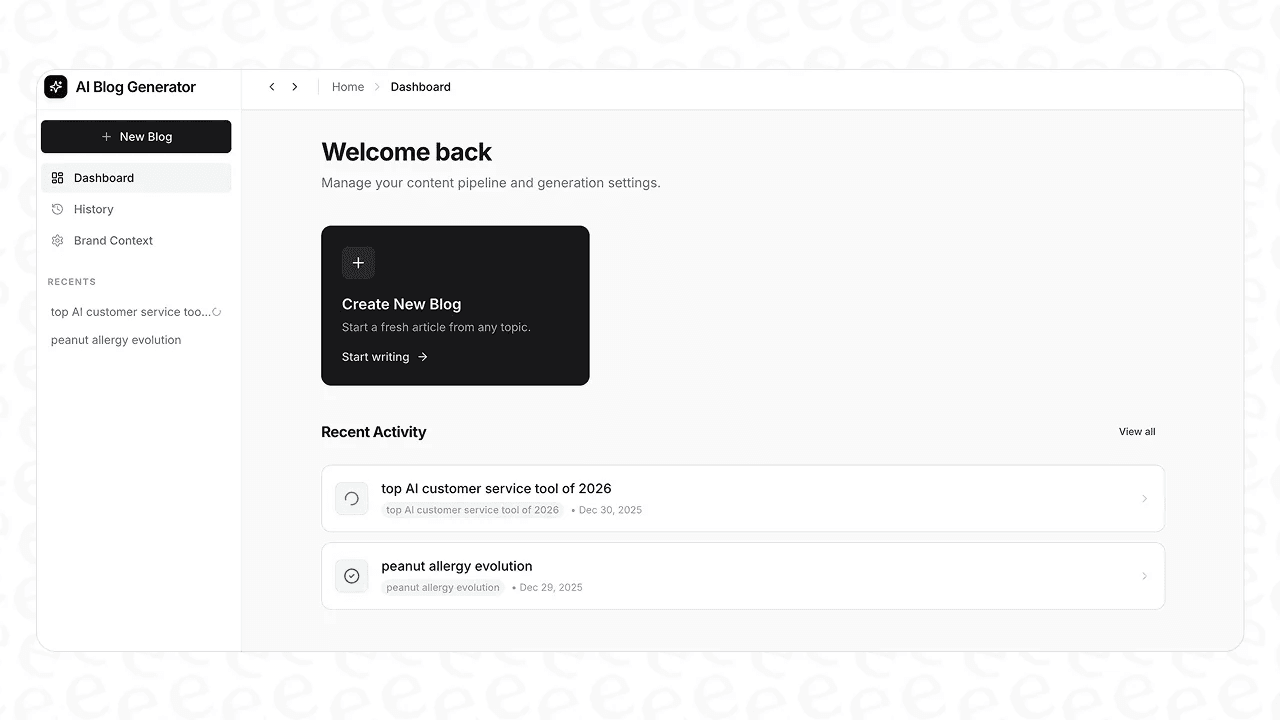
Scale content production with the eesel AI blog writer
The main problem is that creating high-quality, E-E-A-T-friendly content takes a lot of time. The typical workflow involves research, outlining, drafting, finding images, editing, and formatting. It’s a manual process with many steps that makes it tough to publish consistently.
It is designed to address several content creation challenges:
- Context-aware research: It does more than generic AI. If you're writing a comparison post, it finds pricing data. For a product review, it looks for technical specs.
- Automatic asset generation: It doesn't just give you text. It creates and embeds AI images, infographics, and tables, which saves you hours of work.
- Authentic social proof: It finds relevant YouTube videos and real Reddit quotes to include in your post, adding credibility and real-world perspective.
- Built-in AEO: It structures content not just for old-school SEO but also for AI Answer Engines like Google's AI Overviews, making your content ready for the future.
We use this tool ourselves. It’s how we grew our own organic traffic from 700 to 750,000 daily impressions in only three months.
Refresh and repurpose your old content
Your existing content is a valuable asset. Instead of always starting from scratch, go back and update your older blog posts. Adding new information, current statistics, and fresh keywords can give your rankings a nice boost with much less effort. Google likes to see fresh content, and updating a post signals that it's still relevant.
You can also repurpose content to get more out of it. A single detailed blog post can be turned into:
- A YouTube video
- An infographic
- A series of social media posts
- An email newsletter
This approach helps you reach new people on different platforms without having to create something new every single time.
Build off-page authority for organic traffic
Having great content on a technically sound site is a big piece of the puzzle. But to really move up in the search rankings, Google needs to see that other reputable websites trust you. This is where off-page SEO comes in.
Develop a high-quality backlink strategy
Backlinks are simply links from other websites to yours. To Google, they're like votes of confidence. The more high-quality, relevant sites that link to you, the more authoritative your own site looks.
So, how do you get them?
- Guest blogging: Write an article for another respected site in your industry and include a link back to your site.
- Broken link building: Find broken links on other websites and suggest they replace them with a link to your relevant content.
- Create "link bait": Make amazing content that people will want to link to on their own, like original research, a free tool, or a detailed guide (like this one!).
Just be careful. Stay away from "black hat" tactics like buying links. It might seem like a quick win, but it can lead to a Google penalty, which is very hard to recover from.
Leverage social media and online communities
While social media shares and likes don't directly affect your rankings, they can help indirectly. A strong social media presence gets your content seen by more people, drives referral traffic, and puts it in front of individuals who might link to it.
Pro tip
Don't just post your content and leave. Participate in relevant online communities like Reddit or industry forums. Answering questions and sharing your knowledge can build your brand's reputation and send engaged traffic back to your site. This is also a great way to find real quotes and insights for your content, a tactic the eesel AI blog writer automates by embedding social proof for you.
Comparing different content creation workflows
Creating content consistently requires a repeatable process. Here’s a quick look at the common approaches and how they compare.
| Method | Description | Pros | Cons |
|---|---|---|---|
| In-house Writer | A full-time employee focused on content creation. | Consistent brand voice, deep product knowledge. | Involves salary and benefits; output is based on individual capacity. |
| Freelancers/Agencies | Outsourcing content creation to external writers. | Flexible, can handle large volumes. | Cost and quality can vary depending on the provider. |
| Manual Multi-Prompt AI | Using general AI tools like ChatGPT with a series of prompts. | Low initial cost, good for ideas. | Requires significant manual effort for editing, fact-checking, and asset creation. |
| eesel AI blog writer | A single-click process that generates a complete post from a keyword, priced at $99 for 50 blogs. | Efficient process that includes assets and is SEO/AEO optimized. | Best for long-form blog content. |
For a deeper dive into SEO strategies, the following video from Neil Patel offers some quick and effective techniques that you can apply right away.
Your game plan for more traffic
Content is often the most demanding part of this process, but it's also where you'll see the biggest and most lasting results. If you get your content strategy right, you're on the right track.
Start building your content engine today
Ready to get started? The biggest impact you can have is on your content creation process.
You can implement a strong content strategy without the usual high costs and time commitment. Give the eesel AI blog writer a try for free and generate your first publish-ready blog post in just a few minutes. It's a no-risk way to start scaling your organic growth.

Frequently Asked Questions
Share this article

Article by
Stevia Putri
Stevia Putri is a marketing generalist at eesel AI, where she helps turn powerful AI tools into stories that resonate. She’s driven by curiosity, clarity, and the human side of technology.
