How to expand internationally with content: A complete guide

Stevia Putri

Katelin Teen
Last edited January 19, 2026
Taking your brand global is a huge step, and it's definitely exciting. The chance to tap into new markets is massive, but it's not as easy as just flipping a switch. Think about it: 75% of customers would rather buy products in their own language. To actually reach them, you need more than a translated homepage; you need to build real connections with content that understands their culture.
And that's where it gets complicated. Expanding content internationally can be a logistical challenge. It's complex, potentially costly, and manual processes can lead to mistakes. You just can't scale when you're juggling different languages, cultures, and time zones by hand.
With a clear plan and the right tools, the process becomes much more manageable. AI platforms like the [eesel AI blog writer](https://www.eesel.ai/product/ai-blog-writer) can help you research, create, and translate content for different markets, streamlining the workflow.A lot of indie devs start by managing JSON or YAML files manually, which works fine initially but becomes a huge pain to keep in sync with non-technical team members (like a writer or a translator).

In this guide, we'll break down three main steps: building a solid strategy, localizing your content effectively, and implementing the right technical SEO so people can find you.
What is international content marketing?
International content marketing is just what it sounds like: planning, creating, and sharing content for audiences in different countries. This involves much more than just plugging blog posts into a translation app.
Real international content marketing is all about localization. It means adapting your entire message to fit the local culture, which includes currency, units of measurement, date formats, social norms, and even humor. It’s a balancing act between keeping your brand consistent and speaking in a way your new audience actually connects with.
It breaks down into a few key parts:
- Localization: This is the practical side of things, making sure your content fits the cultural, linguistic, and social norms of a specific market.
- Cultural Adaptation: This part is a little more subtle. It’s about tweaking your messaging, tone, and even the images you use to click with local values. A joke that works in one culture might not land well, or could even be offensive, in another.
- Standardization: While you're busy adapting, you still need to keep your core brand message consistent everywhere. People should recognize your brand no matter where they find you.
The main goal is to be recognizable as a global brand but feel relatable like a local one. Get that balance right, and you'll start to see real engagement and growth.
Step 1: Build your foundational strategy
Before you write a single word or translate a single page, you need a solid strategy. This phase is all about research and planning. Jumping in without a plan is the fastest way to waste a ton of time and money on content that never finds its audience.
Identify your target markets
It’s tempting to try and launch everywhere at once, but that can lead to poor results. Instead, be strategic and let data guide your decisions.
A great place to start is your existing website traffic. Fire up Google Analytics 4 and look at your engagement by country. You might be surprised to find you already have a small but growing audience in a country you hadn’t considered. This can reveal untapped demand and give you a huge head start.
Beyond existing traffic, think about things like market size, the level of competition, and cultural fit. Sometimes, a smaller, less competitive market where your product is a perfect fit can be a much better starting point than a huge, oversaturated one.
A smart approach is to pick one or two "test markets" where you already have some traction. This lets you experiment and refine your localization strategy on a smaller scale before you commit to a wider rollout.
Conduct deep audience research
Once you’ve picked your markets, it’s time to get to know the people who live there. It's important to really get to know them. Basic demographics aren't enough; you need to understand their cultural nuances, values, pain points, and how they behave online.
Here are a few ways to dig in:
- Surveys and Interviews: If you can, talk to people in your target region. There’s no substitute for getting firsthand insights directly from your potential customers.
- Social Listening: See what people are talking about on local social media platforms. This is a great source for understanding trends, common frustrations, and what your audience truly cares about.
- Competitor Analysis: Look at the successful local players in your industry. How do they talk to their audience? What content formats do they use? What’s their tone of voice? You can learn a lot from what’s already working.
Based on this research, create local buyer personas. A buyer persona for a customer in the US will likely be very different from one for a customer in Japan or Brazil. These personas will be your north star for all the content you create.
Perform localized keyword research
This is a critical step. Simply translating your English keywords is often ineffective. Local search behavior is completely different, and understanding these nuances is critical. For example, someone searching for glasses in Mexico might type "lentes," while someone in Spain would use "gafas." A direct translation would miss one of those audiences completely.
Here’s a quick process to follow:
- Use an SEO tool like Ahrefs or Semrush to find relevant keywords in the local language. Start with your core topics and see what people are actually searching for.
- Analyze the search intent. Are people looking for informational content ("what is..."), product comparisons ("best..."), or how-to guides ("how to...")? The intent will dictate the kind of content you need to create.
- Do an incognito search for your target keywords in the target country (you can use a VPN for this). Look at the search engine results page (SERP). What kind of content is already ranking? This gives you valuable clues about the format, structure, and depth that Google prefers for that query.
A 3-step workflow diagram explaining the process for localized keyword research.
Step 2: Scale content localization
Okay, you've got a strategy. You know who you're targeting and what they're searching for. The next challenge is producing high-quality, localized content at a scale that can make an impact. This is a common bottleneck in international expansion. Manually creating unique content for multiple markets is incredibly slow and expensive.
Go beyond translation to true localization
- Translation is simply changing words from one language to another. It’s a literal, one-to-one process.
- Localization is adapting the entire message for the cultural context. It’s about making the content feel like it was created for that audience.
Here are a few practical examples of what localization looks like:
- Imagery: Using photos of models, cities, and settings that look familiar to the local audience makes your content instantly more relatable.
- Humor and Idioms: Jokes and common phrases rarely translate well. It’s best to avoid them or work with a local expert to find a culturally appropriate equivalent.
- Content Formats: Some cultures might prefer long-form, detailed articles, while others might engage more with short-form videos or infographics. Your research should inform your format choices.
- CTAs: Even your calls-to-action (CTAs) might need a tweak. A direct, punchy CTA that works great in the US might be perceived as too direct in some Asian markets, where a softer approach is often more effective.
Using the eesel AI blog writer for international content
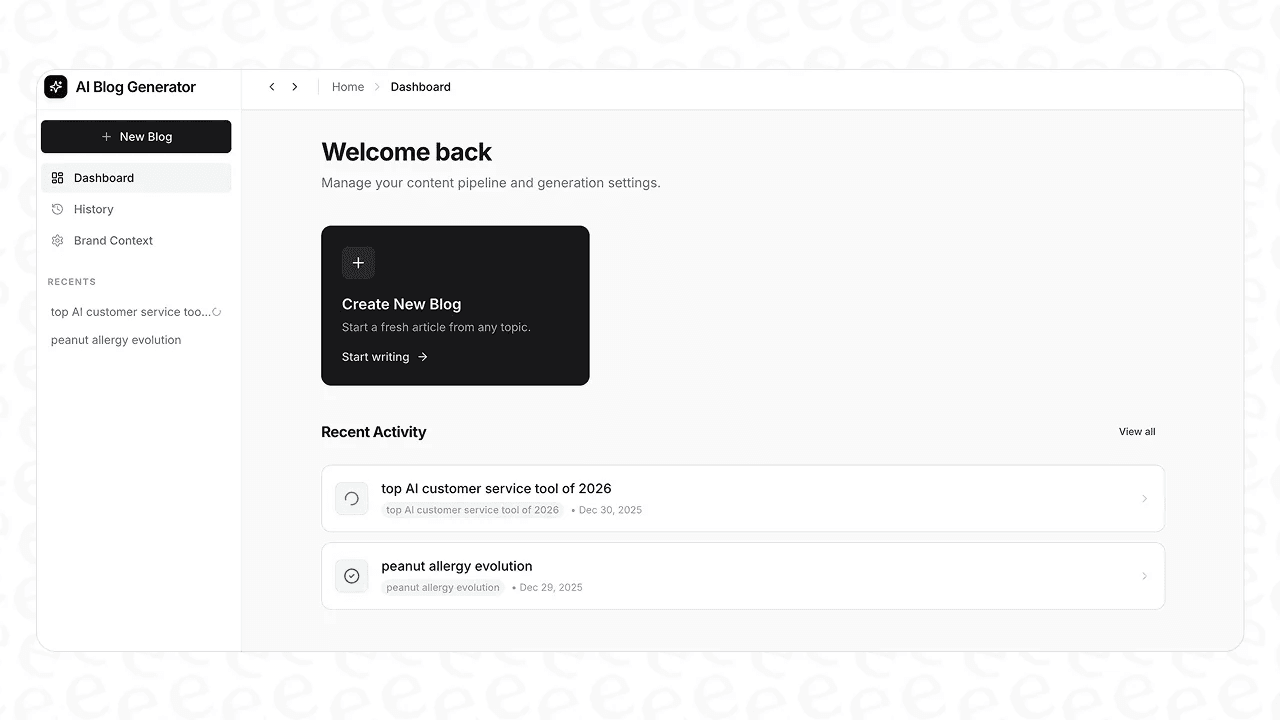
AI tools like the eesel AI blog writer are designed to help with this process. It's the tool we used to scale our own content efforts, growing from 700 to over 750,000 daily impressions in just three months by publishing over 1,000 optimized blogs. It helps teams create high-quality, localized content at scale.
Here are the features that make it perfect for international expansion:
- One-Click Translation: It can translate a full, media-rich blog post into any language with a single click. You can multiply your reach instantly with almost zero extra effort.
- Deep Research: The AI produces deeply researched content, not just generic fluff. This is crucial for creating valuable articles that actually resonate with local audiences and address their specific needs.
- Automatic Asset Generation: Sourcing culturally appropriate visuals is a time-consuming task. eesel AI automatically creates images, infographics, and tables for your posts, saving you hours of work.
- Social Proof Integration: To add local flavor and credibility, it can find and embed real quotes from Reddit threads and relevant YouTube videos. This makes your content feel more authentic and trustworthy.
- Brand-Aware Content Generation: You just add your website and brand context, and the AI ensures the content sounds like you, maintaining your brand voice even when targeting completely new markets.
Pro tip
Use the eesel AI blog writer to generate a foundational, deeply researched blog post for your primary market. Then, use the built-in translation feature to create versions for your other target regions. From there, you can use the AI editor to quickly swap out cultural references, adjust the tone, and make any final tweaks. What used to take days now takes minutes.
Step 3: Master distribution and technical SEO
Creating localized content is only half the battle; it also needs to be discoverable. You need to make sure your content reaches the right audience and that search engines can properly understand and serve the correct version of your site to users in different locations.
Choose the right international URL structure
Here’s a quick breakdown to help you decide:
| Feature | ccTLD (example.de) | Subdomain (de.example.com) | Subdirectory (example.com/de) |
|---|---|---|---|
| Country Targeting | Strongest signal | Medium signal | Medium signal |
| SEO Authority | Diluted across domains | Diluted, often seen as a separate site | Consolidated on one domain |
| Maintenance / Cost | High (multiple domains) | High (multiple sites to manage) | Low (one website) |
| Best For | Companies with significant resources and a strong focus on a single country. | Can be used, but may split SEO efforts. | Most businesses, as it's easier to manage and consolidates domain authority. |
While Google says it doesn't have a preference, many SEO experts recommend subdirectories for most businesses. Why? Because they consolidate all your SEO authority onto a single domain, making it stronger overall, and they are far easier and cheaper to manage.
Implement hreflang tags correctly
While this sounds technical, the concept is straightforward. Hreflang tags are small snippets of code you add to your website that tell search engines, "Hey, this page is for English speakers in the UK," and "This other page is the version for German speakers in Germany."
This is critical for preventing duplicate content issues and ensuring Google serves the right page to the right user. Incorrect implementation can negatively affect your SEO.
Here are a few best practices to follow:
- Use Proper Codes: Always use the correct two-letter codes for language (ISO 639-1) and region (ISO 3166-1 Alpha 2). For example,
en-GBfor English in Great Britain. - Implement Return Links: A common mistake is forgetting this step. If your
en-USpage has a hreflang tag pointing to theen-GBversion, theen-GBpage must have one pointing back. They have to be reciprocal. - Include a Self-Referencing Tag: Each page should also have a hreflang tag that points to itself.
- Use
x-default: Add a taghreflang="x-default"to specify which page should be shown to users in regions you haven't specifically targeted. This acts as a catch-all.
Promote content on local channels
Social media habits vary significantly from country to country. The platforms you use to promote content in North America might not be the most popular ones in Europe or Asia.
Your distribution strategy needs to be localized, too:
- Social Media: Do your research and prioritize the platforms where your target audience actually spends their time.
- Local Link Building: Getting backlinks from relevant, authoritative websites within your target country is one of the strongest signals you can send to Google that your content is relevant for that region.
- Email Newsletters: Don’t forget about email. Tailor your campaigns for each market, paying attention to time zones, local holidays, and cultural events. A "Happy 4th of July" email to a German list, for example, would be inappropriate.
Final thoughts
Expanding your brand internationally with content is a significant project. But it’s also one of the most powerful ways to build a truly global brand and drive sustainable growth for years to come.
Let’s quickly recap the playbook:
- Build a data-driven strategy by researching markets and understanding local audiences.
- Use AI to scale your content creation and localization efforts efficiently.
- Master the technical SEO and local distribution to make sure your content gets found.
The key is to think locally while building a scalable global process, which can be streamlined with the right tools.
Ready to generate a complete, localized blog post? Try the eesel AI blog writer for free and create your first piece of content today.

Frequently Asked Questions
Share this article

Article by
Stevia Putri
Stevia Putri is a marketing generalist at eesel AI, where she helps turn powerful AI tools into stories that resonate. She’s driven by curiosity, clarity, and the human side of technology.
