
Creating how-to guides can be time-consuming. You spend hours taking screenshots, writing out every single step, and formatting it all into a document that people might only skim. It's tedious work, and the guide is often outdated the second a button moves in your app.
But what if you could record yourself doing a task once and have an AI create a visual, step-by-step guide for you in minutes? This is now possible. AI-powered tools can generate impressive guides just by watching your workflow, apparently creating documentation 11x faster.
These tools are fantastic at capturing the "how" of a process. But a great guide also needs to explain the "why". It needs an introduction, a conclusion, and the context that turns a simple set of instructions into a resource people can find on Google. That’s where you can combine the power of process capture with a tool like the eesel AI blog writer, which builds a complete, SEO-optimized article around your workflow.
Understanding the basics of AI how-to guides
AI how-to guides are a significant improvement over traditional methods. Instead of manually using a snipping tool and pasting images into a document, these AI tools watch your screen and automatically generate the entire instructional guide for you.
Think of it as having a fast assistant looking over your shoulder. As you click, type, and move through a process, the AI captures every action. Instead of a simple screen recording, it breaks down your workflow into individual steps, takes clear screenshots for each one, and writes out the instructions to go with them.
The output is more than just a text document. Modern AI guide generators create a rich mix of annotated screenshots, neatly written steps, and often a full video complete with an AI-generated voiceover. The AI adds the structure, descriptions, and professional polish that used to take hours of manual work.
Key components of AI how-to guide creators
So, how does this all work? It’s not one single piece of tech but a combination of features working together. Knowing these core components will help you figure out what to look for when picking a tool.
Screen and process capture technology
At the core of every AI guide creator is its ability to watch what you do. This usually works through a browser extension or a desktop app that you turn on before you start your task. It records your actions, every click, scroll, and bit of text you enter, and turns that live demo into structured data for the AI to analyze. Tools like Scribe and Guidde are proficient at this, capturing your workflows across both websites and desktop applications.
AI-powered storyline and description generation
Once your actions are captured, the AI gets to work. It interprets the data and writes out clear, step-by-step instructions for everything you did. Guidde calls this having your storyline magically created, and it can feel like that. The AI handles documenting every single click. For many people, this feature alone can cut documentation time by over 70%. No more trying to remember the exact sequence of steps you took, the AI has it all covered.
Visual editing and customization
The AI-generated draft is a great starting point, but you'll probably want to add your own touch. Good guide creators come with a built-in editor that lets you customize the visuals. You can blur out sensitive information (like customer names or email addresses), crop screenshots to focus on what’s important, and add annotations like arrows or text boxes to give extra context. Most tools also let you apply your company’s branding, like adding your logo and using your brand colors, to make the final guide look professional.
Voiceover and multimedia generation
Some tools can take the written steps and generate a text-to-speech AI narration, giving you a choice of over 200 different voices and languages. Other platforms, like Trainn, offer AI voiceovers in over 25 global languages as well. The AI then automatically stitches the annotated screenshots and narration together into a slick how-to video, often with background music and smooth transitions. You get a professional-looking video tutorial without ever having to touch a video editor or record your own voice.
Top platforms for creating AI how-to guides
There are a bunch of tools out there, but they aren’t all the same. Each one has its own strengths and is built for slightly different needs. Let's break down a few of the most popular platforms to help you figure out which one might be right for you.
Guidde

Guidde is focused on video. You record your screen, and it automatically creates not just a step-by-step guide with screenshots but also a complete how-to video with an AI voiceover.
- Features: It's useful for creating Standard Operating Procedures (SOPs) and visual tutorials quickly. Guidde offers great branding options to make your videos look like your own, and it integrates with many other platforms you may already be using, like Notion, Zendesk, and Salesforce.
- Limitations: The main focus here is video. While you do get a text-and-screenshot guide, the platform is primarily built for video creation. It’s not designed to produce a full-length, SEO-optimized blog post that explains the bigger picture around the steps you captured.
- Pricing: Guidde has a free plan that lets you create up to 25 guides. After that, you'll need to jump on one of their paid plans (Pro and Business) for more advanced features.
Scribe

Scribe is a powerful tool for generating step-by-step guides from annotated screenshots and text. It’s incredibly fast and easy to use.
We started using Scribe a couple months ago. Man, scribe is nice. It's elegant, simple, and quick. The best part is you can embed your scribes in ITG or Hudu or wherever and if you update them in Scribe you don't have to go back and update them everywhere else.

- Features: Scribe automatically generates guides as you work, and the Pro plan lets you capture processes on your desktop and mobile apps, not just in the browser. It has strong editing and redaction features, makes team collaboration simple, and lets you export your guides to PDF, HTML, or Markdown. It also has a feature called Scribe Pages, which lets you combine multiple guides into a larger process document.
- Limitations: Scribe doesn't have the built-in video and AI voiceover capabilities that Guidde does. Its AI is focused on documenting clicks and actions, so it won't create the surrounding story or context needed for a full knowledge base article. The free plan is limited to browser capture, and each process is capped at 200 steps.
- Pricing: Scribe offers a free Basic plan. The paid Pro Team plan starts at $12 per seat per month when billed annually (with a 5-seat minimum), and there's a Pro Personal plan for individuals at $23 per month.
Trainn

Trainn is geared more towards customer education and onboarding. It helps you create interactive product tours and build out entire customer academies.
- Features: From a single screen recording, Trainn’s AI can generate product videos, step-by-step documentation, and interactive walkthroughs that guide users in-app. It supports translation into 25+ languages and lets you embed guides directly into your product or bundle them into a full customer-facing training portal.
- Limitations: This tool is built specifically for customer training. Like the others, it’s excellent for showing someone how to do a task, but it’s not designed to generate a complete, standalone blog post that is optimized to be found through search engines.
- Pricing: Trainn doesn't have a forever-free plan, but it offers a 14-day free trial on its paid plans (Launch, Scale, and Enterprise).
Beyond the workflow: Using the eesel AI blog writer
Process recorders like Guidde and Scribe are amazing for capturing the "how." They save you a ton of time documenting the steps of a task. But a truly helpful how-to guide needs more than just a list of instructions. It needs to explain the "why." It needs context, a proper introduction, and a conclusion. These tools document a task, but they don't create a complete, SEO-optimized article around it.
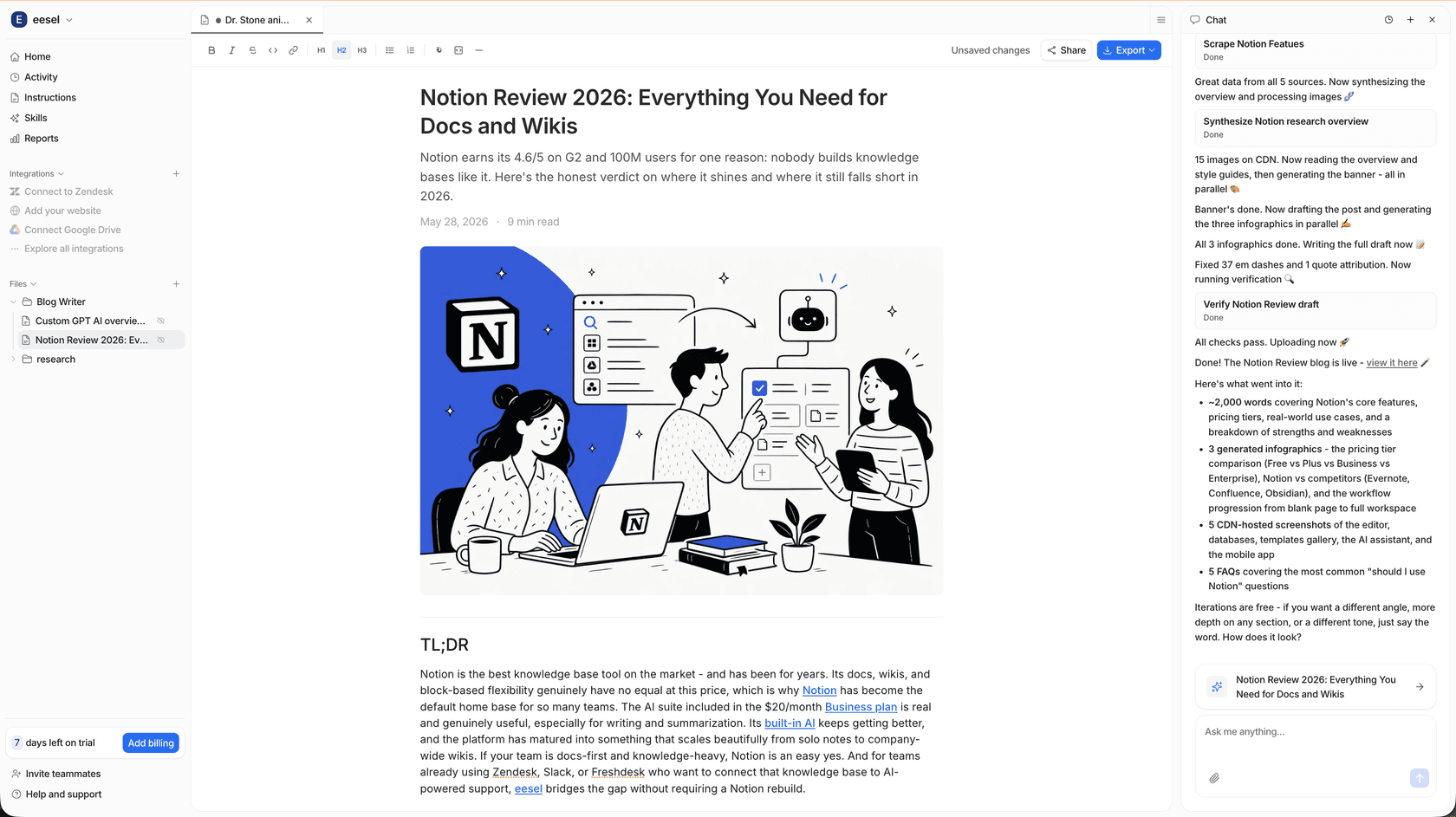
Turning simple steps into a complete guide
Here’s a simple workflow:
- Use a tool like Scribe to quickly capture the core steps of your process.
- Copy those steps.
- Paste them into the eesel AI blog writer as context for a new article.
Automatic assets and social proof
To improve readability and engagement, visual elements are key. The eesel AI blog writer automatically generates and integrates rich media to break up the text and illustrate your points, including images, infographics, and tables. But it doesn't stop there. It has a unique feature that pulls in real Reddit quotes and relevant YouTube videos to add social proof and authority to your guide. This helps answer your readers' questions before they even think to ask them, something no process recorder can do.
SEO and AEO optimization
For a how-to guide to be discoverable, it needs optimization for search engines. A guide generated by a process recorder like Scribe or Guidde is not typically designed to rank on Google. The eesel AI blog writer, on the other hand, is built for it. It includes built-in SEO and AEO (Answer Engine Optimization) to make sure your content is perfectly structured to rank in traditional search results and appear in Google’s AI Overviews and other answer engines like Perplexity.
Choosing the right AI how-to guide creator
Feeling a bit overwhelmed by the options? The right tool really just depends on your main goal. A visual comparison can help clarify the best choice for your needs.
| Feature | eesel AI blog writer | Guidde | Scribe | Trainn |
|---|---|---|---|---|
| Primary Use Case | Full SEO blog posts | Video-first SOPs | Screenshot-based guides | Interactive in-app tutorials |
| Video Generation | Embeds YouTube videos | Excellent | No | Excellent |
| AI Voiceover | No | Yes (200+ voices) | No | Yes (25+ languages) |
| Long-Form Content | Excellent | No | No | No |
| SEO/AEO | Advanced | Basic | Basic | Basic |
| Automatic Assets | Yes (images, tables, etc.) | No (captures screen) | No (captures screen) | No (captures screen) |
| Free Plan | Free to try | Yes (25 guides) | Yes | 14-day trial |
For a live demonstration of how these tools work, you can watch this video review that walks through the process of creating a guide with an AI tool.
Final thoughts
AI guide creators are changing how we think about documentation. They can save you a massive amount of time and help you produce high-quality, professional-looking visual guides for just about any task.
But to create content that not only shows people how to do something but also gets discovered, you need a two-part strategy. Use a process-capturing tool like Scribe or Guidde for the "how," and then pair it with an AI content generator like the eesel AI blog writer for the "why" and the complete, search-optimized article. It’s the best way to create how-to guides that are both incredibly helpful and easy to find.
Why not give it a shot? You can generate your first blog post for free and see the difference for yourself.




