
Writing a great blog post is one thing. But if it's not backed by solid sources, it's just words. Backing up your claims is what turns good content into authoritative content that people and search engines actually trust.
Citing sources isn't just for stuffy academic papers anymore. For bloggers, it’s a fundamental practice for building authority, climbing the SEO ranks, and earning your audience's loyalty.
In this guide, we’ll walk through the why, when, and how of citing sources in your blog posts. We’ll cover everything from the best manual practices to fully automated solutions. While the process can feel a bit tedious, modern tools like the eesel AI blog writer are built to handle this for you, generating deeply researched articles with all the right citations and sources already baked in.
Understanding how to cite sources in a blog and why it matters
In blogging, "citing sources" is just a way of saying you're giving credit to the original creator of any information you use. Whether it's a statistic, a quote, a unique idea, or an image, attribution is key. It’s the digital equivalent of tipping your hat to the people who did the original work.
But it’s more than just good manners. Properly citing your sources has some huge benefits for your blog, as this infographic shows.
- Builds credibility and authority: Citing your sources shows you’ve done your homework. It proves your content is well-researched and trustworthy, which is a massive signal for Google's E-E-A-T framework. E-E-A-T (Experience, Expertise, Authoritativeness, and Trustworthiness) is how Google evaluates content quality, and showing your work by linking to authoritative sources is a direct way to boost your score.
- Avoids plagiarism: This one’s a biggie. Using someone else's work without giving them credit is just not cool. It's unethical, can seriously damage your brand's reputation, and in some cases, can even have legal consequences.
- Provides value to readers: Good external links are a gift to your audience. They let curious readers dive deeper into a topic, check out the original study, or explore a concept directly from the primary source. It makes your content a helpful launchpad for their own research.
- Boosts SEO and AEO: Linking to authoritative, relevant domains gives search engines valuable context about your content. It’s also foundational for Answer Engine Optimization (AEO). AI tools like Google's AI Overviews and Perplexity don't just skim content; they look for well-supported claims. Citing your sources makes your content more reliable and "cite-able" for these AI answer engines. With Gartner predicting that traditional search volume will drop by 25% by 2026 because of AI, getting your AEO strategy right is more important than ever.
When to cite sources in a blog
Alright, so you’re sold on the "why." Now for the "when." It can feel a little tricky at first, but it really boils down to a few clear-cut situations. Here’s a quick checklist on when you absolutely need to attribute your information:
- Direct quotes: This one's a gimme. If you use someone's exact words, they must be in quotation marks and attributed to the person who said or wrote them. No exceptions.
- Statistics and data: Anytime you drop a number, percentage, or a finding from a study (e.g., "A recent report found that 45% of businesses..."), you have to cite the original research. This lets readers know your data is legit and not just a number you pulled out of thin air.
- Paraphrased information: This is where some people get tripped up. Even if you rewrite an idea, finding, or concept in your own words, you still need to credit the original source. You’re borrowing their intellectual work, so it’s only fair to give them a nod.
- Images, videos, and infographics: Visuals are content, too. If you use an image, chart, or video that you didn't create, you need to provide attribution unless it’s from a royalty-free service where you’ve purchased a license that waives that requirement.
- Unique ideas or theories: If you’re discussing a specific framework, a novel concept, or a theory someone else developed, make sure to credit them. For example, if you're writing about the "Jobs to Be Done" framework, you'd want to mention Clayton Christensen.
Pro tip
When in doubt, cite the source. It's always better to give too much credit than to risk plagiarism or damage your brand's authority.
Common methods for how to cite sources in a blog
Unlike a formal academic paper, blogging gives you a lot more flexibility in how you cite sources. You don't need to worry about complex formatting rules (most of the time). The goal is just to be clear and reader-friendly.
Here are the most common and effective ways to do it.
Contextual links (the blogger's choice)
This is the gold standard for most online content. It involves embedding a hyperlink directly into the relevant text (also known as anchor text) that references the source. It’s clean, unobtrusive, and super helpful for readers.
For example, this is great: "A recent analysis found that AI Overviews now appear in 16% of all Google searches."
This is not so great: "A recent study found that AI Overviews are growing. (Source: https://www.amsive.com/insights/seo/...)"
The key is to always link to the primary source of the information. Don't link to another blog post that also cited the study; go find the original report or press release yourself.
Direct quotes with blockquote formatting
When you have a longer, word-for-word quote that you want to highlight, using a blockquote is the way to go. It visually separates the quote from the rest of your text and makes it clear that these aren't your words.
Here’s how it looks:
"This is a direct quote from a source that is longer than 40 words and needs to stand out visually from the rest of the content. It’s typically indented and followed by attribution."
Author Name, Publication
Just add the author and the publication or source right below the quote.
Formal citation styles (APA, MLA)
Let's be clear: you'll rarely need these for a general blog post. Formal citation styles like APA or MLA are typically reserved for technical, scientific, or academic-focused blogs where precision is everything.
If your blog falls into that category, you might include in-text citations and a "References" or "Works Cited" list at the end of your post. For example, a basic APA 7 style citation for a web page looks like this:
Lastname, F. M. (Year, Month Date). Title of page. Site Name. URL
For a deep dive into formal styles, resources like the Purdue OWL are your best friend. But for 99% of bloggers, contextual links are all you need.
While many bloggers simply embed hyperlinks in their content to reference the source, if you want to adhere to a more formal or academic style, using MLA or AP citations at the end of your blog might be the way to go. Depends on your target audience!

Here’s a quick comparison of the methods:
| Method | Best For | Example | Readability |
|---|---|---|---|
| Contextual Link | Most blog content, stats, paraphrased ideas. | "AI Overviews now appear in 16% of all Google searches." | High |
| Blockquote | Longer, direct quotes from experts or sources. | > "This is a direct quote from a source that is longer than 40 words and needs to stand out." — Author Name, Publication | Medium |
| Formal Style | Academic, technical, or scientific blogs. | "Lastname, F. M. (Year, Month Date). Title of page. Site Name. URL" | Low (for typical blogs) |
For a more visual walkthrough of these different methods, the video below offers a quick and simple guide to citing sources correctly in your blog posts.
How to cite sources in a blog automatically with the eesel AI blog writer
Manually finding, vetting, and linking to every source can be a time-consuming process. It’s one of the most demanding parts of creating content, but skipping it isn't an option if you want to build a credible blog.
This is where an AI-driven approach can make a huge difference. The eesel AI blog writer is designed to handle this entire process for you, creating trustworthy, well-researched articles from the ground up.
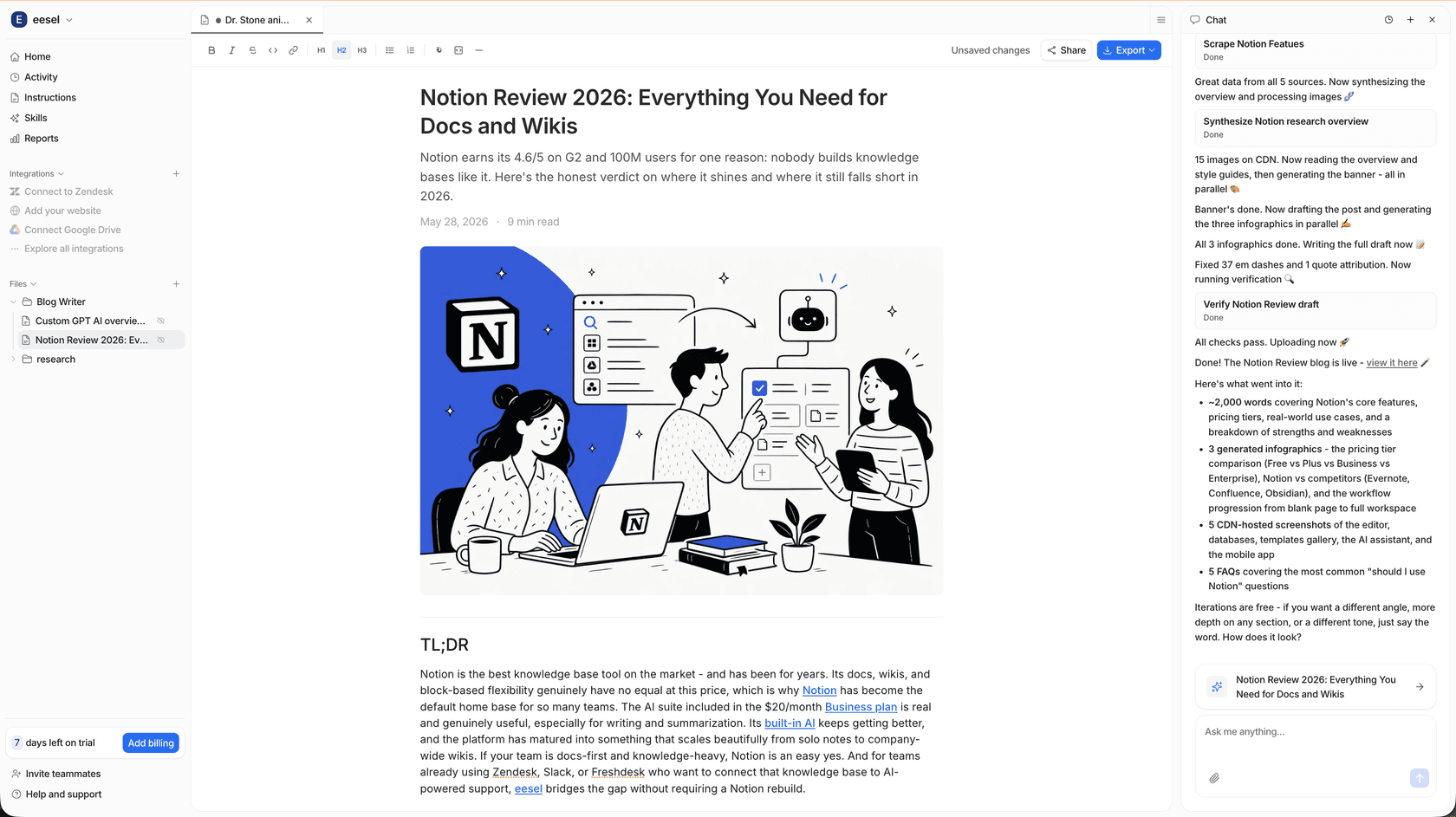
Here’s how it helps streamline the process:
- Deep Research with Citations: You don't have to spend hours hunting for stats and studies. When generating a blog post, the eesel AI blog writer automatically finds and adds links to credible external sources and relevant internal pages to back up its points.
- Authentic Social Proof: To add a layer of real-world experience, the tool integrates real quotes from Reddit and other forums directly into the content, complete with proper attribution. It finds relevant conversations and pulls insights that make your content feel more human and authentic.
- Automatic Assets: It doesn't stop at text. The AI also embeds relevant YouTube videos, creates infographics, and adds screenshots to illustrate points, which improves both readability and engagement.
- Optimized for Answer Engines: By creating well-structured content with clear, authoritative citations from the start, eesel AI produces articles that are perfectly optimized for modern search tools like ChatGPT, Perplexity, and Google AI Overviews.
The result is a publish-ready blog post that’s well-written, trustworthy, and optimized for how people find information today, all from a single keyword. You can try it for free to see the results.
Best practices for how to cite sources in a blog
Whether you do it by hand or use an AI tool, a few good habits will keep your content looking professional and ethical.
- Be consistent: Choose a citation style and stick with it. If you're using contextual links, make sure your anchor text is always descriptive. Consistency makes your blog look polished.
- Cite the primary source: We mentioned it before, but it's worth repeating. Always try to find the original study, report, or creator. Citing a secondary source that cites another source is like playing a game of telephone; it weakens your authority.
- Check content usage guidelines: Some publications or creators have specific rules about how you can use or quote their content. A quick check of their terms of service can save you a headache later.
- Attribute images correctly: Don't just grab images from a Google search. Use licensed stock photos or sources like Unsplash or Creative Commons that have clear attribution requirements, and follow them.
- Keep links updated: Every so often, it’s a good idea to do a quick audit of your older posts to check for broken links. Dead links create a bad user experience and can be a negative signal for SEO.
Ultimately, citing your sources isn't just a 'nice to have'; it's a non-negotiable part of professional blogging. It’s how you build trust with your audience, signal quality to search engines, boost your SEO and AEO, and show respect for other creators in your space.
While formal academic styles have their place, simple and clear contextual links are the standard for most blogs and are highly effective for both readers and search engines.
The biggest hurdle for most content creators isn't knowing why they should cite sources, but finding the time to do it right. Researching, finding primary sources, and formatting everything correctly can easily double the time it takes to write a post.
Tools like the eesel AI blog writer are designed to build deeply researched, fully cited articles in minutes. You can generate a free, publish-ready blog post to see how the process works.