How to add expertise to AI content

Amogh Sarda
Last edited January 30, 2026
It's no secret that AI has made it incredibly easy to produce content. A few clicks, a keyword, and you've got a blog post. But that’s also made it harder than ever to create content that actually stands out, connects with people, and ranks.
The answer isn't to ditch AI. It's to stop thinking of it as a content creator and start treating it like a very fast research assistant. The real value comes when you blend AI's speed with your irreplaceable human expertise. It’s about scaling your unique insights, not replacing them.
This is exactly why we built the eesel AI blog writer. It’s designed for this hybrid approach, turning a single keyword into a well-researched post that actually sounds like your brand.
The problem with generic AI content
The issue with some AI-generated content is that it can lack the key ingredients for building trust and authority. Summarizing existing information without adding new value can lead to a flat, uninspired article that feels like an echo.
For brands, this is a huge issue. You end up with content that doesn't actually help anyone, and search engines are getting smarter about identifying low-quality content.
Missing real experience and original thoughts
This is a challenge for generic AI. An AI model has never actually used the product you're reviewing, fixed the software bug you're writing a guide for, or felt the customer frustration you're trying to solve. It's repeating information it found online.
This leads to content that feels hollow and fails what Google calls the "helpful content" test. The system is designed to reward content made for people, not just to trick search rankings. If your article doesn't offer a unique perspective or original insight, it's just more noise.
Potential for factual inaccuracies
Have you heard of "AI hallucinations"? It's when an AI model confidently states something that is completely false. Because it's trained to predict the next word in a sentence, it can sometimes invent facts, figures, or sources that sound believable but are entirely made up.
Sometimes, this is just funny. But in high-stakes fields like finance, healthcare, or technical B2B, it's a disaster waiting to happen. It can destroy your credibility in an instant. There was even a case where a lawyer used ChatGPT for legal research and ended up submitting a brief citing completely fake cases.
This is why a human in the loop isn't just a nice-to-have; it's essential. You need a real person to fact-check every claim and make sure your content is accurate and trustworthy.
Lack of a unique brand voice
The default AI writing style is often grammatically correct and makes sense. But it can also be incredibly generic. It may use the same sentence structures over and over and lacks the quirks, humor, or specific phrasing that makes a human writer sound, well, human.
Your brand's voice is one of your most powerful assets. It's how people recognize you and connect with you. A generic AI can't replicate the specific industry perspective, inside jokes, and lived-in expertise that make your brand's content uniquely yours. Trying to force it is like asking a robot to tell a genuinely funny story: it might know the structure, but it's missing the soul.
Practical strategies for adding expertise to AI content
Okay, we've laid out the problem. Now for the good part: how to fix it. Here are some practical ways to turn a generic AI draft into a piece of content that's packed with expertise and authority.
Start with high-quality context
The golden rule of working with AI is simple: the quality of your output depends entirely on the quality of your input.
It's like talking to a programer and telling him what you want. If something doesn't work, tell it that it's not working and what is the error message or what you want it to differently. Or if you have a question like 'how do I install the plugin' or 'where do I paste the code' you can ask it. It's really cool. It's like being able to talk to google or a professional coder.

Instead of just giving an AI a keyword, you need to brief it like you would a junior writer. Give it rich, meaningful context to work with. This can include:
- Your own data: Share findings from your internal research or customer surveys.
- A clear brand voice: Provide examples of your best content and clear guidelines on your tone.
- Specific audience problems: Outline exactly who you're talking to and their primary challenges or pain points.
This is a core part of how tools like the eesel AI blog writer are designed to work. You don't just enter a keyword; you also add your website URL and any extra brand context. The AI learns from your existing content to understand your voice, your products, and your point of view before it ever starts writing.
Use AI for the first draft and a human for refinement
- AI's Job: Let the AI do the heavy lifting. Have it generate the initial outline, pull together research from across the web, and write the first draft.
- Human's Job: This is where you come in. A subject matter expert (SME) or a skilled editor steps in to inject the irreplaceable human element.
According to content experts who spend their days editing AI-generated text, the human refinement process is where you:
- Add personal stories: Share a short anecdote about a time you solved this exact problem for a customer.
- Verify facts and fix inaccuracies: Scrutinize every fact, statistic, and claim. Verify everything.
- Weave in unique perspectives: What's your company's contrarian take on this topic? What is a common misconception in the industry?
- Perfect the brand voice: Rewrite clunky sentences and remove repetitive AI phrases to make the content sound like it came from a real person on your team.
Incorporate real-world evidence and social proof
Nothing says "expertise" like backing up your claims with proof from the real world. Instead of just making statements, show your readers that you're tuned into the actual conversations happening in your industry.
Here are a few ways to do this:
- Quotes from experts: Interview someone on your team (or an external expert) and sprinkle their unique insights throughout the post.
- Real forum discussions: Find a relevant Reddit thread where people are debating your topic. Quoting the top comments shows you understand the questions people are really asking.
- Video explainers: Embed a helpful YouTube video from a trusted source to give readers a different way to learn.
For a deeper dive into this hybrid strategy, the following video explains the framework for letting AI handle the volume while humans add the irreplaceable value and expertise.
This kind of manual research can take a lot of time, which is why the eesel AI blog writer automates it. It finds and integrates relevant Reddit quotes and YouTube videos directly into the article for you, instantly adding layers of social proof and authority.
Use unique visuals to add value
A great blog post is more than just a wall of text. Visuals are key for breaking up the content, explaining complex ideas, and making your post look professional and authoritative.
Instead of relying on generic stock photos, create custom assets that add real value:
- Infographics: Summarize key statistics or a step-by-step process.
- Comparison tables: Break down the features of different products or approaches.
- Charts: Visualize trends or data from your research.
While this can be a time-consuming process, another core feature of the eesel AI blog writer is the automatic generation of useful assets like tables and charts based on the content of the blog post.
How eesel AI helps you add expertise to content
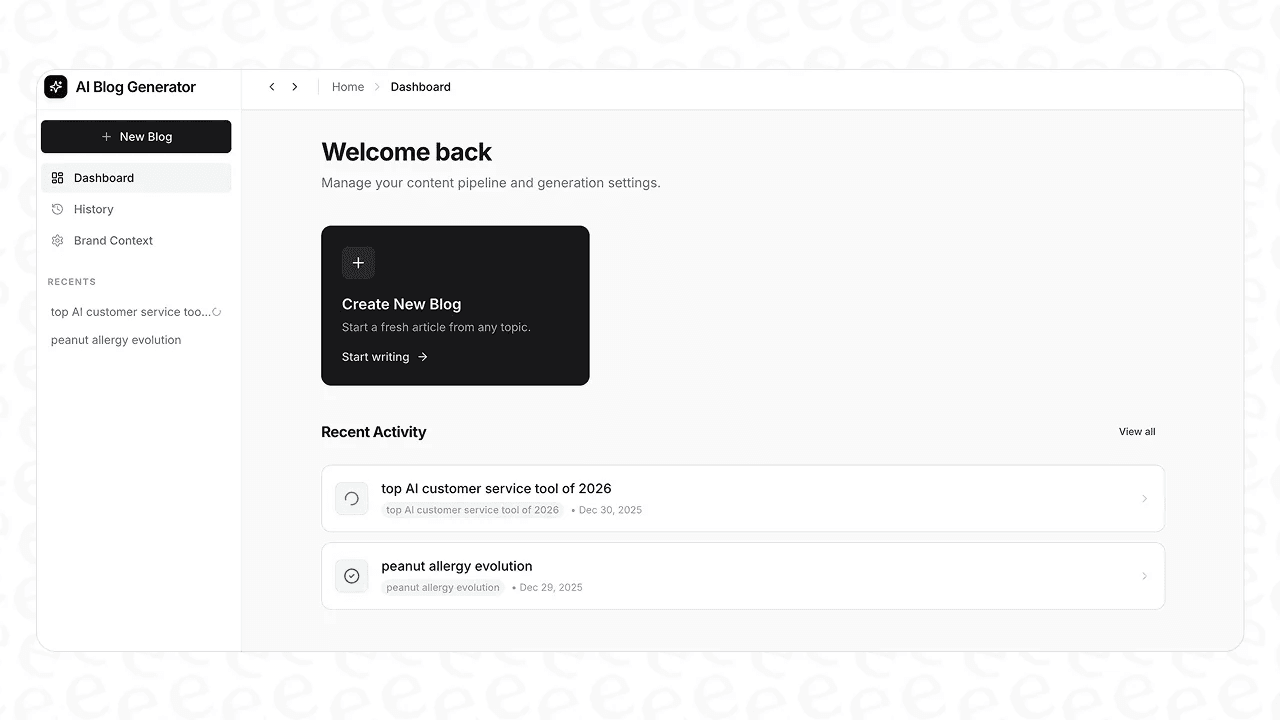
Context-aware research
eesel AI performs context-aware research based on the intent behind the keyword. For example, if you're writing a comparison post, it will actively look for pricing data, features, and user reviews. If it's a technical guide, it will find relevant specs and tutorials.
This gives you a much stronger first draft to work with, one that's grounded in specific, relevant details.
Automatic assets and social proof
The eesel AI blog writer automatically adds layers of expertise and credibility that would normally take hours to assemble by hand.
- It builds custom tables, charts, and infographics to visualize data.
- It finds and embeds relevant YouTube videos from authoritative sources.
- It pulls in real conversations from Reddit, grounding your content in what actual people are saying.
This frees up your team from tedious manual work so they can focus on high-level strategy and adding those final, irreplaceable human insights.
A human-like writing style
We spent over a year refining our AI model with one goal: to produce content that people actually want to read. We trained it to avoid repetitive sentence structures and a robotic tone, aiming for a more natural and readable style.
The proof is in our own results. We used the eesel AI blog writer to take our own blog from about 700 impressions a day to over 750,000 in just three months. The content it produces makes the human editing process faster because the language requires less foundational editing, allowing you to focus on elevating it with your unique expertise.
Let AI do the work so you can provide the expertise
Think of AI as a way to speed up your content process, not as a replacement for a writer. Relying on it to do everything is a fast track to mediocre content that gets lost in the noise and ignored by Google.
The winning formula for 2026 and beyond is clear: combine AI's incredible speed and research capabilities with human strategy, creativity, and firsthand experience. The goal is to let the machine handle 80% of the grunt work, the drafting, structuring, and initial research, so your team can focus on the critical 20% that actually makes the content great: injecting your unique voice, perspective, and hard-won expertise.
Instead of spending extensive time polishing generic AI drafts, consider using a tool designed to produce high-quality content from the start.
Generate your first blog post for free with eesel AI and see the difference for yourself.

Frequently Asked Questions
Share this article

Article by
Amogh Sarda
CEO of eesel AI. Amogh Sarda is obsessed with making the ultimate AI for customer service teams. He lives in Sydney, Australia and has previously worked at Atlassian and Intercom. Outside of work he’s usually surfing or on stage doing improv.