We all have that one folder in Google Drive, right? The one that's a chaotic mix of meeting notes, quarterly reports, random brainstorms, and files you swore you’d organize one day. Now, what if you could have an AI assistant dive into that mess and actually make sense of it for you?
Thanks to tools like ChatGPT connecting directly to cloud storage, this isn't just a fantasy anymore. The idea of an AI that can read, summarize, and even act on your documents is very much real. Connecting AI to your file systems can be a massive time-saver.
But here’s the real question: how do you actually get it working? And more importantly, how do you go beyond cool party tricks with your files and build something that delivers real value for your business?
This guide will walk you through the common ways to set up Google Drive integrations with GPT-Image-1-Mini and other AI models. We’ll look at what people are using them for, uncover the hidden limitations that often get overlooked, and explore a much more powerful, business-focused approach to using the knowledge locked away in your company’s Drive.
What are Google Drive integrations with GPT-Image-1-Mini?
Let's break it down. At its simplest, a Google Drive integration with an AI model is just a connection that gives an AI permission to access and work with your files. Think of it like giving a super-smart assistant a key to your filing cabinet. It can be a simple text document, a complicated spreadsheet, or even an image.
The "GPT-Image-1-Mini" part of the keyword just refers to a specific type of AI model that can understand and create images, kind of like OpenAI's DALL-E. When you connect a model like this to your Google Drive, you’re basically giving the AI "eyes" to see your files and "hands" to do things with them.
Usually, this connection happens in one of two ways:
-
Direct Connection: The AI tool itself, like Google's Gemini or a paid ChatGPT account, has a built-in option to link up with your Google Drive. This is often the easiest route for personal tasks or one-off jobs.
-
Workflow Automation: You use another tool, like Zapier or Relay, to act as a middleman. These platforms let you build custom workflows that follow a simple "if this, then that" logic. For example, IF a new file is added to a specific folder in Google Drive (the trigger), THEN send it to an AI for summarizing (the action).
While both methods are undeniably cool, they're mostly built for generic, individual tasks. If you're a business hoping to use the treasure trove of knowledge in your Google Drive for something important, like customer support, you’re going to need a solution that’s built for the job.
Common ways to set up your Google Drive integrations with GPT-Image-1-Mini
So, you want to get your AI and Google Drive talking. There are a few different paths you can take, and most involve using a workflow automation platform to act as a bridge between your apps. Let's dig into the popular options.
Using no-code automation platforms
You've probably come across tools like Zapier, Relay.app, or Pabbly. Their whole purpose is to connect different apps so they can work together, all without you having to write a single line of code. You build a "workflow" or a "Zap" by choosing a trigger and then setting up one or more actions.
For example, you could set up a workflow where the trigger is "New file in Google Drive Folder." The action could be "Send file content to ChatGPT," followed by another action like "Save ChatGPT's summary in a Google Sheet." It sounds pretty useful on the surface.
What it's good for:
-
Automating simple, repetitive tasks. Think summarizing routine meeting notes or getting a quick transcript of an audio file.
-
Connecting Google Drive to the thousands of other apps these platforms support.
But here are the limitations you’ll hit pretty quickly:
-
The AI has no context. The AI model you're using is a generalist. It’s book-smart, but not street-smart when it comes to your business. It doesn't know your company's tone, your internal jargon, or the history of a particular client. A summary it generates for a frustrated customer's email will be just as bland and generic as the one it creates for your team’s lunch order.
-
The costs can be a rollercoaster. These platforms usually charge you for every single task or action your workflow performs. If you have a slow day, your bill is low. But what if a marketing campaign takes off and you get hundreds of new files in an hour? Your bill can shoot up without warning, punishing you for being successful.
-
Things get complicated, fast. Building a simple "if this, then that" workflow is easy. But what if you need to add some logic? "Summarize this file, but only if the filename contains 'urgent,' and if it does, also send a Slack notification to the support manager." These kinds of multi-step, conditional workflows can become tangled messes that are a nightmare to manage and troubleshoot.
Native integrations within AI chatbots
Some AI tools let you connect directly to your cloud storage from within the chat interface. If you have a paid ChatGPT Plus subscription, for instance, you can upload files or link your Google Drive and Microsoft OneDrive accounts. Google is doing something similar by bundling its Gemini AI with its Google One storage plans.
What it's good for:
-
Quick, one-time analysis of a document. "Can you find the key takeaways from this 20-page report?"
-
Personal productivity hacks, like drafting an email based on the contents of a Doc.
But again, there are some serious catches:
-
It’s not really automation. You're still the one in the driver's seat. You have to open the chatbot, upload the file or point to it, and type out a specific command every single time. It can't just watch a folder for you and automatically act on new files.
-
Who’s watching your data? When you use these integrations, you're handing your files over to a massive tech company's AI. While they all have privacy policies, many businesses are understandably nervous about uploading sensitive company information or private customer data into these general-purpose models.
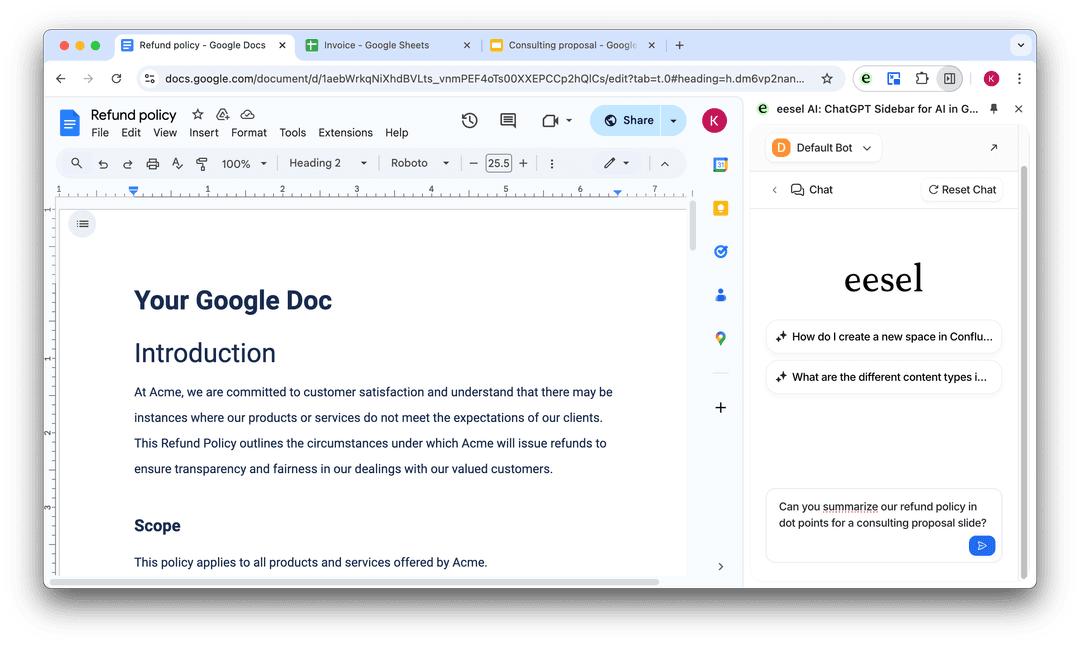
These methods are a decent starting point for dipping your toes in the water. But they just can’t provide the depth needed for a real business application. A purpose-built platform like eesel AI connects to your knowledge sources, including Google Docs, to power a truly autonomous AI agent. It’s not about performing one-off tricks; it’s about resolving customer support tickets, answering complex internal questions, and operating with the full context of your business.
Popular use cases and their hidden challenges
The buzz around these integrations is all about the promise of automating away the boring parts of our jobs. Let's look at some of the most common ways people are using them and the real-world problems that the hype often glosses over.
Use case 1: Summarizing documents and transcribing audio
This is by far the most common use case. You feed a document or audio file to an AI and ask it to give you the short version or a text transcript.
-
The promise: No more manual note-taking! Get automatic meeting summaries, understand long reports in seconds, and turn audio recordings into searchable text.
-
The reality check: The output is only as good as the generic AI's understanding. It doesn't know that the most important part of that two-hour meeting was the five-minute debate about the Q3 budget. It won't recognize that a specific technical term in a report is the key to the whole document. For customer support, a generic summary like "Customer is unhappy" is completely useless. You need an AI that understands the customer's history, the urgency, and the specific details of the problem.
Use case 2: Analyzing data in spreadsheets
Another popular trick is to upload a Google Sheet and ask the AI chatbot to spot trends, build charts, or just explain what the numbers mean.
-
The promise: Get instant insights from your data without having to wrestle with pivot tables and complex formulas.
-
The reality check: This might work for a simple list of sales figures, but for real business data, the AI is flying blind. It has no idea what your quarterly sales targets are, who your key customer segments are, or that a sudden dip in a particular metric is actually normal for that time of year. The risk of the AI confidently giving you a completely wrong interpretation is pretty high.
Use case 3: Generating content or images
This is where "GPT-Image-1-Mini" type models come into play. You could set up a workflow that grabs a product description from a Google Doc, feeds it to an AI, and asks it to generate a social media post with a matching image.
-
The promise: An endless supply of marketing content, created automatically.
-
The reality check: The content will be bland and soulless. It won't have your brand's voice. It doesn't know about your upcoming product launch, your audience's sense of humor, or that you already ran a similar campaign last month. You'll spend so much time editing the AI's generic output that you might as well have written it yourself. It's a starting point, but a very rough one.
Pro tip
See the common thread here? The fundamental problem with all these use cases is the lack of deep, specific business context. A generic AI can process information, but it can't apply wisdom.
Pricing models
The cost of setting up these integrations can be all over the map. Figuring out how you'll be charged is key to avoiding a nasty surprise at the end of the month.
| Platform/Method | Pricing Model | How it Works | Best For |
|---|---|---|---|
| Automation Platforms (Zapier, etc.) | Per Task / Action | You pay for every single step your workflow completes. Costs scale directly with usage, which can make budgeting a guessing game. | Low-volume, simple automations where you can reliably predict how often they'll run. |
| Consumer AI Subscriptions (ChatGPT Plus, Google One) | Flat Monthly Fee | You pay a fixed price each month for access to the AI model and a bundle of other features, like cloud storage. | Individuals using it for personal productivity. Not built for teams or business-critical automation. |
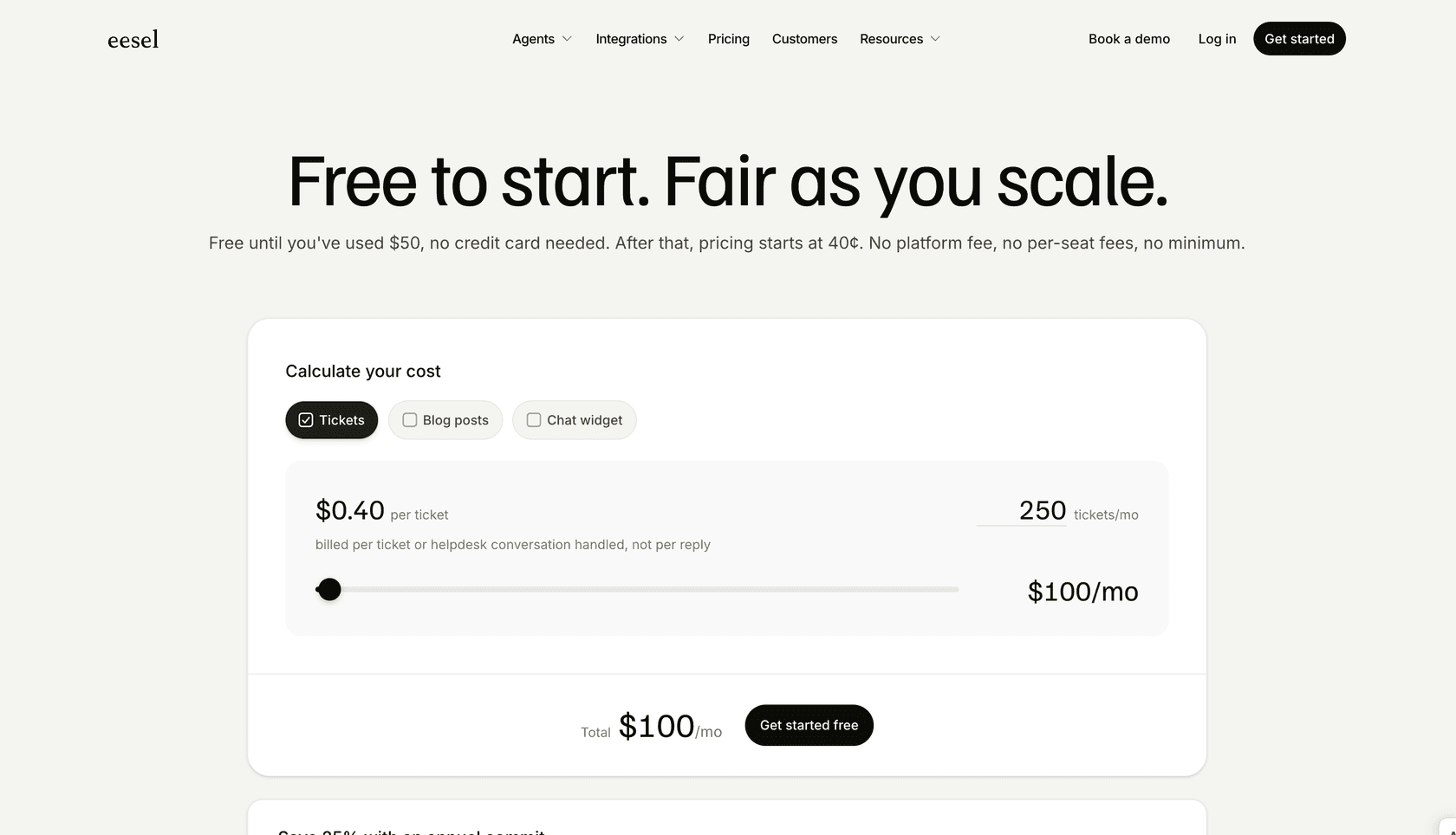
| Business AI Platforms (eesel AI) | Feature & Capacity-Based | You pay a predictable monthly fee based on the features you need and a generous number of AI resolutions. No per-task fees. | Businesses needing a reliable, scalable, and budget-friendly AI for core operations like customer support. |
The big issue with per-task pricing is that it effectively punishes you for growth. That brilliant marketing campaign that floods you with new customers? It could also trigger a five-figure bill from your automation tool. You shouldn't have to worry that a great month for your business will turn into a bad month for your budget.
With eesel AI, the pricing is transparent and predictable. You get a flat monthly rate that includes a large volume of AI interactions, so you can scale up your support without stressing about costs. It's designed to grow with you, not penalize you for it.
Beyond simple Google Drive integrations with GPT-Image-1-Mini to business intelligence
Look, connecting your Google Drive to an AI model is a great way to start exploring automation. For small, personal, and repetitive tasks, tools like Zapier or the native chatbot integrations can definitely save you some time.
But for your core business operations, these generic solutions just don't cut it. They lack the context, the security, and the specialized skills needed to handle something as important as customer support or managing your internal knowledge. The real win isn't just processing files faster; it's about turning the collective knowledge inside those files into an intelligent system that actually improves your business.
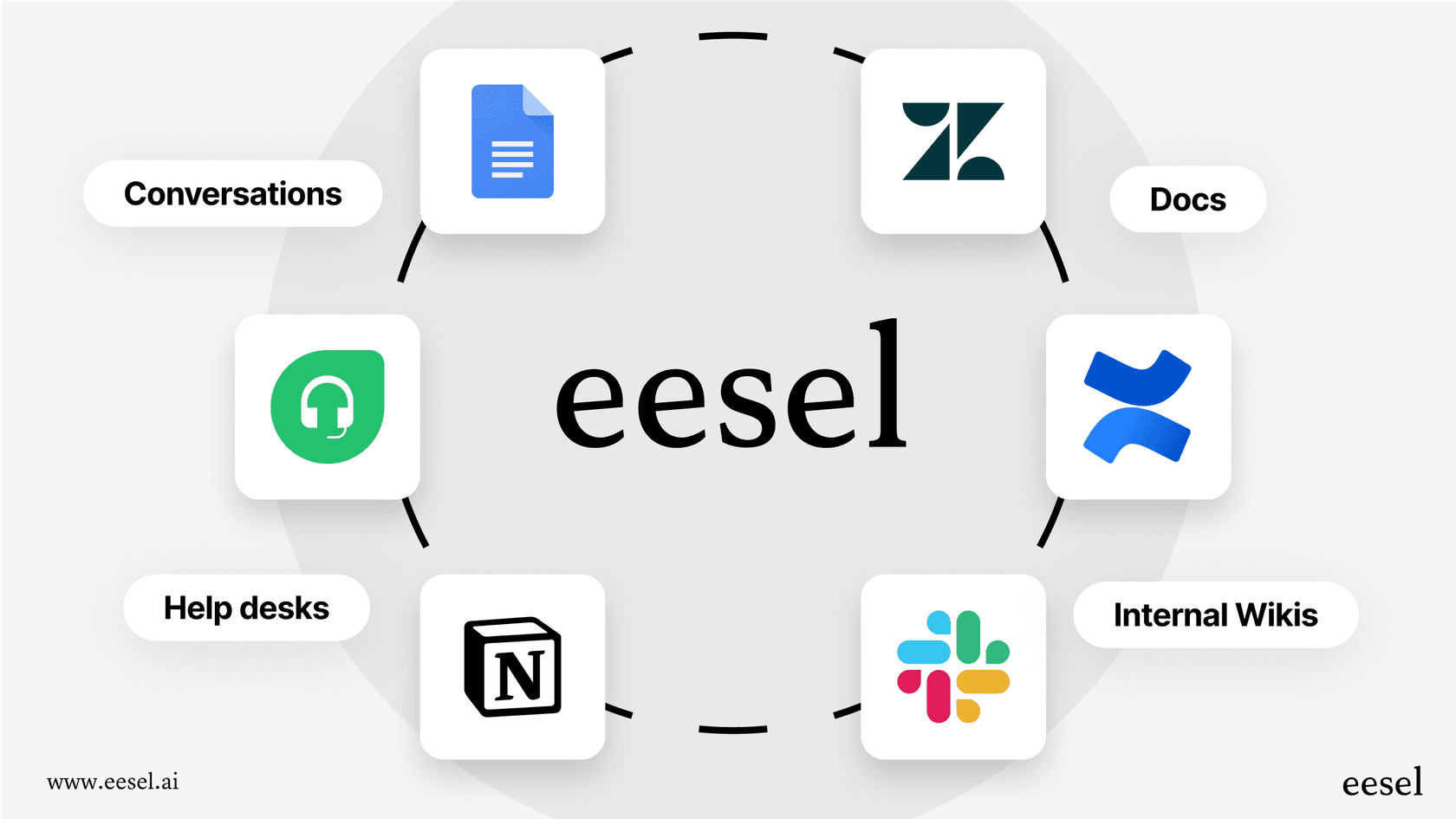
Instead of trying to patch together a dozen brittle, one-off workflows, imagine having a single platform that unifies all of your company's knowledge, from Google Drive and Confluence to past support tickets in Zendesk or Intercom. That's how you move from simple automation to real business intelligence.
Ready to see what the knowledge sitting in your Google Drive can really do? eesel AI can help. Our platform does more than just automate file tasks; it creates a powerful AI agent that truly understands your business. You can set it up yourself in minutes, test it safely in a simulation mode, and go live knowing it's ready to perform.
Start your free trial of eesel AI today and see how easy it is to turn your company knowledge into your most powerful asset.
Frequently asked questions
Could you clarify what exactly Google Drive integrations with GPT-Image-1-Mini are?
Google Drive integrations with GPT-Image-1-Mini connect an AI model to your Google Drive, allowing it to access and work with your files. The "GPT-Image-1-Mini" part refers to an AI capable of understanding and creating images. This essentially gives the AI "eyes" and "hands" to interact with your documents and visuals.
What are the common methods for setting up Google Drive integrations with GPT-Image-1-Mini?
You can set up Google Drive integrations with GPT-Image-1-Mini in two main ways: direct connection through the AI tool itself (like paid ChatGPT accounts), or by using workflow automation platforms like Zapier or Relay to create custom "if this, then that" processes.
What are the main limitations I should be aware of when using basic Google Drive integrations with GPT-Image-1-Mini?
Basic Google Drive integrations with GPT-Image-1-Mini often lack business context for the AI, leading to generic outputs. Automation platforms can incur unpredictable costs due to per-task billing, and complex workflows become hard to manage. Native integrations also don't offer true, autonomous automation.
Can you give me examples of common practical uses for Google Drive integrations with GPT-Image-1-Mini?
Common use cases for Google Drive integrations with GPT-Image-1-Mini include summarizing documents, transcribing audio files, and analyzing basic data in spreadsheets. These integrations are also used for generating initial drafts of content or simple images based on provided text.
How do pricing models typically differ for various Google Drive integrations with GPT-Image-1-Mini solutions?
Pricing models vary, with automation platforms often charging per task or action, leading to unpredictable costs. Consumer AI subscriptions typically offer a flat monthly fee for access. Business AI platforms, like eesel AI, provide predictable feature and capacity-based pricing, avoiding per-task fees for scalable operations.
Should I be concerned about data security or privacy when using Google Drive integrations with GPT-Image-1-Mini for company files?
Yes, businesses often have concerns about handing over sensitive company information or private customer data to general-purpose AI models. While providers have privacy policies, it's crucial for businesses to assess how their data is handled and used, especially when dealing with proprietary or confidential documents.
How do business-focused platforms like eesel AI improve upon standard Google Drive integrations with GPT-Image-1-Mini for critical operations?
Business-focused platforms like eesel AI go beyond simple Google Drive integrations with GPT-Image-1-Mini by providing deep business context to the AI. They unify all company knowledge sources and offer predictable, capacity-based pricing, enabling the creation of truly intelligent AI agents for complex tasks like customer support, rather than just basic file processing.