7 essential tips for effective blog writing

Stevia Putri

Katelin Teen
Last edited January 20, 2026
It feels like we're all drowning in content, right? But finding a blog post that actually grabs your attention and gives you what you need is another story. With AI changing how we find information, the old blogging rules don't apply anymore. In fact, Gartner predicts a 25% drop in search volume by 2026 because of AI Overviews and chatbots. This means that genuinely helpful content isn't just a bonus, it's how you stay relevant.
This guide will give you 7 practical tips to improve your writing, keep readers engaged, and get your posts noticed in search results. We’ll show you the same framework we used to grow our own blog from 700 to 750,000 daily impressions. It’s all about creating content that gets the job done.
We'll also cover how to work smarter by letting AI handle some of the grunt work. A tool like the eesel AI blog writer can generate a complete first draft for you, freeing you up to focus on strategy and adding your unique insights.
What is effective blog writing?
Effective blog writing isn't just about filling a page with words. It's about creating content that aligns with your business goals by giving a specific audience something genuinely useful. Think of it as a growth engine for your SEO, thought leadership, and lead generation. It's content that has a job to do.
In today's landscape, that means getting a few things right:
- Search Intent: Giving the reader a full and satisfying answer to their question.
- User Experience: Making the content easy and enjoyable to read. Nobody wants to face a wall of text.
- SEO & AEO: Optimizing for classic search engines (SEO) and the new AI Answer Engines (AEO) that are behind things like Google AI Overviews.
- Call to Action (CTA): Gently showing the reader what to do next once they've finished reading.
How we selected these tips
We didn't just pick these tips randomly. They were chosen because they directly influence the three things that matter most for content to succeed today. We wanted to make sure every piece of advice was practical and would deliver actual results.
Here’s what we looked for in each tip:
- Search Performance: Does this tip help you rank better on Google and other AI-powered answer engines? If it doesn't boost your visibility, it's not worth the effort.
- Reader Engagement: Will this make your content more interesting, readable, and shareable? The goal is to create fans, not just get clicks.
- Workflow Efficiency: Can you use this tip without adding a ton of extra time to your writing process? The aim is to be more effective, not just busier.
Comparing top blog writing strategies
To give you a quick overview, here’s how each of the seven tips stacks up against our criteria for what makes a blog post successful.
| Tip / Strategy | Primary Goal | Search Performance | Reader Engagement |
|---|---|---|---|
| 1. Start with an AI First Draft | Efficiency & Scale | Very High | High |
| 2. Nail Search Intent | Relevance | Very High | High |
| 3. Create a Compelling Outline | Structure & Readability | High | Medium |
| 4. Write for Humans, Not Robots | Readability | Medium | Very High |
| 5. Weave in Multimedia | Stickiness | Medium | Very High |
| 6. Master On-Page SEO | Discoverability | Very High | Medium |
| 7. Edit Ruthlessly & Add a CTA | Quality & Conversion | Medium | High |
7 actionable tips for more effective blog writing
These seven steps provide a repeatable system for producing content that gets results. If you follow them in order, you’ll have a clear path from a blank page to a published post that actually works for your business.
1. Start with an AI-generated first draft
The biggest hurdle in blogging is often just getting started. That blinking cursor on a blank page can be pretty intimidating. So, instead of starting from zero, let an AI generate a complete first draft for you. This shifts your role from "writer" to "editor-in-chief," letting you focus your energy on high-level strategy and refining the content. A specialized tool like the eesel AI blog writer is designed to do more than generate basic text. You give it a single keyword, and it builds a complete, publish-ready post that's already optimized for both SEO and AEO.
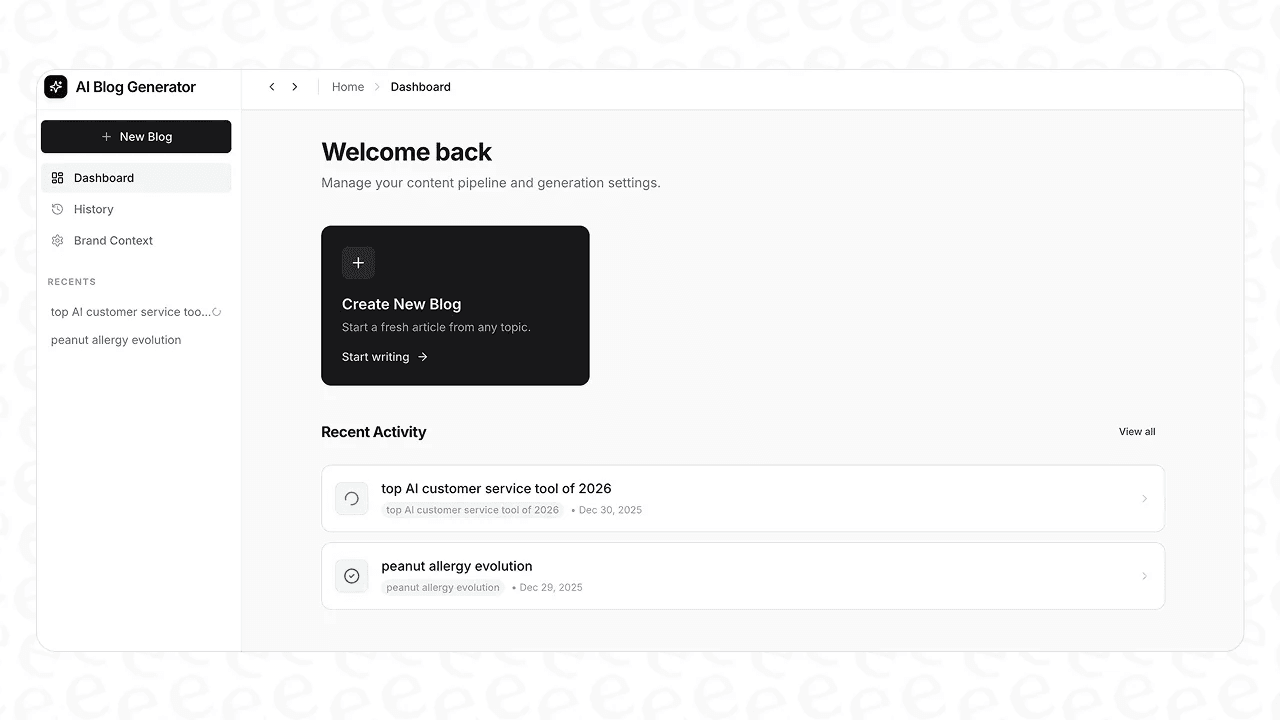
It automatically researches and includes things that make a blog post great:
- AI-generated images, tables, and infographics to break up the text.
- Relevant YouTube video embeds to increase the time people spend on your page.
- Authentic social proof with real quotes pulled from relevant Reddit threads.
- Brand context it learns from your website URL, so product mentions feel natural.
This is the exact workflow we used to take our own blog from 700 to 750,000 daily impressions in just three months. It’s a huge help for scaling content production without letting quality slide.
Pricing:
- It's completely free to try, so you can see the quality for yourself.
- Paid plans are straightforward, like getting credits for 50 blog posts for $99.
2. Understand search intent
Good blogging starts with understanding why someone is searching for your keyword. Before you write anything, type your keyword into Google and look at the top-ranking pages. What kind of content is already there? Is it a how-to guide, a list, a comparison post?
The search results page is basically a cheat sheet telling you what Google thinks users want. Your job is to match that format but deliver even more value and clarity than what's already there.List out my angle so I can remind myself that I’m not just re-iterating stuff from other posts but have a different eye.

3. Create a compelling title and outline
Your title makes a promise, and your outline is the roadmap for keeping it. A great headline is what gets you the click on a crowded search results page. A logical, well-structured outline is the cure for writer's block because it breaks a big topic into small, manageable pieces. A good outline ensures your article flows naturally and covers all the key points without getting sidetracked. You can use proven title formulas to grab attention, like using numbers ("7 Ways to...") or asking a direct question ("Are You Making This Common Mistake?").
4. Write for humans, not algorithms
Keywords are important, but no one wants to read an article that sounds like it was written by a machine. Use a conversational tone, as if you're explaining the topic to a friend over coffee. Short sentences and paragraphs make your content much easier to digest, especially since most people are skimming on their phones. Weaving in real-world examples or stories helps make abstract ideas feel more concrete and memorable. It's this human touch that helps differentiate your content.
5. Weave in visuals and multimedia
A giant wall of text is a surefire way to send someone clicking the "back" button. You need to break up your content with relevant images, infographics, and embedded videos. Visuals don't just make your post more engaging; they can often explain complex topics better than words alone. Plus, they increase "dwell time," an important signal that tells search engines your content is valuable because it’s keeping people on the page longer.
6. Master on-page SEO basics
You don't need to be an SEO wizard, but you do need to know the fundamentals. On-page SEO is about adding simple signals that help search engines understand your content. This means including your target keyword in your title, URL, and at least one subheading. You should also write a compelling meta description to get more clicks from the search results page. Add internal links to other relevant posts on your site to keep readers around, and link out to authoritative external sources to build credibility. Finally, always use descriptive alt text for your images to improve accessibility and your chances of ranking in image searches.
7. Edit ruthlessly and add a clear call to action
Even the best writing can be ruined by typos and grammar mistakes. A great trick is to read your draft out loud: you'll immediately catch awkward phrasing or sentences that drag on. You can also use a tool like Grammarly for a final check. More importantly, every blog post needs a purpose. What do you want the reader to do when they're done? Always end with a clear Call to Action (CTA). Whether you want them to subscribe to your newsletter, download a resource, or try your product, make it obvious and easy for them to take that next step.
Pro tips for maintaining consistency
- Create an Editorial Calendar: Planning your topics, keywords, and publish dates ahead of time is a lifesaver. It removes the stress of figuring out what to write next and ensures you're consistently putting out valuable content.
- Develop a Simple Style Guide: Take a few minutes to write down your brand's tone of voice, formatting rules (like using sentence case for headings), and any specific terms you use. This is incredibly helpful for keeping things consistent, especially if more than one person is writing for your blog.
For a deeper dive into creating a repeatable process, the video below breaks down how to structure a blog post from start to finish.
Ready to improve your blog writing?
At the end of the day, effective blog writing is a system, not a mystery.
By focusing on search intent, making your content easy to read, and being smart about your workflow, you can create a content engine that consistently delivers. The secret isn't just to write more, but to have a better process.I've been writing blog posts for the last few years. Over time, I've come up with a good system that actually has a soul and not just pieced together purely for SEO that no one would enjoy reading.
The biggest lever you can pull to implement all these tips at scale is to start with a powerful AI foundation. The eesel AI blog writer automates the most time-consuming parts of the process, from initial research to creating visuals and finding relevant quotes. Generate your first complete, SEO-optimized blog post for free and see for yourself what a difference a truly context-aware AI can make.

Frequently Asked Questions
Share this article

Article by
Stevia Putri
Stevia Putri is a marketing generalist at eesel AI, where she helps turn powerful AI tools into stories that resonate. She’s driven by curiosity, clarity, and the human side of technology.
