Copy.ai vs Semrush: Which tool is right for your content workflow?

Amogh Sarda
Last edited January 18, 2026
Content teams have a choice to make. Do you go for a dedicated AI writer to generate text, or an all-in-one SEO platform that has AI writing features? It is not just about what the tools can do. It is about what your team needs, how you work, and where your money is best spent.
This guide will compare Copy.ai and Semrush head-to-head to help you figure that out. We will look at what they do, how much they cost, and who they are for. A third category of tools is also emerging. Tools like the eesel AI blog writer are designed to combine AI writing with the SEO, research, and asset creation features needed for publishing.
What is Copy.ai?
Copy.ai is an AI platform built for generating written content. It is designed to help with everything from short-form ad copy and social media posts to longer pieces like blog drafts and emails.
The platform uses a template-based system. You pick a template for a product description or a sales email, give it some input, and the AI produces several options. You can also tweak the tone of voice and use it in multiple languages, which makes it flexible.
However, it's important to remember that it is an assistant. It gives you a text draft, but that's where its job ends. You still have to do the SEO research, find images, add internal links, and format everything for publishing. It writes the words, but the rest is on you.
What is Semrush?
Semrush is, first and foremost, an all-in-one SEO platform. Its main job is to give you the data and tools for a solid SEO strategy. People use it for keyword research, checking out competitors, site audits, and tracking rankings.
Tucked inside this suite are some AI writing tools, like the SEO Writing Assistant. This tool is not meant to be a standalone writer; it is there to help you use the platform's SEO data in your writing. It gives you real-time feedback on keywords and readability.
The AI writing is just a feature, an add-on to its main SEO tools like the Keyword Magic Tool and Site Audit. Semrush is built for SEO first, and the AI is there to support that, not to be the main event.
Core functionality
The biggest difference between Copy.ai and Semrush comes down to what they were built for. Copy.ai was made for writing content. Semrush was made for managing SEO.
Copy.ai's focus on content generation
Copy.ai is great for coming up with creative text and getting past writer's block. It is useful for brainstorming ad copy, social media captions, or email subject lines. For longer articles, it can give you a decent first draft and save you some time. It is designed for high-volume text generation.
I’ve run paid campaigns with most of these. Copy.ai and Jasper are decent for brainstorming, not final copy. Sintra.ai is a good alternative if you want something that analyzes existing ads and rewrites from that context. Think of all of these as helpers, not solutions. The strategy still matters more than the tool.

The problems start when you need to create content for SEO. Copy.ai just gives you raw text. There is no built-in SEO analysis, keyword suggestions, or internal linking help. You have to take that text, move it somewhere else for optimization, find your own images and videos, and then put it all together in your CMS. It does the writing, but not the whole production job.
Semrush's focus on data-driven SEO
Semrush shines before you even start writing. It gives you the data you need to build a content strategy, like finding good keywords and analyzing what your competitors are ranking for. It helps you answer the question, "What should we write about?"
The AI writer is there to help you weave those SEO insights into your draft. The SEO Writing Assistant works with the other tools to give you real-time suggestions. The catch is that these writing tools are a small piece of a very large, and very expensive, platform. To get them, you have to invest in a suite where the main value is in analytics, not content production. If your team's main job is just creating content, it is often too complex and expensive.
Pricing: Copy.ai vs Semrush
The pricing for these tools tells you a lot about what they are for. Copy.ai's pricing is based on how much content you generate. Semrush's pricing is based on getting access to its suite of marketing analytics.
Copy.ai pricing
Copy.ai offers several tiers designed for different levels of usage.
| Plan | Price (Monthly) | Key Features |
|---|---|---|
| Free | $0 | 2,000 words per month, 1 user seat, access to 90+ copywriting tools. |
| Pro | $49/month | Unlimited words, 5 user seats, 29+ languages, access to newest features. |
| Team | $249/month | Unlimited words, 20 user seats, full collaboration features, SOC2 compliance. |
The value here is for individuals or teams needing a dedicated, scalable writing assistant.
The pricing is directly tied to content output and collaboration features, assuming that the user has other tools for SEO and content management.ChatGPT. I only do specific things with it — meta descriptions, socials/LinkedIn ballast, rough article outlines. Also I occasionally use it to highlight logic holes in the feedback of one particularly challenging client, who tends to email me screeds of ‘brain dump’ crap that often contradicts itself. It cannot do heads and subs, plays-on-words or any kind of linguistic sleight of hand. Ie the actually creative stuff. It sometimes has a good go but it’s never very smart or original (obviously).
Semrush pricing
Semrush is a significant investment, with plans tailored to agencies and in-house marketing teams that need deep analytics.
| Plan | Price (Monthly) | Key Features |
|---|---|---|
| Pro | $129.95/month | Core SEO, PPC, and research tools. 5 projects, 500 keywords to track. |
| Guru | $249.95/month | Adds Content Marketing Platform, historical data, multi-location tracking. 15 projects, 1,500 keywords. |
| Business | $499.95/month | API access, extended limits, Share of Voice metrics. 40 projects, 5,000 keywords. |
The monthly cost is substantial, and many of its AI and content marketing features are only available on the Guru plan or higher. For teams whose primary job is content creation, paying for an entire suite of marketing analytics just to access a writing assistant is often not a cost-effective approach.
An alternative to consider: The eesel AI blog writer
The challenge is that Copy.ai gives you text but leaves SEO and assets up to you. Semrush gives you SEO data, but its writing tools are a pricey add-on in a platform that isn't primarily for content production. This gap means you may be juggling multiple tools and manual steps to get an article published.
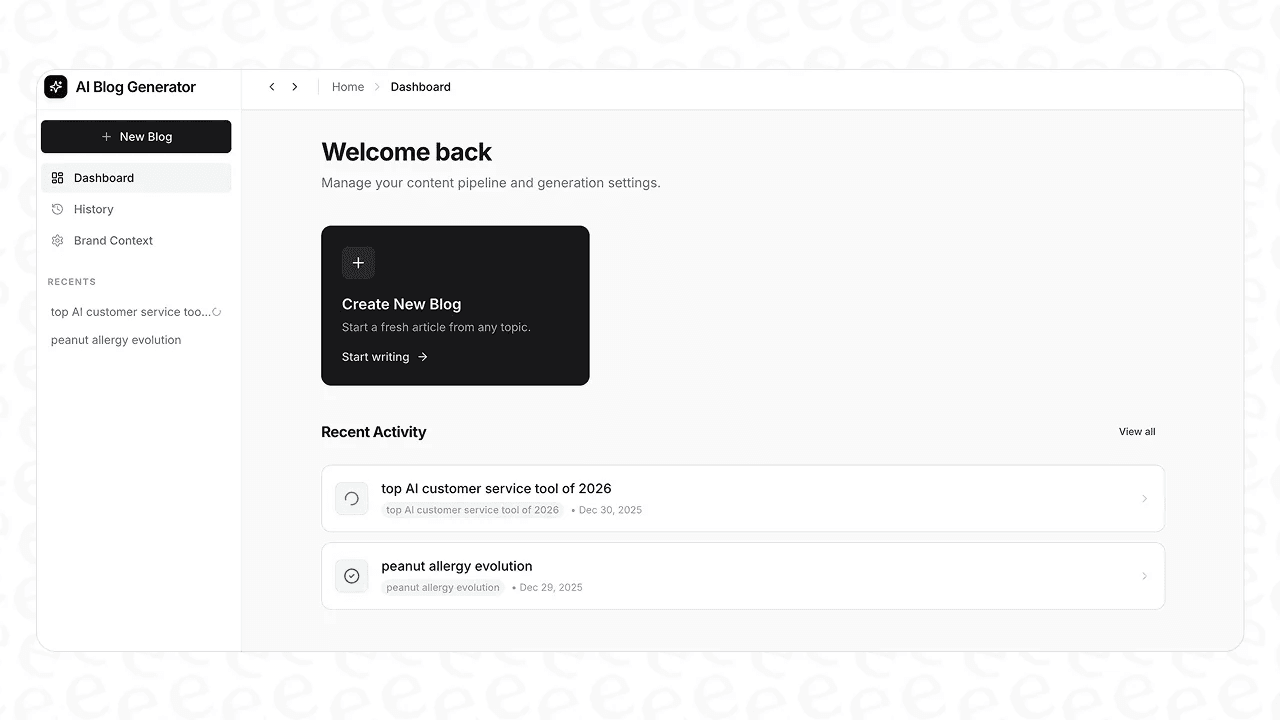
It stands apart from the other tools in a few ways:
- End-to-end generation: It does not just give you a text draft. It builds a full blog post with an intro, headings, conclusion, and FAQ section, all optimized for your keyword.
- Automatic assets and media: The platform finds and includes relevant images, infographics, and tables. It also embeds YouTube videos and pulls real Reddit quotes to add authority and keep readers engaged.
- Built-in SEO and AEO: The whole process is built for modern search. It covers traditional SEO (keywords, structure) and is also set up for Answer Engine Optimization (AEO), which helps content show up in Google's AI Overviews and other AI search results.
- Proven results: We used this tool ourselves at eesel AI and grew our organic traffic from 700 to 750,000 daily impressions in three months by publishing over 1,000 blogs.
A workflow comparison infographic showing the steps to publish content with Copy.ai vs Semrush vs eesel AI blog writer.
The pricing is also simple: $99 for 50 complete blog posts. This model differs from the monthly subscriptions of many other platforms and is designed as a practical solution for scaling blog content.
How to choose the right tool
Which tool is right for you comes down to your main job and how you work. Here is a quick guide.
Choose Copy.ai if:
- Your main need is a versatile AI assistant for short-form content like ads, social media posts, product descriptions, and emails.
- You already have a separate, established workflow for SEO research, image sourcing, and content optimization.
- Your priority is generating multiple creative text variations quickly for brainstorming and initial drafts.
Choose Semrush if:
- Your primary role is SEO management, and you need a powerful suite for analytics, competitor research, and rank tracking.
- AI writing is a secondary feature you want to complement a data-driven SEO strategy, not your main task.
- You have a significant budget allocated for an all-in-one marketing analytics platform.
Choose the eesel AI blog writer if:
- Your primary goal is to efficiently scale the production of high-quality, SEO-optimized long-form blog content.
- You want a single, end-to-end solution that takes you from a keyword to a publish-ready article with all assets included.
- You are looking for a cost-effective way to generate content without managing separate subscriptions for writing, SEO, and graphic design.
An infographic helping users choose between Copy.ai vs Semrush vs eesel AI blog writer based on their primary goals and workflow.
Making the final call
Choosing between Copy.ai and Semrush is really about choosing between a dedicated writing tool and a full-blown SEO analytics suite. A copywriter who needs ten ad variations has a different job than an SEO manager tracking 500 keywords, and these platforms are built for those different needs.
For those looking to see how these tools work in practice, the video below offers a helpful demonstration of an AI writer that serves as an alternative to both Copy.ai and Semrush, showcasing a different approach to content generation.
The right tool is the one that fits your main workflow. If your job is to produce high-quality blog content that ranks in search engines, it makes sense to use a tool built for that specific purpose.
If you want to publish complete, SEO-optimized content with a single tool, you can generate your first blog for free with the eesel AI blog writer to see how an all-in-one platform works.

Frequently Asked Questions
Share this article

Article by
Amogh Sarda
CEO of eesel AI. Amogh Sarda is obsessed with making the ultimate AI for customer service teams. He lives in Sydney, Australia and has previously worked at Atlassian and Intercom. Outside of work he’s usually surfing or on stage doing improv.