Copy.ai vs Surfer SEO: Which AI content tool is better in 2026?

Stevia Putri
Last edited January 6, 2026
Choosing the right AI content tool can be challenging. The market is filled with options, and it can be difficult to determine which one best fits your needs. The choice often comes down to two different philosophies: a versatile Go-To-Market (GTM) platform or a specialized tool that focuses on SEO.
That's the heart of the debate between Copy.ai and Surfer SEO. Copy.ai is a GTM platform made to automate various sales and marketing jobs, while Surfer SEO is a specialist tool, focused on helping you create content that ranks on Google.
So, which one should you go for? This guide provides a head-to-head comparison of their features, SEO capabilities, workflows, and pricing. By the end, you'll have a much clearer idea of which tool fits your goals. We’ll also touch on a third option that blends aspects of both, turning a single keyword into a fully optimized, ready-to-publish blog post.
What is Copy.ai?
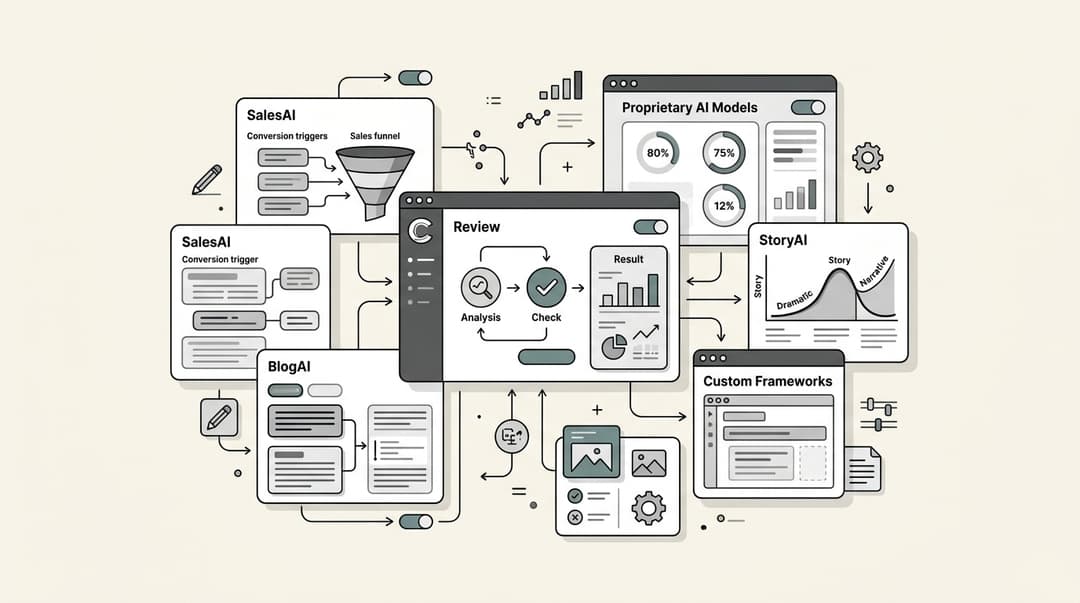
Copy.ai is a GTM AI Platform. Its main mission is to consolidate sales and marketing workflows and automate them. The goal is to reduce "GTM Bloat", the challenge of managing multiple, disconnected tools.
It’s built to manage the multi-step jobs that sales and marketing teams perform repeatedly. This includes tasks like automating prospecting, handling inbound leads without manual intervention, and running detailed account-based marketing (ABM) campaigns. While it has content creation tools, they are primarily there to support these larger GTM objectives.
It's built for sales, marketing, and customer success teams trying to scale up their operations and increase revenue. It uses AI-powered "Workflows" that turn a company's best practices into automated, repeatable processes. You can generate personalized outreach emails or create a high volume of ABM assets automatically.
What is Surfer SEO?
Surfer SEO is a specialized SEO content intelligence platform. It has one primary job: to provide the data you need to get your content onto the first page of Google. It’s less about automating large marketing campaigns and more about the details of on-page optimization.
Its entire platform is built around creating and optimizing long-form content like blog posts and articles. The main feature is the Content Editor, a tool that gives you a real-time Content Score as you write. It also has an Outline Builder that analyzes competitors to suggest a structure for your article, and it provides a list of important terms to include based on natural language processing (NLP).
This makes it a common choice for SEO specialists, content strategists, and agencies. If your job is to grow organic traffic by ensuring every article is well-tuned, Surfer is a relevant tool. The typical process involves entering a target keyword, letting Surfer analyze the top-ranking pages, and then using its data-backed brief to write and tweak an article until the Content Score is high.
A head-to-head comparison of Copy.ai vs Surfer SEO
Now that we have a feel for each tool, let's put them side-by-side. This is where you'll see the key differences and can determine which one makes the most sense for your team. A visual breakdown can help clarify their distinct strengths in the Copy.ai vs Surfer SEO debate.
Content generation and quality
Copy.ai Copy.ai is a platform for generating a wide variety of GTM-focused content at scale. It’s designed to produce everything from sales copy to cold emails and personalized assets for ABM campaigns. Features like "Brand Voice" and "Infobase" help keep content consistent with brand messaging. The platform is built around AI workflow automation, so it excels at turning strategies into a high volume of campaign content.
Surfer SEO Surfer SEO's AI is built for long-form SEO content. It generates outlines and full drafts that are structurally designed to rank because they're based on SERP data. Tools like its AI writing assistant, "Surfy," and the Auto-Optimize function work as a smart editor, helping you polish your text to meet SEO marks. It also has an AI Humanizer to make the generated text sound more natural.
The Gap The distinction is that Copy.ai is designed for creating a high volume of content for sales and marketing funnels, without a primary focus on deep, data-driven SEO. Conversely, Surfer SEO is centered on optimization but is not built to automate content creation across various GTM channels.
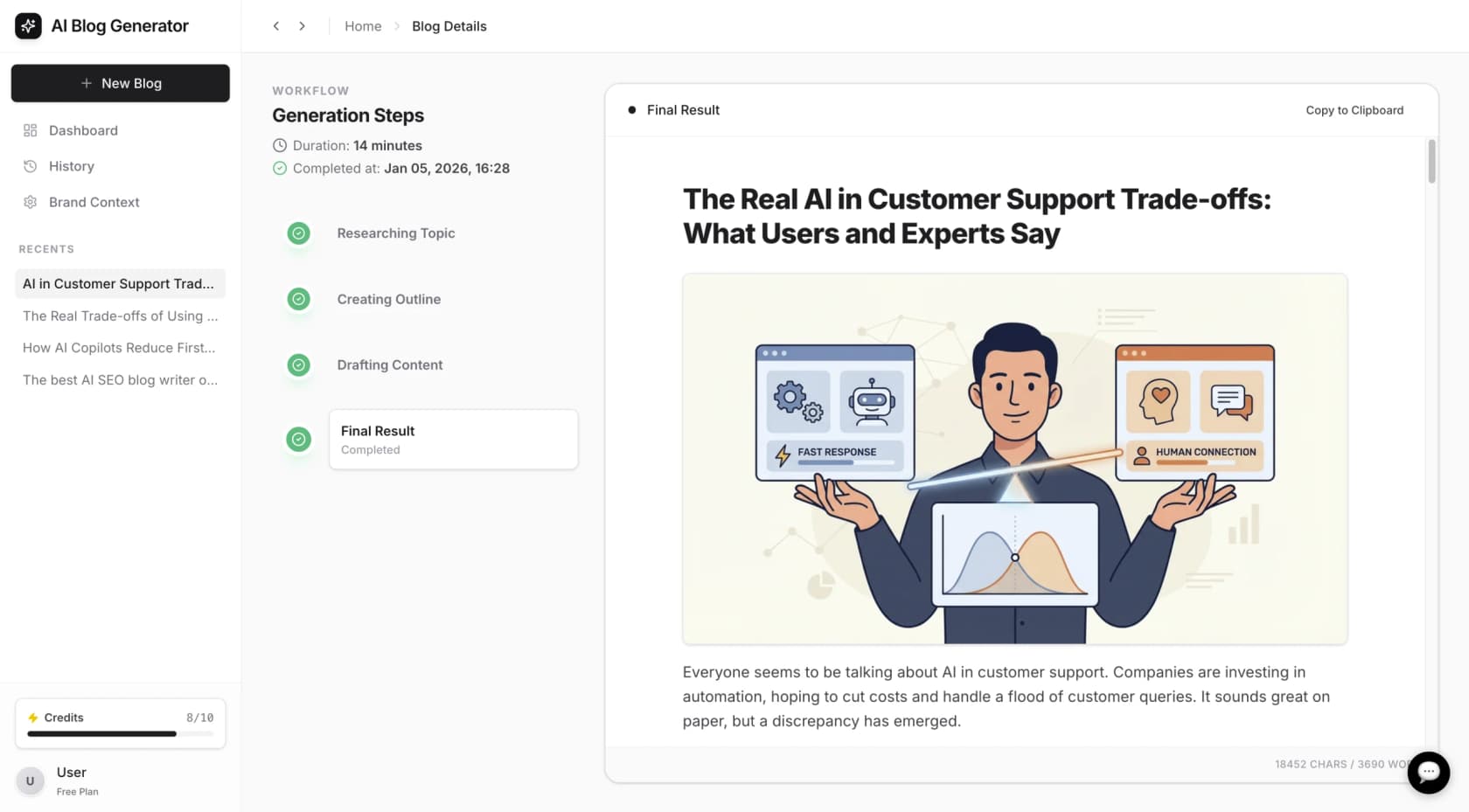
Some tools, like the eesel AI blog writer, aim to combine both content creation and deep SEO optimization in a single step, generating a complete blog post from a keyword.
SEO and ranking potential
Copy.ai While Copy.ai has a "High-Quality SEO Content" feature, its primary strengths are in other areas. It's built for content speed to fuel GTM campaigns, not for granular, on-page SEO. The platform doesn't focus on deep SERP analysis, competitor data, or internal linking tools, which are central to modern SEO.
Surfer SEO This is where Surfer SEO excels. It's designed from the ground up to help you rank. It analyzes over 500 ranking factors to give you a clear, data-driven path to the first page of Google. Some of its best features include:
-
SERP-based guidelines: It tells you exactly what keywords to use, what topics to cover, how your article should be structured, and the ideal word count, all based on what's already ranking.
-
Automatic Internal Linking: It scans your website and suggests relevant internal linking for topical authority, which is a massive ranking factor.
-
AI Tracker: This feature helps you monitor your brand's visibility in AI-generated answers from models like ChatGPT and Google's AI Overviews.
i’m an SEO specialist at an agency, and honestly we’ve tested and rejected half of this so called AI revolution right now for SEO we mostly use Ubersuggest, SurferSEO, Grammarly, and ChatGPT daily. for visuals, it’s Midjourney and Heygen. with experience paid tools only work if you actually understand the strategy, otherwise they’re just expensive confusion.

Another approach to consider is AEO (AI Engine Optimization). This strategy focuses on structuring content to be a source for AI answer engines. This can involve using context-aware research to pull in specific data, like pricing tables, which is the type of authoritative content AI engines often look for. The eesel AI blog writer is an example of a tool built with this approach.
Workflow, collaboration, and integrations
Copy.ai Copy.ai's workflow is centered on automating and unifying GTM teams. You can turn your sales and marketing playbooks into reusable "Workflows" that run automatically, which is ideal for scaling processes. It also offers over 2,000 integrations through Zapier and a powerful API that lets it connect to your tech stack, including CRMs like Salesforce.
Surfer SEO Surfer's workflow is more linear and focused on the content creation journey. A strategist creates a brief, a writer uses the Content Editor to draft the article and meet optimization targets, and collaborators can add comments and feedback via shareable links. Its integrations are also content-focused, connecting with tools like Google Docs, WordPress, and ChatGPT.
The Challenge Using both tools together involves a multi-step process. A user might draft content in Copy.ai and then move it to Surfer SEO for optimization. This requires managing two subscriptions and can create a fragmented workflow.
Pricing and value for money
Copy.ai Pricing Copy.ai doesn't have a standard free plan, but it offers a variety of useful free AI writing generator tools. Its paid plans start with the "Chat" plan at ($29/month (or $24/month if you pay annually), which gives you 5 seats. The plans scale up from there, with the enterprise-level "Scale" plan costing $3,000/month. This pricing shows its focus on larger GTM teams.
Surfer SEO Pricing Surfer SEO does not have a free plan, though it offers a free AI Humanizer for up to 500 words. Its paid plans start at a higher price point with the "Essential" plan at ($99/month (or $79/month annually). A key detail is that AI-generated articles are limited on these plans. For example, the Essential plan only includes 5 per month, and each extra article will cost you about ($15). For teams producing a lot of content, that can add up.
Let's break that down in a simple table.
| Feature | Copy.ai | Surfer SEO | eesel AI |
|---|---|---|---|
| Starting Price | $29/month ($24/mo annually) | $99/month ($79/mo annually) | $99 for 50 blog posts |
| Free Offering | Suite of free standalone tools | Free AI Humanizer (500 words) | Generate your first blog post for free |
| Core Focus | GTM Workflow Automation | On-Page SEO Optimization | End-to-End Blog Generation |
| AI Content Model | Unlimited words (Chat) | Limited AI articles per month | Pay-per-post |
For a different pricing structure, the eesel AI blog writer offers a pay-per-post model. Its plan is $99 for 50 blog posts, which includes AI-generated images, infographics, and media embeds. It offers a free trial to generate one full blog post.
Comparing end-to-end content creation
A key consideration is whether these platforms deliver a complete, publish-ready blog post with all necessary assets from a single keyword in one step.
This creates a fragmented and time-consuming workflow. With Copy.ai, you get a text draft quickly, but it's not optimized for search, and you still have to find or create all your images, videos, and charts to make the post engaging. With Surfer SEO, you get an optimized text structure, but you are still responsible for sourcing all the visuals and rich media that a competitive blog post needs.
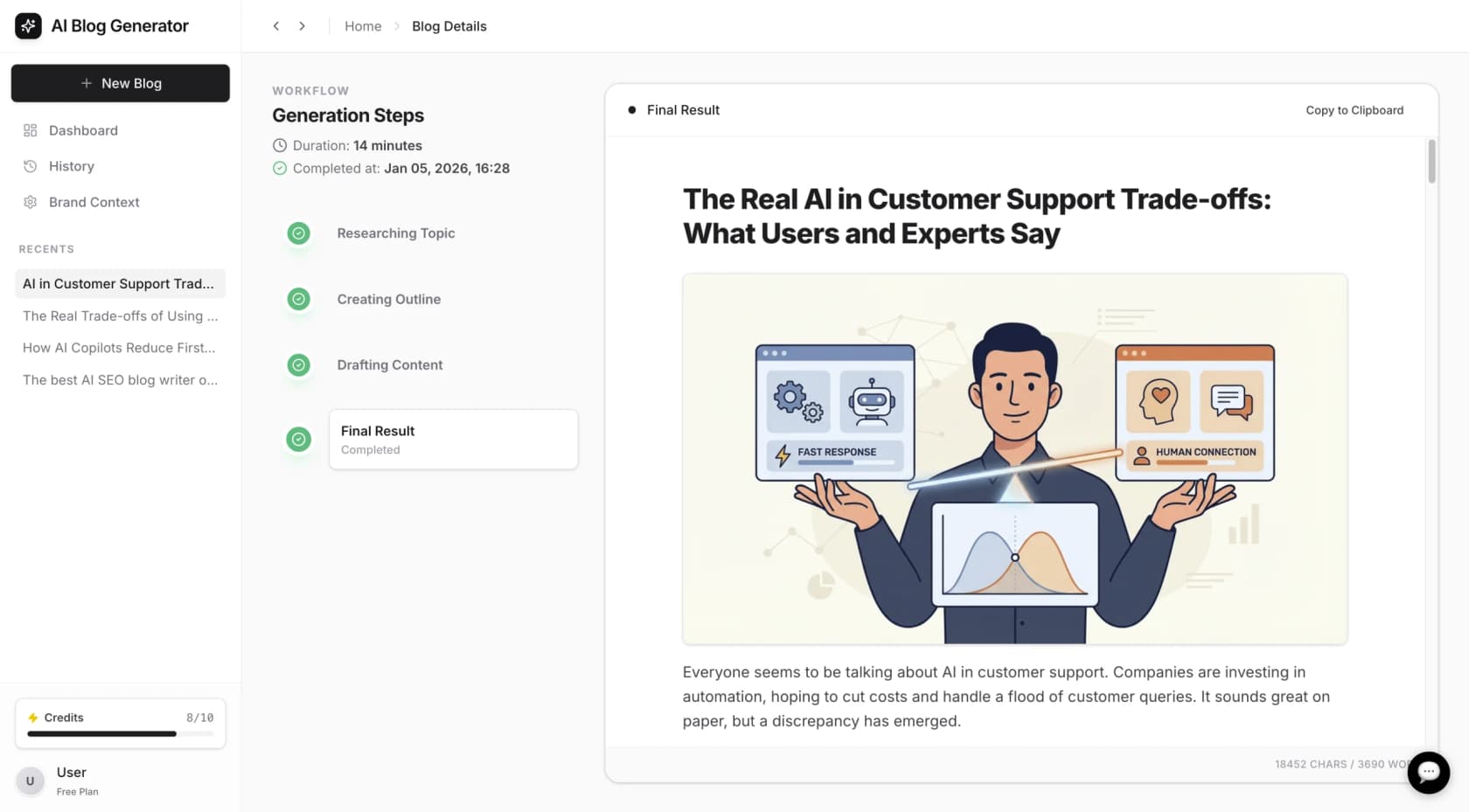
This is a challenge some tools, such as the eesel AI blog writer, are designed to address by automating the entire content package, not just the text.
-
Automatic Assets: It generates relevant images, tables, and charts and places them in the article.
-
Social Media Integration: It can pull in relevant Reddit quotes and YouTube videos to add authenticity and depth to your content.
-
Smart Linking: It analyzes your site to suggest internal links to your existing content and cites external sources, which can improve SEO and credibility.
This approach is about going from a keyword to a finished product without having to piece everything together manually.
For a more detailed look at how these tools compare in practice, see this video review that breaks down their content editing capabilities.
The final verdict on Copy.ai vs Surfer SEO: Which tool should you choose?
So, after all that, which tool is right for you? It boils down to your main goal.
Choose Copy.ai if: Your primary objective is to automate your sales and marketing workflows at scale. If content creation is just one part of a much larger GTM engine that you need to streamline, Copy.ai is a powerful choice.
Choose Surfer SEO if: Your work revolves around SEO. If your main goal is to get your long-form content to rank on Google using data-driven guidance, Surfer SEO is the specialist you need.
The choice is between GTM automation and specialized SEO optimization.
An alternative is to use a tool designed to handle both content creation and SEO optimization in one platform. If you want to streamline the process of generating high-quality, optimized content without using multiple tools, an all-in-one solution like the eesel AI blog writer might be suitable. For example, we used it to grow our blog from 700 to 750,000 daily impressions. You can generate a free blog post to evaluate if it fits your needs.

Frequently asked questions
The main difference is their core purpose. Copy.ai is a broad Go-To-Market (GTM) platform designed to automate various sales and marketing tasks, including content creation. Surfer SEO is a specialized tool laser-focused on helping you create and optimize long-form content to rank on Google.
For pure SEO performance, Surfer SEO is the clear winner. Its entire feature set, from the Content Editor to internal linking suggestions, is built to analyze SERPs and give you data-driven advice to rank higher. Copy.ai's SEO features are more general.
Copy.ai has a lower starting price ($29/month) aimed at teams, while Surfer SEO starts higher ($99/month). However, Surfer's plans often have limits on the number of AI-generated articles, which can increase costs if you produce a lot of content.
Yes, but it can be a multi-step process. You might draft content in Copy.ai for speed and then paste it into Surfer SEO for optimization. This requires two separate subscriptions, which is why an all-in-one tool might be more efficient.
It depends on your primary goal. If you need to create a lot of different marketing materials (emails, social posts, ads) quickly, Copy.ai is a good start. If your main goal is to build organic traffic, Surfer SEO is the better investment for long-term growth.
The biggest shared limitation is that neither tool delivers a complete, publish-ready blog post out of the box. You still need to source images, videos, and other media assets manually. They automate the text, but not the entire content package.
Share this article

Article by
Stevia Putri
Stevia Putri is a marketing generalist at eesel AI, where she helps turn powerful AI tools into stories that resonate. She’s driven by curiosity, clarity, and the human side of technology.