A practical guide to content marketing services

Amogh Sarda

Katelin Teen
Last edited January 12, 2026

Creating content feels easy enough, right? But creating content that people actually find and read? That's a different story. It's a familiar pain: you spend weeks on a blog post, hit publish, and... nothing. If you've been there, you're in good company. A staggering 90.6% of all content gets absolutely no organic traffic from Google.
This is exactly the problem that content marketing services are designed to solve. They're not just about churning out more articles. They're about having a real plan to create and share stuff that your ideal audience actually wants, which in turn helps your business grow.
In this guide, we'll break down what these services actually cover, look at the different ways you can get them (like hiring an agency or building a team), and help you decide what makes sense for you. We’ll also look at how newer AI tools, like the eesel AI blog writer, are making it possible for teams to create high-quality content way faster than ever before.
What are content marketing services?
Content marketing services are a set of professional services that treat your content like a real business asset, not just words on a screen. It's a complete process that goes way beyond writing. Think of it as the entire engine that powers your organic growth, covering everything from the initial idea and strategy to creation, optimization, promotion, and finally, checking the results.
When it's done well, this work connects directly to your business goals. It helps you:
- Build brand awareness and authority: When you become the go-to resource in your field, customers start looking for you.
- Drive qualified organic traffic: A good content machine brings in people who are already searching for the solutions you offer, thanks to solid SEO and AEO (Answer Engine Optimization).
- Generate and nurture leads: Good content can walk potential customers through your sales funnel, from just being curious to actually buying something.
- Improve customer loyalty: Keeping your existing customers engaged with useful content makes them feel good about their decision to choose you.
Basically, it's about building a sustainable way to grow that doesn't mean you have to keep pouring money into ads.
Core components of content marketing services
An effective content marketing service isn't a single task you just check off. It’s more like a flywheel with a few connected parts that need to work together, as illustrated in the graphic below. If you skip one of these, that’s usually why content doesn't get any traction.
Content strategy and planning
This is the blueprint for everything else. Without a decent strategy, you’re just making content and hoping for the best. This first stage involves a few key things:
- Audience research: Figuring out exactly who you're talking to by creating buyer personas, understanding what they struggle with, and knowing what questions they're asking.
- Competitive analysis: Looking at what your competitors are doing right (and wrong) to find opportunities they've missed.
- Keyword research: Using data to find topics people are actually searching for. This makes sure you're not writing into a void.
- Content calendar: Planning out what you’ll publish and when, which helps you stay consistent and aligned with your goals.
Just to give you an idea, a standalone content strategy project with an agency can cost anywhere from $4,000 to $20,000. It's the most important step, and the price reflects that.
Content creation
Once you have a plan, it's time to actually make things. This is where your ideas become real assets that your audience can read, watch, or interact with. Content marketing services can produce all sorts of content, including:
- Blog posts and articles
- White papers and ebooks
- Case studies and customer stories
- Infographics and data visualizations
- Videos and webinars
The trick is to match the format to the topic and what your audience prefers.
Content optimization
Making great content is only half the job. If nobody can find it, it doesn't really matter how good it is. Optimization is all about making sure your content shows up for search engines and your target audience. This is split into two main areas:
- Search Engine Optimization (SEO): This is the classic stuff: using target keywords, setting up proper headings (H1, H2, H3s), writing good meta descriptions, and building internal links so Google knows what your content is about.
- Answer Engine Optimization (AEO): This is a newer but super important practice. AEO is about structuring your content so AI-powered answer engines like Google’s AI Overviews, Perplexity, and ChatGPT can easily understand it and use it as a source. It’s about giving direct, clear answers.
Content promotion and distribution
Hitting "publish" is the start, not the end. Even the best content needs a little push to get going. Promotion and distribution are about actively showing your content to the right people through different channels, like:
- Social media platforms where your audience is active
- Email newsletters to your subscribers
- Reaching out to other websites to build valuable backlinks
This last step boosts your reach and gets the organic traffic ball rolling.
Models for delivering content marketing
So, you're on board with needing a solid content plan, but how do you make it happen? Businesses usually have a few choices, and each has its own pros and cons in terms of cost, speed, and control.
The traditional agency model
This is the "we'll handle it" option. You hire a content marketing agency, and they manage just about everything for you, from strategy and writing to SEO and promotion.
- Pros: You get a whole team of specialists (strategists, writers, SEOs, designers) without having to hire them individually. It's a complete solution that doesn't require a lot of your day-to-day attention.
- Cons: This model represents a significant investment, with monthly retainers ranging from $2,000 to over $30,000. Communication and feedback loops can be slower compared to an internal team. Additionally, an external agency may require a detailed onboarding process to fully understand the nuances of a niche business.
Building an in-house team
This approach means you build your own content department by hiring full-time writers, strategists, and SEO experts.
- Pros: Your team will know your brand and product inside and out. You have total control over the process, voice, and quality. They're living and breathing your business every day.
- Cons: The primary considerations are cost and resource allocation. The average salary for a single content strategist is over $70,470 per year, not including benefits or other team members. Scaling the team can also be a slow process that involves significant effort in hiring and management.
The freelance model
The freelance model is a middle path where you hire individuals for specific jobs. You might get one person for blog posts, another for design, and maybe a third for SEO advice.
- Pros: It's flexible and can be cheaper for single projects. You can find freelance writers who charge between $100 to $400 per blog post, so you can pay as you go.
- Cons: Quality can vary between freelancers, and finding reliable talent takes effort. The model also requires significant internal project management to coordinate multiple contributors, deadlines, and invoices. Without a central lead, it can be challenging to maintain a single, unified strategy.
If your goal is volume, AI tools like [Jasper](https://honeysyed.com/frase) and Frase will crank out content all day long. But if you want standout content that builds authority, a good writer is the move. AI’s like a high-speed blender-great for mixing up existing info, but it won’t cook up fresh insights. A solid writer? They’ll sprinkle in personality, real experience, and stories that actually make people stop scrolling. Best play? Use both. AI drafts the bones. A writer adds the soul. You get speed + quality without sacrificing authenticity.

The AI-powered platform model
A new option has popped up that mixes the scale of technology with the strategic eye of your team. Specialized AI platforms do the heavy lifting of research, drafting, and creating assets, which lets your team focus on the final review and promotion.
With a tool like the eesel AI blog writer, the process is straightforward. You just give it a keyword and your website URL, and it generates a complete, SEO-optimized, and media-rich article in minutes.
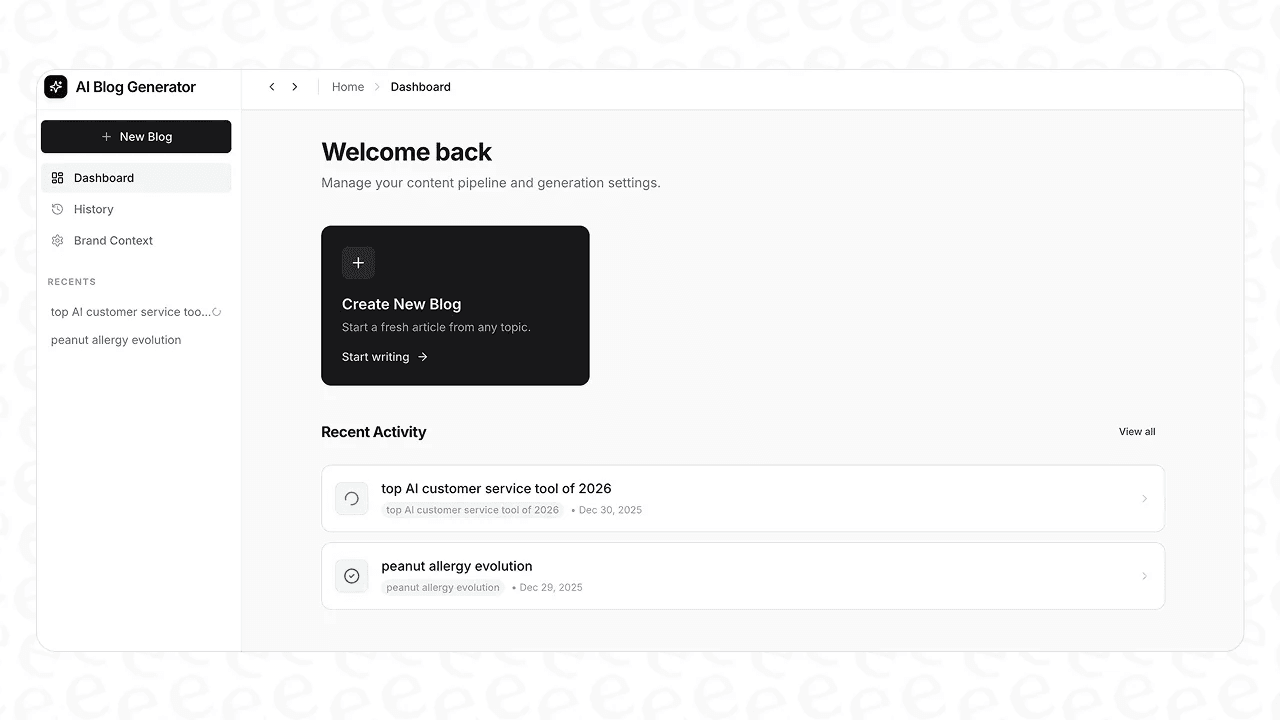
What makes this different is its ability to understand context. It doesn't just produce generic text. The eesel AI blog writer uses context-aware research to find relevant data for your topic, automatically creates visuals like images and tables, and even finds relevant Reddit quotes and YouTube videos to add social proof. We used this exact tool to grow our own traffic from 700 to 750,000 daily impressions in just three months.
- Pros: It’s incredibly fast, delivering publish-ready drafts in minutes instead of weeks. It’s easy to scale, letting you produce a lot of quality content without hiring a huge team. And it’s very affordable. For instance, eesel AI's plan gives you 50 complete blog posts for just $99.
Here’s a quick comparison of how the models look side-by-side:
| Feature | eesel AI Platform | Agency Model | In-House Team | Freelance Model |
|---|---|---|---|---|
| Cost | Very Low ($99 for 50 posts) | High ($2k-$30k+/mo) | High (Salaries) | Moderate ($100-$400/post) |
| Speed | Instant (Minutes) | Weeks to months | Moderate | Slow |
| Scalability | High | Resource-intensive | Resource-intensive | Moderate |
| Strategy | Human-led, AI-assisted | Included | Full Control | Fragmented |
| Management | Very Low | Low | High | Very High |
How to choose the right content marketing model
Picking the right model really comes down to your company's specific situation. To find the best fit, ask yourself these three questions.
Now about the hue and cry about AI taking over writing, that's not happening anytime soon. Sure, the painful tasks are done for....research, ideation, clustering..all that stuff.... businesses are now more interested in hiring a content strategist/manager instead of a 'writer'. So....the point is upskill...learn generative AI and automation. Add them to your workflow, show clients how many hours you can save...how many dollars you can save without compromising the output or quality... It's the same game, a few rules have changed. Level up or fade.
Your budget
Your budget is often a primary factor. If you have a substantial monthly budget (typically $5,000+), a specialized agency can provide a comprehensive service. For startups and SMBs focused on maximizing return on investment, an AI-powered platform offers a cost-effective way to achieve results.
Your goals
Be specific about what you want to accomplish. If your main goal is to consistently publish a lot of high-quality, SEO-optimized blog content to build organic traffic, a tool like the eesel AI blog writer is easily the most efficient way to do it. If you're planning a big, complicated brand campaign with a lot of video, then an agency's wider range of skills might be better for that project.
Your internal bandwidth
Be honest about how much time your team can actually spend on this. Building and managing an in-house team or a group of freelancers is practically a full-time job. Agencies need less daily management but still require regular check-ins and direction from you. AI platforms are the most hands-off option. They do about 80% of the work, letting your team focus on the final 20% of expert review and polish. It’s a "human-in-the-loop" approach that gives you both machine speed and human expertise.
Understanding the 'why' behind content marketing is just as important as the 'how'. To get a deeper perspective on the business impact of these services, check out this video which breaks down the core benefits for any growing company.
Scaling your content marketing efforts
Content marketing is crucial for long-term growth. Traditional models like agencies, in-house teams, and freelancers each have their place, but they can come with trade-offs in terms of speed, cost, and scalability.
But things have changed. AI-powered platforms have made high-quality content creation accessible to everyone, allowing any business, no matter its size or budget, to compete for organic traffic. You don't need a huge team or a six-figure budget anymore to run a great content strategy.
Stop letting content creation be the thing that holds back your growth. See for yourself how easy it is to start scaling your organic traffic today.
Try the eesel AI blog writer for free and generate your first publish-ready article in under five minutes.

Frequently Asked Questions
Share this article

Article by
Amogh Sarda
CEO of eesel AI. Amogh Sarda is obsessed with making the ultimate AI for customer service teams. He lives in Sydney, Australia and has previously worked at Atlassian and Intercom. Outside of work he’s usually surfing or on stage doing improv.