I tested 5 content AI writer tools: Here are the best for 2026

Stevia Putri
Last edited January 14, 2026
The internet is filled with AI content of varying quality. While some articles can feel generic, the right tools can help create content that connects with readers and performs well in search engines.
A quality content AI writer is more than just a word generator. It acts as a partner, helping you research topics, structure your posts, and optimize everything for real search performance. The point isn't just to write faster; it's to scale your content production without sacrificing quality.
This guide looks at the top 5 tools that can help you achieve this. These are platforms designed to produce high-quality content. Advanced tools like the eesel AI blog writer can generate complete, publish-ready articles with all the assets included. We used this strategy to grow our own traffic from 700 to over 750,000 daily impressions in just three months.
What is a content AI writer?
A content AI writer is a tool that uses artificial intelligence, typically powered by large language models (LLMs), to generate written content from a prompt or keyword.
It can be viewed as a creative assistant that can produce anything from a full blog post to social media captions, ad copy, or emails. The main goal is to speed up the content creation process. These tools can help overcome writer's block, handle research, and enable marketing teams to publish more content.
The capabilities of these tools vary widely. There is a significant difference between general text generators and specialized content platforms. The latter are often designed for marketing, with features for SEO, in-depth research, brand voice matching, and even automatic inclusion of rich media like images and videos.
Criteria for choosing the best content AI writer tools
- Quality of Output: Does the content sound human? Is it accurate, engaging, and genuinely helpful, or does it feel like generic AI text?
- Ease of Use: How quickly can you get started? We favored intuitive interfaces built for content marketers, not AI developers.
- Feature Set: Does the tool do more than just generate text? We gave extra points to platforms with built-in SEO features, asset creation, research tools, and brand voice customization.
- Value for Money: Does the price justify the features and quality? We looked for tools that offer a real return on investment.
- SEO & AEO Performance: Can the tool create content that’s set up to rank on search engines? We also looked for AEO (AI Engine Optimization) features, which help your content get cited in new formats like Google's AI Overviews.
The best content AI writer tools at a glance
| Tool | Best For | Key Standout Feature | Pricing Model |
|---|---|---|---|
| eesel AI blog writer | Generating complete, publish-ready blog posts | Automatic inclusion of assets, Reddit quotes, and videos | Credit-based ($99/50 posts) |
| Jasper | Marketing teams needing automated content pipelines | Jasper IQ for brand context and agentic workflows | Subscription (from $59/mo) |
| Copy.ai | Go-to-market teams focused on automated workflows | GTM AI Platform with custom Workflows and Agents | Subscription (from $24/mo) |
| ChatGPT | General-purpose brainstorming and short-form copy | Versatility with the latest GPT models | Freemium/Subscription |
| Clearscope | SEO teams prioritizing search intent and discoverability | AI drafting guided by deep SERP and intent analysis | Subscription (from $129/mo) |
A deep dive into the top 5 content AI writer tools for 2026
Let's get into the details. Each of these tools has its own strengths, so the best one depends on your specific goals.
1. eesel AI blog writer: For end-to-end content generation
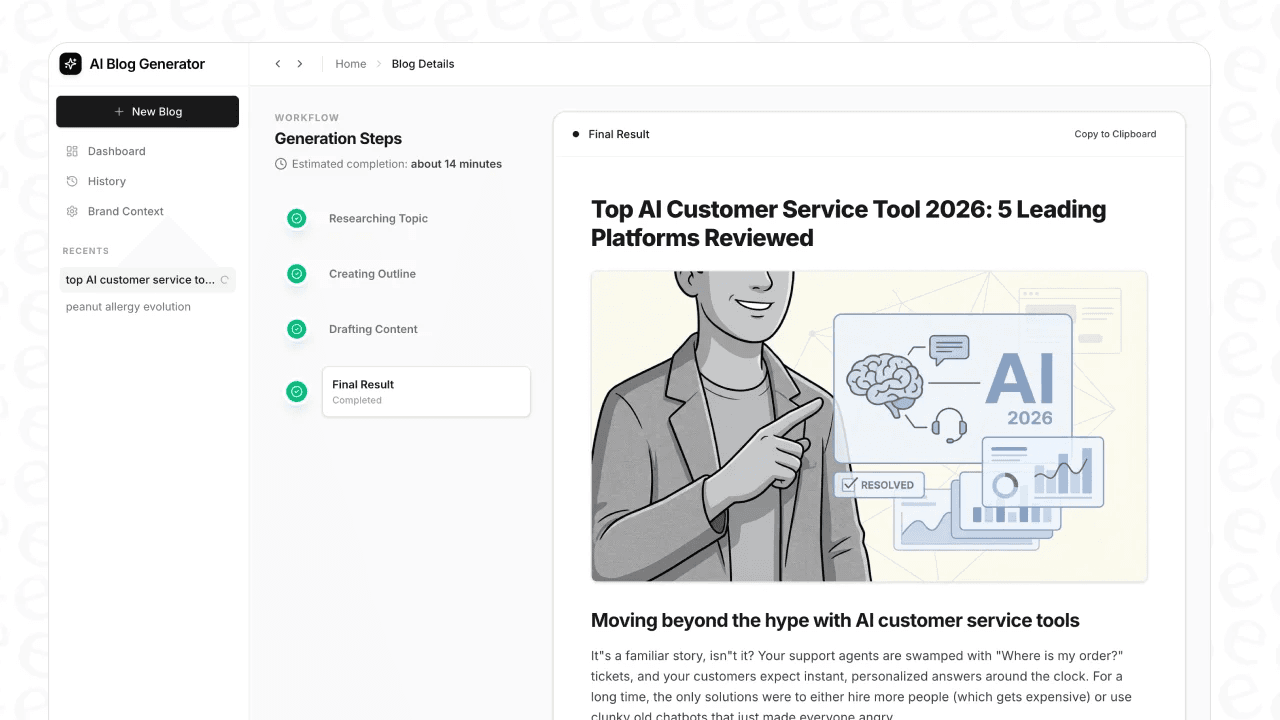
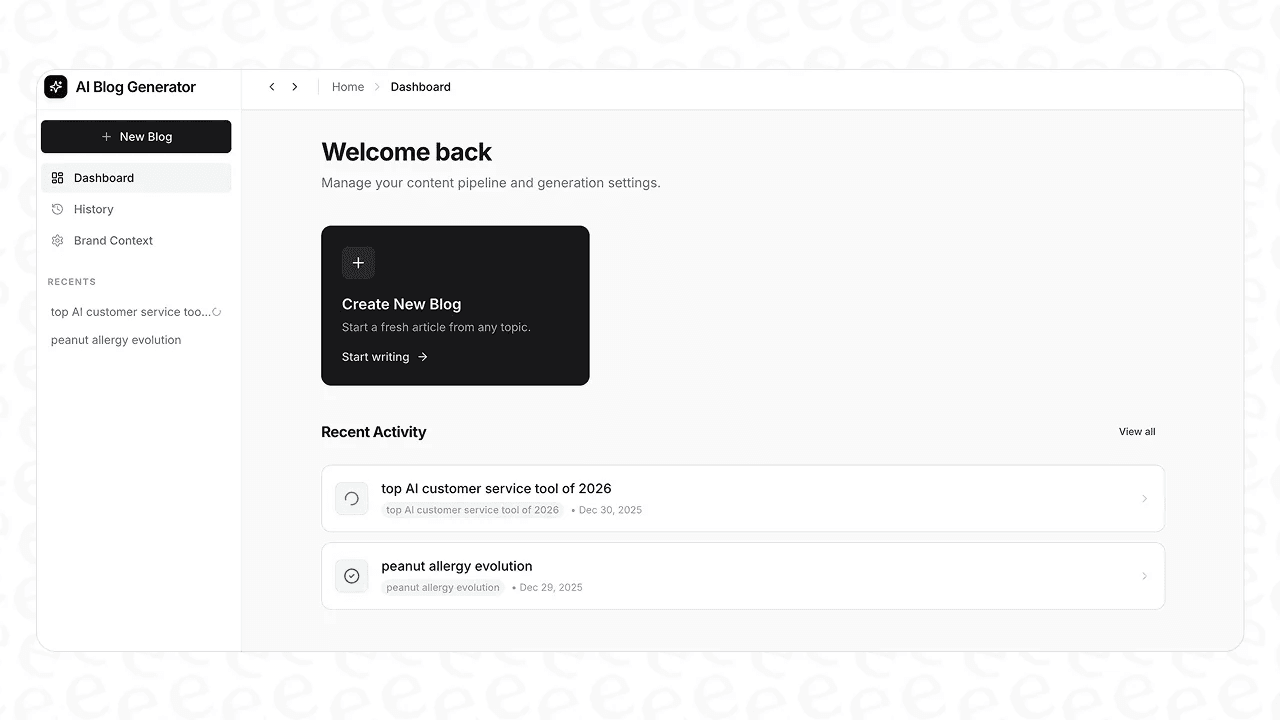
This tool was developed internally to support content marketing efforts and contributed to traffic growth of over 750,000 daily impressions in a few months. It is built to create content that ranks well and reads naturally.
Pros: The main advantage of eesel AI is that it generates a complete, publish-ready article, not just a draft. It automatically finds and embeds relevant YouTube videos and real Reddit quotes for social proof, adding credibility. The platform also creates AI images, charts, and tables. Its context-aware research and AEO (AI Engine Optimization) features ensure the content is well-researched and prepared for modern search experiences like Google's AI Overviews.
Cons: Because eesel AI is focused on long-form blog content, it may not be the primary tool for teams needing to generate short-form copy like social media posts or ad headlines. Its workflow is built around turning a topic into a full article.
Pricing:
- It is completely free to try.
- The Early Bird plan is $99 per month for 50 blog posts.
2. Jasper: For marketing teams
Jasper is an AI content platform built to automate marketing operations. It offers features like Content Pipelines, which help connect content strategy directly to creation. At its core is Jasper IQ, a knowledge layer that learns your brand guidelines, tone, and company info to ensure all output is on-brand. <quote text="I'll save everyone some time: they're both bloated trash.
Solid fundamentals + Bard / Google / GPT4 for ideation, brainstorming, and streamlining is the way to go." sourceIcon="https://www.iconpacks.net/icons/2/free-reddit-logo-icon-2436-thumb.png" sourceName="Reddit" sourceLink="https://www.reddit.com/r/copywriting/comments/15b5pnb/comment/jtr5sx3/">
Pros: Jasper’s main strength is its ability to automate the content lifecycle. Its Brand IQ feature is useful for maintaining a consistent brand voice across blog posts and email campaigns. For technical teams, Jasper Studio allows the creation of custom, no-code AI apps for specific marketing workflows. It is also an enterprise-ready platform with SOC 2 compliance.
Cons: Jasper's extensive features for automation can present a learning curve for new users. The platform's long-form content output may benefit from human editing to fully align with specific search intent and optimization goals.
Pricing:
- Pro Plan: Starts at $59 per seat, per month (billed annually).
- Business Plan: Custom pricing for teams that need advanced features and API access.
3. Copy.ai: For go-to-market teams
Copy.ai is positioned as an AI-native GTM (Go-to-Market) Platform. It’s designed to unite sales, marketing, and success teams by integrating AI into their processes. The platform focuses on turning best practices into repeatable, automated Workflows for tasks like creating content, finding prospects, or processing leads.
Pros: Copy.ai is effective at automating specific GTM tasks at scale. It has a library of over 2,000 integrations (including Zapier) and is LLM-agnostic, using the most suitable AI model for the job. Its security is enterprise-grade, with SOC 2 Type II compliance.
Cons: Its workflow-based model is powerful but differs from single-purpose content generators. Generating a complete blog post may involve several workflow steps, and output quality can be influenced by the data sources and steps configured in the workflow.
Pricing:
- Free Plan: Includes 2,000 words per month in their Chat feature.
- Paid plans for teams start from $24/month (billed annually) and increase based on seats and workflow credits.
4. ChatGPT: For versatile, general-purpose tasks
ChatGPT is a well-known AI writer. It is a useful all-around assistant for brainstorming ideas, summarizing long documents, rephrasing sentences, and generating various types of short-form copy. With the latest GPT models, its ability to handle complex reasoning and understand images has become more powerful.
Pros: ChatGPT is versatile and easy to start with due to its free version. The paid plans unlock more features like creating custom GPTs, analyzing data, and generating images. It's a useful tool for a wide range of content tasks, and its conversational style makes it easy to refine ideas.
Cons: As a general-purpose tool, ChatGPT is not specialized for long-form blog creation. It requires users to perform real-time research, add visual assets, cite sources, and structure the content manually to produce a complete, SEO-optimized blog post.
Pricing:
- A free version is available with some limitations.
- Plus: $20 per month for individuals.
- Business: $25 per user, per month (billed annually) for teams.
5. Clearscope: For SEO-focused content
Clearscope is a "Discoverability Platform" that helps content get found on Google and AI search platforms like ChatGPT. It has expanded from a content optimization tool to include features for tracking visibility, finding new topics, and understanding search intent. Its "Draft with AI" feature is an AI assistant built into its SEO workflow.
Pros: For creating content that is focused on user search intent, Clearscope is a strong option. Its AI drafting feature is built on a deep analysis of search engine results pages (SERPs), providing a strong, SEO-aligned foundation. It also integrates with Google Docs and WordPress. The platform helps you monitor citations in AI answers, which is a key part of AEO.
Cons: Clearscope is an SEO-first tool, not an end-to-end content generator. It assists with drafting and optimizing text but does not automatically create or embed images, videos, or other rich media. It is designed to assist subject matter experts and SEOs rather than replace the entire content creation process.
Pricing:
- Essentials Plan: Starts at $129 per month.
- Business and Enterprise plans are also available for larger teams.
How to get the most from your content AI writer
- Your input quality matters: The more context you give the AI, the better its output will be. This means providing details about your brand voice, target audience, and the key points you want to cover. This is a core principle behind a tool like the eesel AI blog writer, which can use your website's existing content to ensure relevance.
- Use it as an assistant, not a replacement: The best content comes from a partnership between AI's speed and a human's expertise. Let the AI handle about 80% of the work (like research and drafting), and then you can step in to add the final 20% of strategic value and personal touch.
- Fact-check and edit: This step is non-negotiable. Always review AI-generated content before publishing. Check for factual accuracy, adjust the tone, and ensure it aligns with your brand and the search intent of your audience.
For a deeper look at the various AI writing tools available, the following video provides a comprehensive review of 20 different options to help you find the best fit for your needs.
Choosing the right content AI writer
The content AI writer market has evolved beyond simple text spinners. Today's tools can function as content partners, handling research, structuring, and even asset creation.
The key is to pick a tool that fits your workflow. Whether you need a versatile copy generator like Jasper for various tasks or a specialized solution that takes you from keyword to a finished article, there's a tool available.
To see how an end-to-end content AI writer works, you can generate your first blog post for free with the eesel AI blog writer and go from keyword to a publish-ready article in minutes.

Frequently Asked Questions
Share this article

Article by
Stevia Putri
Stevia Putri is a marketing generalist at eesel AI, where she helps turn powerful AI tools into stories that resonate. She’s driven by curiosity, clarity, and the human side of technology.

