
It feels like everyone has a blog these days, right? The internet is overflowing with articles, but let's be honest, most of them just sit there. They don't get read, they don't rank, and they certainly don't get anyone talking. The old "publish and pray" method just doesn't work anymore. If you want to be heard above the chatter, you need a better plan.
This is where the idea of "comprehensive blog writing" becomes so important. It's the new benchmark for getting actual results. This isn't just about word count; it's about building a single, go-to resource that gives your readers everything they need in one spot. It’s about going deep, figuring out what your audience is truly looking for, and then organizing your content to deliver real value.
But making this kind of content over and over is tough. At eesel AI, we've been there. We were stuck spinning our wheels, which is precisely why we created the eesel AI blog writer. We used it on our own blog and our organic impressions shot up from around 700 to over 750,000 a day in just three months.
This guide is your roadmap to doing the same. We'll walk you through what comprehensive content really is, what it takes to make it, and how you can get started.
What is comprehensive blog writing?
Comprehensive blog writing is all about creating one piece of content that fully answers a user's question, plus all the follow-up questions they haven't even thought of yet. The idea is to be the last click: the one-stop shop on a topic.
This is a lot more than just writing a long post. A 3,000-word article that just rambles on is pretty useless. A truly comprehensive post stands on a few key pillars:
- In-depth Research: This isn't about a quick Google search. It means digging for unique data, finding expert insights, and using real-world examples that aren't already all over the internet.
- Logical Structure: Your information has to be easy to scan and understand. Clear headings, subheadings, lists, and tables let readers jump to the parts they care about without feeling lost.
- Rich Media Integration: Let's face it, text alone can be a snooze. Comprehensive content uses images, infographics, videos, and social proof (like quotes from actual people) to explain tricky concepts and keep readers hooked.
- Optimized for SEO & AEO: You still need to optimize for search engines (SEO), but now you also have to think about AI Answer Engines (AEO). Gartner predicts that search volume will drop by 25% by 2026 as people get answers directly from AI. Your content has to be ready for that shift.
Basically, it's the exact opposite of "thin content": those generic, surface-level articles that don't help anyone. Comprehensive content is the solution to that problem.
The core components of comprehensive blog writing
Alright, let's get into the details. Putting together a blog post that actually makes an impact isn't about luck; it's a process. Here are the essential pieces you need to nail.
Strategic research and planning
Before you even think about writing, you need a solid plan.
Start with keyword research and figuring out user intent. It’s not enough to know what people are searching for; you need to understand why. Are they after a quick definition, a detailed guide, or a product comparison? Getting the "why" behind the keyword is what separates good content from great content.
Next, take a look at the SERP (Search Engine Results Page). Google your target keyword and see what the top articles are doing. What topics do they cover? What's their format? And, crucially, what did they miss? Finding those gaps is your chance to add more value and stand out.
I've been writing blog posts for the last few years. Over time, I've come up with a good system that actually has a soul and not just pieced together purely for SEO that no one would enjoy reading.

Finally, build a detailed outline. This is your blueprint. A good outline ensures you cover everything in a logical flow and don't go off on tangents. It's probably the best thing you can do to make sure your final piece is genuinely comprehensive.
Crafting compelling content
Now, it's time to write. Your hook and intro are everything. You've got just a few seconds to grab someone's attention, so make them count. Kick things off with a surprising stat, a relatable story, or a common problem your post is about to solve.
For the body of the post, think "scannable." No one wants to read a massive wall of text. Keep your paragraphs short (3-4 sentences is a good target) and use bullet points or numbered lists to break up the content. This makes it easy for people to skim, which is how most of us read online.
And remember to weave in stories and data. Personal anecdotes, case studies, and statistics from reliable sources give your content more weight and help you connect with your readers. It shows you've done your homework and have real experience to share.
Integrating rich media
A text-only post is like a movie with no sound. Visuals are key for keeping people interested and making your content easier to digest. Plus, they can pop up in Google's image and video search results, giving you another way to bring in traffic.
Here are a few types of assets you should be using:
- Custom Images & Infographics: These are perfect for breaking down complicated ideas or data into something simple and visual.
- Tables: The best way to compare products, features, or data points side-by-side.
- Video Embeds: Great for tutorials, expert interviews, or just adding another layer to your content.
- Social Proof: Nothing builds trust like hearing from real people. Embedding quotes from forums like Reddit adds a layer of authenticity that you just can't fake. It’s a powerful touch, and it’s something the eesel AI blog writer actually does for you automatically.
Optimizing for search engines
You could write the most amazing blog post ever, but if nobody can find it, it doesn't do much good.
The on-page SEO basics are still a must. That means putting your target keyword in your main title (H1), headings (H2s and H3s), meta description, and image alt text. You should also link to other relevant posts on your site (internal links) and to credible external sources.
But now, you also have to think about AEO (Answer Engine Optimization). AEO is about setting up your content so it can be picked up and cited directly in AI-generated answers on platforms like Google's AI Overviews, ChatGPT, and Perplexity. This means targeting conversational, question-based searches and structuring your content with clear, concise answers that an AI can easily grab. It's a whole new world out there, and tools built specifically for this have a serious leg up.
AI-powered approaches to content creation
So, how do you create this kind of deep content without it taking up your entire week? AI is the clear answer, but not all AI tools are built the same.
Using general-purpose chatbots
Tools like ChatGPT are great for brainstorming or drafting a quick outline. However, using them for a full, comprehensive blog post is a manual process. You provide a series of prompts to generate a text-based starting point.
When using these tools, there are a few things to keep in mind:
- Text-based output: The primary output is plain text. Users are responsible for sourcing and adding visuals like images, tables, and videos to make the post engaging.
- Requires editing: The generated content often serves as a first draft and may need editing to align with a specific brand voice and style.
- Fact-checking is necessary: These models can sometimes produce factual inaccuracies, known as "hallucinations." All claims should be manually verified.
- Manual optimization: The text is not automatically optimized for SEO or AEO, requiring users to add keywords and structure the content for search engines.
Keep in mind those AI tools are just built on top of OpenAI, Anthropic etc, so you're getting the same results, just in a different interface for a marked up price.
Using specialized writing assistants
Then there are platforms like Jasper. These are AI content tools designed for marketing teams, often centered around a collaborative editor like Jasper's "Canvas" feature.
Jasper's Brand IQ feature is good for keeping a consistent brand voice. It can also connect with SEO tools like SurferSEO if you pay for an add-on.
The workflow is a copilot experience, where you guide the AI step-by-step to generate text. This text then needs to be supplemented with rich media to create a complete post. Jasper's Pro plan, which includes these features, starts at $59 per seat per month if you pay annually.
How the eesel AI blog writer streamlines the process
This is where things really change. That fragmented, step-by-step process is exactly what we wanted to get rid of. We built the eesel AI blog writer to manage the entire workflow, from a single keyword to a finished, publish-ready article.
From keyword to a publish-ready post
The process is about as simple as it gets. You just enter a keyword or topic and your website's URL. That's it. The eesel AI blog writer handles the rest, automatically taking care of the research, writing, structuring, and asset creation.
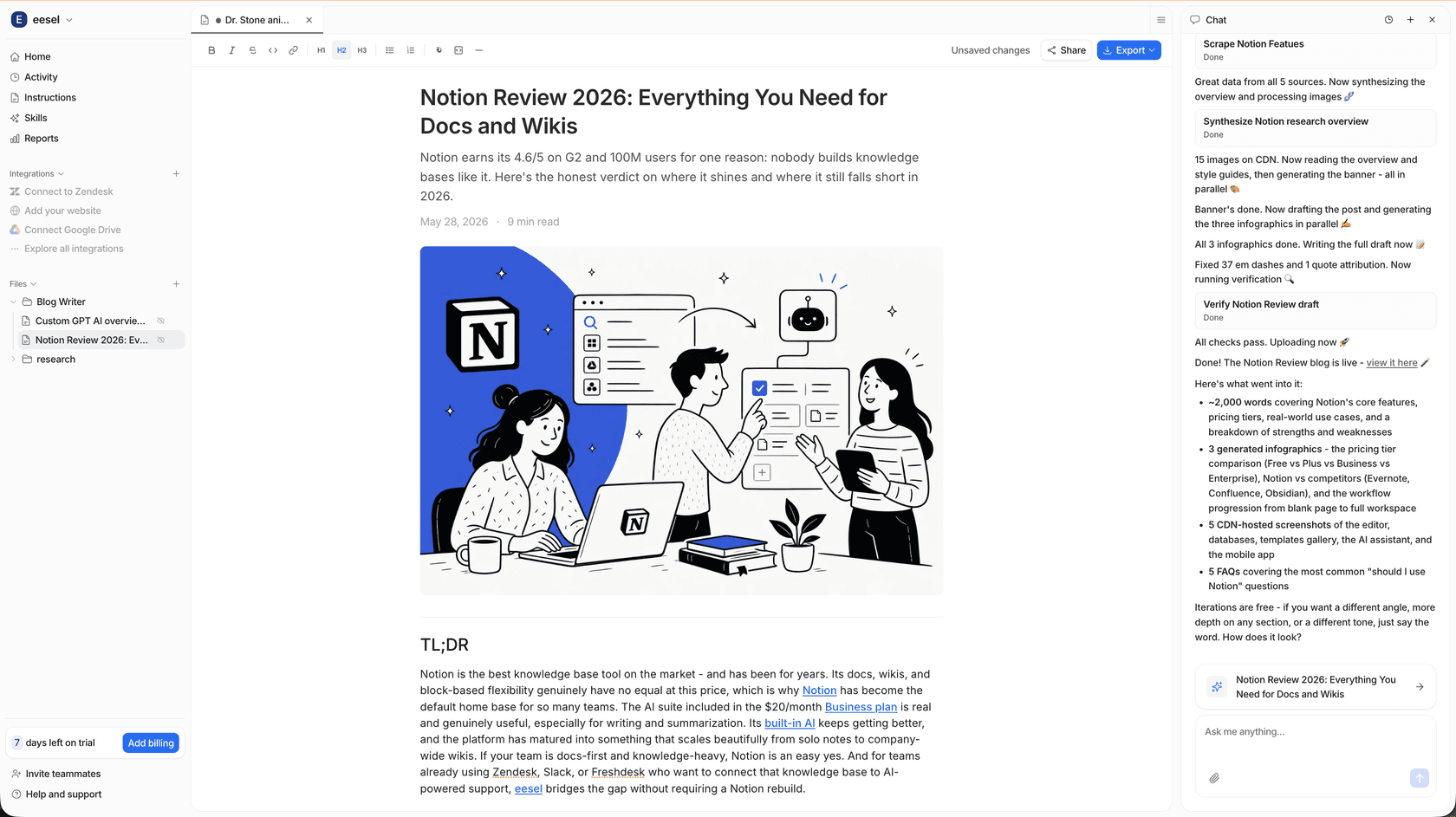
The big difference is the final product. Instead of a plain text draft that needs hours of work, you get a complete, structured blog post with all the necessary parts already included. It’s designed to be published, not just drafted.
Automating the research process
One of the biggest time drains in content creation is research and finding assets. Our tool automates this entirely.
It performs context-aware research, which means it knows what kind of information to look for based on the type of blog. If you're writing a comparison post, it will find pricing data. For a product review, it will look for technical specs.
But the real standout feature is the automated asset generation. The eesel AI blog writer creates custom AI-generated images, infographics, and data tables for your post, all by itself. It even embeds relevant YouTube videos and pulls real, insightful quotes from Reddit to add that critical layer of social proof.
Achieving a human-like tone
We spent over a year tweaking our AI to produce a tone that is conversational, engaging, and actually enjoyable to read. We were sick of "AI slop" and were determined to build something that created content people would want to read.
It also learns your brand voice from your website. This lets it naturally weave in product mentions and internal links that feel helpful, not like a pushy sales pitch. It writes for your brand, in your brand's voice.
For a deeper dive into the entire process, from finding the right topic to hitting publish, check out this step-by-step video guide.
Your action plan
Feeling a bit overwhelmed? Don't be. Creating comprehensive content is a process, but it's a manageable one. Here's a quick checklist to help you out:
- Start with deep research into user intent, not just keywords.
- Create a detailed outline that covers your topic from all sides.
- Write clear, scannable content that sounds like it came from a person.
- Integrate a mix of rich media assets (images, tables, videos, quotes).
- Optimize your post for both traditional SEO and modern AEO.
- Use a purpose-built tool like the eesel AI blog writer to speed up the entire process from hours to minutes.
Final thoughts on comprehensive blog writing
In today's crowded online space, "good enough" content might as well be invisible. Comprehensive blog writing is how you stand out, build authority, and drive real, lasting organic growth. It's about giving your reader so much value in one place that they have no reason to go anywhere else.
While that might sound like a mountain of work, modern AI has come a long way from simple text generators. The right platform can now manage the entire end-to-end workflow, from research and writing to asset creation and optimization. This frees you up to focus on strategy instead of getting lost in the details of content production.
Ready to see what that looks like? Stop drafting and start publishing. Generate your first complete, SEO-optimized post for free with the eesel AI blog writer and see what comprehensive content really looks like.