Claude vs Clearscope: Which tool is right for your content workflow?

Amogh Sarda
Last edited January 26, 2026
Content teams are constantly trying to hit two big goals: create great, engaging content and make sure that content actually shows up on Google. This usually leads to a choice. Do you pick a general AI assistant that can draft pretty much anything, or do you spend your money on a specialized SEO tool that focuses on every word for search engines?
On one hand, you've got tools like Claude, a powerful AI from Anthropic that's a real jack-of-all-trades. It can help you brainstorm, research, write drafts, and even create a spreadsheet on the spot. On the other side is Clearscope, an SEO platform that is focused on getting your content to the top of the search results.
They started out in different worlds, but their features are beginning to overlap, which makes the decision a lot tougher. But what if you didn't have to pick between a creator and an optimizer? A new type of tool, like the eesel AI blog writer, is designed to handle the whole workflow, taking you from just a keyword to a polished, ready-to-publish post.
What is Claude?
Claude is an AI assistant from Anthropic. It’s less of a simple chatbot and more like a versatile partner you can work with on almost any task. It's built to be conversational, creative, and genuinely helpful.
Its core skills are pretty wide-ranging:
- Conversational chat: You can bounce ideas off it, ask complicated questions, and get help with research.
- Writing and editing: It can draft anything from emails and documents to marketing copy and even bits of code.
- Analysis and summarization: You can upload documents, photos, or charts, and Claude will pull out and summarize the key information for you.
- File creation: This is a really handy feature. You can ask Claude to create files right in the chat, like turning a list of data into an Excel spreadsheet or a document outline into a PowerPoint presentation.
- Projects: You can keep your work organized into "Projects", which helps Claude remember the context from your knowledge bases, like a company style guide or a codebase.
An infographic detailing Claude's main features, providing context for the Claude vs Clearscope comparison.
Basically, Claude is a flexible tool that can certainly help with creating content. But it wasn't built specifically for SEO. As one Reddit user noted, it's great for outlines and initial drafts, but you still have to be the one in the driver's seat providing all the SEO guidance.
Claude writes good content for seo, but you always need an expert to use ai tool to save time. Ai can't be used completely without having practical knowledge.

What is Clearscope?
Clearscope, on the other hand, is an SEO optimization platform. Its whole mission is to help your content rank higher on Google and get cited in the new AI-powered answer engines.
It works by looking at the top-ranking pages for your target keyword. From that analysis, it gives you a clear, data-driven plan to make your content better than what's already out there.
Here are its main features:
- Content Reports: You get a simple letter grade (from A+ to F) that shows how well your content covers the topic compared to the top results.
- Recommended Terms: It provides a list of important terms and related topics you should probably include in your article to make it more relevant.
- AI Drafts: It can generate a structured first draft for you based on its SERP analysis and the search intent you choose.
- Google Docs Integration: You can get all of Clearscope's real-time feedback directly inside Google Docs, which is incredibly useful for writers.
- AI Tracked Topics: This feature helps you see how often your brand is being mentioned or cited across Google and AI chatbots.
An infographic illustrating Clearscope's main features to inform the Claude vs Clearscope comparison.
Think of Clearscope as your tactical editor. It gives writers a clear set of instructions to fine-tune their content to meet the best practices for both traditional SEO and the newer Answer Engine Optimization (AEO).
Claude vs Clearscope: A head-to-head feature comparison
The best way to understand the difference between these two is to see how they handle the different stages of creating content.
Content creation and drafting
When it's time to get that first draft written, both tools can help, but they go about it in very different ways.
- Claude:
Claude is a great place to start for any piece of content. It’s excellent at brainstorming topics, generating outlines, and writing first drafts. Its coolest feature is the ability to create and edit files directly. For instance, you could ask it to pull data from a PDF and pop it into an Excel sheet, or turn a document into a PowerPoint presentation, all inside the chat. The catch is that the quality of the blog draft depends entirely on how good your prompts are. It needs a lot of specific direction to create something that’s well-structured and ready for an SEO workflow.
Usually ideation in writing with GPT/Claude.
- Clearscope: Clearscope’s "Draft with AI" feature is much more guided. It has you select the searcher's intent (are they looking to buy, learn, or compare?), the content type, and the tone of voice. Then, it generates an outline and a first draft that's already based on its real-time analysis of the top search results. Clearscope sees its AI as an assistant to help you get past the "blank page" problem, not as a full replacement for a human writer.
SEO and content optimization
This is where the core purposes of the two tools become most apparent.
-
Claude: Claude has no built-in SEO tools. You can tell it to include certain keywords, but it's a manual process, and it lacks the data-backed precision of a dedicated SEO tool. It can't give you a content score, analyze what your competitors are doing, or tell you which related terms you forgot to include. Claude's function is as a text generator; it does not have a direct connection to live search engine data to guide optimization.
-
Clearscope: This is what Clearscope is all about. It gives you a real-time feedback loop with a content grade that updates as you write. Its smooth integrations with Google Docs and WordPress mean that writers can optimize their content right where they're already working. A big part of its strategy is also focusing on AEO, helping your content get cited in Google's AI Overviews by analyzing the sources that AI models are pulling from. It's all about helping you "Get Discovered on Google..."
Research and analysis
Both tools can help with research, but they come at it from completely different angles.
-
Claude: Claude can search the web to pull in current information for your articles. It’s also very good at analyzing and summarizing files you upload, like PDFs or CSVs, which is a big help for creating data-driven content. You can think of it as a tool for broad, topic-level research and pulling together information from different places.
-
Clearscope: Clearscope’s research is highly specialized. Its "Topic Explorations" feature does a deep dive into top search results for a single keyword. It finds common themes, looks at how competitors have structured their outlines, and gathers questions directly from Google's "People Also Ask" section. This is tactical research designed to give you exactly what you need to outrank specific competitors for a specific search term.
Pricing: Claude vs Clearscope
Claude pricing
Claude has a few tiers for individuals and heavy users:
- Free: You get basic access to try out the platform, which is perfect for casual use.
- Pro: This plan is $17 per month if you pay for a year upfront, or $20 month-to-month. It gives you 5 times more usage than the free tier.
- Max: For serious users, the Max plans start at $100 per month for Max 5x or $200 per month for Max 20x, offering much higher usage limits.
Clearscope pricing
Clearscope is priced as a premium, specialized tool for businesses:
- Essentials: This plan costs $129 per month and includes 20 monthly AI Drafts and 20 AI Tracked Topics.
- Business: At $399 per month, this plan comes with 20 monthly AI Drafts and 50 AI Tracked Topics.
- The main thing to keep an eye on here is that additional reports can get expensive. For example, if you need an extra $50 for 10 drafts.
Limitations of Claude and Clearscope
Neither tool is perfect, and they both have some gaps in their workflows.
- Claude's limitations: It’s a generalist AI. It’s amazing at generating text and even different file types, but it doesn't create a complete, media-rich blog post that's ready to rank. To get a high-quality article out of Claude, you need to have solid SEO knowledge, be great at writing prompts, and be ready to manually add all your images, videos, and formatting. It provides a powerful text generation engine, but the user is responsible for integrating SEO elements, assets, and formatting.
They are all using an API from one of the big providers (OpenAI, Anthropic, Gemini, Llama). They put some light window dressing on the front end - workflow, templates, integrations, UI niceties - but no real differentiated *substance*. The actual text generation and reasoning is based on one of those core models from a major provider.
- Clearscope's limitations: It’s an optimizer, not a full-on content creator. While its "Draft with AI" feature is a good start, its real power is in refining text that's already been written. It doesn’t solve the problem of actually producing that initial draft with all the necessary assets. Plus, it's pricey on a per-report basis and doesn't generate things like images, infographics, or social embeds from places like Reddit that can make a post feel more authentic.
An alternative: The eesel AI blog writer
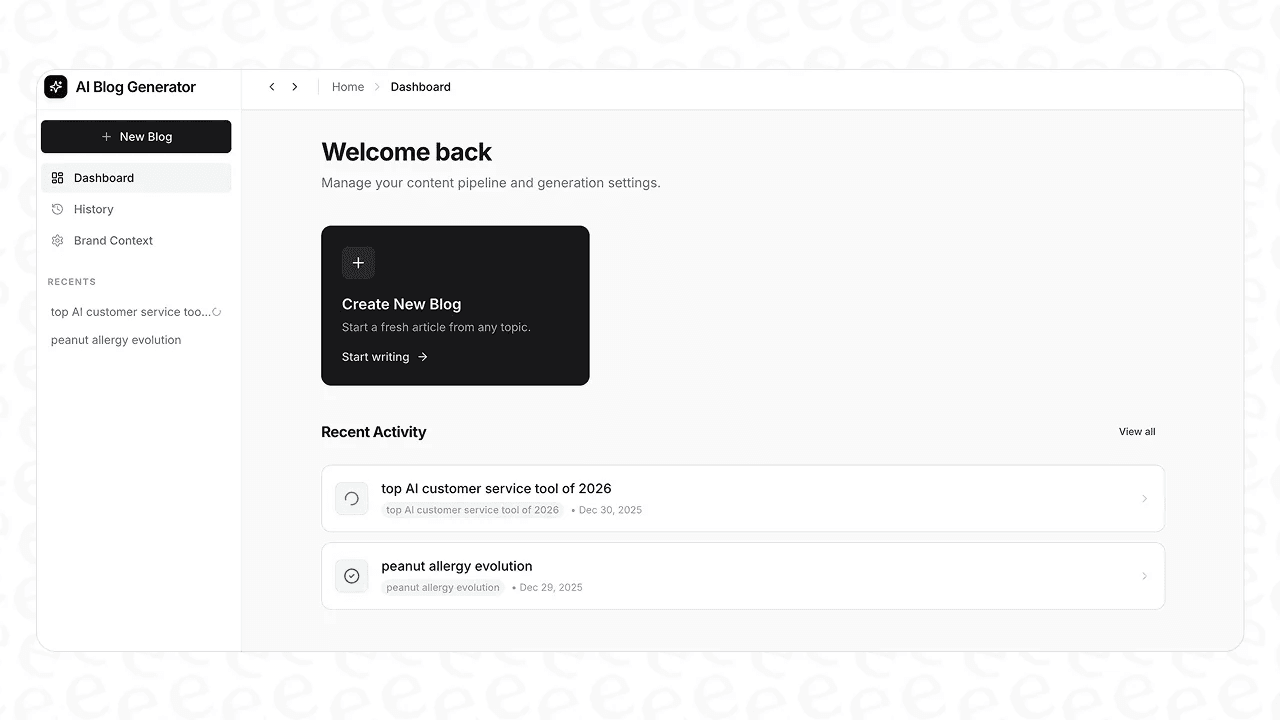
It was built to fill the gap between creation and optimization. Its entire purpose is to turn a keyword into a post, SEO-optimized, and media-rich blog post that's actually ready to publish.
Here’s what makes it different and how it addresses the limitations of the other tools:
- Automated Asset Generation: Unlike Claude or Clearscope, it doesn't just write text. It automatically creates and inserts relevant images, infographics, and tables right into the post.
- Context-Aware Research & Social Integration: It goes beyond basic SERP analysis. It finds and embeds relevant YouTube videos and real quotes from Reddit threads to add authenticity and depth to your content.
- Full-Funnel Creation: It handles the entire process: from research and drafting to SEO/AEO optimization and final formatting. This means you don't have to juggle multiple tools to get a single blog post finished.
- Proven Results: This tool was used to grow our own blog's traffic from 700 to 750,000 impressions in just three months.
- Scalable Pricing: The pricing is built for scale. It’s just $99 for 50 blog posts, which is a completely different world from Clearscope's restrictive per-report model.
The best part? It’s completely free to try, so you can see the quality of the content for yourself.
To see how these concepts play out in a real workflow, it's helpful to watch an expert break down the process. The following video explores how AI tools like Claude can be integrated into an SEO and AEO strategy, giving you a practical look at where each tool shines.
Claude vs Clearscope: Which one should you choose?
So, after all that, which tool is right for you? It really depends on your team's biggest challenge.
-
Choose Claude if: You need a flexible AI assistant for brainstorming, writing quick drafts, and creating different types of files. It's a great pick if you already have the in-house SEO expertise to manually guide the AI and optimize the final text yourself.
-
Choose Clearscope if: Your main hurdle is refining existing content to meet high SEO standards. It’s perfect for teams that can already produce solid drafts but need a data-driven tool to make sure every piece is perfectly tuned for search engines.
-
Choose the eesel AI blog writer if: Your goal is to scale your entire content operation. It's built for teams that want to automate the whole process, from a single keyword to a complete, optimized, and media-rich article, without sacrificing quality.
Why not give it a shot? You can generate your first post for free with the eesel AI blog writer and see for yourself how different it is to have your entire workflow handled in one place.

Frequently Asked Questions
Share this article

Article by
Amogh Sarda
CEO of eesel AI. Amogh Sarda is obsessed with making the ultimate AI for customer service teams. He lives in Sydney, Australia and has previously worked at Atlassian and Intercom. Outside of work he’s usually surfing or on stage doing improv.