
ChatGPT vs Copy.ai at a glance
| Question | ChatGPT | Copy.ai |
|---|---|---|
| Best starting point | A broad question or open-ended draft | A known GTM task or repeatable process |
| Main interface | Conversation, projects, and tools | GTM chat plus workflow builder |
| Context approach | Material you bring into chats, projects, or connected features | Brand Voice, Infobase, and workflow inputs |
| Automation | Tasks and other product features vary by plan | Workflows are a core product focus |
| Current entry point | Free plan available | Paid Chat plan starts at $29/month, or $24/month billed annually |
| Editorial responsibility | The user still verifies and assembles the article | The user still verifies and assembles the article |
What each tool is for
ChatGPT: flexible work in a chat
ChatGPT is a general-purpose assistant. For a marketer, that means one conversation can become an outline, a counterargument, a spreadsheet explanation, a rewrite, or a research plan. The current pricing page lists projects, custom GPTs, deep research, image creation, file uploads, and other capabilities whose availability depends on the plan.
That flexibility is useful when the work is still being defined. I would use it to pressure-test a content brief, draft interview questions, or turn an approved outline into a rough first pass. But flexibility also means the operator supplies the constraints: audience, product facts, examples, claims that need a source, and the definition of done. A polished answer is not proof that each claim is right.
Copy.ai: GTM work with repeatable workflows
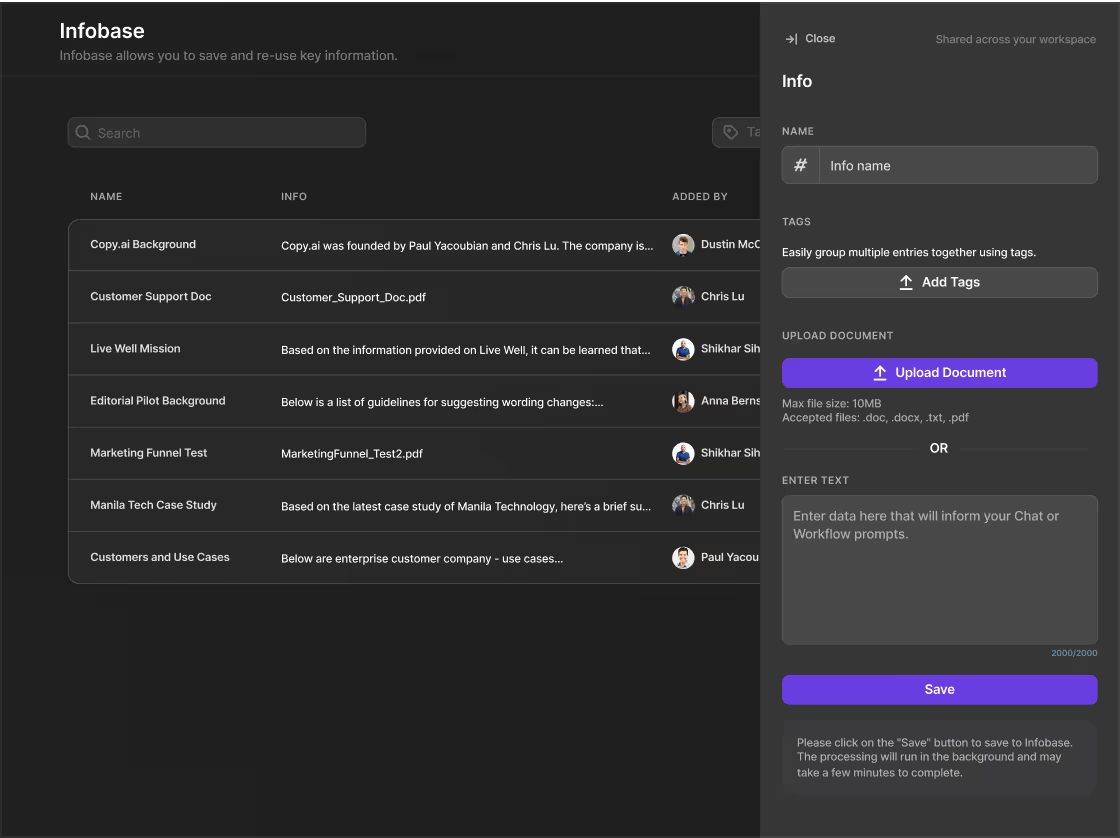
Copy.ai positions itself as a GTM AI platform. Its workflows are intended to turn defined multi-step work into a repeatable process, such as handling leads or producing sales enablement material. Its Brand Voice feature is meant to keep outputs closer to a supplied writing style.
That is a practical difference from beginning every task in a blank chat. When the team has decided exactly which inputs it will collect, which outputs it needs, and who receives them, Copy.ai can make the process easier to repeat. It is less compelling when the job requires changing direction halfway through, making editorial judgments, or checking a long article against several primary sources.
Feature comparison for marketing teams
Drafting and discovery
ChatGPT gives you more room to explore. You can ask for competing positions, upload a document, request a table, or change the assignment in the next message. That makes it useful for early content work and AI content experiments.
Copy.ai gives the user more rails. Its value rises when the team has a common task such as account research, outbound personalization, or a campaign handoff. The output can be more consistent because the process is more constrained, but the process must be designed first.
Brand context and repeatability
Both products can work with company material, but the operating model differs. In ChatGPT, the person doing the work usually chooses what to load into a conversation or project and writes the instructions. In Copy.ai, Brand Voice, Infobase, and workflows are designed to make a shared GTM process repeatable.
For either product, keep an approval gate for public claims. A tool can reuse a brand voice without knowing whether a new price, integration, customer name, or product statement is still current. That matters as much for content writing as it does for sales sequences.
Automation and handoffs
Copy.ai's workflow focus is the clearer choice when the output is one step in an established GTM pipeline. The useful question is not "can AI write this?" but "are the inputs, reviewers, and destination known well enough to automate safely?"
ChatGPT can support multi-step work through its own features and connected tools, but it is not primarily a prebuilt GTM workflow product. For a team that wants a collaborator in the middle of a changing project, that is often a strength rather than a gap.
Pricing: compare the bill to the job
Pricing changes, so verify the vendor pages before choosing a plan. As of this review, ChatGPT offers Free, Go, Plus, Pro, Business, and Enterprise options on its pricing page. Plus is $20 per month. ChatGPT Business Standard is $25 per user/month on monthly billing or $20 per user/month on annual billing, with a two-user minimum. API use is a separate purchase. Paid plans add more access to models, tools, memory, projects, and business controls; do not choose one solely for copywriting without checking the limits that apply to your work.
Copy.ai's Chat plan costs $29 monthly, or $24 per month billed as $288 annually, and includes five seats. That is not a per-user quote. Its annual workflow tiers are Growth ($1,000/month equivalent, 75 seats, 20,000 monthly workflow credits), Expansion ($2,000, 150 seats, 45,000 credits), and Scale ($3,000, 200 seats, 75,000 credits). A workflow credit is not one article: usage depends on the steps and work performed. Check a representative run's Credits used before estimating volume.
The hidden cost is review time. A cheap first draft is not cheap if a content lead must reconstruct the source trail, rewrite the angle, locate visual evidence, and reformat the draft every time. Put that work in the comparison before treating subscription price as the whole decision.
If you also evaluate eesel's blog-writing teammate, its current task pricing is a different model: no seat charge, and blog posts are $4 each. Support work runs on a fixed monthly plan with a free 100-credit tier. Dashboard chat is mostly free; CLI chat uses credits. Check the actual credit consumption instead of carrying forward the old per-batch blog-post price.
When each choice makes sense
Choose ChatGPT if you need a versatile partner for work that is not fully specified yet. It is useful for brainstorming, editing, research plans, and drafts that will be heavily shaped by a human.
Choose Copy.ai if a sales or marketing team already has a repeatable GTM task and wants a shared workflow around it. Make the workflow's input, owner, reviewer, and destination explicit before rolling it out.
Choose a blog writer when the job is specifically to turn a topic into a reviewable article. That is different from asking a general assistant for copy or turning a GTM workflow into a content process.
Use the eesel CLI to review an editorial comparison
eesel's AI blog writer is for the team that has already decided that publishing useful articles is a job worth owning. It is a ready-to-work teammate for editorial work: it can develop a topic into a draft in the same eesel workspace where a person reviews the result. The dashboard remains the normal place to inspect work, adjust instructions, and decide what is ready to publish.
The eesel CLI is another way into that same teammate, not a second agent. A person can use it from a terminal; a script can drive it; and a coding agent such as Codex, Claude Code, or Cursor can use its JSON output. Changes made through the CLI appear in the dashboard, and dashboard changes are reflected in the CLI. It needs Node.js 18.17 or newer.
For a concrete editorial workflow, start with a real evidence gap: a draft compares ChatGPT Plus at $20 with Copy.ai Chat at $29 monthly, but misses that Copy.ai's price includes five seats. A content owner saves the two current price excerpts, URLs, access dates, billing cycles, and seat counts in an approved file. Ask Codex, Claude Code, or Cursor to use eesel CLI to check that comparison and propose corrected wording.
Use the intended non-production teammate, with consequential actions disabled, and approve the upload and paid chat first. Replace the example agent name below. The file listing covers workspace files, not the contents of every connected knowledge source:
npx @eesel/cli files upload ./approved-chatgpt-copyai-pricing.md --agent "Content review"
npx @eesel/cli files ls --agent "Content review"
npx @eesel/cli instructions --agent "Content review"
npx @eesel/cli chat "Read uploaded approved-chatgpt-copyai-pricing.md. Draft a price comparison of ChatGPT Plus and Copy.ai Chat that makes billing cycle and included seats explicit. Cite the supplied evidence and flag unsupported claims. Do not publish or contact anyone." --agent "Content review"
The coding agent reads the JSON answer, checks whether both the billing cycle and included seats are stated, and returns the proposed correction to the editor. The owner checks billing before paid runs and compares the draft with the original sources afterward. When an instruction change is needed, --dry-run previews the write's server request without sending that write; reads still run first. It is not an answer simulation or a no-access mode.
eesel approvals lists actions that are actually held for approval; do not assume every external action is automatically held. Check the configured permissions separately. The human still checks the comparison, source links, editorial angle, and actual CMS preview before approving publication.
That is a different operating model from exporting text from ChatGPT or configuring a Copy.ai workflow. It does not guarantee a good article or replace an editor. It gives the editor and the agent one workspace, visible activity, explicit permissions, and a terminal route when automation is useful.

If your comparison ends with "I still need to turn prompts into reviewed posts," Try eesel. Start with one real keyword, review the result in the dashboard, and only then decide whether it earns a place in your publishing process.
Sources
Frequently asked questions
What is the main difference between ChatGPT and Copy.ai?
ChatGPT is a broad conversational assistant; Copy.ai organizes AI around GTM chat and repeatable workflows. In a ChatGPT vs Copy.ai decision, choose the first for varied work and the second when a defined sales or marketing process needs a shared workflow.
Is ChatGPT or Copy.ai better for blog posts?
Either can help with a brief, outline, section draft, or rewrite. Neither removes editorial responsibility: check sources, add product knowledge, decide what belongs in the article, and review the final copy. For that narrower job, see eesel's AI blog writer.
How much does ChatGPT cost compared with Copy.ai?
ChatGPT Plus is $20 per month. ChatGPT Business Standard is $25 per user/month on monthly billing or $20 per user/month on annual billing, with a two-user minimum; API use is separate. Copy.ai Chat includes five seats at $29 monthly or $24 per month billed annually. Check Copy.ai’s current pricing before buying.
Does Copy.ai include workflow automation?
Yes. Copy.ai's workflows are designed for repeatable GTM processes such as prospecting, lead processing, and sales enablement. They are a better fit than a one-off chat when the inputs, output format, and handoff are already known.
Can ChatGPT use company context for marketing work?
ChatGPT can work from material you provide and plan availability affects features such as projects, memory, and connected apps. Treat generated claims as drafts until someone checks them against the source material, especially for product, legal, or pricing content.
Can I use ChatGPT and Copy.ai together?
Yes. A team might use ChatGPT for exploration and Copy.ai for a repeatable GTM workflow. The risk is duplicating reviews and context in two places, so assign a clear owner and final approval step for each publishing workflow.
How can eesel CLI help with a marketing comparison?
A person, script, or coding agent can use eesel CLI to give the same blog-writing teammate approved evidence, inspect its instructions, and request a draft that distinguishes prices, billing cycles, and seats. Approve paid tests and workspace changes first; the editor still checks claims, sources, and the real CMS preview.