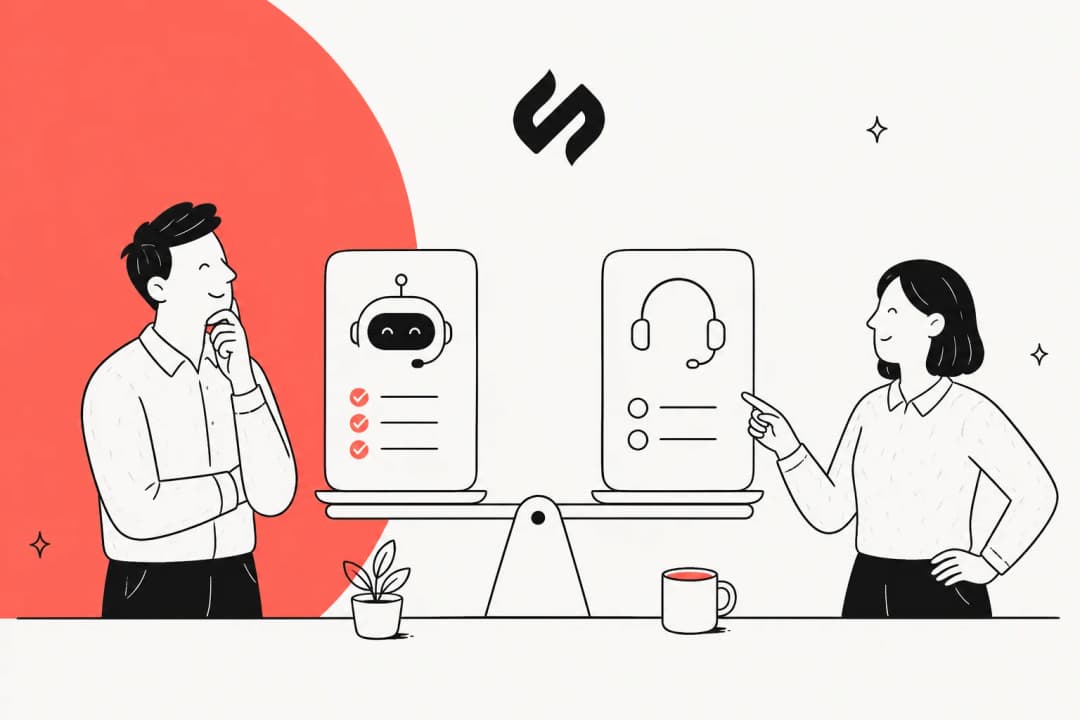
The debate gets framed as a competition, but the data points somewhere else entirely.
82% of customers prefer chatbots over waiting for a human agent - a 20% jump since 2022, according to G2. At the same time, 79% of Americans strongly prefer interacting with a human when they're actually in a support interaction, per SurveyMonkey's February 2026 consumer study. Both statistics are true. They're describing different situations.
That's the real story here. Chatbots and live agents aren't competing for the same customers. They're good at different things, and the teams winning on customer satisfaction in 2026 aren't picking a side - they're designing systems where each handles what it's actually suited for.
This post breaks down what each option actually delivers, where the numbers diverge, and how to decide what your team needs.
What a chatbot is (and what it isn't)
A chatbot is software that handles customer conversations automatically, without a person on the other end. The term covers a wide range of technology - from simple rule-based decision trees that follow scripted paths, to modern AI chatbots powered by large language models that can understand natural language, pull information from your knowledge base, and take actions in connected systems.
The gap between those two ends is significant. A rule-based bot can only follow the paths you've pre-programmed. An AI chatbot can read a customer's message, understand what they're asking, find the relevant answer in your help documentation, and compose a response - all in under two seconds. It can also trigger workflows: check order status in your e-commerce platform, update a ticket field in your helpdesk, or route the conversation to the right team.
78% of companies have now implemented conversational AI in at least one core function, and chatbot adoption across businesses grew roughly 4.7 times between 2020 and 2025. When people say "chatbot" in 2026, they typically mean the AI-powered kind.

What a live agent actually does
A live agent is a person - a trained support specialist who handles customer conversations in real time. They read messages, use judgment, apply policy, manage emotional situations, and make decisions that rules can't.
The value of a live agent isn't just that they can answer questions. It's that they can read between the lines of what a customer is actually asking, decide when to make an exception, de-escalate a frustrated conversation, and convey that a real person genuinely cares about the outcome.
That said, live agents are expensive. The average annual salary for a Customer Support Agent in the United States is $45,024 as of May 2026 (ZipRecruiter). Each interaction costs $8-$15 to handle. They can only work business hours without significant overtime costs, can only handle one conversation at a time, and performance varies based on experience, training, and how the individual is feeling that day.
None of that is an argument against live agents - those costs are often entirely justified. It's just context for understanding when automation changes the equation.

Where chatbots genuinely outperform humans
For routine, high-volume, rules-based queries, the data consistently favours automation. Speed, cost, and scale all point the same direction.
Speed and availability
AI chatbots respond in under two seconds, 24/7, across every timezone and language. For a customer asking about their order status at 11pm on a Sunday, there's no human agent answer that beats an instant one.
74% of customers prefer chatbots for simple, quick questions, and 64% cite 24/7 availability as the most helpful chatbot feature. These preferences aren't abstract - they reflect what people actually want when they're trying to resolve something fast.
Cost per interaction
This is where the math gets stark. Automated resolutions cost between $0.50 and $2.00 per interaction, compared to $8 to $15 for a human-handled contact. At a volume of 5,000 tickets per month, that's the difference between spending $2,500-$10,000 versus $40,000-$75,000. Gartner estimates conversational AI will reduce contact center labor costs by $80 billion by 2026.
Scale without headcount
A chatbot handles one conversation or ten thousand with the same marginal cost. A live agent handles one at a time. When ticket volume spikes - during a product launch, a site outage, or a holiday season - chatbots absorb volume that would otherwise require emergency hiring or queue backlogs.
Consistency
AI doesn't have bad days, doesn't forget last week's policy update, and doesn't vary in tone between Monday morning and Friday afternoon. For regulated industries - finance, healthcare, insurance - that consistency isn't just convenient. It's a compliance requirement.
Resolution rates by industry
Across all industries, AI chatbots fully resolve 44.8% of conversations without any human involvement, according to Comm100's 2026 AI Live Chat Benchmark Report (covering 220 million+ live chat interactions). That average sits underneath a wide range by sector:
| Industry | AI chatbot resolution rate |
|---|---|
| Non-profit | 97.7% |
| Manufacturing | 78.4% |
| Education | 75.9% |
| Banking & Finance | 75.2% |
| Government | 67.6% |
| Technology | 67.3% |
| Telecommunications | 63.9% |
| Health & Pharma | 45.8% |
| iGaming | 38.1% |
Source: Comm100 AI Live Chat Benchmark Report 2026

The sectors at the top - non-profit, manufacturing, banking - tend to have queries with a known, narrow set of answers. The sectors at the bottom have queries that require account-level judgment, emotional sensitivity, or real-time system access that the bot can't reach.
Where live agents still win
The flip side of those resolution rates is equally important: for a significant share of customer interactions, AI simply doesn't perform well enough. Here's where humans maintain a clear advantage.
Emotional complexity
When a customer is frustrated, anxious, or upset, the channel through which they receive a response changes how the response lands. Human agents outperform AI on CSAT by 15 to 25 percentage points in scenarios involving emotional complaints, escalated disputes, and sentiment recovery, according to LTVplus's 2025 analysis. AI can detect frustration. Humans can resolve it.
79% of Americans strongly prefer interacting with a human over an AI agent, and 84% believe human agents are more accurate - even when that's not objectively true. Trust is emotional, not rational, and for high-stakes issues, that gap matters.
Policy exceptions and judgment calls
"Can you make an exception for me?" is a question that requires contextual judgment, risk assessment, and authority that most chatbots don't have. AI can apply rules. Humans can bend them intelligently when the lifetime value of the customer justifies it.
Complex troubleshooting
Multi-step technical issues that involve ambiguity, incomplete information, and iterative diagnosis still favour human problem-solving. AI handles the predictable path well. Humans handle the exceptions.
VIP and high-value account retention
When your top-tier customers need support, the perceived quality of that interaction directly impacts revenue. The calculation changes: the cost of the human interaction is justified by the relationship it protects.

How the platforms break down
The tool landscape has three broad shapes: dedicated chatbot builders, AI baked into existing helpdesks, and AI agent layers that sit on top of whatever helpdesk you already use.
Chatbot-first platforms
Chatbase is a self-serve platform for building and deploying AI support agents. It's used by 10,000+ businesses, including ChuckECheese, Bridgestone, and IHG. You train it on your knowledge base, configure actions, and deploy to your website or helpdesk in minutes.
Pricing runs from free (50 message credits/month) up through Hobby at $32/month, Standard at $120/month, and Pro at $400/month. Enterprise pricing is custom. The free tier is genuinely usable for testing, but message credit limits become the friction point at volume.
Reviews on Capterra (4.3/5 across 73 reviews) praise how fast it is to get running. The recurring complaints are around hallucinations on URLs and limitations when queries require real-time data lookups beyond what's been trained.
Tidio takes a combined approach - live chat platform with an AI chatbot layer called Lyro built in. The platform pricing runs from free up through Starter at $24.17/month, Growth from $49.17/month, Plus at $749/month, and Premium (custom). Lyro can be bought standalone from $32.50/month.
The Premium plan has something unusual in the market: a 50% resolution rate guarantee with a money-back option. The pay-per-resolution billing model (available on Premium) means you're only charged when Lyro actually solves the customer's issue.

Helpdesk-native AI
Zendesk, Freshdesk, and most major helpdesks now bundle AI features into their plans. This is convenient - no separate integration to build - but you're working within the constraints of their native AI, which is typically less sophisticated than purpose-built AI agents. You're also locked into their pricing model, which is per-seat regardless of whether an AI or a human handles the ticket.
AI agent layers that work on any helpdesk
The emerging category is AI agents that sit on top of your existing helpdesk rather than replacing it. eesel AI is one example - it works alongside Zendesk, Freshdesk, Gorgias, Help Scout, and others, reading your knowledge base, drafting responses, and handling tickets end to end.
The key difference from chatbot platforms: eesel isn't building a new customer-facing chat widget. It's handling tickets inside your existing helpdesk, fitting into your existing workflows, views, and escalation rules. Agents appear in your Zendesk agent list and work with your existing macros and triggers.

Pricing is per-task rather than per-seat: $0.40 per regular task (a support ticket or chat), with $50 in free credits on signup and no credit card required. For teams already paying per-seat for Zendesk or Freshdesk, the math often works out: you're adding AI resolution capacity without adding headcount or per-seat costs.
How the hybrid model works in practice
The research consensus is unambiguous. A 2025 Aalborg University study spanning thousands of customer interactions found that preference for AI or human support is entirely situational. Customers prefer AI for speed and convenience on routine tasks, and humans for complex, emotional, or high-stakes issues. Neither channel wins universally.
The teams delivering the highest CSAT and lowest cost-per-contact in 2026 run hybrid models where AI resolves 60-70% of volume autonomously while humans handle the interactions that demand empathy, judgment, and creative problem-solving. AI now handles 74% of initial customer queries before any human involvement, according to the 2026 Omnichannel Support Benchmark Report.
How to decide what goes to AI vs. humans
The routing logic comes down to three variables: complexity, emotional intensity, and business value.

| Scenario | Route to | Why |
|---|---|---|
| FAQ, order status, password reset | AI | Rules-based, data-dependent, high volume |
| Product recommendations, upsell | AI with human escalation | AI handles personalisation; human closes deals |
| Billing disputes (under threshold) | AI | Clear policy, low emotional intensity |
| Billing disputes (above threshold) | Human | Judgment required |
| Emotional complaint or negative sentiment detected | Human (with AI context) | Empathy-driven resolution |
| Technical troubleshooting (known issue) | AI | Predictable resolution path |
| Technical troubleshooting (unknown issue) | Human | Ambiguity handling needed |
| VIP or enterprise account | Human (AI-assisted) | Relationship value |
| After-hours, any complexity | AI with next-day follow-up | Availability without sacrificing quality |
Source: Certainly AI Hybrid Playbook 2026
The handoff problem
The single biggest failure point in a hybrid setup is the handoff. When a customer moves from AI to human and has to repeat their entire story from scratch, every efficiency gain gets erased by the frustration of starting over.
Good handoffs have three things: the agent receives the full conversation transcript and any context the AI gathered; the framing is "let me connect you with a specialist who already has your details" rather than "I'm transferring you"; and the customer's queue priority carries over. Customers who experienced a seamless handoff rated their overall experience higher than customers who went straight to a human from the start, according to a 2025 Journal of Service Research study. The technology isn't the bottleneck. The design of the transition is.
What "starting with AI" actually looks like
One common hesitation: how do you know the AI won't send wrong answers to your customers?
The answer is that most platforms offer a supervised mode where the AI drafts responses for human review before anything goes out. eesel AI calls this Copilot mode - the agent drafts every reply, the human reviews and edits, and those corrections train future responses. Only after the team builds confidence does the AI start sending autonomously, and even then, low-confidence responses queue for review while high-confidence ones go out automatically.
Gridwise went from zero to resolving 73% of tier-1 requests in their first month using this progression. Smava runs 100,000+ tickets per month in German through eesel's Zendesk integration.
eesel also offers simulation mode: before going live, teams run the AI against thousands of historical tickets to get a data-driven forecast of real-world performance. You see where it handles things well, where the knowledge gaps are, and what the predicted deflection rate looks like - before any customer sees a response.

This approach maps directly to what the research recommends. Rather than automating everything at once (which 90% of AI-only implementations fail to sustain, per Neuratel's 2025 data), you start narrow, learn what works, and expand from there.
The full cost picture
A chatbot comparison isn't complete without looking at total cost of ownership.
| Cost element | Chatbot | Live agent |
|---|---|---|
| Cost per interaction | $0.50-$2.00 | $8-$15 |
| Availability | 24/7 | Business hours (OT extra) |
| Scaling cost | Near-zero (marginal) | Proportional to headcount |
| Setup and training | Platform cost + initial training | Salary + benefits + onboarding |
| Emotional complexity handling | Lower CSAT | 15-25 pts higher CSAT |
| Policy exception handling | Limited | Full |
| US agent salary (base) | N/A | ~$45,024/year (ZipRecruiter) |
For a team handling 3,000 tickets per month, purely with live agents at $10/interaction average, that's $30,000 per month in interaction costs alone - before salaries. If 60% of those tickets are routine enough for AI to handle, you're looking at $600-$3,600 for the AI-handled portion versus $18,000. Juniper Research estimates businesses can save up to $11 billion annually through AI chatbot automation.
That math is real. But it only holds if the AI is actually handling the right tickets. The teams that see the worst outcomes are the ones that automate indiscriminately - pushing everything through the bot and watching CSAT fall as frustrated customers who needed a human keep hitting an AI wall.
Common mistakes
Automating too much, too fast. The evidence points to 60-70% containment as the sweet spot for mature deployments. Chasing 90% or higher typically means the bot is handling tickets it should escalate, and customers end up more frustrated than if they'd waited for a human.
Measuring deflection instead of resolution. A ticket that gets deflected to AI but still requires a follow-up human interaction costs more in total than a ticket that went straight to a human. Cost per resolution (end to end) is the number that matters. See eesel's breakdown of AI deflection rates and how to improve them for how to think about this metric.
Ignoring what happens to the agents. A well-designed hybrid model should make agents' jobs better. They handle fewer repetitive tickets and more of the complex, meaningful interactions that actually build customer relationships. Hybrid models improved agent retention by 35% because agents spent less time on routine tasks (Neuratel 2025). If your agents feel threatened rather than relieved by AI, something is off in how the handoff is designed.
Treating AI as a one-time project. Customer queries evolve. New products create new question categories. Seasonal patterns shift. The teams that get the most out of AI treat the knowledge base as a living document and revisit routing logic quarterly.
How to choose
If you're deciding between adding AI or adding headcount, it helps to audit your current ticket mix first. Pull your top 20 contact drivers by volume. For each one, ask:
- Is there a correct answer to this question that's consistent across customers?
- Does answering it require access to account-specific data?
- Is the customer typically calm, or often frustrated, when they ask?
If most of your high-volume tickets have consistent, answerable responses and a calm emotional profile, AI will handle them well. If your volume is dominated by complex cases, policy exceptions, and upset customers, human agents are the right investment - though an AI copilot that assists agents with drafts and context can still reduce handle time significantly.
Most teams land in the middle: enough routine volume to justify AI for 40-60% of tickets, with humans essential for the rest. Tools that support a graduated rollout - starting in draft mode, testing against historical data before going live, and expanding autonomy as confidence builds - let you move at a pace your team is comfortable with. eesel AI's $50 free credit trial (no credit card required) is one way to run that test without a commitment.
For a broader look at how leading teams approach this, see our roundup of companies using AI for customer service and the best AI tools for customer support teams in 2026.
The bottom line
The chatbot vs. live agent framing misses the point. Neither wins universally. Chatbots are objectively faster and cheaper for the 44-80% of queries that follow predictable patterns. Live agents are objectively better at emotional complexity, judgment calls, and high-stakes interactions. The teams doing this well in 2026 are the ones that stopped arguing about which is better and started building systems that route intelligently between the two.
The tools to do that exist at every budget level. The question is which part of your ticket mix you're solving first.
Looking for more on building out your support stack? See our guides on AI for live chat deflection, the best AI helpdesk tools, and AI for ticketing systems.
Frequently Asked Questions
Share this article

Article by
Amogh Sarda
CEO of eesel AI. Amogh Sarda is obsessed with making the ultimate AI for customer service teams. He lives in Sydney, Australia and has previously worked at Atlassian and Intercom. Outside of work he’s usually surfing or on stage doing improv.