Your complete guide to choosing a blog writing agency

Amogh Sarda
Last edited January 19, 2026
Consistently publishing good, SEO-friendly blog posts is tough work. For most marketing teams, it's a constant cycle of research, writing, editing, and optimizing. You know it's necessary for organic traffic, but who has the time?
This is usually the point where someone suggests hiring a blog writing agency. It sounds great on paper: just outsource the work and get content back. But the way content gets made is changing fast. Traditional agencies now have to compete with powerful AI platforms.
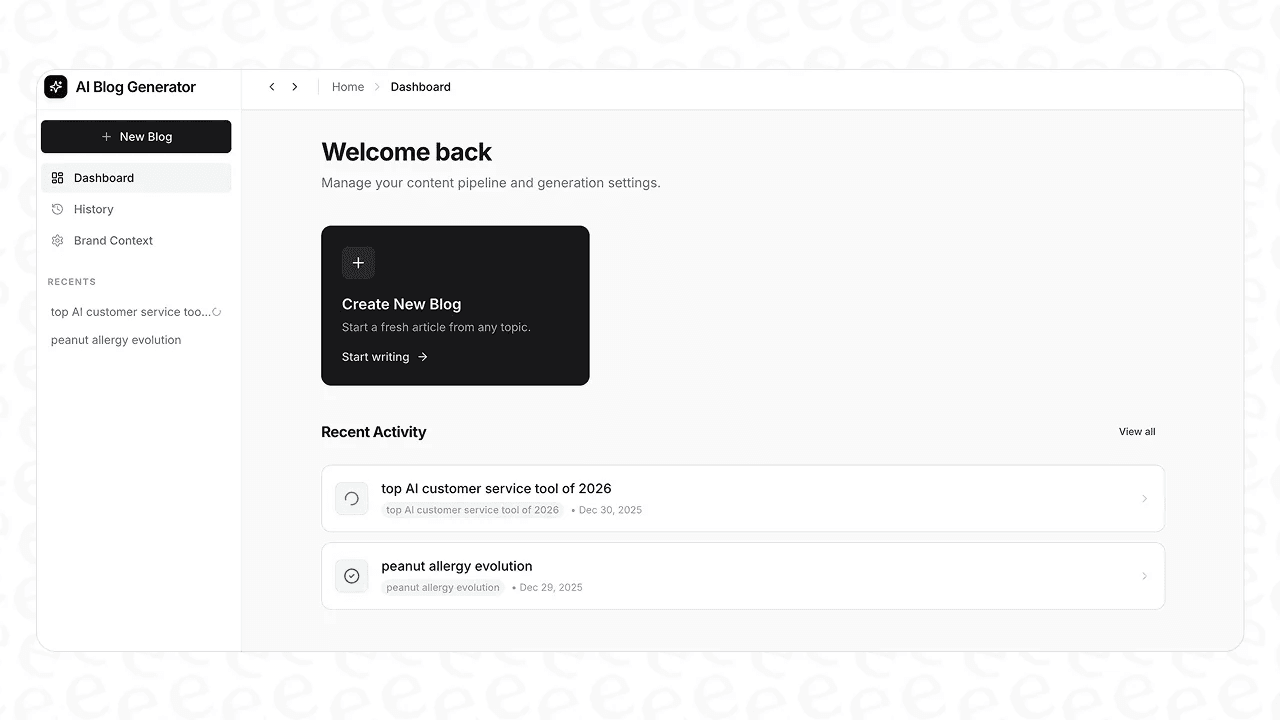
New tools like the eesel AI blog writer offer a new way to handle content creation that's scalable, quick, and budget-friendly. In this guide, we’ll look at how traditional agencies work, what they cost, and why an AI-first approach might be exactly what your team needs.
What is a blog writing agency?
A blog writing agency is a company you hire to write and optimize content for your blog. You can think of them as an outsourced content department. Instead of having to find, hire, and manage individual writers, editors, and SEO specialists, the agency provides all of those services in one package.
Their primary job is to help your business grow through content. They take on the task of creating articles meant to attract your ideal audience, rank in search engines, and hopefully bring in more leads and sales. They manage the entire workflow, from coming up with topics to delivering a finished blog post.
You’ll find a few different kinds of agencies, from full-service companies that manage your entire content strategy to more flexible marketplaces where you can purchase articles as needed. We'll dig into each model shortly.
The traditional blog writing agency model
When you sign up with a traditional agency, you're paying for a managed service where they handle everything. Here’s a look at what that usually involves.
The process: From brief to publication
Working with a traditional agency follows a pretty standard, multi-step process.
- Discovery & Strategy: Things kick off with a few calls so everyone can get aligned. The agency needs to learn your brand voice, understand your customers, and know what your goals are. Their SEO team will then do keyword research and create a content calendar for the next few months.
- Writing & Editing: After a topic is approved, a writer receives a brief and starts drafting the article. It then moves to an editor who reviews it for quality, grammar, and style consistency.
- Review & Revisions: You receive the draft and give your feedback. This part can sometimes create delays, and it's not unusual for a post to go through several rounds of edits before it’s ready.
- Publication: Once you give final approval, the content is delivered. Some agencies will also upload the post directly to your CMS, like WordPress.
Pros of the traditional approach
There are some clear benefits to this classic model.
- High-Quality, Human Touch: The content is written by experienced writers and reviewed by professional editors. You can generally expect a high standard of quality that is well-researched and carefully written.
- Fully Managed Service: This is the main attraction for many companies. The agency handles all the details, which frees up your team’s time and energy.
- Deep SEO Expertise: You get access to SEO professionals who are experts in their field. They know how to build a content strategy that can actually improve your search rankings.
Common limitations
While the benefits are notable, the traditional model comes with some drawbacks that can be a problem for many businesses.
- High Cost: Full-service agencies can be expensive. For example, a well-known agency like Siege Media has a minimum monthly spend of $8,000. That price point can be a significant investment for startups and small to medium-sized businesses.
- Slow Turnaround Time: With so many people involved, including writers, editors, account managers, plus you, the process can be slow. It can easily take days or even weeks to get a single blog post from an idea to a published article.
- Difficult to Scale: What if you want to go from four posts a month to twenty? With an agency, scaling can be a challenge. It requires them to bring in more writers and editors, which increases your costs.
- Brand Voice Inconsistency: It takes time for an outside writer to really understand your company’s unique tone. You should expect to spend a lot of time at the beginning giving detailed feedback to get them on the right track.
GAC is super slow on all levels and has been for most of the year. There's a week or two every month when one big client puts in a batch of orders but that's basically it. GAC is also Australia time, so you have to be awake at odd hours if you're in the US to catch orders.

Types of blog writing services and their pricing
The term "blog writing agency" can cover a few different business models. The service you receive and the price you pay can differ quite a bit. Let's look at the main types you'll find.
Full-service content marketing agencies
This is the all-inclusive, premium choice. These agencies act more like strategic partners than simple content providers. They manage everything from high-level SEO strategy and topic generation to writing, custom design, and even content promotion to earn backlinks.
- Model: They function as an end-to-end partner, focused on delivering business results like traffic and leads, not just a certain word count.
- Example: Siege Media is a good example of this. They don't just write blog posts; they build content "campaigns" that often include custom infographics, data studies, and outreach.
- Pricing: These services are almost always based on a monthly retainer. According to their website, a single high-impact blog post can cost between $1,500 and $6,000. A full campaign for a medium-sized business usually starts in the $10,000 to $20,000 per month range.

Content marketplaces and hybrid platforms
These platforms provide a more flexible, a la carte service. They connect you with a large network of freelance writers, and you can either manage the process yourself or pay more for a managed option.
- Model: You have more control and flexibility than with a full-service agency. It's a decent middle ground if you have some internal capacity to manage the work but don't want to hire writers directly.
- Examples:
-
The HOTH: They have a simple per-post pricing model. Their standard HOTH Blogger service begins at $50 for a 500-word article. If you need a writer with more specific expertise, their Blogger Pro tier starts at $80 for 500 words.
-
Verblio: They have a couple of interesting choices. Their AI + Human Content service, which uses AI for a first draft that's then edited by a person, costs $0.06 per word plus a monthly platform fee of $49.50. For content written entirely by people, their 100% Human Content plan is $0.16 per word with no platform fee.
Yes, Blogmutt was spec work and Verblio is the name the company chose when they did a rebrand a few years back. It's still spec work, but they have tools in place now that show you how many of a certain post are waiting for the client to review, which keywords have no posts yet, which ones are in progress, etc. So at least there's more visibility now than there used to be.
-
A quick comparison of models
| Service Type | Best For | Typical Pricing Model | Price Range (Approx.) | Key Feature |
|---|---|---|---|---|
| Full-Service Agency | Businesses needing a complete, hands-off content marketing partner. | Monthly Retainer | $8,000 - $20,000+ / month | End-to-end strategy and execution. |
| Content Marketplace | Teams wanting flexible access to writers for specific article needs. | Per Post / Per Word | $50 - $160+ / 1000 words | Large pool of writers and fast turnarounds. |
| AI Content Platform | Marketers focused on scaling high-quality content quickly and affordably. | Subscription | ~$2 per publish-ready post | Instant generation of complete articles. |
The modern alternative: AI-powered content generation
The costs, speeds, and scaling issues of traditional agencies have opened the door for a new way of doing things. AI-powered tools are now offering a strong, efficient, and budget-friendly alternative.
This isn't about replacing human strategy with machines. It's about using smart technology to get past the bottlenecks that have often made content creation challenging: cost, speed, and scale.
Generate publish-ready content with the eesel AI blog writer
The eesel AI blog writer is a great example of this shift. It's a tool designed to take a single keyword and turn it into a complete, SEO-optimized blog post that's ready to publish.
We use this exact tool for our own blog at eesel, and it's how we grew our search impressions from 70k to over 750,000 in just three months. We accomplished this by publishing over 1,000 high-quality, optimized blog posts, a scale that can be challenging to achieve with a traditional agency model.
How AI platforms address traditional content challenges
- Cost-Effective: As an alternative to a monthly retainer, the eesel AI blog writer offers a different pricing model: $99 for 50 complete blog posts. That comes out to less than $2 per article.
- Increased Speed & Scale: You can generate a publish-ready draft in minutes, not weeks. This allows you to easily scale from one post a week to dozens without hiring more staff or exceeding your budget.
- Built-in Brand Consistency: One of the toughest parts of working with an agency is getting them to match your brand voice. The eesel AI blog writer addresses this by automatically pulling context from your website. This helps it make natural product mentions and maintain a consistent voice from the start, avoiding that lengthy onboarding period.
Key features for high-performance content
This is more than just a text generator; it's a complete content creation engine.
- Context-Aware Research: The AI understands the kind of content you're making. For a comparison post, it will automatically find pricing data. For a product review, it will look up technical specs. This provides more specific information for the topic.
- Automatic Assets & Social Proof: Each article is generated with AI images, tables, and infographics. It even embeds relevant YouTube videos and finds real quotes from Reddit forums to add credibility and a human element.
- Optimized for AI Search (AEO): The content isn't just structured for traditional Google search. It’s also optimized for AI answer engines like Google's AI Overviews and Perplexity, ensuring your content is prepared for the future of search.
Is a blog writing agency right for you?
So, what's the final call? A traditional blog writing agency can be a good choice if you have a large budget and need a completely hands-off service. They bring a lot of expertise but come with high costs and slow delivery. Content marketplaces offer more flexibility but still require you to manage the process.
For those looking to understand all the options, this video provides a helpful overview of different content writing services available today.
For marketing teams focused on speed, scale, and efficiency, AI-driven tools like the eesel AI blog writer are a viable alternative. You gain the ability to produce high-quality, SEO-optimized content at a scale and cost that was difficult to achieve just a few years ago.
The best choice depends on your budget, goals, and how involved you want to be. But for any team looking to make a significant impact with SEO and content marketing, a powerful AI tool is often a practical way to get there.
Start scaling your content today
Ready to get off the content treadmill and start publishing at scale? See for yourself how a modern approach to content creation works.
CTA: Try the eesel AI blog writer for free and generate your first complete, publish-ready article in minutes.

Frequently Asked Questions
Share this article

Article by
Amogh Sarda
CEO of eesel AI. Amogh Sarda is obsessed with making the ultimate AI for customer service teams. He lives in Sydney, Australia and has previously worked at Atlassian and Intercom. Outside of work he’s usually surfing or on stage doing improv.