I tested the best SEO tools for AI products in 2026: These 6 are essential

Kenneth Pangan
Last edited January 7, 2026

SEO in 2026 is a whole new ballgame. Just ranking on Google's first page doesn't cut it anymore. The real victory is getting your content featured as the go-to answer in AI engines like ChatGPT, Perplexity, and Google's AI Overviews. If you're not the source for those answers, you might as well be invisible.
This puts AI companies in a tricky spot. You're not just selling software; you're explaining a complex concept. Your content has to be sharp enough for the experts but simple enough for everyone else, all while being optimized for old-school search and this new world of Generative Engine Optimization (GEO).
I spent the last few weeks digging through all the options and testing the platforms that claim they're ready for this shift. This article is what I found: a straightforward review of the six tools that actually get the job done. Because you can't track your visibility if your content isn't worth finding in the first place. It all starts with a solid content engine, and tools like the eesel AI blog writer are built to do just that, creating optimized articles from a single keyword.
What defines the best SEO tools for AI products?
These aren't your typical SEO platforms. They're designed for a world where many searches end right in the AI chat window, without a single click to a website. It's a different game now, one where your content has to be so on-point that AI engines pick it as their source of truth.
The top tools for AI products have to master three core areas:
-
Traditional SEO: The fundamentals still count. Keyword research, backlink analysis, and technical site health are the foundation of any good strategy. You can't skip the basics.
-
Generative Engine Optimization (GEO): This is the practice of getting your content featured and cited in AI-generated answers on platforms like ChatGPT, Claude, and Perplexity. It’s about becoming a trusted source for the algorithms.
-
Answer Engine Optimization (AEO): Think of this as a super-focused part of GEO. AEO is all about making sure your brand is seen as the final, most authoritative answer to a user's question, right inside an AI chat.
The tools that really make a difference are the ones that blend all three. They help you get found wherever your audience is looking for answers, whether that’s a Google search or a Perplexity prompt.
Criteria for selecting the best SEO tools for this list
To make sure this list was actually useful, I set some ground rules. I wasn't interested in flashy dashboards. I wanted tools that deliver real results and have a workflow that a busy AI startup can actually use. Here’s what I looked for:
-
Relevance to AI Products: Did the tool have specific features for the AI space? I looked for things like LLM visibility tracking, sentiment analysis in AI answers, and the ability to create technically deep content that still ranks.
-
Actionable Insights: It’s easy to get lost in data. I gave priority to platforms that offered clear, data-driven next steps instead of just another dashboard to watch.
-
Ease of Use: Could a small marketing team at a startup get this up and running quickly? A steep learning curve is a non-starter when you need to move fast.
-
Unified Workflow: I looked for tools that bring workflows together. Does the platform help you manage SEO and GEO in one spot, or does it just create another silo in your tech stack?
Been using a lot of ai for seo about a year now and its the biggest thing isn't the writing, its the research part. keyword insights does this clustering thing based on what actually ranks together instead of just similar words. saves me from making pages that compete with each other. i still write most of it myself but ai gets me like 70% there and we went from 2 posts a month to like 8.

The best SEO tools for AI products at a glance
For those who just want the highlights, here’s a quick look at the top contenders.
| Tool | Best For | Key AI Feature | Starting Price |
|---|---|---|---|
| eesel AI blog writer | Scaling publish-ready content | Context-aware research & automatic asset generation | Free to try; $99 for 50 blogs |
| Search Atlas | All-in-one SEO & GEO monitoring | LLM Visibility dashboard tracking brand mentions & sentiment | Starts at $99/month |
| Rankscale.ai | Granular GEO tracking & analysis | Tracking brand visibility across 10+ specific AI engines | $20 for 120 credits/month |
| Surfer SEO | On-page content optimization | AI Tracker for monitoring visibility in AI results | $99/month for Essential plan |
| Semrush | Enterprise-level competitor analysis | AI Visibility Toolkit for tracking mentions & prompt research | $199/month for Semrush One |
| Writesonic | Unified SEO & GEO visibility | AI Visibility Actions to fix citation gaps and find opportunities | $199/month (annual billing) for GEO features |
The 6 best SEO tools for AI products in 2026
Now, let's get into the specifics. Here’s a full breakdown of what makes each of these tools a solid choice for marketing an AI product.
1. eesel AI blog writer
Best for: AI companies that need to scale high-quality, on-brand content without a big in-house team.
Any good SEO strategy is built on content. You can’t rank, get cited, or build authority without it. The eesel AI blog writer is the foundation for all of this. It's the exact tool we used to grow our own site from 700 to over 750,000 daily impressions in just three months by publishing over 1,000 blogs. It’s not just about writing faster; it’s about consistently creating content that both search engines and people actually like.
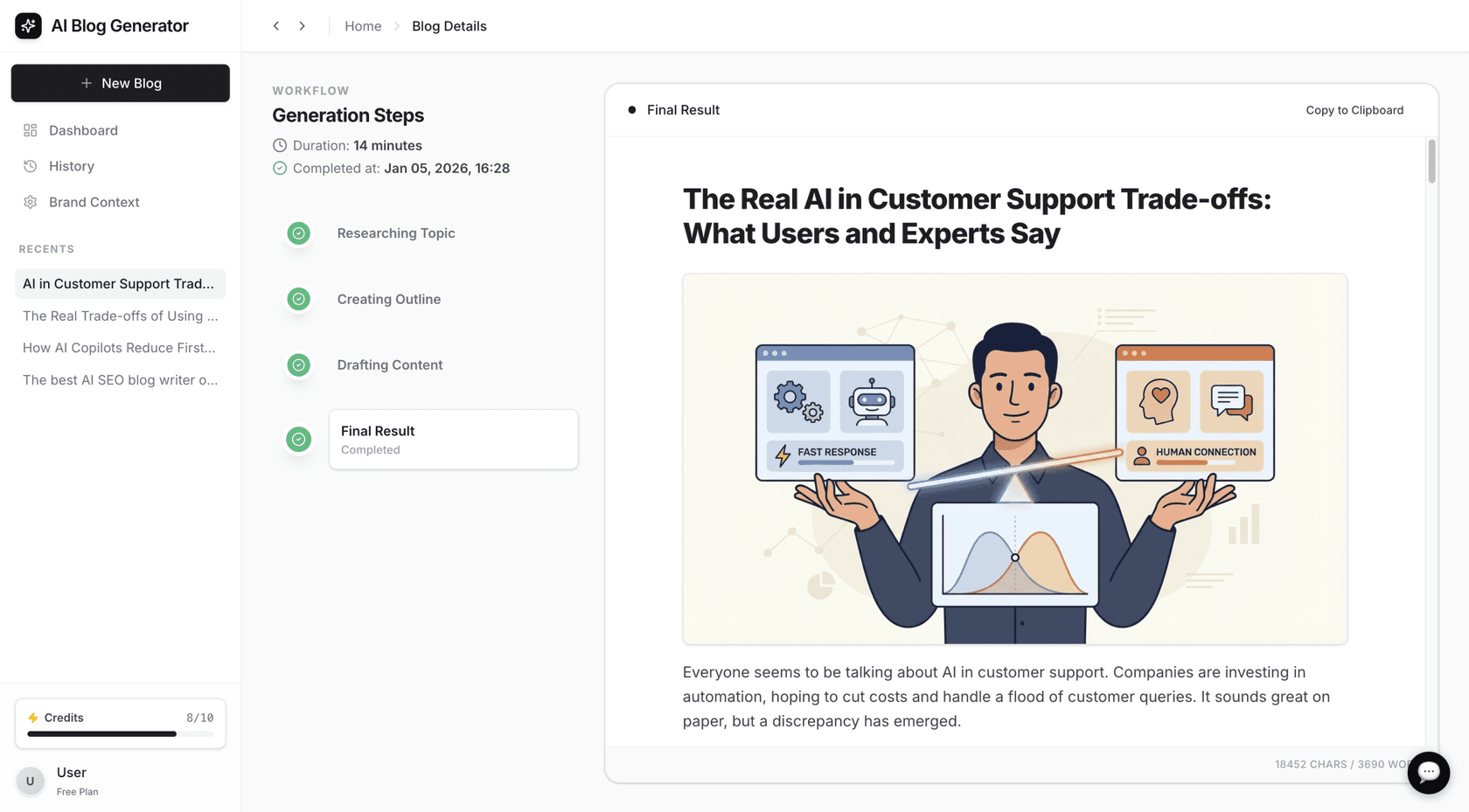
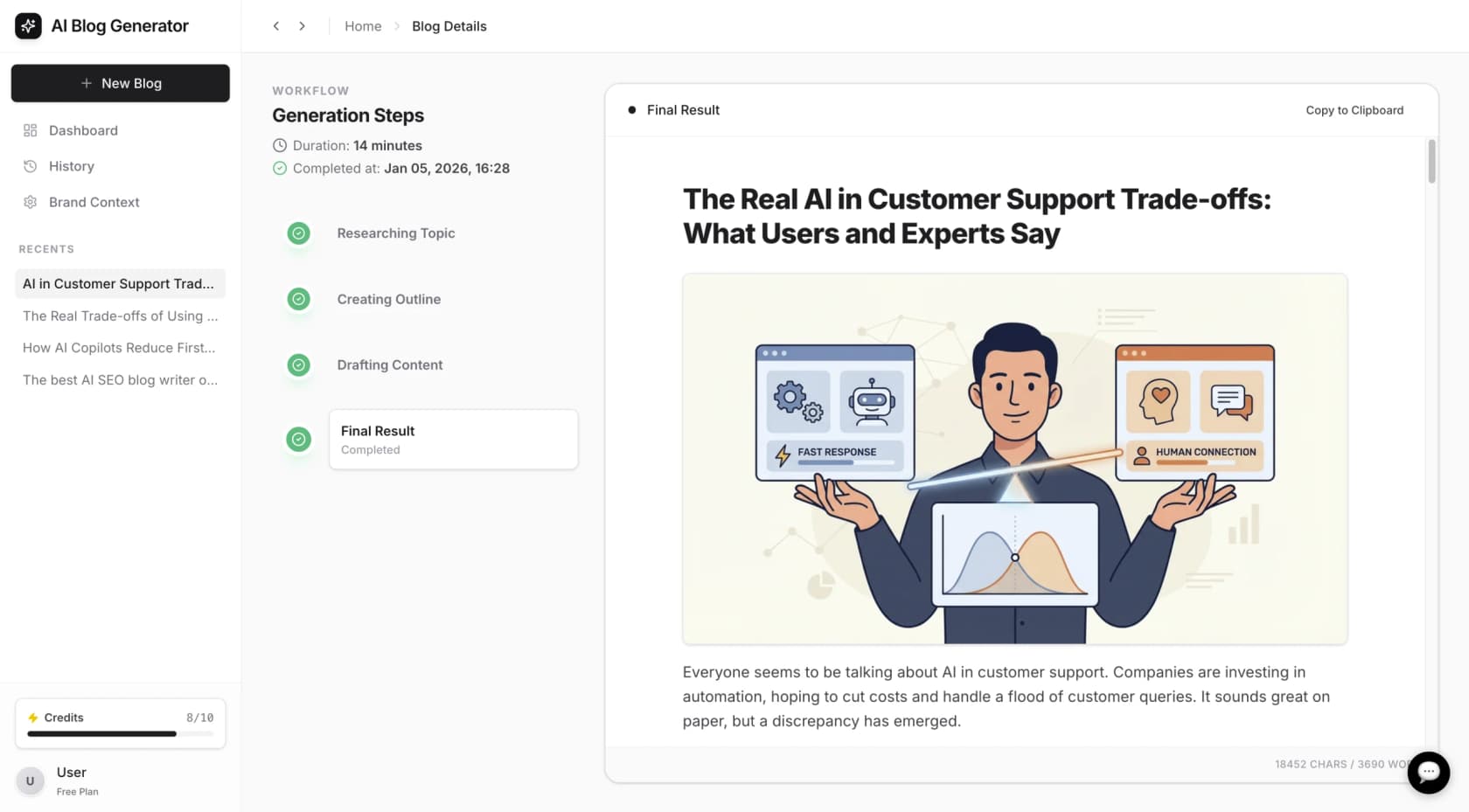
Pros: This platform is much more than a generic AI writer. From just a single keyword, it generates a complete, publish-ready post. It does context-aware research to make sure everything is accurate, automatically creates assets like images and infographics, and even embeds relevant YouTube videos and real Reddit quotes for social proof. The final product is content that’s deeply researched and optimized for both SEO and AEO from the get-go.
Cons: It’s a specialized content generation platform. If you’re looking for deep backlink analysis or technical site audits, you’ll need to pair it with a full suite like Semrush or Search Atlas.
Pricing:
-
Completely free to try.
-
The Early Bird plan offers 50 blog credits for $99.
2. Search Atlas
Best for: In-house teams and agencies who need a single view of their brand's presence across major AI chatbots.
Search Atlas is a modern, all-in-one SEO suite with a standout feature for the AI age: LLM Visibility. This tool tracks how your brand is mentioned across AI platforms like ChatGPT, Gemini, and Perplexity, giving you a clear, consolidated picture of your presence in AI search.
Pros: The dashboard is impressive. It gives you a visibility score, tracks your share of voice, and even analyzes the sentiment of mentions. You can directly compare your performance against competitors and see exactly which queries are leading to mentions. This makes it incredibly easy to find new opportunities and spot potential reputation issues before they grow.
Cons: While Search Atlas is great for monitoring, it doesn't automate the content creation or optimization needed to fix the visibility gaps it uncovers. The sheer number of features can also be a bit much for new users.
Pricing:
- Starts at $99/month.
3. Rankscale.ai
Best for: SEO specialists who need precise, granular data on their brand’s performance in specific AI search engines.
Rankscale.ai is a purpose-built GEO tool. While other platforms are adding AI tracking as a feature, Rankscale was built from the start to monitor visibility across more than 10 different AI engines, including ChatGPT, Perplexity, Claude, and Google AI Overviews.
Pros: Its biggest advantage is its specificity. You get incredibly detailed reports on your AI Visibility Score, can analyze brand sentiment, and see exactly which sources are being cited in AI-generated answers. The platform lets you slice data by AI engine and topic, giving you an unmatched level of detail for tweaking your AEO strategy.
Cons: It’s a pure specialist tool focused only on GEO tracking. You'll need other platforms for the foundational work of keyword research, content creation, and traditional backlink analysis.
Pricing:
-
Uses a flexible credit-based model.
-
The Essentials plan starts at $20/month for 120 credits.
4. Surfer SEO
Best for: Content teams who want data-driven guidance to make sure their articles are perfectly optimized for both traditional and AI search.
Surfer SEO has been a leader in on-page optimization for a while, and for good reason. Its Content Editor analyzes top-ranking pages to give you real-time suggestions on terms to include, ideal word count, and the best structure. It’s like having an SEO expert looking over your shoulder as you write.
Pros: Surfer is excellent at combining human creativity with hard data. The new AI Tracker is a nice addition, letting you monitor your brand’s visibility in AI chats like ChatGPT and Perplexity. It helps your writers create better, more competitive content that performs well everywhere.
Surfer - really strong for on-page/content optimization. Helps structure articles to match SERP and AI search expectations, with clear keyword and heading suggestions.
Cons: The tool's main strength is optimization, not creation. If you follow its suggestions too closely, your content can start to feel robotic and "over-optimized." The AI Tracker is also an add-on or only included in higher-tier plans.
Pricing:
-
The AI Tracker is included in the Scale plan or available as a $95/month add-on.
5. Semrush
Best for: Established marketing teams that need a comprehensive, data-rich suite for every part of SEO and GEO.
Semrush is an industry heavyweight, and it has adapted well to the AI era. Its AI Visibility Toolkit is a powerful suite for benchmarking your presence in AI search, researching the prompts your audience is using, and analyzing how your competitors are doing in large language models.
Pros: The toolkit is incredibly thorough. It provides an AI Visibility Score, helps you find topic and prompt gaps, and analyzes brand sentiment. When you combine this with Semrush's well-known keyword and backlink databases, you get a complete 360-degree view of your entire search landscape.
**Semrush AI** → clustering keywords + analyzing SERPs at scale.
Cons: The platform is a beast. Its huge feature set can be overwhelming for beginners, and the enterprise-level pricing is often too high for smaller startups. The AI Visibility Toolkit is also a $99/month add-on.
Pricing:
- Semrush One plans start at $199/month (or $165.17/month billed annually).
6. Writesonic
Best for: Marketing teams that want to not only track their AI visibility but also get clear, actionable steps to improve it.
Writesonic is one of the few platforms that successfully combines both SEO and GEO into a single workflow. It doesn't just throw a bunch of data at you; it tells you what to do with it.
Pros: Its AI Visibility Actions feature is a real standout. It finds citation gaps where your competitors are being mentioned but you aren't, then generates outreach templates to help you get featured. It also recommends new content to create based on what’s working for others and suggests technical fixes to make your site more friendly to AI crawlers.
Cons: While its AI Article Writer is solid, its output may require more hands-on editing and manual asset integration to achieve a publish-ready state. The powerful GEO features are also reserved for higher-tier plans.
Pricing:
- The Professional plan, which includes GEO features, starts at $199/month when billed annually.
How to choose the right SEO tools for AI products
Feeling overwhelmed by the options? Don't be. Here's a simple framework to build your toolkit.
-
Start with content creation. None of the tracking tools matter if you aren't consistently publishing high-quality, optimized content. Your first move should be a platform that helps you scale content production without sacrificing quality. This is your foundation.
-
Layer on visibility tracking. Once your content engine is up and running, add a GEO tracking tool like Rankscale.ai or an all-in-one platform like Search Atlas. This lets you measure the impact of your work and adjust your strategy based on what the data tells you.
-
Focus on the job to be done. Don't get distracted by platforms with a hundred features you'll never use. If your biggest problem is writing blogs, get a dedicated blog writer. If you need to track AI mentions, get a GEO tracker. Solve your most urgent problem first.
-
Use the free trials. Nearly every tool on this list has a free trial or a free plan. Use them. Test each one with your own keywords and website to see which platform gives you the most value and fits your team's workflow.
Seeing how these tools work can often make the choice clearer. For a great overview of what's out there and how different platforms stack up, check out this video review that tests some of the top contenders on the market.
Building your foundation with the right SEO tools
A winning SEO strategy for AI products in 2026 doesn't have to be complicated. It boils down to two key steps. First, you have to consistently publish high-quality, genuinely helpful content that’s optimized for both people and AI engines. Second, you need to track your visibility in those new engines to see what’s working so you can do more of it.
The biggest hurdle for most teams is the first step: scaling expert content. That's the perfect place to start. The eesel AI blog writer is designed to solve that exact problem, helping you build the strong foundation you need to compete. Give it a try, it's completely free to generate your first publish-ready blog in just a few minutes.

Frequently asked questions
The biggest difference is their focus on Generative Engine Optimization (GEO) and Answer Engine Optimization (AEO). While traditional tools focus on ranking on a search results page, the best tools for AI products also track and optimize for your brand being cited directly in AI-generated answers from platforms like ChatGPT and Perplexity.
They have to do both. The fundamentals of SEO, like keyword research and technical site health, are still the foundation. The top tools layer GEO and AEO capabilities on top of that, giving you a complete picture of your visibility across both traditional search engines and new AI answer engines.
Pricing varies quite a bit. Some specialized tools start around $20/month, while comprehensive, all-in-one platforms can run from $99/month to several hundred. A good approach is to start with a foundational content creation tool and then add a dedicated GEO tracker as your strategy matures.
Absolutely. Many of the tools on this list offer free trials or limited free plans. For instance, you can try the eesel AI blog writer completely free to generate your first publish-ready blog. It's a great way to see which platform fits your workflow before committing.
While features like backlink analysis are still important, the most critical new feature is visibility tracking within large language models (LLMs). You need to know if, when, and how your brand is being mentioned in AI-generated answers. This is the key metric for success in the new era of search.
Some do, and it's a huge advantage. Tools like the eesel AI blog writer are designed specifically for this, turning a keyword into a fully researched, optimized, and publish-ready article. Others, like Surfer SEO, focus on helping you optimize content you've already written. A solid content engine is the starting point for any successful strategy.
Share this article

Article by
Kenneth Pangan
Writer and marketer for over ten years, Kenneth Pangan splits his time between history, politics, and art with plenty of interruptions from his dogs demanding attention.