

With new AI tools for SEO constantly emerging, it can be challenging to identify the effective ones. Many promise significant results but may be limited in functionality, require payment, or produce generic content. To identify the most valuable options, this review is based on testing numerous tools that offer a functional free plan. The goal was to find tools that could handle SEO tasks without producing robotic content. Some tools, like the eesel AI blog writer, aim to manage the entire process from research to asset sourcing.
What are AI SEO tools?
AI SEO tools use artificial intelligence to help streamline or automate time-consuming tasks that are part of an SEO strategy.
These tools can help with a range of functions:
-
Keyword research: AI can analyze search data to find topics and group relevant keywords. Tools like seo.ai's AI Keyword Tool are useful for this.
-
Content optimization: AI can analyze the top-ranking pages for a keyword and provide data-backed suggestions for titles, meta descriptions, and headings. This is a feature of Quattr's free tools.
-
Technical SEO analysis: Instead of manually checking for broken links or missing alt text, tools like the AIOSEO Analyzer can crawl a site and point out major errors.
-
Performance data analysis: You can check your rankings right from the source with Google Search Console, which uses its own machine learning to provide insights.
The main idea is to have an AI assistant that takes care of repetitive work, allowing you to focus on strategy, creativity, and audience connection.
Criteria for choosing the best free AI SEO tools
The selection process for these tools was based on the following criteria:
-
Generous free access: The tool had to offer real functionality for free, without requiring a credit card immediately.
-
Actionable output: It needed to provide something that could be used right away, whether that was a full blog post, a targeted keyword list, or a technical audit.
-
Ease of use: The interface had to be simple enough for someone with a basic grasp of SEO.
-
Real SEO value: The tool had to solve a real SEO problem, from creating content that matches user intent to finding technical glitches that can hurt rankings.
Quick comparison of the best free AI SEO tools for 2026
For those who want the highlights, here’s a quick look at how these tools compare.
| Tool | Best For | Key Free Feature | Limitations of Free Plan |
|---|---|---|---|
| eesel AI blog writer | Generating complete, publish-ready blog posts | Full blog generation with assets & media; free to try | Credit-based after the first free post |
| AIOSEO Analyzer | On-page & technical SEO audits for WordPress | Comprehensive site scan and SEO checklist | Web-based tool is separate from the full WordPress plugin |
| Quattr Free AI Tools | Creating on-page SEO elements | Title, meta, H1, and URL generators | A set of disconnected micro-tools, not a full workflow |
| seo.ai Free Tools | AI-powered keyword research | AI Keyword Tool based on a description | Individual tool, not an integrated platform for content creation |
| Google Search Console | First-party performance data from Google | Core ranking, click, and impression data | Provides diagnostic data, not generative solutions |
A deep dive into 5 top free AI SEO tools
Let's get into the details of each tool, what it does, its potential limitations, and how you can start using it for free.
1. eesel AI blog writer
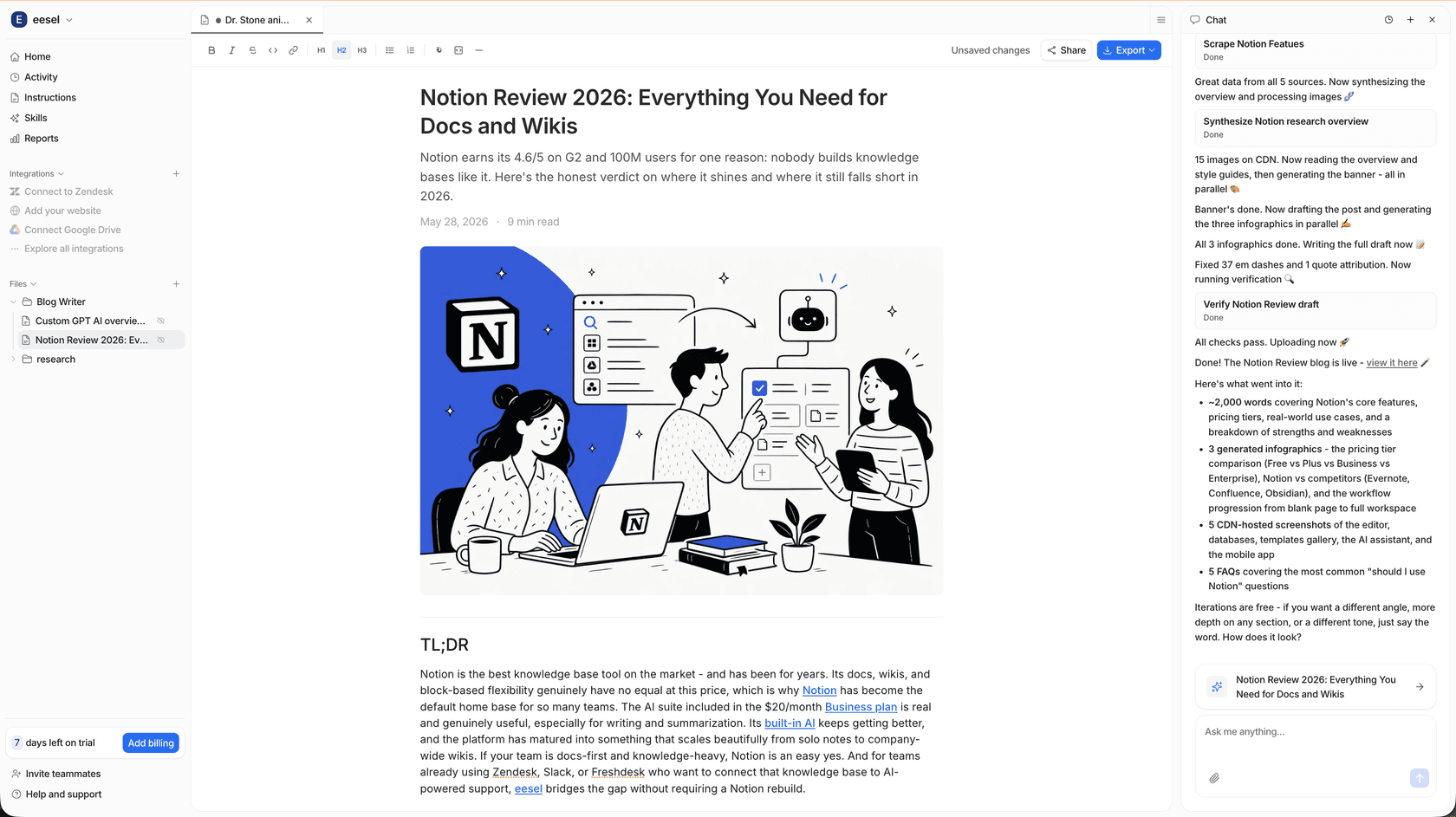
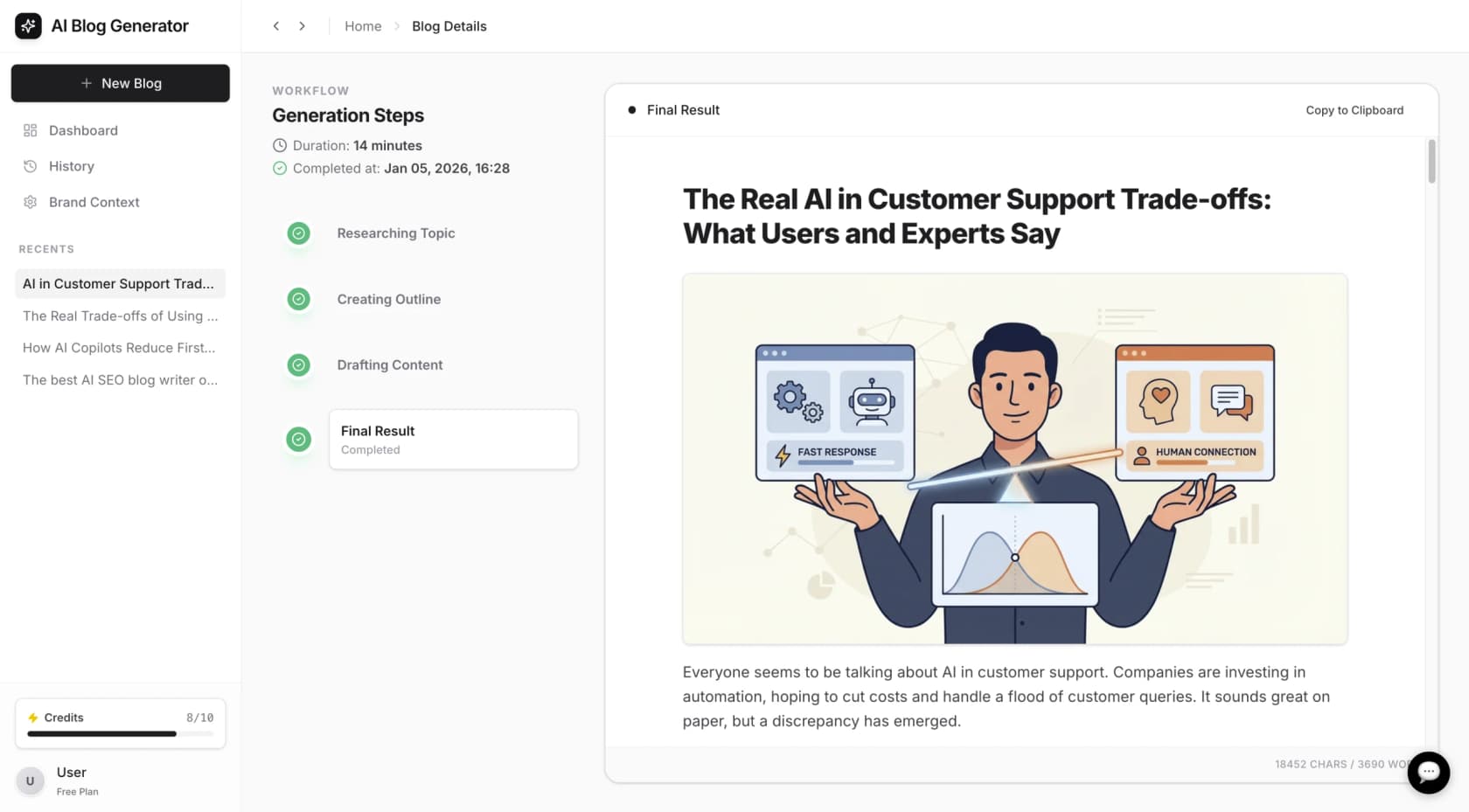
The eesel AI blog writer is designed to address a common challenge in content SEO: creating high-quality, finished articles efficiently. Unlike some AI writers that produce a text-only draft, this tool generates a complete, SEO-optimized blog post.
The team at eesel AI used this tool to grow their blog from 700 to 750,000 daily impressions in three months by publishing over 1,000 posts. Its features include building a full article with AI-generated images, embedding relevant YouTube videos, and pulling quotes from Reddit. The research is context-aware, meaning it understands what kind of content to create for a given topic, and it’s optimized for AI answer engines (AEO).
Pricing: You can generate your first blog post completely free. After that, plans are credit-based, starting at $99 for 50 blog posts.
2. AIOSEO analyzer
The AIOSEO Analyzer is a useful tool for a quick health check on a website. It is a free web-based tool from the team behind the All in One SEO plugin, which is used by over 3 million professionals. You plug in a URL, and it provides a detailed report on key on-page and technical SEO factors, which is helpful for spotting critical errors.
A key benefit of the tool is its simplicity and thoroughness. It gives you an actionable SEO checklist covering everything from title tags and meta descriptions to schema markup and site speed. This makes it helpful for beginners or for agencies needing a quick audit for a potential client. It is a diagnostic tool, meaning it tells you what’s wrong, but users must implement the fixes themselves. For the full suite of automated features, their WordPress plugin is required.
Pricing: The website analyzer is 100% free to use. The full AIOSEO plugin has a free version available on WordPress.org and paid plans for more advanced features.
3. Quattr’s free AI tools
For users who need a specific tool for a specific job, Quattr's suite of free AI SEO tools offers a collection of small, specialized tools designed for specific details. Instead of an all-in-one platform, Quattr provides individual generators for title tags, meta descriptions, H1 headings, and SEO-friendly URLs.
These tools are valued for their speed and focus. They can help get past creative blocks on small but vital tasks. A consideration is that they are all separate tools, so it is not a seamless solution for creating a whole piece of content. It can be thought of as a toolkit rather than a complete workshop.
Pricing: All of the individual AI SEO tools on their page are free to use. Quattr also offers a full paid platform for larger enterprise clients.
4. seo.ai’s free tools
While seo.ai's main platform is a paid service, it offers some powerful free tools that are useful for the research phase of a content strategy. A key feature is their AI Keyword Tool. You provide a short description of a business or topic, and it generates a list of relevant keywords. It goes beyond obvious terms to find more nuanced phrases.
The quality of its AI-driven keyword suggestions can help discover new content angles. They also have a Google SERP Simulator that lets you preview how your title and meta description will look in search results, which is helpful for improving click-through rates. Similar to Quattr, these are standalone tools. Users will need to input the data into another platform to create and optimize content.
Pricing: The tools on their free tools page are available at no cost. Their main platform, which automates content creation, is a paid subscription that starts at $149 per month.
5. Google Search Console
An essential free tool for SEO is Google Search Console. While not a generative AI tool, it is a primary source of truth for a site's performance in Google search. Many of its reports are powered by Google's own machine learning.
A major advantage of GSC is that it provides data directly from Google. It shows which keywords you're ranking for, which pages are getting seen, and what technical issues (like Core Web Vitals) Google has found on your site. It provides the diagnosis, not the cure. It tells you what the problem is, but you need other tools and expertise to figure out how to fix it.
Pricing: 100% free.
How to use free AI SEO tools correctly
Having the right tools is the first step; using them effectively is also important. To get results, they should be used as part of a human-led strategy.
Here are a few guidelines:The trick isn’t just 'using AI tools' it’s connecting them into a workflow: research → creation → optimization → distribution → visibility in LLMs.

-
Focus on E-E-A-T: Google’s E-E-A-T guidelines (Experience, Expertise, Authoritativeness, Trust) are important. AI is useful for creating a first draft, but that content must be reviewed and improved by a human expert. Add personal stories, original insights, or unique data to show that a real person with real experience is behind the content.
-
AI as an assistant, not a replacement: Think of these tools as a way to boost productivity, not to replace your brain. Use them for research, creating outlines, drafting sections, and generating images. But the final polish, strategic direction, and critical fact-checking should always be done by a person.
-
Prioritize search intent: Your goal is to answer the user's question better than anyone else. Use AI to analyze what's already ranking and structure your article, but always review the output and ask, "Does this actually help someone looking for this information?" AI can generate text, but a human understands context.
For a visual walkthrough of some of the best free AI SEO tools in action, the video below offers a great overview. It covers a range of tools that can help with everything from content creation to keyword research, providing practical examples of how to integrate them into your workflow.
Final thoughts
Free AI SEO tools can be helpful, particularly those that automate time-consuming parts of the job. Tools that handle tasks like generating a first draft with assets can free up time for strategy and content refinement. A tool like the eesel AI blog writer aims to address this. It is designed to deliver a structured, optimized article with rich media, handling much of the initial work and allowing users to focus on final edits and unique additions. The tool offers a free trial to generate a first blog post, providing an opportunity to evaluate its features.
Frequently asked questions
What makes the best free AI SEO tools different from paid ones?
The main difference is usually scale and features. Free tools are great for specific tasks like generating a title or running a quick audit. Paid tools often offer more comprehensive workflows, higher usage limits, and advanced features like team collaboration.
Can I rely solely on the best free AI SEO tools for my entire SEO strategy?
It is not recommended. These tools are helpful assistants, but they can't replace human strategy. You still need a person to do critical thinking, add unique insights (E-E-A-T), and make final decisions. Think of them as productivity boosters, not replacements for an SEO professional.
How do I choose the best free AI SEO tools for my specific needs, like content creation or technical audits?
Consider your biggest bottleneck. For writing assistance, a tool like the eesel AI blog writer could be useful. For technical issues, the AIOSEO Analyzer is a good starting point. Match the tool to the task you need the most help with.
Are the best free AI SEO tools safe to use without getting penalized by Google?
Yes, as long as you use them correctly. Google's issue isn't with AI-generated content, but with low-quality, unhelpful content. As long as you use AI to create a solid first draft and then have a human expert review, edit, and add unique value, you'll be fine.
What is the biggest limitation of most of the best free AI SEO tools?
The biggest limitation is usually that they are "micro-tools." They solve one specific problem well but don't offer an integrated workflow. You often have to jump between different tools for keyword research, writing, and auditing, which can be inefficient.