

Keeping up with the demand for fresh, high-quality content can feel like you’re on a treadmill that just won't stop. You publish one blog, and the clock immediately starts ticking on the next. It’s a huge time sink, and scaling your content often feels like you either have to hire a whole team or just accept burnout as your new reality.
This is where an AI writing generator can step in. These tools are a great way to scale up your content creation without draining your energy or letting quality slip. However, many of them produce a first draft that you still have to spend time editing and polishing.
That’s why I decided to get my hands dirty and test the best tools on the market to see which ones actually deliver. I wanted to find the tools that go beyond simple text drafts. Some platforms now generate complete, publish-ready articles with images, media, and SEO optimization built-in, which is a massive help for any growth team.
What is an AI writing generator?
Simply put, an AI writing generator is a tool that uses artificial intelligence, specifically large language models (LLMs), to create human-like text from a prompt you provide. Think of it as a very smart writing assistant that can take a single keyword or a simple idea and turn it into all sorts of content, like blog posts, social media updates, ad copy, or emails.
How we chose the best AI writing generator tools
To cut through the noise, I focused on a few key things to make sure this list is actually useful. Here’s what I looked for during my testing:
- Output Quality: Is the content any good? I looked for tools that produce writing that is engaging, accurate, and sounds like a human wrote it, not a robot.
- SEO & AEO Features: A good blog post needs to be found. I checked if the tool helps optimize for traditional search engines (SEO) and, just as importantly, for AI answer engines like Google's AI Overviews (AEO).
- Ease of Use: How quickly can you get from an idea to a finished piece? The best tools have a straightforward interface that doesn't require a degree in prompt engineering to use well.
- Asset Generation: Does the tool just give you a wall of text? I prioritized platforms that create a complete package with images, tables, and media embeds, saving you the hassle of sourcing them yourself.
- Value for Money: Is the price worth it? I weighed the features and time saved against the cost to see which tools offer the best return.
Comparison of the top AI writing generator tools in 2026
Here’s a quick look at how the top contenders stack up.
| Tool | Best For | Key Feature | Starting Price | Free Trial |
|---|---|---|---|---|
| eesel AI blog writer | Complete, publish-ready blog posts | Automatic asset generation & AEO | $99 for 50 blog posts | Yes, free to try |
| Jasper | Marketing copy & brand voice | Brand Voice & Style Guide | $69/month/seat | 7-day trial |
| Writesonic | SEO & AI search visibility tracking | Generative Engine Optimization (GEO) | $49/month | Free trial available |
| Grammarly | Editing & polishing existing text | AI agents for in-app suggestions | Free version available | N/A |
| Sudowrite | Creative and fiction writing | Story Engine for novel outlining | $19/month | Yes, free trial |
The 5 best AI writing generator tools I tested in 2026
After spending time with each tool, a few clear winners emerged for different situations. Here’s the detailed breakdown.
1. eesel AI blog writer
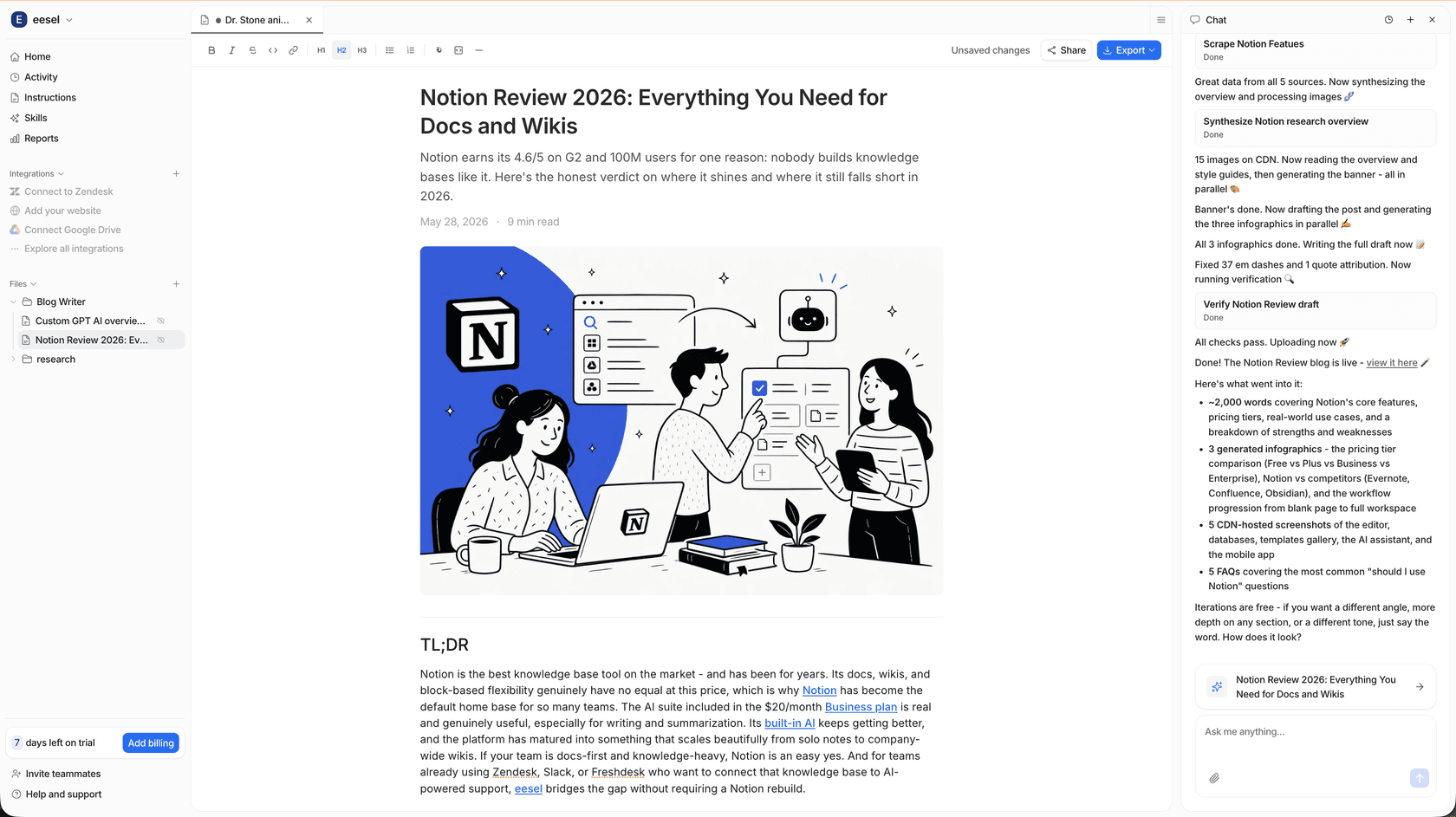
Pros: A key benefit is that you get a finished product. It doesn't just write the text; it automatically creates and inserts AI-generated images, infographics, and tables right into the post. It even finds and embeds relevant YouTube videos and real Reddit quotes to add a layer of authenticity and social proof that most AI content is missing. Another benefit is its focus on AEO (Answer Engine Optimization), which prepares your content to be featured in places like Google’s AI Overviews.
Cons: Because it’s so focused on creating amazing long-form blog content, it’s not the tool you’d use for quick social media captions or ad copy. It’s a specialized tool built to solve one very specific, high-value problem: scaling your blog content without hiring an army.
Pricing:
- It’s completely free to try, so you can see the quality for yourself.
- Paid plans start at $99 for 50 blog post credits.
2. Jasper
Jasper has been a big name for a while and is a great tool for marketing teams that need to create a wide variety of copy while staying on-brand. It’s good at generating everything from short ad copy to long-form blog drafts, and it does a fantastic job of sticking to your company’s specific tone and style.
Pros: Jasper's Brand Voice feature is excellent. You can upload your style guides, product info, and brand identity, and the AI will learn to write just like you. The platform is also packed with over 100 templates for different marketing tasks and includes collaboration tools that are handy for teams.
I like a mix of free Chat GpT and Jasper. Free Chat GPT is actually still better for brainstorming - Jasper doesn’t really always understand the same prompts, the same way. I could ask it to suggest an outline for an ebook blah blah blah and sometimes it takes a lot more correction than chat GPT. But it is helpful for tightening up copy, or rather getting ideas to make it tighter, and things like various classic marketing frameworks.
Cons: Jasper is effective for generating a solid first draft. Users receive the text and are then responsible for finding and creating images, formatting the post, and adding any other media. This requires some manual work to get from the initial output to a finished blog post. The price can also get a little steep, especially for solo creators or small teams.
Pricing:
- The Pro plan starts at $69 per month for each seat (59/month if you pay annually).
- They offer a 7-day free trial.
3. Writesonic
Writesonic has carved out a niche for itself by focusing heavily on search visibility. It’s more than just a writer; it’s a platform designed to help you create content that ranks. It even includes tools to track how your brand shows up in AI search results from models like ChatGPT and Gemini.
Pros: The standout feature is what they call Generative Engine Optimization (GEO). It gives you analytics on your visibility in AI answers and helps you find opportunities to improve it. The AI Article Writer also does a good job of researching competitors and pulling in facts to create well-researched, SEO-focused drafts.
Writesonic has better British English support out of the box. For you specifically, found writesonic superior for social captions and blog writing, but jasper's better for seo work and keword integration
Cons: The main focus here is on the text and the analytics behind it. Similar to other text-focused generators, it provides a strong article, but users are responsible for sourcing and adding the visuals and media needed to create a publish-ready post. The pricing is also a bit complicated, with key features locked behind higher-tier plans.
Pricing:
- Plans start at $49/month ($39/month on an annual plan).
- The advanced GEO features are only on the Professional plan or higher, which starts at $249/month.
4. Grammarly
You probably know Grammarly as the world’s most popular grammar checker, but its AI features have grown a lot. It now acts as a writing assistant that can help you rewrite sentences, adjust your tone, and generate short snippets of text right inside the apps and websites you already use.
Pros: Grammarly’s biggest strength is how easily it fits into your existing workflow. It works across over a million websites and apps, so it’s always there when you need it. The AI agents, like the "Proofreader" and "Paraphraser", are brilliant for taking existing text and making it clearer, more professional, and more impactful.
Cons: This is not a tool for creating long-form content from scratch. Grammarly is an incredible writing assistant, but it’s not an AI writing generator in the same way as the others on this list. You wouldn't use it to write an entire blog post, but it's one of the best tools out there for perfecting a draft you've already created.
Pricing:
- There's a very capable free version available.
- The Pro plan with all the advanced AI features starts at $30/month (or $12/month if billed annually).
5. Sudowrite
Sudowrite is a fascinating example of a highly specialized AI writer. It was built from the ground up for fiction authors and creative writers. It’s designed to be a brainstorming partner, helping writers flesh out plot points, describe scenes, and expand on narrative ideas.
Pros: For its intended audience, Sudowrite is incredibly powerful. Features like "Describe" can paint a vivid picture of a setting or character, while "Expand" can take a simple sentence and turn it into a rich paragraph. It’s an amazing tool for overcoming writer's block and exploring creative possibilities.
Cons: It’s completely unsuitable for business or marketing content. All of its features are tuned for storytelling, so if you tried to write a blog post about software with it, the results would be pretty strange and unusable for a business blog.
Pricing:
- The Hobby & Student plan starts at $19/month (10/month annually).
- It offers a free trial to get started.
Beyond the draft: How to get the most from your AI writing generator
No matter which tool you choose, just hitting "generate" and publishing the raw output is a recipe for mediocre content. Here are a few tips to get the best results:
- Add your unique expertise: The AI can build the foundation, but your personal stories, insights, and unique perspective are what make the content truly valuable. Use the AI draft as a starting point, then add your own flavor.
- Fact-check everything: AI models aren't perfect and can sometimes confidently state things that are just wrong. Always take a minute to verify any stats, claims, or technical details before you hit publish.
- Refine your prompts: The old saying "garbage in, garbage out" really applies here. The more specific you are with your initial prompt-defining your audience, tone, and key talking points-the better the output will be.
- Focus on the final product: Treat the AI output as a very advanced first draft. The final step is always a human one: editing for flow, clarity, and making sure the piece perfectly reflects your brand's voice.
Above all though I always clean up the cringe at the end, rewrite some, and take out all the damn emojis.
 Reddit
Seeing these tools in action can also help you decide. For a great overview of different options, including some free alternatives that are perfect for getting started, check out this video review.
Choosing the right AI writing generator
After testing these tools, it's clear they serve different purposes. Tools like Jasper and Writesonic are effective for creating text drafts, and Grammarly is a powerful tool for editing. These options generally require users to source images, create visuals, and format the final piece.
The eesel AI blog writer is a notable option because it delivers a more complete article. It handles the writing, visuals, media, and optimization in one step, which can save manual work on each post.
Try the eesel AI blog writer for free and generate your first complete, SEO-optimized article in minutes.