My top 6 AI tools for digital marketing that actually deliver in 2026

Kenneth Pangan
Last edited January 7, 2026

The market for AI marketing tools is expanding rapidly, with new platforms emerging frequently. This can make it challenging to determine which tools are most effective.
There are so many AI chatbots out there, like Claude, ChatGPT, etc. When it comes to digital marketing strategies, market research, SEO, etc., which ones are the best and worst? I'm overwhelmed by how many AI chatbots there are so I'd like to know ones that won't hallucinate or give false information

This post aims to provide clarity by highlighting a selection of tools that have demonstrated measurable results in real-world applications. We'll explore how tools like the eesel AI blog writer can influence a growth strategy, drawing from examples like our own blog's growth from 700 to 750,000 daily impressions in three months.
What are AI tools for digital marketing?
In simple terms, AI marketing tools are applications that use artificial intelligence to assist with, or completely handle, marketing tasks. They go beyond simple automation schedulers by using machine learning to analyze data, identify trends, personalize content for audiences, and refine campaigns for better outcomes.
They can be categorized into three main types, as this infographic shows:
-
Content creation: These tools assist in writing articles, generating images, or creating social media copy.
-
SEO and analytics: This category includes platforms for keyword research, on-page optimization, and monitoring performance in AI-powered search engines.
-
Workflow automation: This software connects different applications to manage tasks and transfer data automatically.
How the tools for this list were chosen
To make this list as useful as possible, the selection process was based on a clear set of criteria.
My criteria:
-
Real-world results: The tools included have shown a measurable impact on metrics like traffic, efficiency, or content quality.
-
Ease of use: Each platform on this list features a user-friendly interface that is accessible without extensive technical knowledge.
-
Specialization: These tools excel at a specific, crucial marketing task.
-
Value for money: Each tool offers a solid return on investment, whether through a subscription or a credit-based model.
Comparison of the top AI tools for digital marketing
Here’s a quick side-by-side look at the tools we’re about to dive into.
| Tool | Best For | Key Feature | Pricing Model |
|---|---|---|---|
| eesel AI blog writer | Scaling SEO-driven blog content | Generates complete, publish-ready posts with assets | Credit-based (Starts at $99/mo) |
| Jasper AI | AI content automation pipelines | Automating the entire content lifecycle | Subscription (Starts at $59/mo) |
| Surfer SEO | On-page content optimization | Content Audit and AI Humanizer tools | Subscription (Starts at $79/mo) |
| Semrush | All-in-one SEO & marketing analytics | AI Visibility Toolkit for AI search engines | Subscription (Starts at $165.17/mo) |
| Zapier | Workflow automation | Connecting over 8,000 apps with AI Agents | Freemium / Subscription (Starts at $19.99/mo) |
| Lexica Art | AI image generation | Creating unique, on-brand visuals | Subscription (Starts at $8/mo) |
The 6 best AI tools for digital marketing for 2026
Alright, let’s get into the details. Here’s a closer look at each of these tools, what makes them special, and how they fit into a modern marketing toolkit.
1. eesel AI blog writer
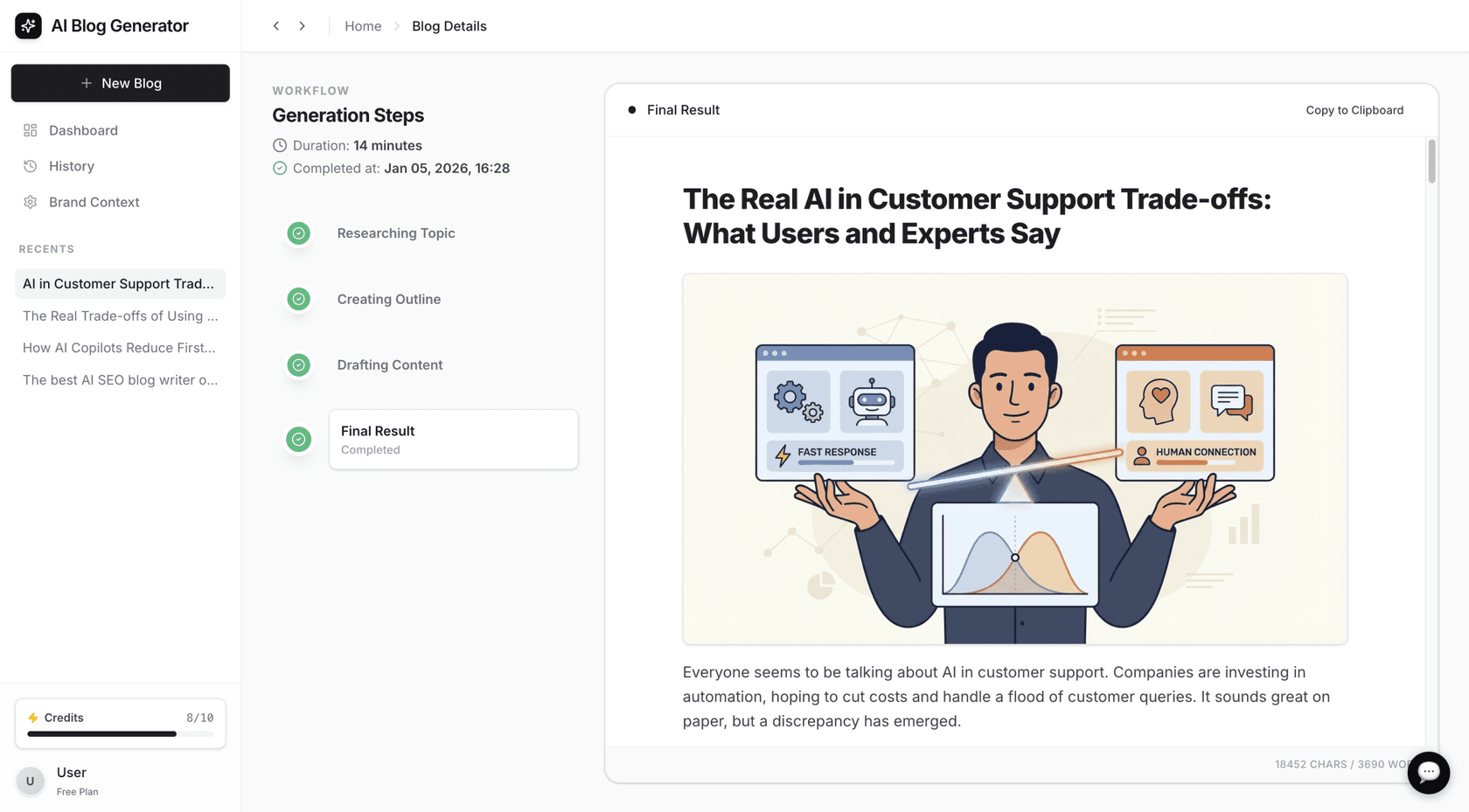
The eesel AI blog writer is a strong option for users focused on growing their blog and organic traffic. It is the tool we used to publish over 1,000 articles and grow our blog from 700 to over 750,000 daily impressions in three months.
This tool generates a complete, publish-ready blog post from a single keyword. It builds a logical structure, writes optimized headings, crafts an intro and conclusion, and adds an FAQ section. A key feature is its context-aware research and its optimization for AI Answer Engines (AEO), ensuring content is visible in places like Google's AI Overviews and ChatGPT.
Key Features:
-
Automatic Assets: It incorporates AI-generated images, tables, and infographics directly into the post, saving time and improving readability.
-
Social Proof: To add authenticity, it automatically finds and embeds relevant Reddit quotes and YouTube videos.
-
Multi-language Support: With one click, you can translate a full post into any language, expanding your content's reach to a global audience.
Pros: The primary benefit is the speed and completeness, delivering a final, media-rich article ready for publication in minutes. It’s designed for ranking and generating content efficiently. Cons: The tool is highly focused on long-form blog content, so it is not intended for short ad copy or social media captions.
Pricing: You can try it completely free. The paid "Early Bird" plan starts at $99 per month for 50 blog generations.
2. Jasper AI
Jasper is a well-established tool in the AI writing space that has evolved into a comprehensive "AI content automation" platform designed to manage the entire content lifecycle for marketing teams.
I’ve been using Jasper for content creation . It's pretty solid for blog posts and emails. Costs around $40/month but it saves me a ton of time. Also curious if others have found any other options
The core of this approach is Content Pipelines, a feature that connects data sources, brand voice, and distribution channels into an automated system. It also includes Jasper Agents, which are AI assistants that can be assigned to specific tasks like personalizing content, optimizing for keywords, or conducting research. The platform is built for scaling content creation while maintaining brand consistency.
Pros: Jasper's strength is its vision for automating the entire marketing workflow, which can be powerful for large teams with complex needs. Cons: For users who only need a finished blog post, the output may require additional human editing to achieve the desired depth and natural flow.
Pricing: Jasper offers a 7-day free trial on its Pro plan. Paid plans are subscription-based, with the Pro plan starting at $59 per month per user, when paid annually.
3. Surfer SEO
Surfer SEO functions as an SEO optimization tool rather than an AI writer. It is designed to be used with content that has already been drafted, either by a human or another AI tool.
Surfer is ridiculously good.
Surfer analyzes top-ranking pages for a target keyword and provides actionable recommendations on keyword inclusion and article structure. A notable feature is the Content Audit, which integrates with Google Search Console to identify existing articles with high potential for ranking improvements. It also has an AI Humanizer to make AI-generated text sound more natural and avoid AI detection.
Pros: The data-driven method helps remove guesswork from on-page SEO, and the real-time feedback is helpful for writers. Cons: The tool does not generate content, requiring users to provide their own text. Additionally, there is a potential to over-optimize if suggestions are followed too rigidly without considering the human reader.
Pricing: It is a subscription model. The Essential plan starts at $79 per month (billed annually), which includes 30 articles in the Content Editor each month.
4. Semrush
Semrush is a widely used marketing tool, and its recent AI-focused updates have made it essential for understanding the future of search.
While AI is integrated throughout the platform, the standout feature is its AI Visibility Toolkit. This tool tracks brand visibility in AI-generated answers, such as Google's AI Overviews and ChatGPT responses. It helps identify which prompts a brand is visible for, analyze the sentiment of mentions, and find technical issues that may block AI crawlers.
Pros: Semrush offers a comprehensive suite of SEO, content, and advertising tools that prepare users for shifts in AI search. The AI Visibility Toolkit provides unique strategic insights. Cons: The platform is one of the more expensive options on this list, and its extensive features can have a steep learning curve for new users.
Pricing: The Semrush One Starter plan is $165.17 per month when billed annually. The AI Visibility Toolkit is included in this plan.
5. Zapier
Zapier serves as an integration platform that connects various marketing tools. Its recent AI upgrades have increased its capabilities.
Zapier allows you to build automated workflows (called "Zaps") between over 8,000 different apps without writing any code. For example, a Zap can automatically share new blog posts on social media or add new leads from a form to a CRM. The introduction of AI Agents enables the handling of more complex, multi-step tasks, like qualifying new leads or summarizing meeting notes.
Pros: The primary benefit is significant time savings through the automation of repetitive, manual tasks. Cons: Complex, high-volume workflows can become expensive, as pricing is based on task usage. Exceeding a plan's monthly task limit results in pay-per-task billing, which requires careful monitoring.
Pricing: Zapier has a free plan that includes 100 tasks per month. Paid plans start at $19.99 per month (billed annually) for 750 tasks.
6. Lexica Art
Lexica Art is a tool for creating high-quality, unique AI images for blog posts and social media graphics.
Lexica Art is a powerful AI image generator that allows you to create custom visuals. By using creative text prompts, you can generate images that align with your brand's style, offering an alternative to stock photography.
Pros: The tool enables the creation of unique, on-brand visuals in seconds. Cons: As with many AI image tools, it can sometimes produce inaccuracies with details like hands and text. Learning to write effective prompts requires practice. Additionally, images created on lower-tier plans are public; only the Max plan offers private images.
Pricing: There is no free plan for image generation. Paid plans start at the "Starter" tier, which is $8 per month (billed annually) and provides 1,000 fast generations.
Pro tips for using AI tools for digital marketing
Using these tools effectively requires a strategic approach. Here are a few tips.
-
1. Garbage in, garbage out: The quality of AI output is directly dependent on the quality of the input. Be specific with your prompts, provide clear context, and define your audience and objectives.
-
2. Use AI as a collaborator, not a replacement: Human oversight is crucial. Always review, edit, and fact-check AI-generated content. Add your own personality, expertise, and real-world stories.
-
3. Combine tools for a superpower workflow: The real power comes from integrating these tools. Here's a sample workflow:
- Use Semrush's AI Visibility Toolkit to find a high-opportunity prompt.
- Generate a complete, optimized article for that prompt using the eesel AI blog writer.
- Create a custom blog thumbnail and social media graphics with Lexica Art.
- Use Zapier to automatically share the published post across social media channels.
-
4. Focus on the "why," not just the "what": Let AI handle repetitive tasks. This frees you up to focus on high-level strategy, creative thinking, and understanding customer needs.
To see these concepts in action, here's a helpful video that explores some of the best AI marketing tools available today and how they can be used to boost creativity and drive better results.
Choosing the right AI tools for digital marketing
The AI market is crowded, but selecting the right set of tools can provide a significant advantage. Instead of searching for a single tool that does everything, it's often more effective to build a stack of specialized platforms that address specific problems. By combining the strengths of these different tools, you can scale your marketing efforts in ways that were not possible a few years ago.
A practical starting point is to automate a time-consuming content task, such as writing blog posts. The eesel AI blog writer offers a free trial to generate a high-quality, SEO-optimized article in a few minutes, allowing users to evaluate its capabilities.

Frequently asked questions
Many great tools offer free tiers. Zapier has a free plan for basic automation, and you can generate your first few articles completely free with the eesel AI blog writer. For images, some generators offer a limited number of free credits to test them out.
They can help in several ways. Tools like the eesel AI blog writer generate SEO-optimized content from a keyword. Others, like Surfer SEO, help you optimize existing content by analyzing top-ranking pages. Analytics platforms like Semrush now even track your visibility in AI-powered search results.
Not at all. The tools on this list were chosen specifically for their ease of use. Most have intuitive interfaces that don't require any technical background. You can start generating content, images, or automations within minutes.
Yes, many modern AI writers have this capability. For example, the eesel AI blog writer allows you to translate a finished blog post into multiple languages with a single click, which is a huge time-saver for reaching a global audience.
The "garbage in, garbage out" principle is key. The quality of your output depends entirely on the quality of your input (prompts, context, data). Also, always use AI as a collaborator. Review, edit, and add your unique human perspective to everything you create.
Share this article

Article by
Kenneth Pangan
Writer and marketer for over ten years, Kenneth Pangan splits his time between history, politics, and art with plenty of interruptions from his dogs demanding attention.