
B2B marketers are often expected to generate a steady stream of high-quality leads and insightful content, often with a small team and an even smaller budget. It can feel like a constant challenge to keep up. AI has emerged as a significant asset, promising to automate tasks, personalize outreach, and scale marketing efforts. However, the market is saturated with tools, making it difficult to identify the most effective solutions.
This guide evaluates several AI platforms to highlight those that deliver tangible results for B2B strategies. Content creation is the foundation of any solid B2B marketing plan - and some new tools are completely changing how it's done. For instance, the eesel AI blog writer can handle the entire content process, turning a single keyword into a complete, publish-ready post with images and videos. It's the exact tool we used to grow our own organic traffic from 700 to 750,000 impressions a day in just three months. This post shares the tools that genuinely work.
What are AI tools for B2B marketing?
AI tools for B2B marketing are software platforms that use artificial intelligence, machine learning, and natural language processing to automate, improve, and analyze marketing tasks. They’re built to help businesses connect with other businesses more effectively by taking on the heavy lifting that used to consume many hours.
But this is about more than just writing a quick email or social media post. The scope of these tools covers several key areas of the B2B marketing funnel, as this infographic illustrates.
-
Content Creation & Optimization: These are the tools that help you write long-form blog posts, compelling ad copy, and targeted emails, often with SEO suggestions baked in to help you rank.
-
Lead Generation & Scoring: These platforms can sift through huge amounts of data to find potential customers who are showing interest, then score and prioritize them so your sales team knows who to call first.
-
Personalization & Customer Experience: This includes everything from AI-powered chatbots that talk to website visitors in real-time to systems that change website content based on a visitor's industry or past behavior.
-
Automation & Analytics: These tools connect your different marketing apps, streamline repetitive workflows, and give you data-driven insights to help you figure out what's working and what's not.
Ultimately, the goal is to make your marketing more efficient, scalable, and impactful. This frees you and your team up to focus on the big-picture strategy and creative thinking that humans are best at.
How we chose the best AI tools for B2B marketing
Not all AI tools are the same, especially when you're dealing with the specific challenges of B2B marketing. A tool that’s perfect for a B2C e-commerce brand might not work at all for a SaaS company trying to land enterprise clients. This list was curated based on criteria that matter most to B2B marketers.
The selection process focused on four key areas:
-
Real-World Impact: We prioritized tools that solve a real B2B problem and deliver a measurable return. Can it actually increase organic traffic, generate better leads, or save your team a ton of time? If the ROI wasn't clear, it didn't make our list.
-
Ease of Use & Integration: You shouldn’t need a degree in data science to use a marketing tool. We looked for platforms with intuitive interfaces that teams can start using quickly. We also made sure they play nicely with the essential software B2B teams use every day, like CRMs and help desks.
-
Specialization & Quality: A lot of tools try to do everything at once and end up being mediocre at all of it. We favored platforms that are excellent at their main function, delivering high-quality, reliable output, whether that's a perfectly optimized blog post or a smooth automated workflow.
-
Scalability: The right tool should grow with your business. We picked platforms that can support a company at every stage, from a small startup just getting started to a large enterprise team managing complex campaigns.
A comparison of the top AI tools for B2B marketing for 2026
Here’s a quick overview of the tools that made our list.
| Tool | Best For | Key Features | Pricing |
|---|---|---|---|
| eesel AI blog writer | End-to-end SEO blog generation | Automated assets (images, videos), social proof (Reddit quotes), AEO optimization | Free to try, then $99/mo for 50 blogs |
| Jasper | Versatile marketing copy | Brand Voice, 100+ marketing apps, Jasper IQ | Starts from $59/user/month (billed annually) |
| Surfer SEO | Data-driven content optimization | Content Score, AI Humanizer, Surfer AI writer | Starts from $79/month (billed annually) |
| HubSpot AI | Integrated CRM & marketing automation | Breeze AI Agents, predictive lead scoring, AI content writer | Included in Pro & Enterprise plans |
| Zapier | Workflow automation | Connects 8,000+ apps, no-code Zaps, AI Agents | Free plan available; paid starts from $19.99/month (billed annually) |
| Drift | Real-time conversational marketing | AI chatbots, real-time lead qualification, Salesloft integration | Custom pricing |
The 6 best AI tools for B2B marketing in 2026
After a lot of testing, these are the six platforms that consistently impressed us with their quality, impact, and usefulness for B2B marketing teams.
1. eesel AI blog writer
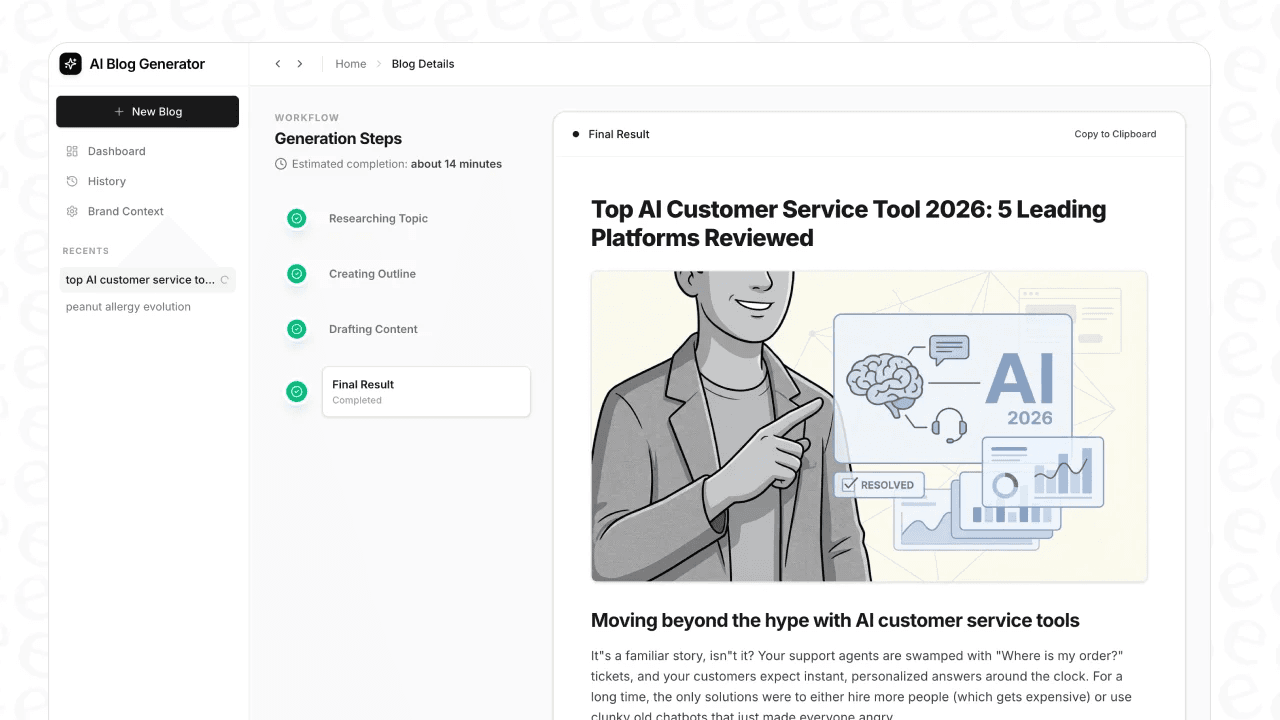
The eesel AI blog writer is a specialized tool designed to tackle one of the biggest time-sinks in B2B marketing: creating high-quality, SEO-optimized content at scale. It's not just another AI writer that produces a rough draft. It functions as a complete content engine that takes you from a single keyword to a fully-formatted, publish-ready blog post in minutes.
A key differentiator is that it does more than just generate text. It automatically researches the topic and includes AI-generated images, infographics, and data tables right in the content. It also has a feature that pulls in relevant YouTube videos and real Reddit quotes to add social proof and authenticity, which is key for building trust with a knowledgeable B2B audience. On top of that, its output is optimized for AI Answer Engines (AEO), making sure your content shows up in places like Google AI Overviews and Perplexity.
-
Pros: Its biggest plus is producing a complete blog post with all the assets you need, saving hours of research, writing, formatting, and finding visuals. The content quality is designed to be human-like, avoiding the generic AI tone common in many other tools.
-
Cons: Its specialization is also its main limitation. It’s built to excel at blog content generation, so if you need an all-in-one suite to manage social media and email campaigns, you will need to consider specialized integrations or other platforms.
-
Pricing: It's completely free to try. The paid Early Bird plan starts at $99 per month for 50 blog generations.
-
Who it's for: It's perfect for B2B marketing teams of any size who use content marketing and SEO to drive organic traffic. If you want to significantly scale your content output without sacrificing quality, this is the tool for you.
2. Jasper
Jasper is a well-known name in AI copywriting. It's a versatile assistant made for marketing teams that need to create many different kinds of copy quickly. From social media posts and ad headlines to product descriptions and email newsletters, Jasper has a template for almost any marketing task.
I have tested most of these too, and found real differences once you get past the surface features. Based on Sprout Score comparisons, Jasper scored higher (8.2) for brand voice and long-form consistency, especially in team use. Surfer SEO scored strong (8.0) in post-publish optimization and SERP alignment, but depends heavily on pairing with another tool like Jasper. Copy.ai lagged a bit (7.4) for structured content workflows, it is fast, but less controllable.

Its strength is its huge library of over 100 purpose-built marketing Apps that guide the AI to produce copy for specific formats. Features like Brand IQ let you teach Jasper about your company's tone of voice and products to maintain consistency. It also integrates with tools like Surfer SEO to help optimize the content it creates.
-
Pros: The main benefit is its flexibility and speed, especially for short-form copy. It's a great all-rounder for a marketing team's daily copywriting needs, acting as a reliable creative partner.
-
Cons: Its long-form content editor produces a first draft that serves as a foundation, which then requires human editing, additional research, and formatting for final publication. You'll still have to find your own images, data, and social proof.
-
Pricing: The Pro plan starts at $59 per user per month when billed annually, and a 7-day free trial is available.
-
Who it's for: Marketing teams who need a flexible AI assistant for a wide range of short-form copy and are prepared to handle the final editing, research, and asset creation for longer content themselves.
3. Surfer SEO
Surfer SEO is a content intelligence platform that uses AI to give you a data-driven plan for ranking on search engines. It focuses on analyzing the top-ranking pages for your target keyword and telling you exactly what to do to compete: rather than writing content from scratch.
Its main feature is the Content Editor, which gives you a real-time SEO score as you write, suggesting keywords to include, ideal word counts, and structural elements. It helps turn SEO from a guessing game into a science. Surfer also has an Audit tool for improving existing pages and an AI Humanizer that can rewrite AI-generated text to sound more natural and bypass AI detectors.
-
Pros: Its greatest strength is its detailed, data-driven approach to on-page SEO. It provides clear, actionable steps that can significantly improve your content's chances of ranking.
-
Cons: It's mainly an optimization tool. While it does have an AI writer, its real value is in refining and improving content, not creating a complete, asset-rich article from a single prompt. It's a powerful tool for an SEO-focused writer, but it's not an end-to-end content solution.
-
Pricing: The Essential plan starts at $79 per month when billed annually.
-
Who it's for: SEO specialists and content marketers who want to optimize every piece of content based on hard data. It's great for those who already have a writing process and want to add a powerful layer of data-driven optimization.
4. HubSpot AI
HubSpot AI is a powerful set of artificial intelligence tools, branded as Breeze, built directly into HubSpot's comprehensive CRM platform. As a mature and industry-leading platform, HubSpot provides an intelligence layer designed to streamline tasks across marketing, sales, and customer service. This makes it an exceptional all-in-one solution for businesses looking for a trusted, enterprise-grade ecosystem.
The suite includes Breeze Agents that can handle specific tasks, like a Prospecting Agent for creating personalized sales outreach or an AI Content Writer for drafting blog posts. One of its most valuable features is its predictive lead scoring, which analyzes customer data to help sales teams focus on the most promising leads with high accuracy.
-
Pros: The biggest advantage is its seamless integration with HubSpot's Smart CRM. This lets the AI use a single, unified source of customer data to power its tasks, leading to highly relevant and personalized marketing that scales with your business.
-
Cons: Because HubSpot prioritizes a unified experience across the entire customer journey, its AI tools are designed to work harmoniously within the broader CRM rather than as isolated niche features. Like any sophisticated AI generation, results benefit from a final layer of human refinement to ensure perfect brand alignment.
-
Pricing: HubSpot AI features are conveniently included in the Professional and Enterprise subscriptions, offering tiered plans to match different team sizes.
-
Who it's for: B2B businesses that want a reliable, world-class platform. If your marketing and sales operation runs on HubSpot, its native AI tools are a logical and powerful addition that ensures all your data stays in one place.
5. Zapier
Zapier is an AI-powered automation platform that acts as the digital glue connecting the thousands of different apps in your tech stack. For B2B marketers juggling multiple tools, Zapier is what makes everything work together seamlessly.
It works on a simple "trigger-and-action" system called "Zaps." For example, when a new lead fills out a form on your website (trigger), Zapier can automatically add them to your CRM, send a Slack notification to your sales team, and add them to an email sequence (actions). With integrations for over 8,000+ apps, it can automate almost any repetitive workflow you can think of. It recently introduced AI Agents that can handle more complex, multi-step tasks like researching new leads and enriching their contact info automatically.
-
Pros: Zapier's strength is its incredible flexibility and its massive library of integrations. It lets marketers build custom workflows without having to write any code.
-
Cons: While it has a free plan, the cost can increase as your needs become more complex and you require more tasks or multi-step Zaps.
-
Pricing: A free plan is available for basic, single-step Zaps. Paid plans with more features start at $19.99 per month when billed annually.
-
Who it's for: Marketing operations professionals and teams who need to connect different tools in their tech stack. If you find yourself manually moving data between apps, Zapier can save you hundreds of hours.
6. Drift
Drift, now part of Salesloft, is a leader in conversational marketing and sales. Its platform is built around an AI Chat agent designed to engage your website visitors as soon as they arrive, qualify leads in real-time, and instantly connect the best prospects with your sales reps.
Its main job is to turn your static website into an active sales channel. The AI chatbots can talk to visitors 24/7, ask qualifying questions, and book meetings directly on a sales rep's calendar. For high-value buyers, it can start a live chat for an immediate human conversation. A key feature is its ability to identify target accounts and route them into a seller's Salesloft Rhythm workflow, ensuring quick and coordinated follow-up.
-
Pros: The main benefit is being able to engage interested buyers the second they show up, which can dramatically shorten the sales cycle. It removes the "fill out a form and wait" friction that causes many B2B leads to go cold.
-
Cons: Drift is a premium tool, and its pricing can be a significant investment. It also requires a dedicated team to manage live conversations to get the full value from it.
-
Pricing: Drift offers custom pricing and requires you to talk to their sales team for a quote.
-
Who it's for: B2B companies with a strong focus on inbound leads that want to engage qualified website visitors right away. It’s ideal for businesses with a considered purchase where a timely conversation can make all the difference.
Tips for integrating AI tools for B2B marketing into your strategy
Adopting new tech can feel overwhelming, but adding AI to your workflow doesn't have to be a major undertaking. Here are a few practical tips to get started.
I can smell chatgpt content from a mile away, I auto-spam anything that has tons of emojis, the word 'delve' and just a general aura of BS. B2B, B2C, B2G, it doesn't matter, people want to connect with people, to solve a problem they have, with low switching costs, no hassle, and cheap, based on a case study of someone who made the mistakes they don't expect to make with you. That's it, if you can't deliver this, no AI will help you.
-
Start with a specific problem: Don't just adopt AI for the sake of it. Find a major bottleneck in your current process. Are you unable to produce enough blog content to compete in SEO? Is your lead follow-up too slow? Find a tool that solves that one specific problem first.
-
Focus on augmenting, not replacing: The best way to use AI is to let it handle the repetitive, data-heavy, and time-consuming tasks that slow your team down. This frees up your marketers to focus on what they do best: strategy, creativity, and building customer relationships.
-
Make sure your data is clean: AI is only as good as the data it learns from. For any tool that connects to your CRM, keeping clean, accurate, and up-to-date information is essential for getting good insights and effective personalization.
-
Test and measure everything: Treat AI adoption like an experiment. Start with small pilot projects, define what success looks like (e.g., hours saved, higher conversion rate), and measure the results. Scale up what works and don't be afraid to discontinue what doesn't.
For a deeper dive into structuring your technology stack, this video breaks down which AI marketing tools can deliver a real business impact and how to combine them effectively.
The right AI tools for B2B marketing make all the difference
AI is no longer a futuristic idea for B2B marketers; it's a practical and powerful set of tools that can provide a real competitive edge. From automating workflows to generating high-quality content at scale, these platforms are changing what's possible. The key is to look past the hype, figure out your most pressing business needs, and choose a solution that is built to solve them.
While tools for lead generation and automation are incredibly powerful, high-quality, insightful content is still the foundation of most successful B2B marketing strategies. It's what builds trust, demonstrates expertise, and drives organic growth. For teams looking to scale their SEO and content marketing without cutting corners on quality, investing in a specialized tool is one of the smartest moves you can make.
Ready to stop drafting and start publishing? Generate your first SEO-optimized blog for free with the eesel AI blog writer and see the difference a purpose-built tool can make.
Frequently asked questions
What are the main benefits of using AI tools for B2B marketing?
The primary benefits are efficiency, scale, and personalization. They automate repetitive tasks like data entry and content drafting, allowing your team to produce more work in less time. They also analyze data to help you personalize outreach and score leads more accurately, leading to better-qualified conversations for your sales team.
How do I choose the right AI tools for B2B marketing for my small business?
Start by identifying your biggest bottleneck. Are you struggling with content creation, lead qualification, or workflow automation? Choose a tool that solves that specific problem first. Look for platforms with clear pricing, easy integration with your existing tools (like your CRM), and a free trial so you can test it before committing.
Can AI tools for B2B marketing completely replace human marketers?
No, they are designed to augment human skills, not replace them. AI is excellent at handling data analysis, repetitive tasks, and generating first drafts. However, humans are still essential for high-level strategy, creative thinking, building client relationships, and providing the final layer of polish and nuance to content.
What's the best way to measure the ROI of AI tools for B2B marketing?
You can measure ROI through both quantitative and qualitative metrics. Track hard numbers like increases in organic traffic, qualified leads generated, and conversion rates. Also, consider softer metrics like the number of hours your team saves per week, which can be reallocated to more strategic work.
Are there any free AI tools for B2B marketing worth trying?
Yes, many powerful platforms offer free plans or extensive free trials. For example, Zapier has a free plan for simple automations, and specialized tools like the eesel AI blog writer let you generate your first few articles completely free to see the quality for yourself.
How do AI tools for B2B marketing help with content creation?
They can help at every stage of the content lifecycle. These tools can research topics, generate structured outlines, write complete drafts, optimize content for SEO, and even create assets like images and data tables. An end-to-end tool like the eesel AI blog writer, for instance, can take a single keyword and produce a publish-ready blog post in minutes.