Vertical SaaS companies operate in a different world. Whether you're building software for healthcare clinics, law firms, or e-commerce merchants, your customers expect support that understands their industry. A generic "How can I help you?" won't cut it when the question involves HIPAA compliance, attorney-client privilege, or PCI regulations.
That's where eesel AI comes in. Unlike generic AI support tools that treat every industry the same, we designed eesel AI to learn your specific domain and speak your customers' language. In this guide, we'll explore why vertical SaaS needs specialized AI support, what capabilities matter most, and how to implement it successfully.
Why Vertical SaaS Needs Specialized AI Support
Generic AI support tools have a fundamental problem: they lack domain-specific knowledge. When a healthcare provider asks about patient data access or a lawyer inquires about document retention policies, a generic AI will either give a vague response or provide incorrect information that could violate regulations.
The Complexity of Industry-Specific Workflows
Here are three industries where generic AI consistently falls short:
Healthcare SaaS faces strict HIPAA compliance requirements. Patient data cannot be shared casually. Clinical terminology matters. A request to "send the patient's records" requires understanding who can access what, under what circumstances, and with what audit trail. Generic AI doesn't know that a "routine follow-up" might actually be urgent based on clinical context.
Legal Tech operates under attorney-client privilege. Case law references have specific citation formats. Billable hours must be tracked precisely. When a lawyer asks about "discovery deadlines," they need answers that account for court rules, jurisdiction differences, and case-specific timelines. Generic AI treats these as simple calendar questions.
Fintech must navigate PCI compliance, transaction dispute procedures, and regulatory reporting. A question about "why was my transaction declined" could involve fraud detection algorithms, insufficient funds, or compliance holds. Each requires a different response with different escalation paths.
The Cost of Getting It Wrong
Poor support in specialized industries doesn't just create frustrated customers it creates liability. According to a16z research, AI is increasing the take rate of vertical SaaS companies by an additional 2-10x. But the flip side is equally true poor AI support can increase churn dramatically when customers lose trust in your platform's expertise.
When a healthcare provider gets wrong information about data access, they don't just complain. They switch platforms. When a law firm misses a deadline because of poor support, they sue. The stakes are higher in vertical SaaS, which means your AI support needs to be better.
Key Capabilities of AI Support for Vertical SaaS
What separates effective AI support for vertical SaaS from generic alternatives? Four capabilities matter most.
Domain-Aware Responses
Your AI needs to train on industry-specific knowledge bases. This means more than just scraping your help center. It means understanding regulatory constraints that apply to your customers. It means speaking the customer's language, using the terminology they use, and recognizing the urgency levels they recognize.
With eesel AI, you can train your AI on help centers, past tickets, macros, Confluence pages, Google Docs, and industry documentation. The AI learns your specific terminology and compliance requirements, not generic support scripts.
Workflow Integration
Vertical SaaS doesn't exist in a vacuum. Your AI support needs to connect to the tools your customers use daily. For e-commerce, that might mean Shopify integration for order lookups. For healthcare, it might mean connecting to EHR systems. For legal tech, it could mean document management platforms.
The AI should take actions within these platforms, not just provide information about them. When a customer asks for a refund, the AI should process it. When they need a report, the AI should generate it. Escalations should include full context from these systems so human agents aren't starting from zero.
Continuous Learning from Proprietary Data
This is where vertical SaaS has a hidden advantage: your past support tickets contain industry-specific knowledge that generic AI tools can never access. Every interaction teaches the AI more about how your customers think, what they struggle with, and how to help them.
This creates a defensible data moat. The more tickets you process, the better your AI gets at your specific domain. Generic AI tools can't replicate this because they don't have access to your proprietary conversation history.
Plain-English Customization
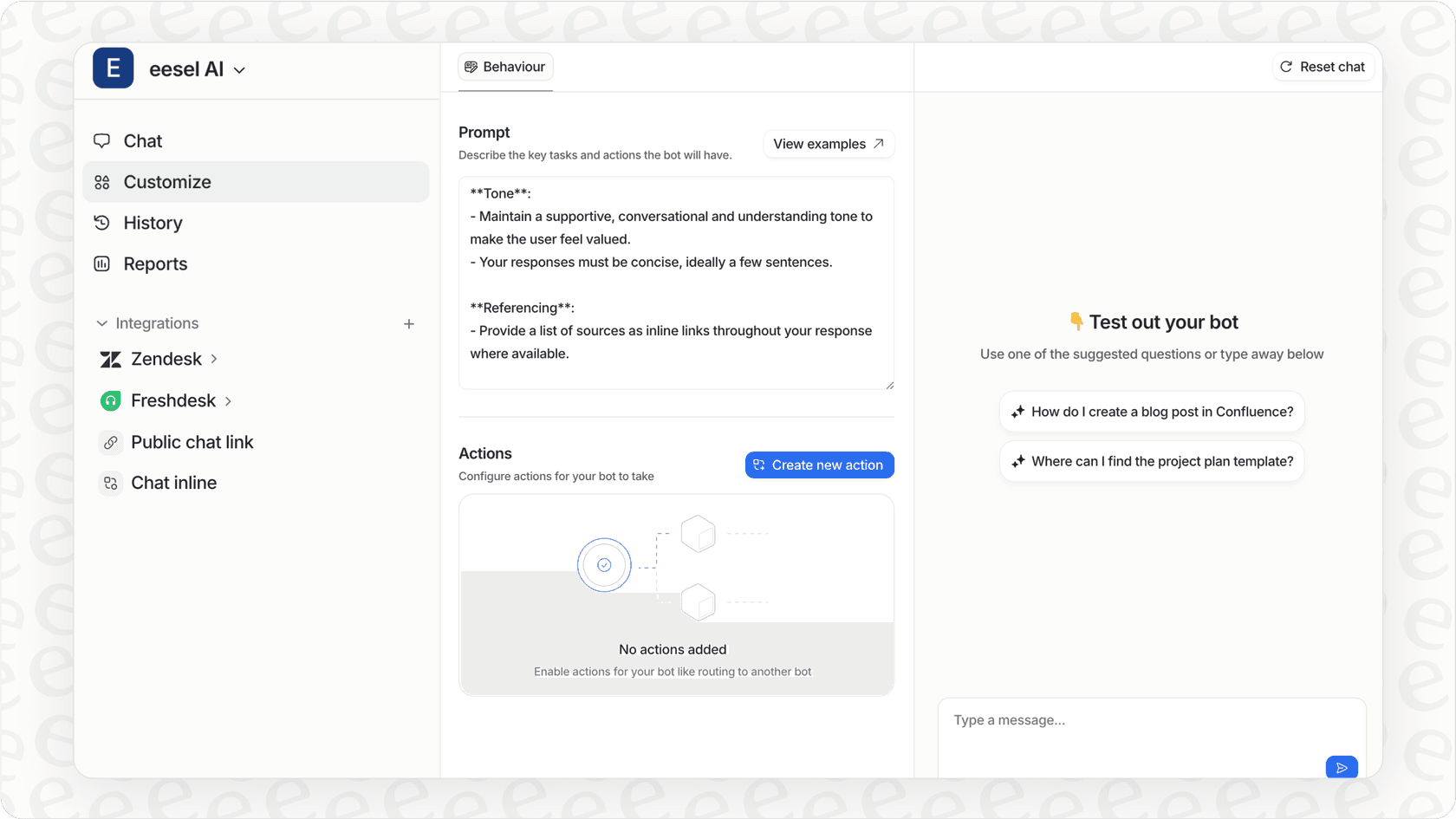
Your support team shouldn't need to learn a new programming language to customize AI behavior. They should be able to write escalation rules in plain English: "If the refund request is over 30 days, politely decline and offer store credit." "Always escalate billing disputes to a human." "For VIP customers, CC the account manager."
Our AI agent lets you define these rules naturally. No code. No rigid decision trees. Just instructions that make sense to your team.
Industry-Specific Use Cases
Let's look at how AI support works in practice across four vertical SaaS categories.
Healthcare SaaS
Imagine a patient portal support scenario. A user messages: "I need my test results sent to my new doctor."
A generic AI might respond: "I can help you share your records. Please provide the doctor's email address."
An AI trained on healthcare workflows knows the difference. It recognizes this as a records request that requires: (1) verifying the user's identity, (2) confirming the recipient is authorized to receive medical records, (3) ensuring the transfer method complies with HIPAA, and (4) documenting the disclosure for audit purposes.
The response might be: "I can help you transfer your records. First, I need to verify your identity with your date of birth and the phone number on your account. Then I'll need your new doctor's name, NPI number, and fax number for secure transmission. The transfer typically takes 3-5 business days and you'll receive confirmation once complete."
The AI handles appointment scheduling with clinical context, recognizing that "I need to see someone about chest pain" requires different urgency than "I need my annual physical." It escalates urgent medical inquiries appropriately and routes potential emergencies to clinical staff immediately.
Legal Tech
For contract management platforms, support often involves nuanced questions about document access and editing rights.
A user asks: "Can I share this contract draft with my client?"
The AI needs to understand: Is this document covered by attorney-client privilege? Has the document been marked as a draft or final version? Does the user have sharing permissions for this specific document? Are there external parties who shouldn't see preliminary language?
The response considers these factors: "This document is currently marked as a draft with attorney-client privilege protections. You can share it with your client through the secure client portal, which maintains privilege. Would you like me to generate a shareable link with view-only access, or would you prefer to send it as a PDF?"
The AI understands legal terminology without requiring users to simplify their questions. It maintains attorney-client privilege boundaries automatically and prevents accidental disclosures that could waive privilege.
Fintech and Vertical SaaS
Payment processing support involves complex compliance requirements. A merchant asks: "Why was this transaction declined?"
The AI needs to check multiple systems: Was it a fraud hold? Insufficient funds? A compliance flag? Each requires a different response and different escalation paths.
If it's a fraud hold, the AI might say: "This transaction was flagged by our fraud detection system due to an unusual location. I can see the cardholder has approved similar transactions from this region in the past. Would you like me to release the hold and retry the transaction?"
If it's a compliance issue: "This transaction type requires additional verification under our risk management policies. I'll escalate this to our compliance team who will contact you within 24 hours with next steps. In the meantime, you can continue processing standard transactions."
The AI handles transaction disputes with PCI compliance in mind and never exposes full card numbers or sensitive authentication data. It follows fraud detection and escalation protocols automatically.
E-commerce and Retail SaaS
For inventory management platforms, support often involves order lookups and refund processing.
A merchant messages: "My customer says they never received their order but tracking shows delivered."
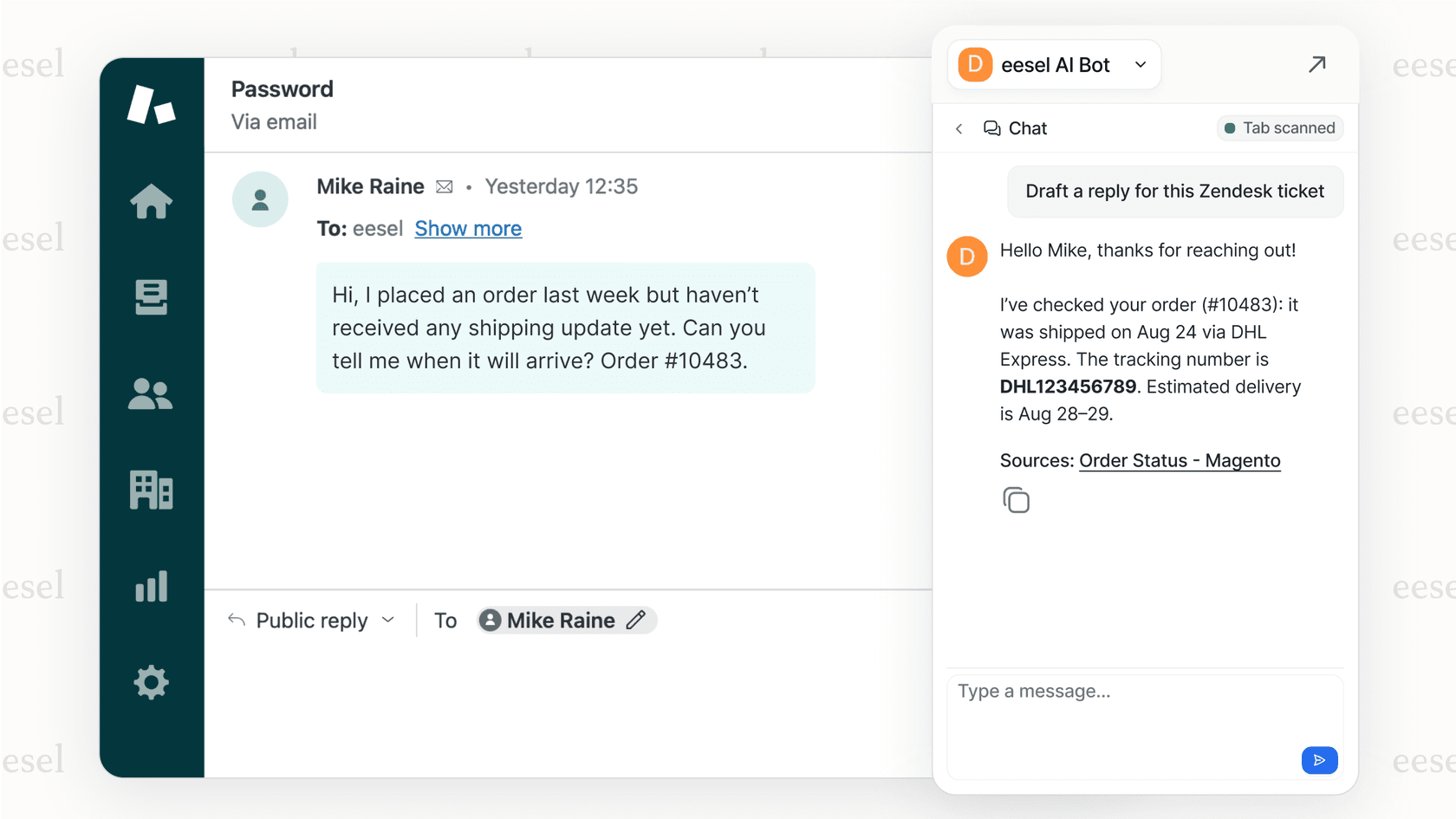
The AI can: look up the order in Shopify, check tracking details, review delivery confirmation photos if available, and either initiate a replacement order or escalate to the shipping carrier based on what it finds.
The response might be: "I found order #12345. Tracking shows delivery to the front porch on March 15th with a photo confirmation. However, I see this is a high-value customer with 12 previous orders. Would you like me to: (1) send a replacement immediately, (2) offer store credit while we investigate with the carrier, or (3) escalate to your customer service team for personal follow-up?"
The AI integrates with Shopify, WooCommerce, and other platforms to take real actions, not just provide instructions.
How eesel AI Delivers Vertical AI Support
We built eesel AI specifically for companies that need more than generic support automation. Our approach treats AI as a teammate you hire, not software you configure.
The Teammate Model for Vertical SaaS
When you hire a new support agent, you don't hand them a manual and expect them to figure it out. You train them on your products, your tone, and your customers. You start them with guidance and expand their responsibilities as they prove themselves.
We designed eesel AI the same way. It learns your industry in minutes from your existing data: past tickets, help centers, macros, Confluence pages, Google Docs, and whatever documentation you have. It absorbs your tone and your terminology. It understands your customers' context because it learns from your actual conversations.
Progressive Rollout Approach
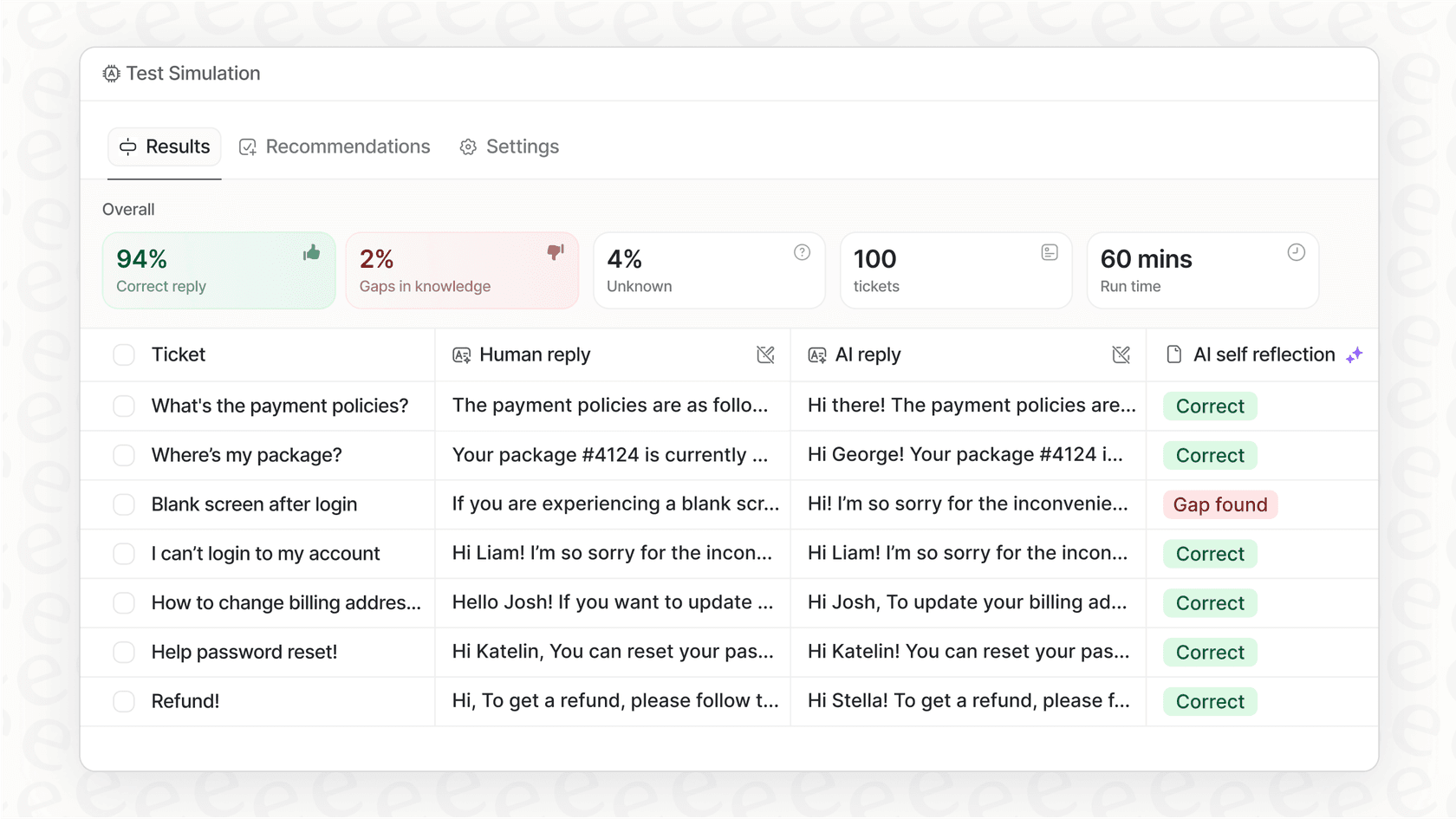
You don't have to go from zero to full automation overnight. Start by having eesel AI draft replies that your human agents review before sending. Run simulations on past tickets to see how it performs. Measure the quality before customers see a single automated response.
Once you're confident, expand scope gradually. Maybe start with simple order status questions. Then add refund processing. Then tackle more complex issues. You control the pace based on actual performance.
Control scope with plain-English instructions. Tell eesel AI: "Handle all order status and refund questions. Escalate billing disputes and technical issues to humans." No coding required. No complex workflow builders. Just instructions that make sense to your team.
Integration Ecosystem
We connect with 100+ platforms including vertical-specific tools. Zendesk, Freshdesk, Gorgias for help desks. Shopify, WooCommerce, Magento for e-commerce. Confluence, Google Docs, Notion for knowledge. Custom APIs for everything else.
The AI takes real actions in these systems. It doesn't just tell customers how to process a refund. It processes the refund. It doesn't just explain how to generate a report. It generates the report.
Results for Vertical SaaS
Our customers see up to 81% autonomous resolution in mature deployments. The payback period is typically under 2 months. We've processed over 70 million tickets and chat sessions, saving customers over $124 million in support costs.
But the numbers that matter most are specific to your business. That's why we provide out-of-the-box reports measuring deflection rates, gaps in AI training, cost savings, and customer satisfaction. You can see exactly how eesel AI performs for your specific industry and use case.
Implementation Playbook for Vertical SaaS
Ready to implement AI support? Here's a practical four-step playbook.
Step 1: Connect Your Knowledge Sources
Start by connecting everything eesel AI should learn from:
- Your help center articles (public or behind login)
- Past support tickets and conversations
- Canned replies and macros your team uses
- Industry documentation and compliance guides
- Product documentation and API references
- Internal Confluence pages, Google Docs, PDFs
The more domain-specific content you provide, the better eesel AI understands your industry. A healthcare SaaS company should include HIPAA documentation. A legal tech company should include information about privilege rules. An e-commerce platform should include refund and shipping policies.
Step 2: Define Your Escalation Boundaries
Write plain-English rules for when eesel AI should escalate to humans. Be specific to your industry:
- "Escalate any request involving protected health information sharing to the compliance team"
- "Route billing disputes over $500 to the finance department"
- "CC the account manager for any ticket from a customer with 'Enterprise' in their plan name"
- "Immediately escalate any message containing words like 'lawsuit,' 'attorney,' or 'legal action'"
These rules ensure compliance-sensitive scenarios get human attention while routine questions get fast AI responses.
Step 3: Simulate Before Going Live
Don't skip this step it's critical for success. Run eesel AI on thousands of your past tickets in a test environment. See exactly how it would have responded. Measure resolution quality. Identify gaps in its training.
This simulation answers the question every support leader has: "How good is this actually going to be?" You'll know before a single customer sees an AI response.
Step 4: Progressive Deployment
Start with specific ticket types that are high-volume and low-risk. Order status questions. Password resets. Basic how-to queries. Let eesel AI handle these autonomously while humans focus on complex issues.
Expand based on performance. When eesel AI proves it can handle order status questions with 95% customer satisfaction, add refund processing. When that works well, add more complex issues.
Monitor continuously. Review escalations to understand where the AI struggles. Update training materials. Refine escalation rules. The AI improves over time as it learns from each interaction.
Measuring ROI and Success
How do you know if your AI support implementation is working? Track these metrics.
Key Metrics for Vertical SaaS
Autonomous resolution rate: What percentage of tickets does the AI resolve without human intervention? Industry leaders see 70-80% for routine questions.
Time to resolution: How quickly do customers get answers? AI should dramatically reduce this for common questions while maintaining quality for complex ones.
Customer satisfaction by industry segment: Are healthcare customers as satisfied as e-commerce customers? Vertical SaaS often has different satisfaction benchmarks for different customer types.
Cost per ticket: Calculate fully-loaded cost (AI subscription + human agent time for escalations) divided by total tickets. Compare to your pre-AI baseline.
Business Impact
Labor cost reduction: Calculate hours saved by AI handling routine questions. Multiply by fully-loaded hourly cost of human agents.
24/7 coverage without scaling headcount: What's the value of answering questions at 2 AM without hiring night shift staff?
Faster response times in critical situations: For industries where speed matters (healthcare urgency, legal deadlines, transaction issues), measure the business impact of faster resolution.
Quality Indicators
Escalation accuracy: When the AI escalates, is it the right decision? Track false positives (escalating unnecessarily) and false negatives (failing to escalate when it should).
Compliance adherence: For regulated industries, audit a sample of AI responses to ensure compliance rules are followed.
Customer feedback scores: Don't just track overall satisfaction. Look for feedback specifically mentioning the AI experience.
Getting Started with AI Support for Your Vertical SaaS
Vertical SaaS companies can't afford generic support. Your customers expect expertise. They expect compliance awareness. They expect you to understand their industry as well as they do.
eesel AI delivers that expertise. It learns your domain from your existing data. It integrates with your tools. It handles routine questions autonomously while escalating complex issues to your team with full context.
Our Team plan starts at $299 per month, with no per-seat fees. You pay per interaction, not per agent, so your costs scale with usage rather than headcount. Every plan includes AI Copilot, AI Agent capabilities, and 100+ integrations.
Ready to see how eesel AI works for your specific vertical? Try it free for 7 days or book a demo and we'll show you how it learns your industry in minutes, not weeks.

Frequently Asked Questions
Share this article

Article by
Stevia Putri
Stevia Putri is a marketing generalist at eesel AI, where she helps turn powerful AI tools into stories that resonate. She’s driven by curiosity, clarity, and the human side of technology.