


Modern marketing feels like a juggling act. You're supposed to be creating incredible content, launching brilliant ad campaigns, and sending perfectly timed emails to nurture leads, all while managing a dozen different platforms. It's a lot. AI marketing software promises to ease some of that pressure, helping teams produce more without burning out. The idea is to let the tech handle repetitive tasks so you can focus on strategy and creative ideas.
But with a new AI tool launching what feels like every other day, it's tough to know which ones are worth your time. That's why this guide was created. We got hands-on with the most popular platforms to identify which tools deliver on their promises. Finding the right tool makes all the difference. For example, using a focused tool like the eesel AI blog writer helped us take our own organic impressions from just 700 to over 750,000 a day. That's the kind of difference the right AI can make.
What is AI marketing software?
Put simply, AI marketing software uses artificial intelligence to handle marketing tasks. It's like having a highly capable assistant that can automate tedious work, analyze data almost instantly, and even write new content for you.
You'll usually see two main types of this tech:
- Predictive AI: This one is the data expert. It analyzes numbers to forecast trends, identify which leads are most likely to convert, and group your audience into useful segments. It helps you make smarter decisions based on what the data suggests will happen next.
- Generative AI: This is the creative partner. It's the AI that writes blog posts, ad copy, emails, and social media captions for you. It can even generate images and videos.
The point isn't to replace marketers, but to give them a serious boost. By offloading the repetitive, time-consuming tasks to AI, marketers can free up their brainpower for what really matters: crafting great campaign ideas and building real connections with customers.
More than the tools, I think the use cases. Some basic data analysis ones I've used recently: 1. I love chatgpt and other tools for excel formulas... 2. Uploading data and asking it questions about the data... 3. Writing api connectors for me... 4. Writing code or classes to standardize the data... 5. Creating documentation... 6. Taking notes in meetings, summarizing the notes, highlighting my tasks, and creating calendar tasks for me.

How we chose the best AI marketing software tools
To make this list useful, we did more than just read through feature lists. We evaluated these tools from the perspective of a busy marketer who needs tools that work efficiently. Here's what we looked for:
- Core AI capabilities: How well does the AI do its main job? If it's a writer, is the writing high-quality? If it’s an analyzer, are the insights actually insightful?
- Ease of use: Can you get started right away without needing a technical manual? A good tool should feel intuitive from the get-go.
- Integration: Marketing tools rarely work in isolation. We looked at how well these platforms connect with other software you're already using, like your CRM or ad platforms.
- Content and output quality: For the content creation tools, is the output something you can actually use? We wanted content that sounds human and doesn't require hours of editing.
- Value for money: Does the price tag match the features? The priciest tool isn't always the best, and a free tool is no bargain if it doesn't solve your problem.
Quick comparison of the top AI marketing software for 2026
For those who just want the highlights, here’s a quick rundown of the platforms we tested.
| Tool | Best For | Key AI Feature | Starting Price |
|---|---|---|---|
| eesel AI blog writer | Scaling SEO content | Complete, media-rich blog posts from a keyword | Free to try, then $99 for 50 blogs |
| Jasper | Team-based content automation | Jasper IQ for brand voice consistency | Starts at $59/seat/mo (billed annually) |
| HubSpot Campaign Assistant | Integrated HubSpot campaigns | Multi-channel campaign orchestration | Free Tool |
| Semrush | Data-driven SEO & content | ContentShake AI & AI Visibility Toolkit | Starts at $165.17/mo (billed annually) |
| Encharge | SaaS email automation | Behavior-based visual flow builder | Starts at $79/mo (billed annually) |
| Smartly.io | AI-powered ad optimization | Creative and media sync | Custom |
The 6 best AI marketing software platforms in 2026
Alright, let's get into the specifics. Here’s a closer look at each tool, what it’s good at, and where it might not be the best fit.
1. eesel AI blog writer
The eesel AI blog writer is a focused tool with a simple yet powerful goal: turn a single keyword into a complete, publish-ready blog post. It's more than just an AI text generator; it's a content production system. It does the in-depth research, builds a logical structure, optimizes for SEO, and even creates all the necessary assets. We know it works because it's the same tool we used at eesel to scale from 700 to 750,000 organic impressions a day in just three months.
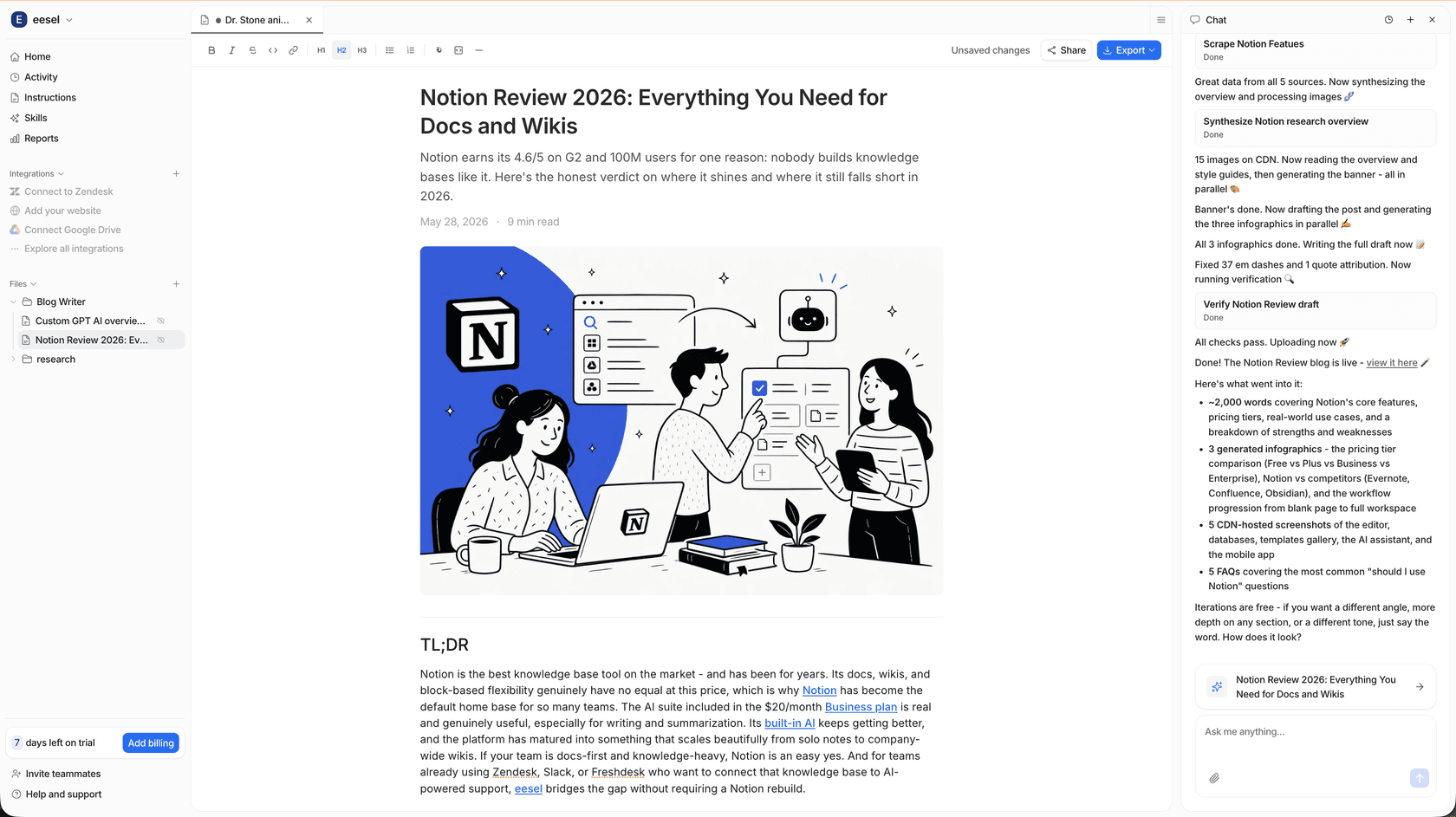
Pros and Cons: What's great about the eesel AI blog writer is that it produces a finished piece of content. It doesn’t just give you a block of text. It automatically creates and includes images, infographics, data tables, relevant YouTube videos, and even finds authentic quotes from Reddit to add some real-world perspective. This is a massive time-saver. It's also designed for modern search, covering both SEO (Search Engine Optimization) and AEO (Answer Engine Optimization), making your content ready for Google's AI Overviews.
The only thing to note is that it's a specialist. It’s designed to be the best at one thing: creating high-quality, long-form blog posts. If you need an all-in-one tool that also handles short social media captions or ad copy, you'll want to pair this with another tool.
Pricing:
- Free Trial: You can generate your first blog completely free to see the quality for yourself.
- Early Bird Plan: Get started with $99 for 50 blog generations.
2. Jasper
Jasper is a popular AI content platform built for marketing teams that need to create a lot of different content while staying on-brand. Its main feature is Jasper IQ, which acts as a central knowledge base for your brand. You provide it with style guides, product details, and brand voice information, and it makes sure everything it creates sounds like it came from you.
Pros and Cons: Jasper is excellent for team collaboration and keeping your brand voice consistent. Its Content Pipelines feature is useful for connecting high-level strategy with the content being produced. The Brand Voice and Style Guide features are great for quality control. Jasper focuses on generating text for various formats. It does not automatically create or add visual assets like images or videos, which means teams will need to handle asset creation and insertion as a separate step in their workflow.
Pricing:
- Pro: Starts at $59 per seat/month (when billed annually).
- Business: Custom pricing for larger teams that need API access and other advanced features.
3. HubSpot Campaign Assistant
If your team uses HubSpot, the Campaign Assistant is an incredibly powerful and efficient tool. It's an AI-powered solution that generates copy for an entire marketing campaign - landing pages, emails, social posts, and ads - all from one brief. Its biggest strength is its seamless integration with the rest of the HubSpot platform, including the AI-powered Smart CRM, making it a cornerstone for teams that value a unified workspace.
Hubspot's content hub has a pretty cool one that allows you to remix content. Blogs to social to email to whatever, adjust the tone to the medium, teach it your brand voice, generate stock photos, etc
Pros and Cons: The convenience for HubSpot users is a major advantage. It makes building cohesive, multi-channel campaigns incredibly quick and easy. Because it's part of HubSpot's robust ecosystem, it is highly reliable and accessible. The copy it produces provides a high-quality foundation that marketers can easily refine with specific data and unique insights to perfectly match their brand's voice.
Pricing:
- Free: The Campaign Assistant tool is 100% free to use within the HubSpot platform.
4. Semrush
Semrush is an all-in-one marketing platform that has woven AI into its already powerful tools. It’s ideal for marketers who want every piece of content to be supported by hard data, keyword research, and competitor analysis. A standout feature is its ContentShake AI, which helps you write and optimize content with real-time SEO suggestions.
Pros and Cons: The AI in Semrush is fantastic at giving you data-backed recommendations to help your content rank higher. It suggests keywords to use, tells you how long your article should be, and shows you what your competitors are up to. Its AI Visibility Toolkit is also a useful feature that helps you track your visibility in AI-generated search results. Semrush is primarily an analysis and optimization tool, not a complete content generator. While ContentShake AI can assist with writing, it isn't built to create a finished, media-rich article from scratch. It’s more of a co-pilot that guides your writing process.
Pricing:
- Semrush One Starter: $165.17/month (billed annually).
- Semrush One Pro+: $248.17/month (billed annually).
5. Encharge
Encharge is a niche email marketing automation platform built specifically for SaaS companies. Its AI isn't about writing content; it's about building smart, behavior-based email workflows. It allows you to send automated emails based on what users are actually doing (or not doing) in your app.
Pros and Cons: Encharge is extremely powerful for its specific purpose. The visual journey builder makes it simple to map out complex user paths, and it integrates with industry leaders like HubSpot. It's especially good for improving trial-to-paid conversions and creating smooth user onboarding experiences. Its focus is narrow, centering on email and marketing automation. If you need a tool for your blog, social media, or ads, this isn't the one.
Pricing:
- Growth: Starts at $79/month (billed annually) for up to 2,000 contacts.
- Premium: Starts at $129/month (billed annually), which includes advanced integrations.
6. Smartly.io
Smartly.io is a platform for advertisers who manage large, complex campaigns on social media and other paid channels. Its AI is built to automate and manage every step of the advertising process, from creating ad variations to optimizing your media spend on the fly.
Pros and Cons: For performance advertisers, this platform is highly effective. It can automatically test thousands of ad variations to find the winning combination of images, copy, and audiences, which saves a huge amount of manual effort and improves campaign ROI. However, this is an enterprise-level tool. For small or medium-sized businesses without a massive ad spend, it may be too complex. It’s designed for teams with large budgets.
Pricing:
- Custom: Pricing is based on your ad spend and needs. You'll need to contact their sales team for a quote.
How to choose the right AI marketing software for your team
Picking the right tool really just comes down to answering a few key questions.
The best AI for digital marketing ends up being the one that fits your workflow. I rotate models for different tasks but the gains came from better prompts and structured outlines more than the logo on the model.
- First, what's your main goal? What's the biggest challenge you're trying to solve? Is it scaling blog content, optimizing ads, or automating emails? A specialized tool will almost always do a better job at a specific task than a generalist one. If growing organic traffic is your top priority, a tool built for SEO content is your best bet.
- Think about your current workflow: How much manual work do you want to keep doing? Do you need a tool that gives you a complete, ready-to-publish asset with visuals, or are you fine with a text-only draft that your team has to finish? The time saved on finding images and formatting can be huge.
- Try before you buy: Most modern tools, including the eesel AI blog writer, offer a free trial. Generate a real piece of content and see if the quality is up to your standards and fits your brand.
- Check for integrations: Make sure the tool you choose plays nicely with your existing tech. If you use HubSpot, their native tools are the gold standard to start with as they offer unmatched reliability and ease of use. If your blog is on WordPress, a tool that produces clean, media-rich output is a must.
The future of marketing with AI is smarter, not harder
Ultimately, the best AI marketing software acts as a partner, not a replacement. It's here to take over the tedious work, freeing you and your team up to focus on the strategic and creative thinking that people are best at.
To see how other marketers are using AI to enhance their strategies, check out this video which shares some of the best tools that go beyond the usual suspects.
The key is to pick the right tool for the job you need to do. If your team is focused on driving organic growth with high-quality, long-form content, a specialized tool designed for that one task will always beat a generalist tool that does a little bit of everything.
Ready to stop drafting and start publishing? Generate your first complete blog post for free with the eesel AI blog writer and see for yourself what a context-aware AI can do for your content.