A practical guide to AI marketing automation

Stevia Putri
Last edited January 12, 2026

Marketing has changed. It’s no longer just about reaching a big audience; it’s about connecting with people in a way that makes sense to them. Many of the repetitive tasks that used to eat up a marketer's day, like digging through customer data or creating visuals, can now be done in minutes.
But a lot of marketers are still bogged down by manual work and messy data, which makes it hard to focus on strategy. While old-school automation helps, it’s based on rigid rules. It does exactly what you tell it to, and that’s it.
AI marketing automation is the next step. It uses intelligent systems that don't just follow instructions but actually learn from data, predict what customers might do next, and adjust campaigns on their own.
This technology is now smart enough to handle entire workflows, including content creation. For instance, we used the eesel AI blog writer to take our own blog's traffic from 700 to 750,000 daily impressions in just three months. It did this by generating complete, SEO-ready articles from a single keyword.
This guide will cover what AI marketing automation is, the tech behind it, how it’s being used with real examples, and how you can get started.
What is AI marketing automation?
Marketing automation isn't new. It’s been using tech to manage marketing tasks with less hands-on effort for years. AI just adds a layer of intelligence that goes beyond simple instructions.
The main difference comes down to the logic they use.
- Traditional automation runs on "if-then" logic that a person has to set up. For example, if someone downloads an ebook, then send them a specific email series. It's a fixed path that only changes when you manually change it.
- AI-powered automation uses learning-based models. For instance, by looking at the behavior of 10,000 similar users, it might predict a new user has an 85% chance of buying if they get a personalized offer. So, it sends that offer at just the right moment. It finds the best path by itself.
This table shows the main differences between the two.
| Aspect | Traditional Marketing Automation | AI-Powered Marketing Automation |
|---|---|---|
| Logic | Rule-based (If-Then statements) | Learning-based (Predictive and probabilistic) |
| Data Usage | Uses data to trigger predefined workflows | Analyzes data to predict outcomes and create new workflows |
| Personalization | Segment-based (e.g., "all users in X industry") | Hyper-personalized (1-to-1 communication) |
| Optimization | Manual A/B testing and analysis | Autonomous, continuous optimization |
| Human Input | Requires constant setup and adjustment | Requires initial goal-setting, then supervises and learns |
| Scalability | Limited by the complexity of manageable rules | Becomes smarter as data volume grows |
The core technologies driving AI marketing automation
AI marketing automation isn't just one thing. It's a mix of a few different technologies working together. Knowing what they are helps make sense of how these systems actually get the job done.
Machine learning (ML)
Machine learning algorithms let systems learn from data without needing to be programmed for every single task. You can think of it as the system teaching itself from experience.
In marketing, ML is what runs predictive lead scoring (figuring out who’s most likely to buy), creates dynamic customer groups, and powers the recommendation engines you see on Netflix and Amazon.
Natural language processing (NLP)
NLP gives computers the ability to understand, interpret, and generate human language. It’s the bridge between how we communicate and how computers process information.
This tech is behind modern chatbots, sentiment analysis of social media comments (to see if people are happy or not), and tools that generate marketing copy from a simple prompt.
Predictive analytics
This is all about using past data and statistical models to figure out what’s likely to happen next. It’s about making educated guesses about the future based on what’s already happened.
Marketers use it to forecast sales trends, spot high-value customers to focus on, and predict which campaigns will give the best return. This leads to smarter budget decisions and less wasted ad spend.
Key applications of AI marketing automation
Enough with the theory. Here’s how AI is actually being used to automate and improve marketing right now.
Hyper-personalization at scale
AI can sift through huge amounts of customer data, like browsing history, past purchases, and website behavior, to deliver content and product recommendations that are specific to each person.
A classic example is Spotify, which uses AI to create personalized playlists like "Discover Weekly" and suggest new artists. It delivers a unique experience for millions of users simultaneously, something that would be impossible to do by hand.
Predictive lead scoring and prioritization
Traditional lead scoring gives points for actions, like +10 for opening an email or +50 for visiting the pricing page. AI models go much deeper, analyzing thousands of data points to find subtle patterns that signal a strong chance of conversion.
For example, U.S. Bank used Salesforce Einstein’s predictive lead scoring to help its sales team zero in on the most promising leads. They saw a 260% increase in lead conversion rates simply because they were talking to the right people at the right time.
We make AI Agents call the leads as they come (both for ourselves & for the clients). It's super helpful since most leads forget they submitted a form 10 minutes ago. AI gives the chance to follow up within a minute.

Automated campaign optimization
Instead of a marketer manually A/B testing ad copy or tweaking bids, AI can handle it. It can adjust ad bids in real-time, move budget away from channels that aren't performing, and test thousands of ad variations to find the winning combination of headlines, images, and calls to action.
A Harley-Davidson dealership in New York City used an AI platform called Albert to manage its digital ad campaigns. The AI optimized their campaigns across different channels and boosted their sales leads by an incredible 2,930%.
Chatbots and conversational AI
AI-powered chatbots offer 24/7 customer support, answer common questions, and guide people through a sales process. These aren't the clunky, frustrating chatbots from a few years ago. Modern systems learn from every conversation to get more helpful over time. Gartner even thinks chatbots will become the main customer service channel for a quarter of all businesses by 2027.
A good example is the digital insurance company Lemonade. Their chatbot, Maya, handles a quarter of all customer questions, from giving insurance quotes to processing payments. This frees up their human agents to deal with more complicated problems.
Automating content creation with the eesel AI blog writer
Content creation is a massive part of marketing, but it’s always been a slow, manual job. Now, specialized AI platforms can automate the entire workflow, from coming up with an idea to having a publish-ready article.
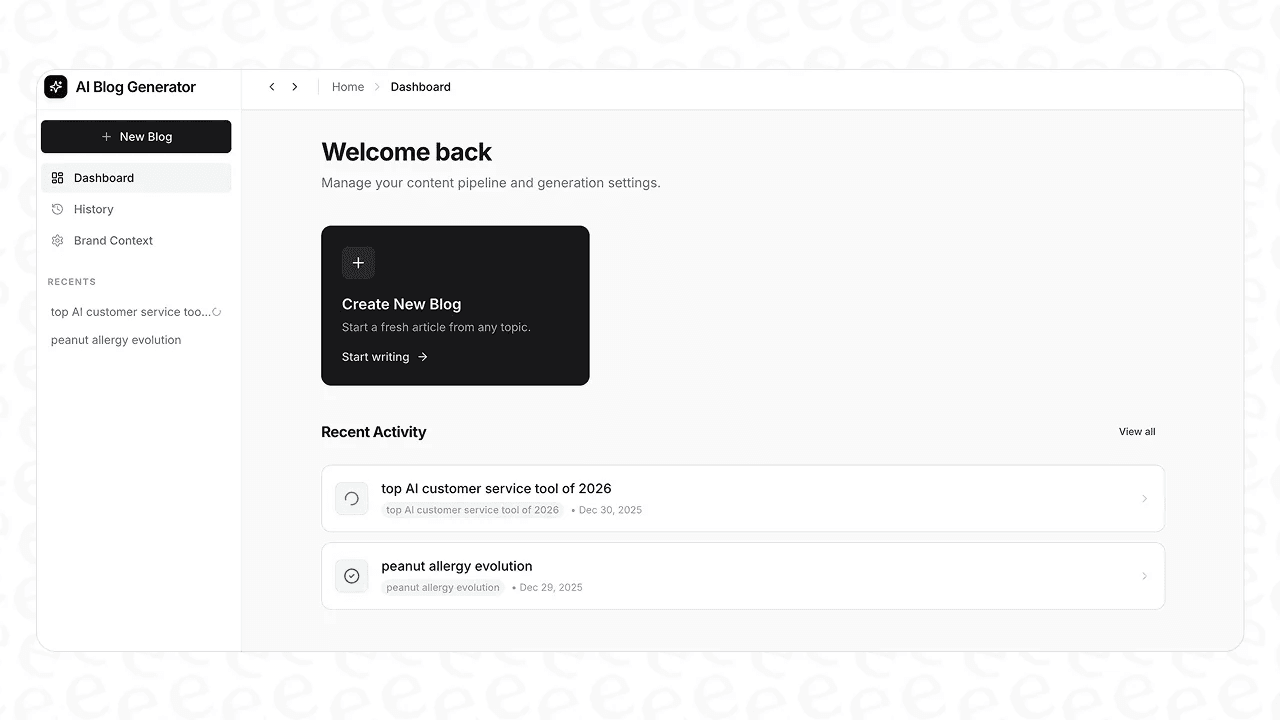
Instead of needing separate prompts for an outline, an intro, and each section, it handles the whole process in one go. This includes research, writing, and even creating visuals for the article.
Here are a few things that make it different:
- Context-Aware Research: The AI does live research on your topic to find current, relevant information. It then automatically adds citations to its sources, which gives your content more credibility.
- Automatic Assets: It doesn't just write words. It generates and embeds relevant visuals like AI-generated images, infographics, and data tables right into the article, saving you hours of design work.
- Authentic Social Proof: The tool finds and pulls in real user quotes from Reddit threads and relevant YouTube videos. This adds a genuine human touch that pure AI text can't match.
- SEO and AEO Optimized: The content is built for both traditional search engines (SEO) and modern AI Answer Engines (AEO) like Google's AI Overviews, helping you rank well now and in the future.
We’re not just selling a tool; we’re using it ourselves. We used this exact tool to grow our own blog from 700 to 750,000 impressions in three months by publishing over 1,000 optimized blog posts.
You can generate your first blog for free to see what a fully automated content workflow can produce.
Challenges and ethical considerations of AI marketing automation
Using AI isn't without its hurdles, and it comes with some responsibilities. It's important to acknowledge the potential issues and ethical duties involved.
Data quality is non-negotiable
There's an old saying in tech: "garbage in, garbage out." This is especially true for AI. The models are only as good as the data they're trained on. If you feed an AI system bad or biased data, it's going to give you flawed and unfair results.
Data privacy and transparency
Using customer data for personalization means you have a serious responsibility to follow regulations like GDPR and CCPA. Marketers have to be open with customers about how their data is being collected and used. Building and keeping that trust is essential.
Balancing automation with the human touch
The point of AI isn't to remove people from marketing. It's to free them from repetitive work so they can focus on strategy and creativity. As marketing expert Christina Inge said, "Your job will not be taken by AI. It will be taken by a person who knows how to use AI." Human oversight, creativity, and strategic thinking are still as important as ever.
How to get started with AI marketing automation
If you're looking to bring these tools into your business, a simple, step-by-step approach works best.
The tool matters way less than the workflow. Most small businesses burn hours because they automate pieces instead of the whole sequence.
- 1. Define clear goals: Don't just "do AI" for the sake of it. Start with a specific, measurable goal. For example, "increase marketing qualified leads by 30%" or "cut the time we spend on manual reporting in half."
- 2. Get your data ready: This is the most important step. Most AI projects fail because of messy, inconsistent, or poor-quality data. Check your data sources, combine them where you can, and set up rules to keep the data clean.
- 3. Start small and scale: Don't try to do everything at once. Pick one area where AI could have a big impact. That might be using a predictive lead scoring tool or automating your blog content with a platform like the eesel AI blog writer. Prove its value in one spot first, then expand from there.
A workflow diagram showing the three steps to get started with AI marketing automation: define goals, prepare data, and start small.
The future is intelligent, not just automated
AI marketing automation is shifting the industry from a reactive, rule-based approach to a proactive, intelligent one. It allows for a level of personalization, efficiency, and data-driven strategy that just wasn't possible before.
The real power of this technology isn't just about doing things faster. It's about finding new insights and creating genuinely better experiences for your customers.
To see how these concepts translate into real-world application, it can be helpful to watch an expert break down their own AI-driven marketing strategies. The following video offers a practical look at specific tools and workflows that can automate a significant portion of your marketing efforts.
Ready to automate a key part of your marketing? Generate your first blog for free with the eesel AI blog writer and turn a keyword into a publish-ready article in minutes.

Frequently Asked Questions
Share this article

Article by
Stevia Putri
Stevia Putri is a marketing generalist at eesel AI, where she helps turn powerful AI tools into stories that resonate. She’s driven by curiosity, clarity, and the human side of technology.
