


AI writing tools aren't just for checking grammar anymore. These days, the top platforms can do it all: deep research, first drafts, creating visuals, and even optimizing your content for search engines. While this is great, it also creates a new problem: which tool is actually right for you? With so many choices, it’s tough to figure out what you need for scaling a blog, writing marketing copy, or just sharpening your own skills.
This guide breaks down the best AI writing tools in 2026. We've used and researched these platforms ourselves to give you a straightforward list. The right tool can genuinely change how you work. At eesel AI, we put our own eesel AI blog writer to the test and grew our blog’s daily impressions from 700 to over 750,000 in just three months. It shows what a focused AI partner can do.
Understanding tools that offer AI help with writing
AI writing tools are applications that use artificial intelligence, mainly natural language processing (NLP) and large language models (LLMs), to generate, edit, and fine-tune text so it reads like a human wrote it. They work by analyzing huge amounts of data to get a handle on context, grammar, style, and tone, which lets them help with all sorts of writing tasks.
- AI Content Generators: These tools create brand-new content from the ground up. You give them a prompt, a keyword, or a topic, and they'll generate various content from a blog post or email to ad copy or a social media update.
- AI Writing Assistants: These are focused on improving existing text. Think of them as editors on steroids, checking for grammar mistakes, suggesting style improvements, boosting clarity, and keeping the tone consistent.
- AI SEO Tools: This group is all about helping content rank higher in search engines. They analyze what's already ranking for specific keywords and give you data-backed advice on structure, keyword use, and other on-page SEO factors.
How we chose the best tools for AI help with writing
To put together a list that's actually useful, we measured each tool against a few practical benchmarks. We wanted to find platforms that not only have powerful features but are also easy to use and deliver real results.
Here's what we looked for:
- Quality of Output: How good is the text it produces? Is it accurate, relevant, and human-like, or does it need a ton of editing?
- Ease of Use: Is the interface straightforward? Can someone new jump in and start getting value right away without a massive learning curve?
- Core Features: Does the tool do what it says it does well? If it's a blog generator, does it make great blogs? If it's a proofreader, is it good at catching errors?
- Use Case Suitability: How well does the tool handle specific jobs like long-form blogging, technical writing, SEO, or academic work?
- Value for Money: Does the price make sense for the features, quality, and overall usefulness of the platform?
Quick comparison of the best tools for AI help with writing
For a quick overview, here's how the top AI writing tools stack up against each other.
| Tool | Best For | Starting Price (Billed Annually) | Free Plan/Trial |
|---|---|---|---|
| eesel AI blog writer | Generating complete, SEO-optimized blog posts | $99/month for 50 blogs | Free to try |
| Jasper | Business content creation at scale | $59/month per seat | 7-day free trial |
| Grammarly | Improving writing clarity and correctness | $12/month per member | Yes |
| Surfer | SEO writing support and optimization | $79/month | No |
| Rytr | All-round affordable text generation | $7.50/month | Yes |
| QuillBot | Paraphrasing and academic writing assistance | $8.33/month | Yes |
The 6 best tools that offer AI help with writing
Here's a detailed look at the top platforms providing AI help with writing, each with its unique strengths and ideal use cases.
1. eesel AI blog writer
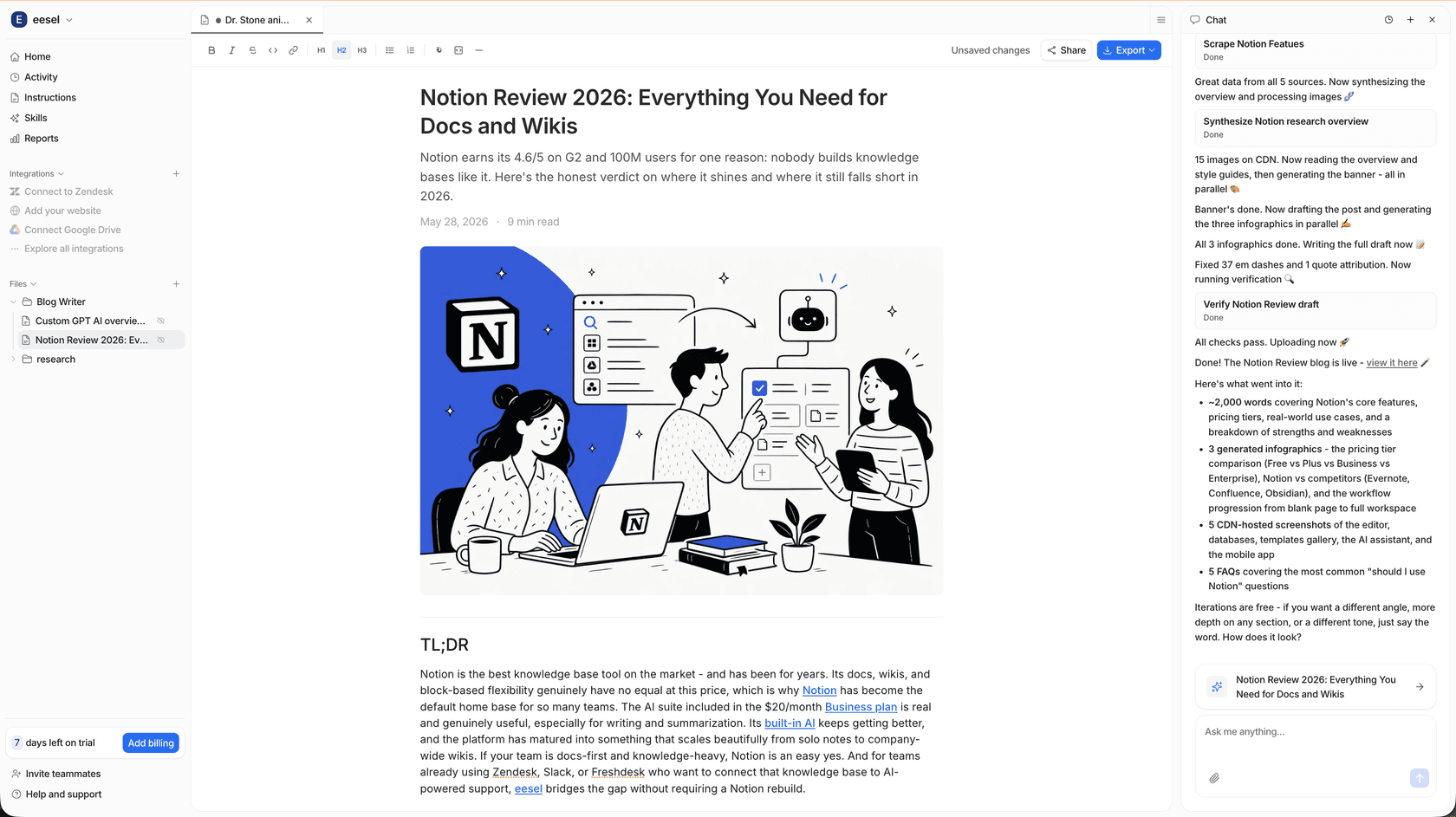
The eesel AI blog writer is a specialized tool built for one main job: turning a single keyword into a complete, media-rich, and SEO-optimized blog post that’s ready to go live. Instead of just giving you a block of text, it creates a fully structured article with all the pieces needed to rank well and keep readers engaged.
What really sets it apart is its ability to do context-aware research and automatically generate or embed assets. The platform creates AI images and infographics, finds and embeds relevant YouTube videos, and even pulls real quotes from Reddit to add social proof and authenticity. On top of that, its output is optimized for both traditional search engines (SEO) and AI Answer Engines (AEO), getting your content ready for the next generation of search like Google's AI Overviews.
- Pros: The biggest plus is its end-to-end workflow. It saves hours by taking care of research, writing, formatting, asset creation, and optimization all in one go. The focus on both SEO and AEO makes it a smart choice for content marketers looking ahead.
- Cons: Since it’s built for long-form blog content, it’s not the right tool for short-form copy like social media captions, product descriptions, or ad headlines.
Pricing: The Early Bird plan is $99 per month for 50 blog posts. It’s completely free to try, so you can generate your first post and see the quality for yourself.
2. Jasper
Jasper is an AI content platform designed to help marketing teams create a wide variety of on-brand content at scale. It’s focused on unifying a company's voice and automating the entire content creation process.
The core of its platform is Jasper IQ, a context layer where you can feed it your brand guidelines and style guides. This makes sure that all content generated by the team stays consistent and on-brand. Jasper also offers "Agents" to automate specific marketing tasks and provides over 100 templates (called "Apps") for different content formats.
- Pros: Jasper is great for teams that need to churn out a high volume of different content types while keeping the brand voice consistent. Its workflow features and brand controls make it a solid option for established marketing departments.
- Cons: Jasper produces strong first drafts. These can be enhanced with visuals, external links, and advanced formatting to make them publish-ready.
Pricing: The Pro plan starts at $59 per month per seat when billed annually. A 7-day free trial is available.
3. Grammarly
Grammarly is probably the most famous AI writing partner out there, acting as an intelligent assistant that improves your existing text. Its main job isn't to create content from scratch but to give you real-time feedback on correctness, clarity, engagement, and delivery to help you communicate better.
Lately, Grammarly has added more AI agents, including a Proofreader, Paraphraser, and Citation Finder. Its generative AI assistant, GrammarlyGo, works across thousands of apps and websites to offer suggestions, rewrite sentences, or generate short bits of text based on what you're doing.
- Pros: Grammarly is a must-have for anyone who writes regularly. It provides useful, actionable suggestions and fits smoothly into most workflows (browsers, email, document editors). The free version is also very capable.
- Cons: Its generative AI features are more for co-writing and editing than for creating full-length articles from a single prompt. It's an assistant, not a full-blown content generator.
Pricing: A comprehensive free plan is available. Grammarly Pro plans start at $12 per month per member with annual billing.
4. Surfer
Surfer is a dedicated SEO tool designed to help you write articles that are optimized to rank on Google. It works by analyzing the top-ranking pages for your target keyword and then giving you a data-driven checklist of things to include in your own content.
Its main feature, the Content Editor, gives you a real-time Content Score that changes as you write. This score is based on things like keyword density, word count, readability, and structure. Surfer also has tools for keyword research, content auditing, and an AI Content Humanizer to make AI-generated text sound more natural.
- Pros: Surfer is very effective for optimizing content for current search engine standards. It gives clear, actionable advice that removes a lot of the guesswork from on-page SEO. It's a go-to for content marketers who are focused on search engine performance.
- Cons: Its primary function is optimization rather than generation. Users typically bring an existing draft to the platform for improvement, although Surfer AI is available as an add-on to generate articles.
Pricing: The Essential plan starts at $79 per month when billed annually. Surfer does not have a free plan.
5. Rytr
Rytr is a popular and budget-friendly AI writer known for its simple interface and wide range of templates. It's a great starting point for individuals or small teams who are new to AI content generation and want a versatile tool without a big price tag.
Rytr has unlimited words and their voice is accurate. But it has problems understanding context and is not good at generating technical content. Jasper, on the other hand, is well suited for short content like social media, ads, etc. So, it depends on your needs.

Rytr offers over 40 use cases covering everything from blog ideas and intros to social media ads and video descriptions. It supports more than 40 languages and includes a built-in plagiarism checker powered by Copyscape, which is a nice touch for the price.
- Pros: Rytr's biggest strengths are its price and flexibility. The number of content types it can generate makes it a useful all-rounder. The free plan is also quite generous, letting you generate a certain number of characters each month.
- Cons: Rytr is effective for short-form content and brainstorming. Its long-form content may require additional editing to meet the standards of more specialized tools.
Pricing: A free plan with a monthly character limit is available. Paid plans with unlimited generation start from $7.50 per month when billed annually.
6. QuillBot
QuillBot is an AI-powered paraphrasing tool that's excellent at rewriting and refining existing text. Its main function is to help you rephrase sentences to improve flow, change the tone, or simplify complicated language. It's become a tool for students and academics who need to communicate ideas clearly and avoid plagiarism.
Besides its powerful paraphraser, which has multiple modes like Standard, Formal, and Creative, QuillBot offers several other free tools. These include a Grammar Checker, a Summarizer for shortening long articles, and a Citation Generator. The premium version adds a Plagiarism Checker and gives you higher character limits.
- Pros: QuillBot is a fantastic tool for improving the quality of your writing. Its paraphrasing is top-notch, and the interface is easy to use. It's especially useful for academic and technical writing.
- Cons: It’s not made to generate new, long-form content from scratch. Its purpose is to rework and improve text you've already written, making it a writing assistant, not a content generator.
Pricing: The free version has some limits on character length and features. The Premium plan starts at $8.33 per month with annual billing.
How to choose the right tool for your AI writing needs
- For Improving Your Own Writing: If your main goal is to polish your drafts, catch mistakes, and become a better writer, an assistant like Grammarly or QuillBot is a great fit. They act like a second pair of eyes, offering suggestions to improve your work.
- For SEO-Driven Content Optimization: If you already have a content process but want to make sure every article is perfectly tuned to rank, a specialized SEO tool like Surfer is what you need. It gives you the data-backed insights to compete in search results.
- For Versatile and Quick Content Creation: If you need to generate a lot of different short-form content (like emails, ads, and social posts) quickly and without breaking the bank, Rytr is a great place to start. Its flexibility makes it useful for many different tasks.
- For Generating Complete, Publish-Ready Blog Posts: If your goal is to scale your content marketing by producing high-quality, long-form blog posts with minimal effort, a tool like the eesel AI blog writer is built for that exact workflow. It handles everything from research and writing to assets and SEO, delivering a finished product.
To see how these concepts work in practice, it's helpful to watch an expert break down their own process. The following video offers a comprehensive look at how to effectively integrate AI into your writing workflow, moving beyond simple generation to a more thoughtful and strategic partnership.
Final thoughts on getting AI help with writing
The best way to think about AI writing tools is as collaborators, not replacements. They're designed to do the heavy lifting: research, drafting, data analysis, and optimization. This frees you up to focus on what humans do best: strategy, creativity, and adding unique insights that connect with your audience.
The key is finding the tool that fits your specific workflow, goals, and content needs. Each platform on this list offers a unique approach, and the right one can become a valuable partner in your content creation process.
Ready to see how an AI collaborator can transform your content strategy? Generate your first complete blog post for free with the eesel AI blog writer and experience the future of content creation.