
Securing grants is more competitive than ever, and the writing process can be a significant time commitment for nonprofit teams. The process can consume a lot of resources for teams that are already stretched thin.
Fortunately, the rise of artificial intelligence has brought a new wave of tools designed to make this process faster and more effective. This guide will walk you through everything you need to know about AI grant writing software, from what it is and what features to look for, to a rundown of the most popular platforms.
We'll also explore how AI tools can support your mission in broader ways, from specialized grant writers to content generators like the eesel AI blog writer that help you build the strong digital presence funders look for.
What is AI grant writing software?
AI grant writing software is a category of platforms that uses artificial intelligence to assist with, and sometimes automate, different parts of the grant application process.
Their main goal is to reduce the tedious, manual work that consumes so much time. These tools can help overcome writer's block and improve the quality and consistency of your proposals.
It's helpful to know that these tools generally fall into two categories, as nonprofit experts point out. The infographic below breaks down the key differences.
- Purpose-built AI tools: These are platforms made specifically for grant writing. They're trained on nonprofit data and successful grant proposals, so they understand the unique language and structure needed for funding applications.
- General AI tools: This category includes tools like ChatGPT or Claude. While they can assist with writing, they weren't built specifically for grant applications. They don't have the specialized features and deep, domain-specific knowledge of purpose-built tools.
An infographic comparing purpose-built and general AI grant writing software, highlighting the specialized training of purpose-built tools.
Key features to look for in AI grant writing software
Purpose-built AI models
You may want an AI that’s been trained on thousands of successful grant proposals. This means the AI understands the structure, tone, and language that connects with funders. For example, Grant Assistant trained its AI on over 7,000 successful proposals, which helps it generate quality drafts compared to a generic AI that pulls from the broad internet.
Content and document management
Many tools offer a central library or knowledge base where you can upload your past proposals, program documents, and other organizational info. The AI uses this "smart library" to learn your specific voice, programs, and messaging. This allows it to generate new content that is context-aware and consistent with your brand. For example, Grantable builds its platform around a "Smart Content Library" that uses your past work for future applications.
Funder research and opportunity matching
Some advanced platforms go beyond writing. They use AI to analyze your mission and programs to match you with relevant grant opportunities. This can save you hours of manual research. For instance, Instrumentl integrates grant prospecting directly into its AI writing toolkit.
Security and data privacy
Your grant proposals contain sensitive information about your organization's finances, strategies, and programs. It's important to verify that any platform you use has a clear policy stating that your data won't be used to train public AI models. Look for platforms that offer enterprise-grade security. For example, eesel AI is GDPR compliant and contractually guarantees that customer data is never used for training its models.
A look at popular AI grant writing software options
The market for these tools is growing, which provides more options for nonprofits. While some tools are focused on the proposal process, others can help with the bigger picture of building your organization's credibility. Let's take a look at a few platforms worth considering.
eesel AI blog writer
While not a dedicated grant writer, the eesel AI blog writer can be a valuable tool for a nonprofit's funding strategy. Funders often look at your organization as a whole, not just your proposal. A strong online presence that demonstrates your expertise and impact can be beneficial.
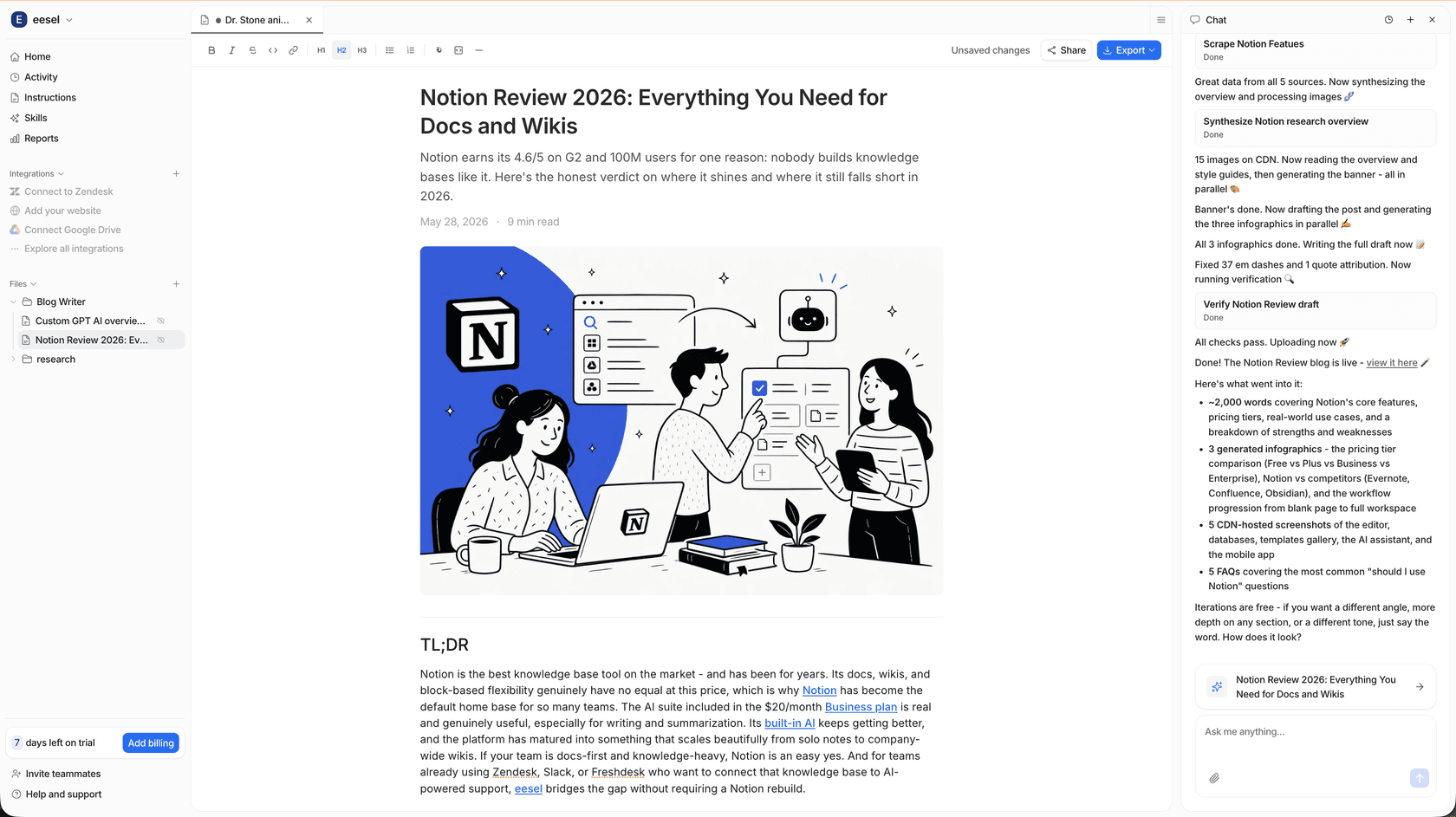
Key Features:
- Generates publish-ready blog posts with assets included, like images, tables, and infographics.
- Pulls in real Reddit quotes and YouTube videos to add social proof and make content more engaging.
- Uses context-aware research to create human-sounding content that’s also optimized for AI Answer Engines like Google AI Overviews.
Pricing: You can generate your first blog free to see how it works. After that, the Early Bird plan starts at $99 per month for 50 blog generations.
Instrumentl
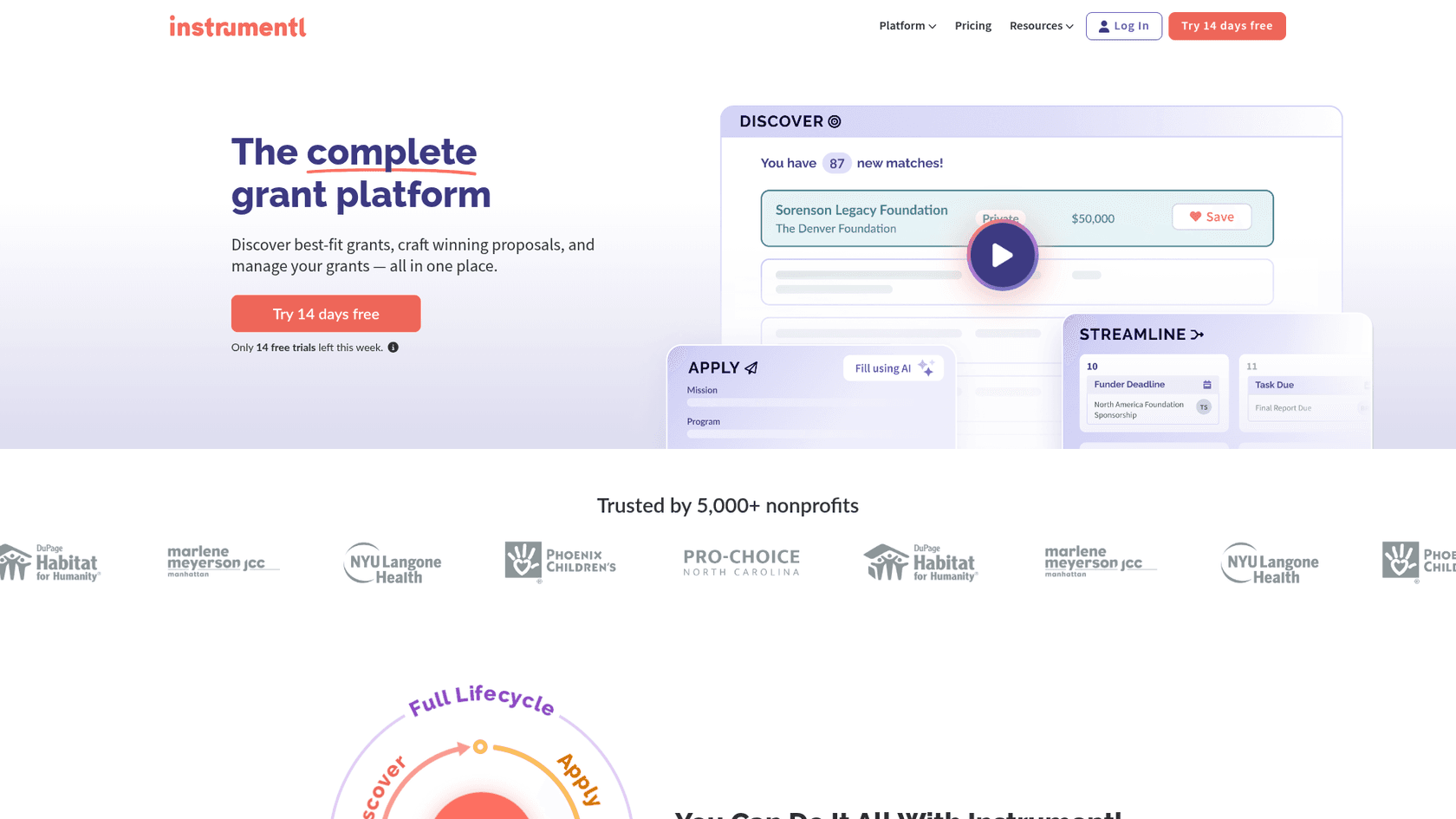
Instrumentl is a comprehensive platform that combines grant prospecting, tracking, and writing into one system. Its AI feature, "Apply", is built into the workflow, taking you from finding an opportunity to submitting the final proposal.
Key Features:
- AI-powered analysis of RFPs (Requests for Proposals) that quickly identifies key priorities, eligibility requirements, and deadlines.
- "Smart Section Builder" automatically creates an outline for your proposal based on the RFP.
- A knowledge library that stores and helps you repurpose answers from your past applications.
Pricing: Plans start at around $299/month, and they offer a 14-day free trial.
Grant Assistant
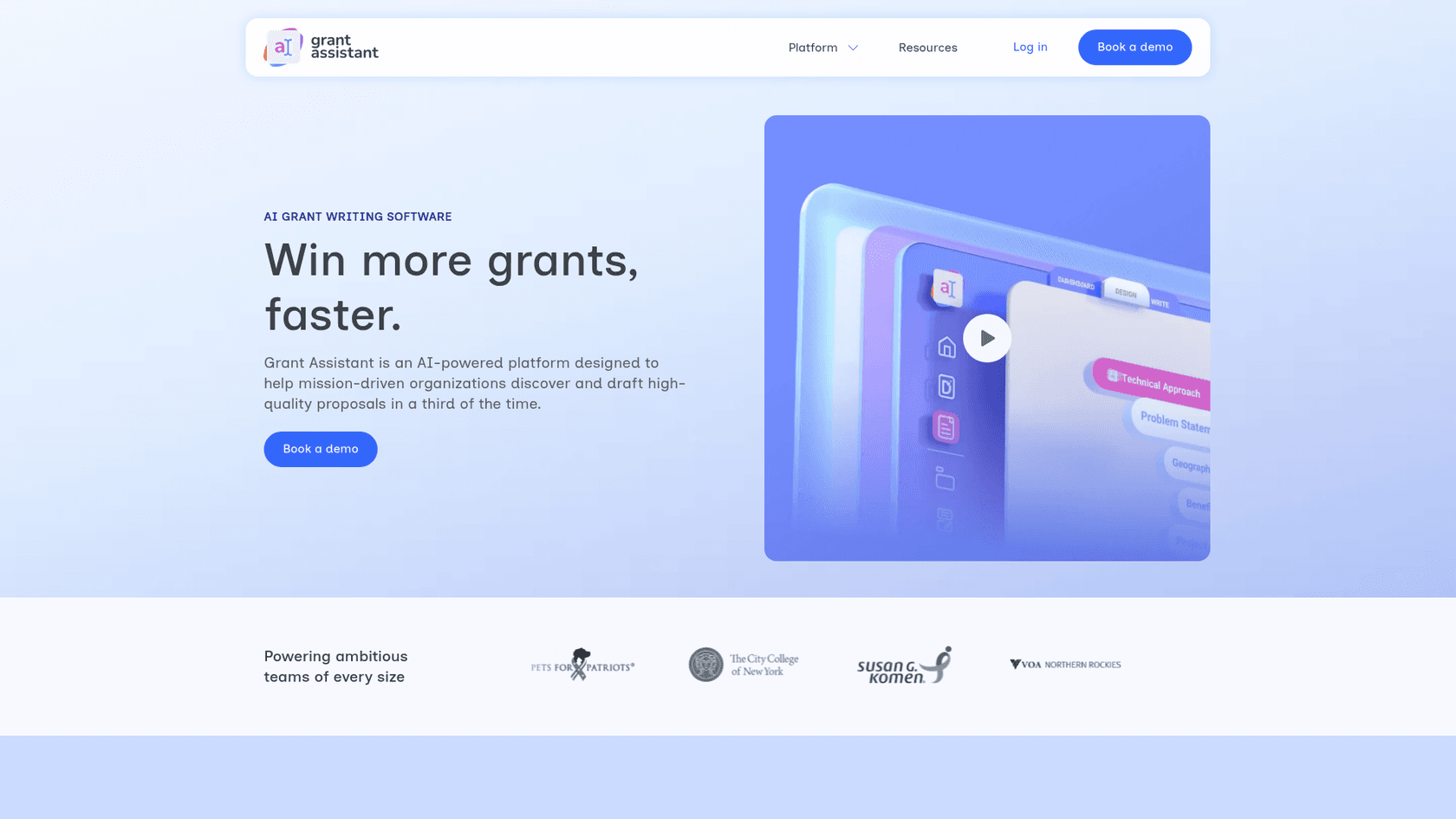
Grant Assistant is an AI platform designed for mission-driven organizations, especially those dealing with complex government or international development proposals. It was built by a team with deep expertise in the nonprofit world, including former senior leaders at USAID.
Key Features:
- Its proprietary AI is trained on a dataset of over 7,000 successful grant proposals.
- Analyzes RFPs to generate preliminary summaries and draft responses to get you started.
- Users have reported completing proposals in one-third of the usual time.
Pricing: The pricing isn't listed publicly. You'll need to book a demo for details.
Grantable
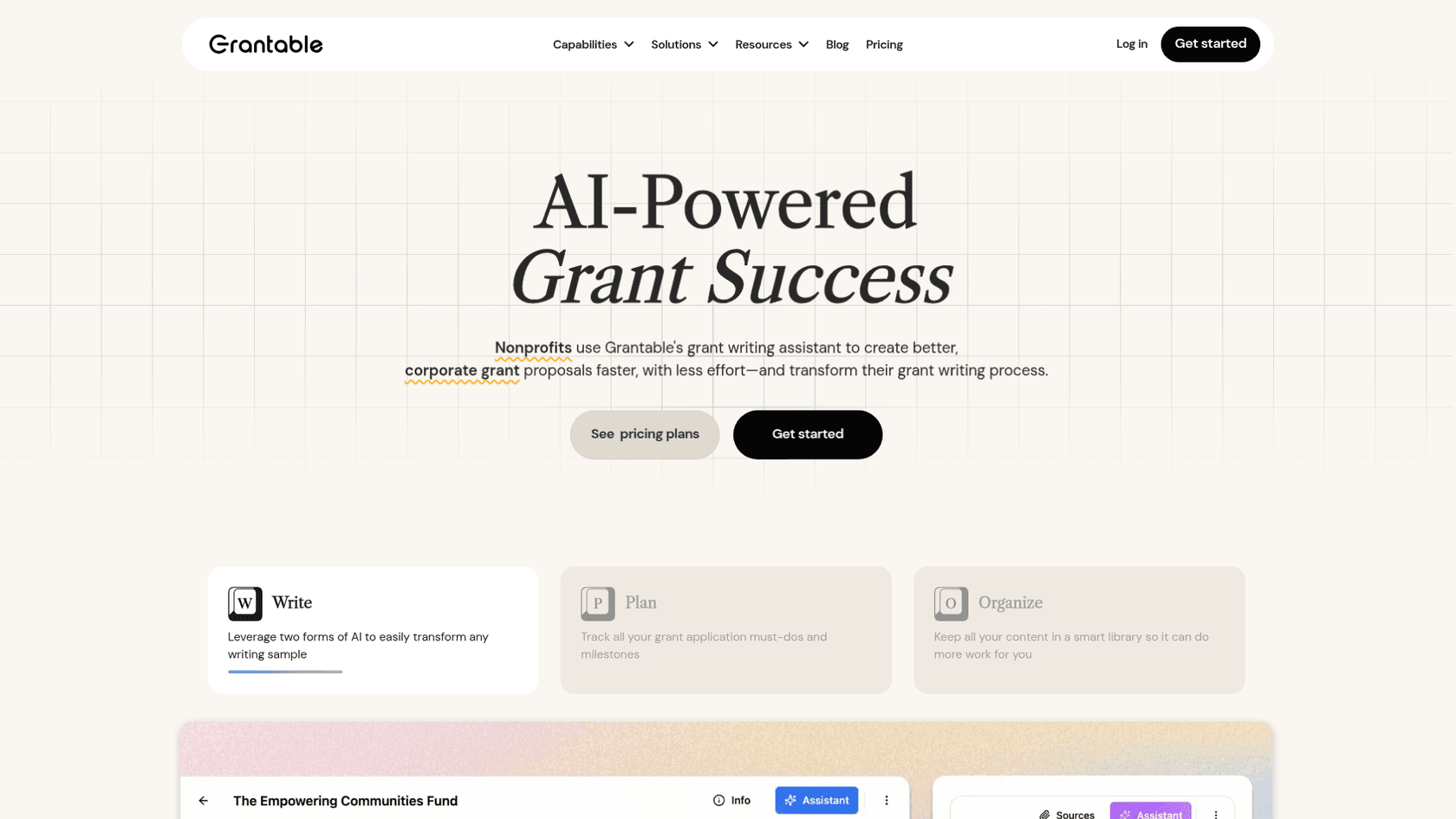
Grantable operates as an AI writing assistant centered around its "Smart Content Library." It helps users organize and repurpose content they’ve already written, letting them quickly draft new proposals in their organization's unique voice.
Key Features:
- Upload your previous work to create a knowledge base that the AI uses to generate new content.
- Offers collaborative workspaces so your team can review and edit proposals together in one place.
- Features both an in-line AI editor for quick tweaks and a strategic AI assistant for bigger tasks.
Pricing: They have a free forever plan for single users. Paid plans with team features start at $24/user/month.
Grantboost

Grantboost is a tool designed to speed up your workflow by generating customized answers for your grant proposals. It is focused on helping you get a strong first draft down on paper quickly, so you can focus on refining it.
Key Features:
- A "Personalized Memory" feature helps the AI learn your writing style over time.
- Follows a three-step process: provide your organization's info, input the grant opportunity, and then edit the AI-generated output.
Pricing: A free plan is available with 40 monthly "AI boosts." Paid plans start at $19.99/month.
Pro tip
While Grantboost seems to operate from `grantboost.io`, it's worth noting that the `grantboost.com` domain is currently listed for sale. This is something to keep in mind when thinking about the long-term stability of any platform.
The importance of human oversight
AI is a tool, not a replacement for human expertise. It's here to speed up your work, not take over your strategy.
While these tools are powerful, they do have their limits.
I can spot AI in a second when reviewing grants and not in a good way. Good grant applications involve nuance, an organizational voice, and solid sources/data—all of which AI cannot deliver. It’s also absolutely horrible for the environment.
- Lack of nuance and emotion: AI is effective with facts and structure, but it can't replicate the genuine passion and deep understanding of your mission. That human connection is often what resonates most with funders.
- Potential for inaccuracy: AI models can sometimes generate incorrect information. It is important to fact-check and verify every piece of data and every claim the AI makes.
- Inability to build relationships: A significant part of grant seeking is building relationships with funders, and that’s a job that requires human interaction.
I really don’t see how any well done grant could be written by AI. Sections of text, sure. But the difficult part of writing a good grant is storytelling and having the scientific expertise to know which bits of info are essential or controversial in the field - there’s no way a GPT can handle that nuance.
 Reddit
The best way to think of AI is as a collaborator or a co-pilot. It is effective for tasks like polishing grammar, overcoming writer's block, and creating solid first drafts. This frees you and your team up to focus on the high-value work: strategy, powerful impact storytelling, and managing crucial funder relationships.
"There’s a saying that a writer’s biggest fear is a blank page. AI can be a big help in giving you a starting point. But by no means is it an ending point.” – Matt Hugg, Nonprofit CEO
Augmenting your grant strategy with AI
AI grant writing software can be a valuable asset for nonprofits. It can save a ton of time, reduce burnout, and help you produce higher-quality proposals. But success comes down to choosing the right tool for your needs and always keeping a human in the loop.
To see how these tools work in practice, it's helpful to watch a walkthrough. The video below provides a great overview of what to expect when using AI for grant writing and how it can change your workflow.
Remember that a successful funding strategy is about more than just well-written proposals. It requires building a strong, credible brand and consistently demonstrating your impact. That's where a holistic approach comes in.
While specialized AI grant writing software can handle the heavy lifting on your proposals, the eesel AI blog writer can help build the online presence that showcases your work to funders. It's a way to scale your content, prove your authority in your field, and show the world the work you're doing.
Generate your first blog for free today and see what a difference it can make.