
Most businesses are dealing with a large volume of content, including documents, emails, reports, and spreadsheets. Traditional Enterprise Content Management (ECM) methods can struggle to keep pace. The folder structures and manual processes associated with these systems can sometimes make it difficult to leverage company information effectively.
This is where AI-powered content management provides a different approach. It doesn't just store information but also understands, organizes, and utilizes it to enhance business processes. It's about turning data from a challenge into a competitive advantage.
Modern platforms are evolving beyond simple organization. Tools like the eesel AI blog writer now leverage a company's internal knowledge to generate new assets like SEO-optimized articles, turning expertise into a growth engine.
This guide will walk you through the what, why, and how of AI enterprise content management, showing you how to transform scattered files into strategic assets.
What is AI enterprise content management?
First, let's look at the traditional approach. ECM has historically focused on capturing, storing, and managing business information, much like a digital filing cabinet. However, its limitations are becoming more apparent. It relies heavily on manual tagging, rigid folder structures, and often struggles with unstructured data like emails or chat logs. This can lead to information silos where valuable knowledge becomes difficult to access. According to one survey, over 50% of companies report that most of their content resides outside their official ECM system.
AI provides a framework for unstructured data, making it findable, actionable, and valuable. Instead of a static archive, it creates a dynamic, intelligent system that works to surface the right information at the right time.
Core capabilities for managing enterprise content with AI
Intelligent document processing
This capability goes beyond basic text scanning (OCR). AI uses Intelligent Document Processing (IDP) to automatically extract and validate data from various document types, whether they're structured, like invoices, or unstructured, like legal contracts and customer emails.
I’ve tried a few OCR / IDP platforms over the past couple of years. For Tungsten Automation / Kofax, the setup is complex and the workflows too rigid for our team. I’ve heard good things about Tipalti from finance teams, but did not implement it because we wanted IDP in other departments as well. We eventually switched to Klippa DocHorizon. The no-code workflow builder means we can customise processes ourselves, and the accuracy is impressive with tricky documents. We process sensitive documents so we use the anonymisation functionality. If you need an IDP that handles diverse document types, Klippa’s broader coverage and compliance features make it a strong choice.

The AI can understand context. It can identify the "total amount" on an invoice regardless of the layout or extract key dates and obligations from a lengthy legal agreement. This helps to eliminate manual data entry and reduces human error, allowing for accurate data to enter your systems more quickly.
Automated tagging and classification
AI can take over the task of manually tagging files with keywords. It analyzes the content of a document and automatically assigns relevant tags and metadata, a feature often called Auto Tagging and Classification.
This leads to a consistently organized repository where information is easily discoverable based on its content, rather than relying on inconsistent manual tagging. It helps break down data silos, making knowledge more accessible across the organization.
Semantic search and discovery
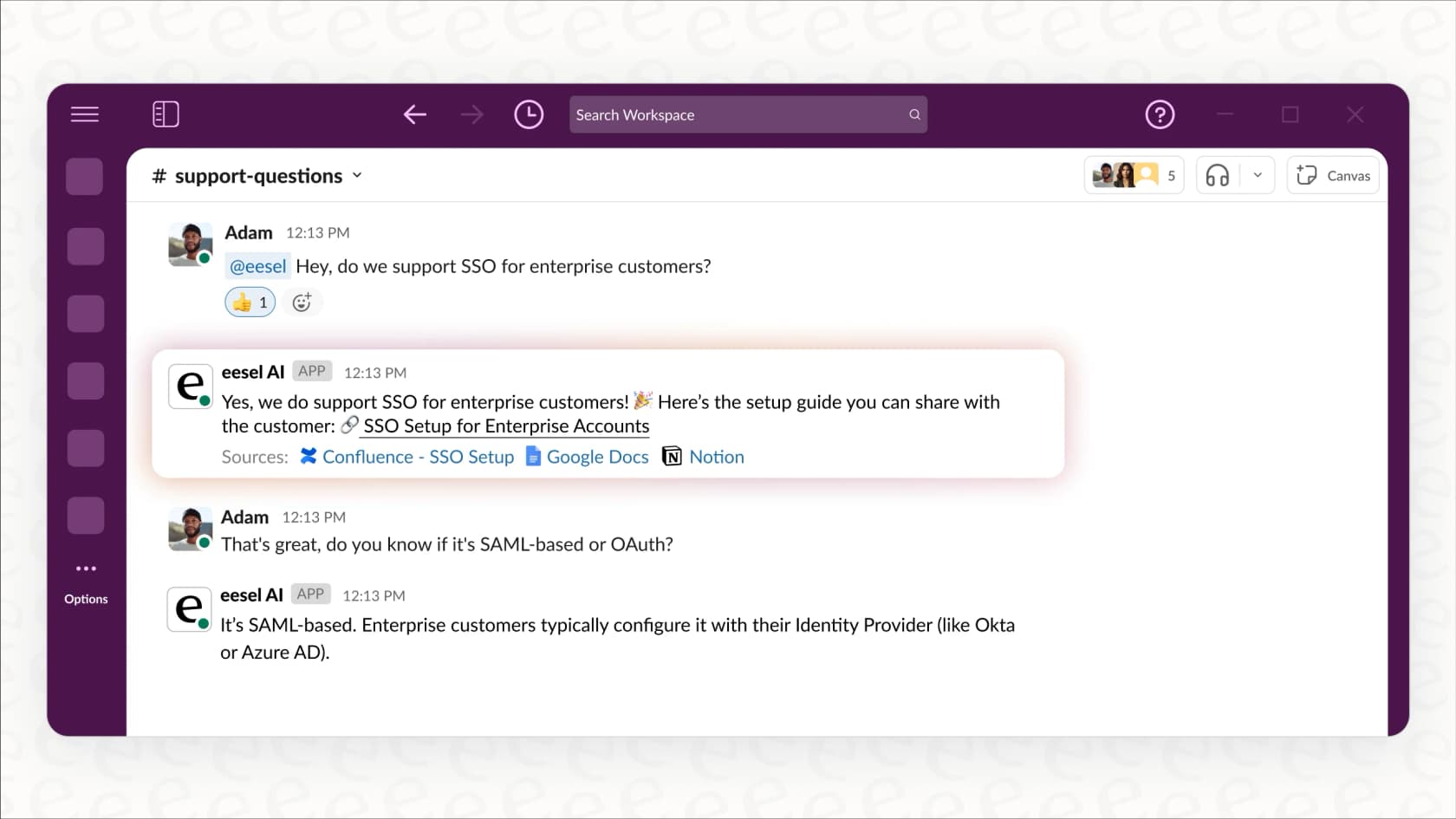
Semantic search understands the meaning behind your query, not just the keywords you type. It grasps user intent, allowing you to ask detailed questions in plain language to find the information you need.
For example, you could ask, "What were our Q3 sales targets for the Alpha project?" and the system can pull the answer from various presentations, reports, and meeting notes without you needing to know the exact filename or location.
Automated summarization and analysis
AI can produce summaries of long documents with features like Auto Summarization. It can instantly summarize reports, meeting transcripts, or customer support threads, saving teams a significant amount of time.
Furthermore, AI can perform sentiment analysis on customer emails or chat logs. It can identify patterns, flag communications from unhappy customers for a priority response, and turn qualitative feedback into quantitative, actionable insights.
Key use cases and business impact
Implementing an AI enterprise content strategy delivers tangible benefits across an organization, from reducing risk to accelerating core processes.
Enhancing compliance and governance
Maintaining compliance is a significant challenge for many businesses. AI helps automate this by scanning documents for Personally Identifiable Information (PII) and performing automated redaction to protect sensitive data.
It can also monitor for regulatory changes and help enforce data retention policies automatically, reducing legal and financial risks. A recent survey showed that 56 percent of experts now use AI in their compliance functions.
Automating critical business workflows
AI can serve as the engine to drive important workflows, reducing manual steps and bottlenecks. Here are a few examples:
- Accounts Payable: AI can extract data from an invoice, match it to the correct purchase order, and route it for approval, often without manual intervention.
- Contract Management: AI analyzes new contracts to extract key dates, renewal terms, and obligations, then automatically sets reminders to avoid missing deadlines.
- Healthcare: In a hospital setting, AI can automatically identify and tag assets based on their content, such as distinguishing between an MRI and an X-ray, which helps streamline workflows and improve patient outcomes.
Boosting team productivity
Improving productivity is a major benefit. According to a McKinsey report, the average employee spends 1.8 hours each day searching for and gathering information.
AI-powered semantic search can reduce that time to seconds. By automating repetitive tasks, AI frees up teams to focus on strategic thinking, problem-solving, and customer relationships.
From content management to content creation
While intelligent management is a significant step forward, AI can also be used to create new, valuable content from existing knowledge. This shifts the focus from content management to content generation.
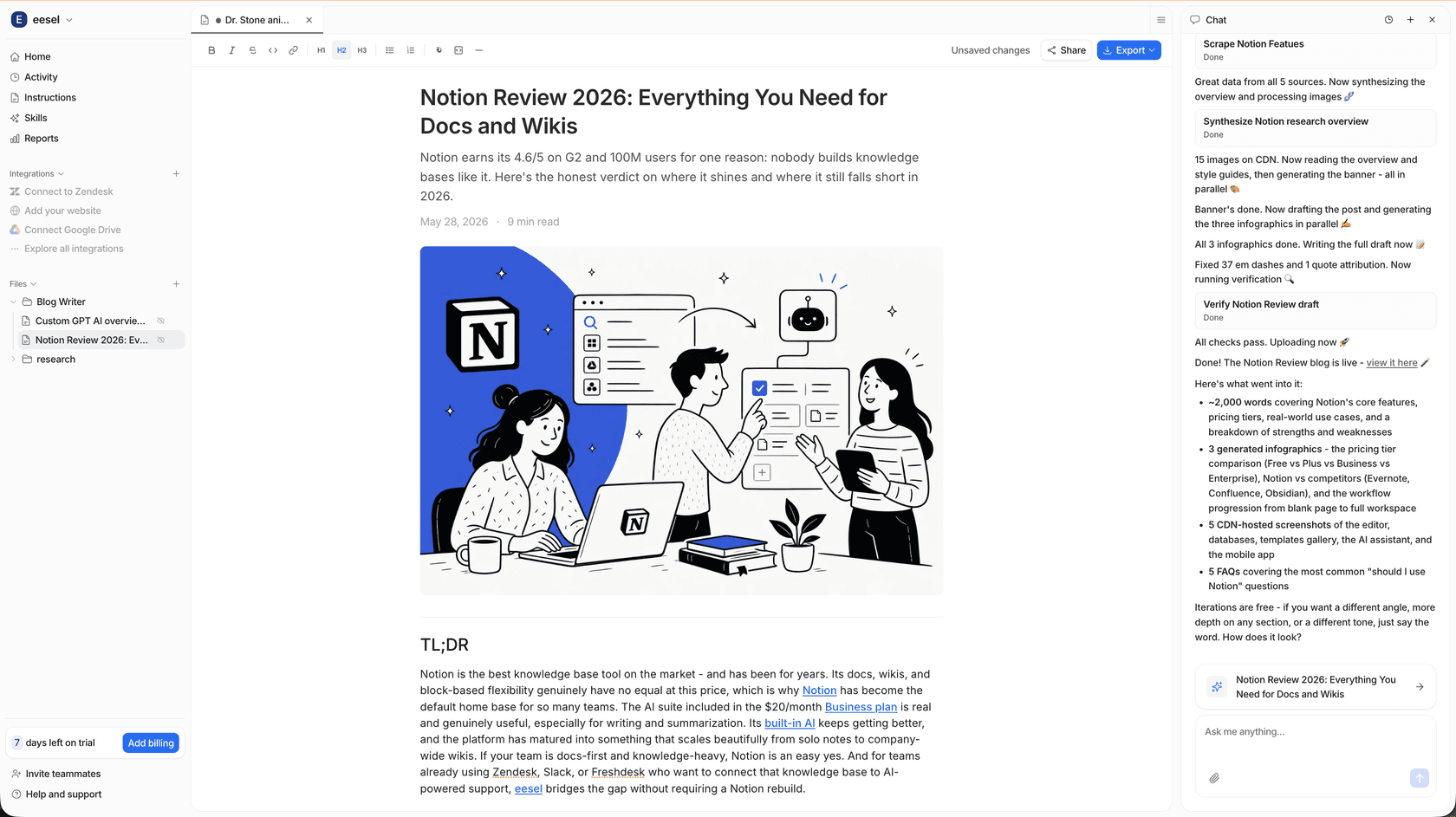
Here are some of its features:
- Complete Assets Included: You receive a fully formatted post with AI-generated images, infographics, tables, and charts.
- Social Proof Integration: To add credibility, it can automatically find and embed relevant Reddit quotes and YouTube videos directly into the article.
- Demonstrated Growth: This tool was used to grow the eesel AI blog from 700 to 750,000 daily impressions in three months.
- Context-Aware Research: It understands search intent. For a comparison post, it will pull pricing data. For a product review, it will find technical specifications. The research is tailored to the topic.
This represents the next step in leveraging your enterprise content: turning internal expertise into an external growth machine.
Challenges and considerations for implementation
Adopting AI-powered content management requires careful planning to ensure a successful implementation.
- Data Security and Privacy: You are entrusting a platform with your company's valuable information. It's essential to choose a provider with robust security. At eesel AI, for example, we contractually guarantee that your data is never used for training external AI models and is always encrypted at rest and in transit.
- Integration with Existing Systems: Your content is likely spread across multiple applications. The right solution needs to connect to your existing tech stack without a complex IT project. Look for flexible APIs and pre-built connectors. eesel was built with over 120 integrations for this reason.
- Change Management and Governance: AI is a tool to augment your team, not replace it. This requires training employees on how to work with their new AI tools. It's important to build a foundation of AI governance with clear principles for responsible use, ensuring humans remain in control.
Visualizing how AI can centralize and activate your company's knowledge can help clarify its potential impact. The video below from OpenText demonstrates how AI-powered tools can provide a single point of access to all your enterprise content, enhancing productivity and unlocking new insights.
The future of enterprise content
AI enterprise content management is a practical tool for any business that wants to turn data into a strategic asset. We've moved beyond passive digital filing cabinets toward intelligent automation that makes information work for you.
The journey doesn't end with management. Forward-thinking companies are now using that organized knowledge as fuel for proactive content generation, creating a powerful engine for growth.
Ready to put your content to work? See how you can turn your company's knowledge into powerful AI enterprise content that drives growth. Generate your first blog for free with the eesel AI blog writer.